
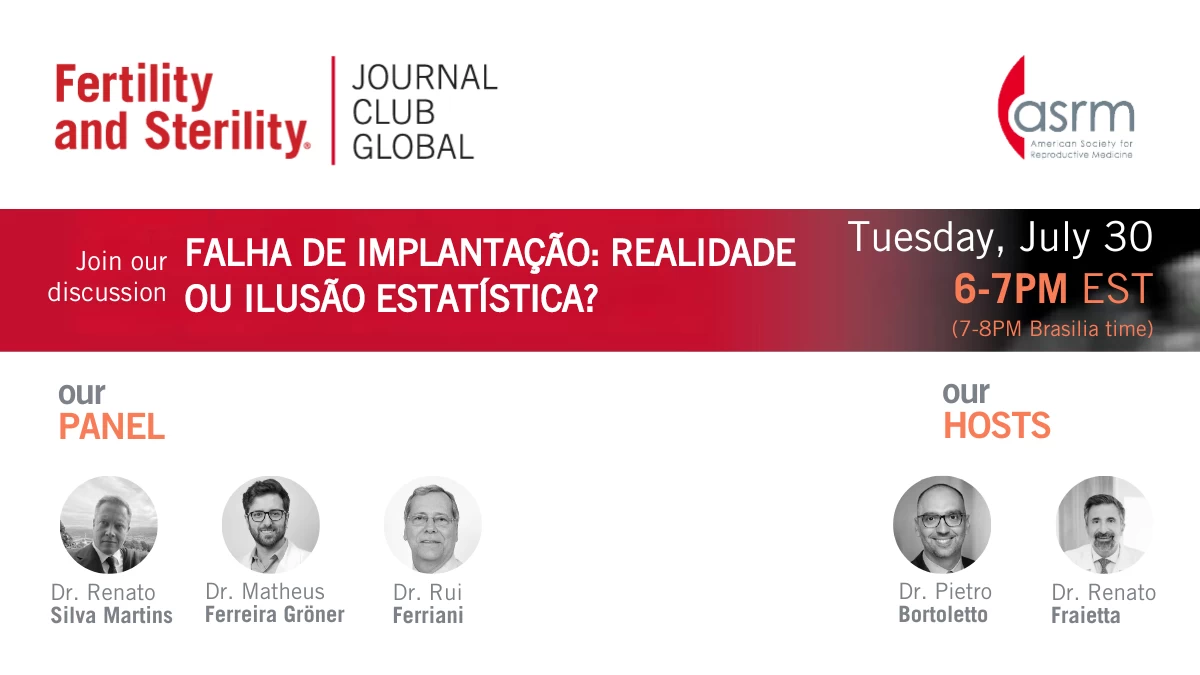

This Journal Club Global explores the consensus statement from the July 1, 2022 Lugano Workshop on recurrent implantation failure.
View the Article being discussed: Recurrent implantation failure: reality or a statistical mirage? Consensus statement from the July 1, 2022 Lugano Workshop on recurrent implantation failure
Panelists:
Dr. Rui Ferriani - raferria@fmrp.usp.br
Dr. Fernanda de Paula Rodrigues
Dr. Renato Silva Martins
Moderators:
Dr. Renato Fraietta
Dr. Pietro Bortoletto
Transcripts
Hello and welcome to the Fertility and Sterility Journal Club Global. My name is Pietro Bortoletto. I am the Interactive Associate Chief of Fertility and Sterility.
I am extremely happy to be with you, our listeners, in this online journal club, in Portuguese, live from Brazil, for the first time. Today's event is being organized and presented by Dr. Renato Fraeta. Dr. Renato is a free teacher, Vice-Chief of Urology, and Coordinator of the Integrated Human Reproduction Sector at the Federal University of São Paulo.
Dr. Fraeta, please introduce our topic of discussion and our panel. Hello everyone. I would like to thank you for the presentation.
I feel privileged to be able to moderate this first Fertility and Sterility Journal Club Global in Portuguese. Remember that we are nine Lusophone countries that speak Portuguese as the official language. I hope that we can, in addition to at least these two who are participating here at this table, have more opportunities for more countries to participate, and also people who are in other countries, even if they do not speak the Portuguese language, but who speak Portuguese.
So I want to thank. And also the backstage staff, Natalie and Meredith. Thank you very much.
So I want to present the subject, implant failure, reality or a statistical illusion. And I want to introduce the people who have already accepted the invitation and participated in the discussion. Dr. Rui Alberto Ferriani, Professor of the University of São Paulo, Ribeirão Preto, Head of the Human Reproduction Sector at the Ribeirão Preto Clinical Hospital.
Once again, thank you for accepting and participating. Dr. Renato Silva Martins, Assistant Professor, Graduate Assistant Doctor, Obstetrics and Gynecology Consultant, Sub-Specialist in Reproduction Medicine, University of Beira and Interior, Faculty of Health Sciences, Department of Health, Children and Women, Obstetrics and Gynecology Service, Reproductive Medicine Unit, Centro Estalar Universitário Cova da Beira, Covilha, Portugal. Thank you.
It is later still in Portugal and is here participating. And Dr. Matheus Ferreira Groner, Doctor of Urology at the Federal University of São Paulo, UNIFESP, and Perceptor of Medical Residency in Assisted Reproduction at UNIFESP. I would also like to thank Dr. Fernanda de Paula Rodrigues, who would be here, but she is sick, she has no voice and will not be able to participate.
So I will ask Dr. Matheus to present, to make a summary of the article in question, in a time of up to 10 minutes. Then we will go to the discussion. I just want to confirm that everyone is seeing my screen? Yes.
Well, good evening everyone. I would like to thank ESM for this opportunity, thank everyone present in the room for your attention. So my idea is to summarize a little bit of the article that we are going to discuss today.
It is an article from 2023, published in Fertility Strategy, with this theme of the recurrent implantation failure, a reality or a statistical illusion. I have no conflict of interest in the presentation of this article. And the idea of this article was actually to bring ... Just a minute so I can ... It was an article described after a workshop that was held, in Lugano, in 2022.
So a pharmaceutical industry, and it is important for us to bring this up even because of conflict of interest, was the one that sponsored this workshop. There were 27 experts in the area of reproductive medicine, both from Europe and the Americas, who made a systematic review of the subject. So they did research from January 2015 to May 2022, in PubMed InfoCrane, only with articles from English language, and they made, with this systematic review, among medical experts, a publication with a consensus on the subject.
What they bring up right at the beginning is that there is no consensus about when to consider a recurrent implantation failure, and this already brings some conflicts in the scientific production itself. This happens even because we don't have a certain consensus about the measure of success, when we consider a success after in vitro fertilization, and thus how we consider or define a failure in the face of an assisted reproduction technique. To make this consensus and analyze the articles, these experts focused primarily on some studies that brought embryo transfer, euploid, and artificial endometrium preparation with phase supplementation, Lutia, with progesterone M. The idea of trying to focus on this scenario is to avoid confusing factors, of a prognostic malignancy, to bring a real recurrent implantation failure.
In this article, they divided it into practically three topics, trying to define this disease, trying to bring the possible causes, and what we have in treatment today. In the matter of definition, they already put in consensus among themselves that they considered a success in in vitro fertilization to reach clinical pregnancy, which we consider when we can identify, at least, gestational sacs to ultrasound. Also brought in situations of good quality embryo transfer and with normal morphology uterus, trying to avoid biases of other causes of failure in the treatment of fibroids.
They brought a little of what is considered, when we start to consider that this failure is recurrent. Initially, the studies considered up to 10 transfers, the last studies have shown 3 transfers, but I think that regardless of the question of the definition as to the transfer time, the biggest concern of the group is to try to divide the two groups in a specific way. The group that still has a realistic probability of success and has not yet achieved this pregnancy, that has not yet made enough transfers to reach this statistic, and the clinical group of a couple that will even have a biological resistance to implant.
This is the focus to try to define and identify this couple that has recurrent implantation failure. Trying to bring a little of what should be the prevalence of this recurrent implantation failure, the initial studies brought around 10%, and this article already tries to debate that this is very overestimated. If we think, and this graph helps us in this sense, if the prevalence was really 10%, in the third embryo transfer, because these are the statistics that we can bring here, 55% of the patients would already have this number of failures, and we do not observe this in our day-to-day.
Here they tried to bring, this article shows the possibility of pregnancy according to the number of transfers. If we think about the gray line, it is bringing a possibility of 1% of real implantation failure. In the yellow line, 2%, in the blue line, 5%.
And they tried to associate a very important article that was published recently as well, which brings the possibility of pregnancy according to the number of transfer of euploid embryos. We know that in the first transfer, 70% of couples can reach pregnancy, in the second, 59.8%, and in the third, 60.3% in this study, bringing an accumulation after three embryo and euploid transfer of success up to 95.5%, bringing a possibility of failure in an incidence of up to 4.5%, which is exactly this line observed, which is this red line. So, in this way, this consensus brings that very possibly we have in our treatment scenario 2% to 5% of couples that will really have a recurring implantation failure.
A very important point of the discussion is obviously the embryonic euploid. It is a very important factor, the embryonic euploid is a big negative factor about implantation, obviously, and it is closely associated with maternal age. And if we don't have these embryos tested, it is important for us to estimate the number, they bring this in this table, what would be the number of non-tested embryos in a situation that we can consider or start to consider as a recurring implantation failure.
So, for example here, for women under 35 years old, the euploid rate is observed around 20%, so we should consider at least 4 non-tested embryos of good quality, and obviously this number increases according to the increase in the age of the woman. And then trying to bring the possible causes. The first thing they bring as a discussion is the issue of oocytarian color.
We know that a patient, for example, who had a fertilization failure in the ICSY process, when she has a second treatment, the chance of having a recurrence of total fertilization failure is low, bringing that, yes, there is a question of oocytarian color, there is the question of good color and bad color within a couple. If a color had a triploid embryo, even the other embryos that are normal also have a reduced implantation rate, bringing a negative factor within the same color. And if in this color I managed to have an exceeding embryo, I had a good color to the point of having an exceeding embryo, I also have a rate increase in success, bringing the importance of not considering or not thinking about recurrent implantation failure if I only treated with a color of in vitro fertilization treatment, because yes, there is an important weight of an oocytarian color in the success rates and in the success of assisted reproduction.
It is also important to bring the uterine factors, which can lead to a worsening of the success rates of in vitro fertilization, and they should usually be discarded even before our first embryo transfer. It is in the case of hydrosalpinges, or intracavitary lesions, or even due to symptomatic adenomiasis. Usually, the patient who will undergo a transfer has an initial evaluation with ultrasound, an esterosonography, or even an esterosalpingography, and manages to discard these uterine factors.
It is important to have this out to even think about a recurrent implantation failure. The endometrial receptivity tests, widely used in recent decades, both the ERA and the RECEPTIVA, did not have evidence of help or success even in more controlled studies. So the consensus of this article brings that there is no importance in this endometrial receptivity factor as a possible cause of recurrent implantation failure.
The endometrial thickness is also very debatable. The literature does not yet bring a very specific cut of how much we consider a good endometrium, above 6, above 7, or above 8 mm. Most of these studies that try to bring the best scenario of endometrial thickness were not done with euploid embryos, or describing embryonic quality, which can bring some biases.
Another important point of endometrial thickness is the compaction that this endometrium can suffer after the beginning of progesterone, which is observed in some cases. And the effect of this on the success rates and the success of in vitro fertilization are also controversial in the literature. So it does not bring this as a possible cause of these recurrent implantation failures.
The research of endometrial microbiome also has many divergences, so currently we can rarely bring this problem as a cause. There are some endometrial inflammatory factors, including the presence of endometriosis in these women, so much so that the blockade of endometriosis with agonists, with the central blockade, can improve the pregnancy rates in some studies, but the study that speaks against these inflammatory factors are the similar clinical displacements of patients with endometriosis, but who received embryos coming from donated bones, bringing a certain resistance to whether this endometriosis factor can be even important or not in the face of a recurrent implantation failure. In addition, chronic endometriosis is also very much researched in clinical practice, but it has very heterogeneous diagnostic criteria, whether they are stereoscopic or even anatomo-istopathological, and this brings a difficulty in having an important degree of evidence.
And if we treat these women, there is no improvement in some studies that used euploid embryos as a treatment for displacement. The level of progesterone during the luteal phase support has been increasingly observed and brought as a possible cause of these in vitro fertilization failures. Some studies have shown that progesterone below 10 or 20 nanograms per ml in the embryo transfer can represent some of the worst displacements, and supplementation with another subcutaneous or intramuscular route can improve these displacements.
There are two trials that also showed that the comparison with IEM progesterone compared to intravaginal, more used, for example, here in Brazil, showed better displacements, but there are still few studies, there is evidence that they are still being built. There is an important point of the metabolic factor, the obesity of the woman brings a worsening of the scenario and can be a cause correlated to these failures occurring during implantation, the treatment of this obesity being important. It is difficult for us to have strong evidence of such a specific point, the studies are still taking place, but it is an important point for us to discuss with couples as well.
In addition, the male factor, we know that it interferes a lot in the success rates, including within IXI itself. We know that both the seminal quality and the high sperm DNA fragmentation can have a relevant factor as a cause of the recurrent implantation failure, but also in initial studies, the main studies evaluate this possibility with abortion, but not necessarily with recurrent implantation failure. Remember that these couples come fragilized, with several failures, and the search to improve their displacement in some way.
Everyone wants that magic medicine, but we have to guide these patients, that there is no scientific evidence that will help them in this process. The acquired thrombophilia, SAF, has important evidence for treatment in patients with repetitive abortions, but there is still conflicting evidence when we talk about recurrent implantation failure. So this consensus does not recommend investigation in this scenario.
Endometrial stretching did not improve displacement, and in recent studies it even had harmful effects, being proscribed in the orientation of this consensus. So, just to finish, remember that there may be factors of interference in the success of the non-diagnosable FIV, so we have to pay attention to this before thinking about a recurrent implantation failure. The real recurrent implantation failure, by statistical questions analyzed, is rare, it should happen in less than 100% of couples.
It is important, especially in the face of a recurrent failure, to re-investigate the whole process and not just focus on the endometrium. New studies to try to evaluate implantation recurrent failure should be focused on failure diagnoses in the successive failure realization after three good embryonic euploids, or equivalent according to the woman's age, and we know that today we are investigating too much, we are diagnosing too much, and we are treating this disease too much. We have to be careful about this.
Thank you very much, Dr. Matheus. I will start our discussion. I will ask some questions, following a sequence.
Before talking about failure, I want to talk about success. So, before talking about failure, what is a success for you, Dr. Renato? What is the success of an in vitro fertilization treatment? Born alive, heart beat present, or beta-HCG positive? First of all, good evening to everyone. I would like to thank the SRM and Fertility and Sterility for this Journal Club and Dr. Renato for the invitation.
Although I am Brazilian, I have lived in Portugal for many years, so I will try to speak slowly and very clearly. If there is anything you don't understand, please, I will do my best to give a more Brazilian touch to my Portuguese. In relation to the question, it is a very pertinent question.
I think the question still lacks another option, which is the option that the couple or the woman puts when they come to our consultation. The couple does not want a positive beta. The couple does not want an ultrasound with six weeks with positive beats.
The couple wants a live and living birth, that is, a live and healthy child. And that is, for me, the success of the treatment. Everything else is steps, are sequences that lead to this outcome.
But in reality, the parental project that these couples or these women choose has as a final goal a live and healthy birth. And therefore, that is what we interpret as and more and more studies are taking away the focus of this more biochemical part or of the initial pregnancy itself and are focusing more on the live birth rate, which ends up being a criterion for all success in the reproductive process. And we all hope, right? So, we already talked about success, because to be able to talk about failure, I wanted to talk about success first.
And now, Dr. Mateus, how many failures are necessary for you to characterize a recurring failure? Thinking about the quality of the embryo. And the very anxious couple made a treatment, did not succeed in the first one, and brings all that important emotional load. Do you already investigate after a first failure? How is the conversation with the couple? I think it's even a discussion that this article brings, and we still have it in the literature.
I believe more and more that we need the best treatment for an infertile couple is the recurrence of attempts. Faced with the first failure, the best treatment, without a shadow of a doubt, is the new attempt to gestate. So, I am in favor of what this article brings, in the sense of at least three good euploid embryos, and in a situation, obviously, of a younger woman, or a woman who did not want to do this genetic analysis, we try to bring this possibility of the number of untested embryos.
I think this is important to be shared with the couple, because we know that our maximum rate, even with a good quality euploid embryo, in a good uterus, in a non-obese woman, we will reach a maximum of 60-70% per attempt. So, we have a statistical issue that we have to discuss, and the couple has to be aware of it before the first treatment. I think that with this science, as much as it will always be a mourning phase, faced with a failure, it is easier for us to work, not necessarily having to investigate something more, normally these couples already come with all the research that is necessary for a second attempt.
It is not an easy conversation, obviously, no one likes to go through a failure, but I think that working from the beginning with this couple, they can digest it in a better way. I totally agree. And remember that they are separate events, it's like throwing a dice, and you hope to get a number when you throw a dice.
And the fact of not getting a number does not mean that it is not possible to get a number next time. Dr. Rui, the article talks about good euploid or equivalent embryos. What do you understand or suggest as an equivalent? There is that table that he showed you on the side, how do you put this into practice? Hello, friends.
I congratulate Pertilis Theory for this initiative, it is very good, it is good to have the Portuguese language talking about a subject as controversial as this. I say controversial because it really is an important issue, and this question that you asked, the colleagues answered. A criticism that I make to our activity is that we want to give an explanation to facts that often have no explanation.
And with that, we strengthen a lot the use of diagnostic and therapeutic techniques called heads-on, whose scientific evidence, and Mateus put some focused on this study, see how much controversy there is in relation to this. And what do you do? You try to apply a series of these themes. This implies spending, and often the patient runs out of his financial reserve, and then comes another discussion about who is paying, but does anyone pay for all this? And what we need more, which is clear by this article and by other subsequent articles, is that we need to have an embryo to transfer.
It is better to invest in more cycles than if you occupy a range of 1% to 5%, really of an unexplained cause. So, the more embryos I have, and if I can have euploid embryos, better, but if I have good quality embryos, even in the cleavage stage, or in blastocyst, without the possibility of doing PGT, this is our goal. So, for that, you need to repeat the cycle.
It is very easy to label a patient with a failure of implantation in a situation where she had one or two embryos of poor quality, for example, that she didn't even have ploidy. And you label and spend an energy and money researching or employing therapists without success. Proven.
And what does she need? She needs to know these numbers to trust that repeating the cycle and trying to form an embryo, there is a fact that this article comments, for example, the effect of maternal age, of implantation of a subsequent blast, it is not so impactful. So, even a patient with advanced maternal age, if she gets a euploid blast later, she has a very reasonable chance. So she needs to do more cycles to have a euploid blast and increase her chances.
Therefore, the similar is not a definition. It is a good quality embryo, the chance of success is good. But if he has normal ploidy, even better.
So these are the goals. But it doesn't mean that we have to always achieve this goal of euploidy. I still think we have to repeat cycles, run away from the cohorts that Mateus put, sometimes a disfavorable cohort or oscillatory, then we can get a cohort a little more favorable.
To do this, you have to have access, money, to repeat and have more passive embryos to be transferred. Very good. Following this same line, as Dr. Rui started talking, I would like, Dr. Mateus, following this line of how do you think in services that transfer fresco embryos and or in cleavage stage, so you can characterize a good quality embryo? I think in fresco itself, we will not have so much difficulty, for statistical reasons, to help us reach this magic number that I will have to worry about with a failure of implantation.
With a good quality embryo, in transference in D5, we can bring that possibility according to the age of the woman, without a good number of embryos, as I said, under 35 years, for example, 4 embryos of fresco transference in the test, all right. When we do cleavage transference in D3, we already have another statistic on top of that, that obviously not all cleavage embryos would reach blastocyst, that is, very possibly this one that would no longer reach blastocyst, but if we transfer it before, it will no longer give a chance of pregnancy. All this is very hypothetical, but we do know that the implantation rate and the success rate, if you transfer an embryo in D3 or D5, it changes, even because you have this evolution for you to reach the embryo that gives a chance of pregnancy.
Not that the embryo in cleavage does not give pregnancy, it does, obviously, but it is an embryo that, obviously, would reach blastocyst, in theory, if it were in cultivation. Thinking about this rate, we know that the rate of formation of blastocyst is 50%, so I would think, for example, in this scenario of doubling that number, it's magic. So, in a transference situation in D3, for a patient, for a woman under 35 years, I would think of a real failure from the transference of 7 or 8 embryos in cleavage, trying to bring a statistical question, a magic number, but we know it's not the best scenario.
The best scenario is for us to try to reach the blasto embryo, possibly with a possibility of diagnosis of oploidy. Just to remind the people who are listening to us, please, you can send questions in the chat, and we can answer them, if possible, in the time we have, but whoever is participating, can send questions to us. Moving on, Dr. Rui, the article itself says, and we know this, that neuploidy is the main cause of recurrent failure of implantation.
And in a young woman, how to proceed in a young woman who, at first, would have no indication of submitting to a PGTA? She had a failure, and even young, it would be interesting for her to do the PGTA, so we can get to the diagnosis and see if the problem is neuploidy. How do you conduct? The data really show that this rate of neuploidy is not recurrent. What she will need is to have more embryos.
We had, after this article in 2022, two consensuses by Escher and Edson, the failure-implantation consensus, which reinforce all this information and show that the patient needs to have more embryos to transfer. And the PGTA, which is considered as an Edson, in a situation like this, especially in young patients, does not have clearly demonstrated for this type of population. And the patient, I think we all know, she comes and says, Doctor, I'm back here now, because now I want to investigate everything I need to investigate, and do everything I need to do.
As if we had not already done everything when you do a patient cycle. All the basic, fundamental, we already did. Now I want an explanation for this.
In fact, she had some neoploid embryos, and then she can get a neoploid embryo, and this recurrence, therefore, does not mean that it always produces the neoploid. I've had patients who produced 10 blastocysts, for example, for PGTM, and did PGTA, of these 10 she had, a young patient, 2 neoploid blastocysts. It is a casuistic phenomenon, bad in this.
And she has to submit to a new occipital cut, and try to get more. I think this is the most neurological point in history. And following this, the article, when he talks about the X-ON, precisely, the final conclusion that we can understand, is that in fact, the research is precisely what we do during the research of the infertile couple, and try to solve everything before the transfer of the embryo.
So it all comes back, the occipital evaluation, the uterine evaluation, this evaluation done before. And what is left after is very little, and that very small percentage that will really have recurrent failure of implantation. We have a question here.
In cases of transfer in D6 or D7, should this magic number be statistically higher? Dr. Renato, can you answer? The problem of transfer in D6 and D7 is often the synchronization, especially if it is not in a cycle of endometrial preparation, speaking of a fresh cycle. The synchronization with the endometrium will make practically impossible this transfer. It's like everything, in this area, the question is very, very interesting, but it's very controversial what to do and, above all, what to explain to the couple.
Because if everything goes well, we'll keep thinking it was because of that. If things go wrong, we don't have a plausible explanation to give to the couple, so we don't know what to say. The vast majority transfer in D5, not in D6 or D7.
We have another question here. A comment, Renato. In our clinic, we freeze on the 5th, 6th and 7th.
We do the biopsy, we do the PGT in 3 days. When we have D5 and D6, our experience in implantation is 65% with the embryo embloid. With D7, we realize that it continues to implant, but instead of 65%, it goes down by 35% to 45%, depending on the quality of the embryo.
So, when we are doing this math, that Matheus was explaining, I think that when you have the transfer of an embryo from D5 to D7, you have to change the count of how many transfers until you have an implantation problem. Pietro, in this case, the choice of D5, D6 and D7 depends on the expansion of the blastocyst, right? And not by your choice. Exactly.
This embryo that took longer, is a little different. It is a little different. And other reports show that it has a slightly lower rate.
I think the endometrial preparation should try to extend a little bit, even in the subsequent cycle of frozen transfer. Exactly. Do we have another question? We know that it is very rare to transfer two embryos in the same cycle, due to the risk of twinning.
However, some doctors opt to transfer two embryos in difficult cases. In this case, considering the count of four good quality embryos, without PGT, to have the diagnosis of implantation failure, would the transfer of two embryos affect this criterion? How would you evaluate in this case? Dr. Matheus, can you answer? For sure. First, it is important to say that if you transfer one or two embryos, in theory, you don't change the success rate of the treatment.
You increase the rate of twinning. There is the risk that was even mentioned in the question. Given this, if I don't improve the gestation rate by transferring two embryos, I maintain this need for four transferences, regardless of whether it is one or two embryos.
What many can do in their clinical practice are embryos of worse quality, a C grade, maybe you transfer two embryos knowing that the pregnancy rate is already a little lower, or the D7 embryo, as we were talking about now, and then associate a double transference, in the sense of trying to improve a little the success rate of implantation in this transference. But since the rate does not change in this sense of two embryos, I don't think I would change the magic number we are talking about. I think, Renato, if you allow me, this pressure of patients to transfer two in the sense of wanting a better result, it is a false impression.
Until today, no one has ever proven that if I put two instead of one, one helps the other to implant. It would only make sense, especially if it is frozen. The chance that each one has together or separately is the same, while I increase the chance of twin gestation, and worsen the prognosis, going towards the final result that Renato mentioned, of being born alive.
So nothing convinces me, and it is worth transferring two embryos in a situation like this. There are obviously situations as Mateus mentioned, of poor quality, you are trying to spend an embryo that you were not very confident in. But this pressure of patients to transfer two, I think we all receive it, and we do not have very strong arguments to support this request of the patient.
I do not see much logic in this, I try to avoid this situation as much as possible. If I may, there is a work that is worth it, which is quite interesting and which speaks especially in this conversation that exists between the embryo and the endometrium. And many times, the question of transferring an embryo that is of dubious quality, not to say that it is of poor embryonic quality, many times, in this conversation that the embryo has with the endometrium, and that resides, there is the holy grail of success, and that we still cannot understand how this communication works, because sometimes transferring an embryo of worse quality can even prevent that good quality embryo from being implanted, because the endometrium is not a passive structure that only welcomes the embryo.
The endometrium also has this ability to reject an embryo that it does not consider of good quality. Therefore, it is very important to explain to the couple that making a double transfer only increases the risk of demolarity, and does not increase the reproductive success. Therefore, sometimes it is important to have this conversation, even if it is difficult for the couple to understand this.
Very good. I will go back to Dr. Rui. Dr. Rui, following the same line here, we have a question.
The 4AA euploid embryo with failure, should it already be considered a failure of implantation? No. You see, in the consensus of AES of failure of implantation, they use the criterion of having a 60% probability of pregnancy. Either one or many were.
Exactly. The number of attempts based on a 60% implantation rate. And if it does not reach this, it characterizes the failure of implantation.
So the only embryo, in that table that Renato showed, or Mateus, sorry, table 2, if you take a young patient, which is the best prognosis with an euploid embryo, they say to intervene after two embryo transplants. With an euploid embryo in a patient under 35 years old. Which would be the best situation that we would have in this case.
Still, two attempts to characterize in this statistic. So I think it needs to have a slightly higher recurrence. It has to have more embryos.
So it's a lot like a 41-year-old patient transferring an embryo that is not a top quality and the doctor labels it as a failure of implantation. And there is a whole unnecessary investigative process. It is an over-treatment.
It is harmful. Dr. Renato, coming back to you, I know you are an ecography specialist and work a lot on the diagnostic part. How do you assess, let's change the subject a little bit, how do you assess a normal uterus? Great question, Renato.
Can we do a session just about embryology? How much time do I have to answer? I can take care of the rest of the session. I'll try to be very brief. Well, first of all, we need to keep in mind that ecography has, in fact, a very great potential for diagnosis.
And what we can see is that the resolution capacity of ecography has been improving a lot in recent times. In other words, at that moment, ecography can show us things that our eyes can hardly see. So, how would I assess a normal uterus? First of all, with a transvaginal ecography, 2D, where I can assess not only the uterine anatomy, but also, in an early follicular phase, I can assess the ovarian reserve.
This is very important for the treatment and orientation of our patients. It is also very important to have some topics that the gynecologist in this case has to pay special attention to. Namely, not only if there are myomas, if there are uterine malformations, but also, where is the ovary? Is the ovary accessible? Is there a hydrosalping? No, because many times we know that a salpingitis may not have such an exuberant And many times, the diagnosis is an imageological diagnosis.
We can also see some indirect signs of endometriosis, which will also condition not only the treatment, but also the real perspective and the patient's prognosis. Speaking of this, keep in mind that not all people are equal. We are not equivalent.
The other is also not equivalent. And, going back to the issue of endometriosis, which we often evaluate, which is the endometrium, which we usually see in a coronal cut, medial-sagittal, and we see the endometrial line with the trilaminar parameter and the dimension of 6, 7, 8, 9, whatever, to consider an endometrium capable of receiving the embryo, we have to take into account that this can also vary. There are women with larger uterus and will have an endometrium in a larger 2D cut, and women with smaller uterus will obviously have a smaller endometrium.
And we are talking about the difference of 5 to 6 millimeters, or 4 to 5, or 6 to 7. A millimeter is very little for that. Obviously, what is increasingly existing is also the aid of artificial intelligence, which will never replace the doctor, especially in the context of ultrasound, but it will help a lot so that we can actually see what sometimes or because we have another distractor or because we are focused in another region and we may not be evaluating conveniently. Basically, that's it.
Transvaginal ultrasound, well done in the initial follicular phase to be able to evaluate the reserve. With the ultrasound, in my case, which is what I like to do at the same time, is also to do a 3D echography to have a volume that is more precise than the 2D image, namely in terms of endometrial volume and instillation with a small amount of saline solution that allows me to verify the existence of small intrauterine lesions that can then harm the process itself and, as the consensus itself says, if we see a polyp, if we see a sinec, if we see a myoma, to treat before transferring and not waste a good quality embryo, potentially a polyp, in a cavity that may not be the cavity with the best conditions to receive it. Then, of course, the estroson, there are a whole series of other exams that we usually try to do right away in the first diagnostic act, that is, the first echography can take a little longer, it can be a little longer, but try to do everything in one act because there are women who simply don't like to undergo several echographies and several transvaginal exams.
Therefore, in a first opportunity, try to get as much information as possible so that we can then guide all the treatment from then on. Renato, just ask Pietro if estroson is widely used in the United States or not, estrosonography. Yes, almost 100% of our cycles in Boston we use, because the insurance asks, before making the transfer, before approving the treatment, the insurance asks for confirmation that the cavity is normal to avoid exactly this problem of not having perfect conditions for the embryo.
And what about stereoscopy? Stereoscopy, if we find something, yes, but as a diagnosis, no. Not even recurrent failure, if you get to 5%. When you get to recurrent failure, we use 100% to evaluate, to find those things that we may have developed in recent months between the first exam and the second, but also to confirm that there is no myoma, there is no polyp, there is no synechia, as Renato explained, but also to be able to do a biopsy to check if there is an infection, if there is something that we have to treat before the next biopsy.
Miguel asked a question that I will share 100% with what you asked here, but I'll talk about it in a little while, but I also want to talk more about it. Before moving on, I want to talk about something else, I want to talk to Dr. Renato and tell him something. In Brazil, intramuscular progesterone has no record by the responsible and we also have subcutaneous via.
How is it in your country? How do you supplement progesterone? Dr. Renato, I would also like if Dr. Pietro and Dr. Rui could comment. I think it's an interesting subject and there are more and more articles talking about it. Yes.
We also don't have the formula intramuscular or subcutaneous. The one we prefer is intravaginal and in some situations, on the day of transference, if the value is too low, we can coadjuvate with oral via. Do both.
Exactly, do both combinations. Always remembering that the progesterone in the same woman varies a lot on the same day. Therefore, it depends a lot on when it is dosed and the value of the seric progesterone doesn't coabulate directly with the value of the tessitular progesterone.
So, when do we have the other option? Just to talk about supporting luteal phase, because it's another option. In the United States it's simple. We have access to intramuscular and vaginal.
So, when we are doing the transference in the natural cycle with normal ovulation, we only use the vaginal. When we are doing an artificial prepared cycle, we prefer to use the intramuscular. We don't have the succutaneous version in the United States.
So, we only use intramuscular or vaginal. The oral via in the United States is extremely rare, we don't use it. And the dihydrogesterone, do you have experience? We don't have it in the United States.
In the United States, I knew it didn't exist. Portugal has it, right, Renato? You don't use it. No, we use it.
We use it in the situation when we do the seric dosing of the progesterone and the value is very low and we don't want to lose the opportunity of the transference. So, we do it as if it were an extra supplementation. That is, we try to do a rescue scheme to not lose that cycle.
But it's worth it. There are jobs, especially Japanese and Chinese, with a very large number of numbers, and it has also been proven that this situation of doing the rescue progesterone on the day of the transference doesn't influence the rate So, it's more of those things that we do without much support and without much scientific support. But the patient needs to do something.
Dr. Rui, do you want to comment? How do you do it? I also do it in the same scheme, the vaginal and eventually supplementing with the progesterone, which loses the issue of dosing and we have work in progress and really the issue of dosing, we see this oscillation of the same patient since the work of Helena Labarta that raised this aspect, but I think that literature is still owing, but I don't know if Matheus paid attention to the text when they comment on this subject at work, they end up with vaginal progesterone. I don't know if it's a matter of conflict of interest of the study, because we have to take this into account, but they say, Matheus, did you pay attention to this? They cite two or three studies talking about a much lower rate of pregnancy with vaginal progesterone. And one thing that always intrigues me, the studies of oral micronized progesterone in transgenic cycles are very small too.
We know there is the issue of tolerance of the patient and everything else, but in terms of efficiency, we don't find great data of this progesterone. Did you pay attention to this, Matheus? Yes, even the pharmaceutical industry that did it, that ended up banking this workshop, is a producer of progesterone, if I'm not mistaken, in subcutaneous, so I think there is this bias that may have been brought in this study, which is important, and it really brings two trials that were said that intramuscular is much superior to the question of vaginal, one is still in progress, bringing this weight that we use so routinely here in Brazil, which is vaginal, I believe even by studies and by the question of intramuscular which is much more used also in the United States. Well, following the final stretch, I'm going to share what Miguel asked and I also wanted to talk about it with you.
I missed in the article about, maybe because it's a bad situation, it's not an obvious thing, but talk about the technique of embryonic transfer, so, Dr. Rui, how impactful can embryonic transfer be to lead to implant failure? The importance of delicacy, speed, the quality of how embryonic transfer is done, and if this cannot be a factor of implant failure. What is your opinion? Well, the process of transfer is fundamental, there is no doubt, and there are studies showing, for example, different clinical transferers with different results. This is really a fact.
Now we have important standardizations, which is ultrasound visualization, the type of catheter, those basic techniques that are relatively well standardized. Today, when we talk about the training of a specialist, the process of transfer, which I would say is one of the most crucial processes, I fully agree, but it is easier to train than, today we have simulators and even in practice, than the process of egg collection. The training of a situation, I don't know if you share this idea, I think it is easier in transfer.
But I think that the recurrence of the failure in relation to this is possible, and it is a super crucial point in the whole process. Very well. Do we have more time for one more question? Renato, another point in the failure and recurrence, in the same way you mentioned the process itself, the transfer, is an extremely controversial subject, which is the preparation of a cycle of heating of embryo in transference.
I mean, natural cycle versus artificial cycle, the biases in this process, the natural induced, the number of variables, I think this is the great methodological difficulty when we analyze these aspects, because there are many variables in this whole process. So this process, I would say, at least it is open. We have recent works showing non-inferiority of the artificial, others showing superiority.
Now at ASH, I attended a table exactly talking about the non-superiority of the natural versus the artificial. So these are important variables that do not have a final outcome yet. But this has to be taken into account in the failure diagnosis of implantation.
And here among us there is another Journal Club on this subject. There are at least three subjects. Let's set a time and we'll mark it.
So if you want one more subject, throw adenomyosis in infertility and all the impact there. Well, I'm going to do one more question and then I'll pass it on to Dr. Pietro. Dr. Matheus, I would like you to comment about the title of the article.
This issue, recurrent failure of implantation, reality or statistical mirage or statistical illusion. I know this caught your attention. I would like you to comment about the title of the article.
I think the article came to bring a stronger opinion in the sense that not everything that is called failure is. This issue of super diagnosis, super evaluation, I think it was very happy. I think it brought a lot of reflection in that sense.
We think a lot more about statistical illusion in the sense that we always talked about here, that the patients they need is to transfer more good embryos, get more embryos than we tax a patient with recurrent failure of implantation for having a bad embryo, for having these other scenarios that we know interfere a lot. So I think it's a small reality and a big statistical illusion. I think it's real.
I think some couples will suffer and will get to this scenario, but not what we consider today in our clinical practice. I think there is a lot of statistical illusion on top of our diagnoses today in implantation failure. Well, I will now thank you again for everyone's participation, for accepting the invitation and this discussion, I think we learn a lot and there are several topics for the next ones.
But I am very happy and grateful. Now I will give the floor to Dr. Pietro to make the final considerations. Thank you Renato, Rui, Matheus and Renato Martins.
It was a very rich discussion, very interesting. I have at least three or four ideas for the next events. It was a great success this first Journal Club in Portuguese.
Undoubtedly it will not be the last event. It is a great pride of mine to have finally held this event. Thank you very much Renato for organizing and moderating.
Today's discussion will be shared in the podcast of Fertility and Sterility. It will be the first episode in Portuguese. We hope you also share with your colleagues in Brazil who cannot be here with us tonight.
Thank you again and see you next time in Portuguese. Good night. Good night and thank you.
Good night.
Olá e bem-vindos ao Fertility and Sterility Journal Club Global. Meu nome é Pietro Bortoletto, eu sou o Interactive Associate Chief da Fertility and Sterility e estou extremamente feliz de estar com vocês, nossos ouvintes, nesse Journal Club Online em português ao vivo do Brasil pela primeira vez. O evento de hoje está sendo organizado e apresentado pelo Dr. Renato Fraeta.
O Dr. Renato é professor adjunto livre docente, vice-chief da disciplina de urologia e coordenador do setor integrado de reprodução humana da Universidade Federal de São Paulo. Dr. Fraeta, por favor, apresenta o nosso tópico de discussão e o nosso painel. Olá a todos, eu gostaria de agradecer a apresentação e me sinto privilegiado por poder moderar esse primeiro Fertility and Sterility Journal Club Global em português.
Lembrar que nós somos nove países lusófonos que falam português como língua oficial e espero que a gente possa, além do mínimo desses dois que estão participando aqui nesta mesa, em que em próximas oportunidades também mais países possam participar e também pessoas que estejam em outros países, mesmo que não falem a língua portuguesa, mas que falam português. Então quero agradecer e também ao pessoal do backstage, Natalie, Meredith, muito obrigado. Então eu quero apresentar o assunto, falha de implantação, realidade ou uma ilusão estatística e eu quero apresentar as pessoas que já agradeço a terem aceito o convite e participar da discussão.
Então, doutor Rui Alberto Ferriani, professor titular da Universidade de São Paulo, Ribeirão Preto, chefe do Setor de Reprodução Humana do Hospital das Clínicas de Ribeirão Preto, mais uma vez obrigado por ter aceito participar. Doutor Renato Silva Martins, professor auxiliar, médico assistente e graduado, consultor em ginecologia e obstetrícia, subespecialista em medicina da reprodução da Universidade da Beira e Interior, Faculdade de Ciências da Saúde, Departamento de Saúde de Criança e Mulher, Serviço de Ginecologia e Obstetrícia, Unidade de Medicina Reprodutiva, do Centro Estalar Universitário Cova da Beira, Covilha, Portugal, obrigado, é mais tarde ainda em Portugal e está aqui participando. E doutor Matheus Ferreira Groner, doutor em Urologia pela Universidade Federal de São Paulo, Unifesp e preceptor da residência médica e reprodução assistida da Unifesp.
Também quero agradecer a doutora Fernanda de Paula Rodrigues, que estaria aqui presente, mas ela está doente, ela está sem voz e não vai poder participar. Então eu vou pedir para o doutor Matheus apresentar, fazer um resumo do artigo em questão num tempo aí de até 10 minutos, depois iremos para a discussão. Eu só quero confirmar que está todo mundo vendo a minha tela? Sim.
Bom, boa noite a todos, gostaria de agradecer a ESM por essa oportunidade, agradecer todos os presentes aí em sala pela atenção. Então a minha ideia é resumir aí um pouquinho do artigo que a gente vai estar debruçado hoje, é um artigo de 2023, publicado na Fertility Strategy, com esse tema da falha de implantação recorrente, uma realidade ou uma ilusão estatística. Eu não tenho nenhum conflito de interesse na apresentação desse artigo, e a ideia desse artigo foi, na verdade, trazer um minutinho só para eu conseguir passar aqui.
Foi um artigo descrito depois de um workshop que foi realizado em Lugano, em 2022. Então uma indústria farmacêutica, é importante a gente trazer isso, até por questão de conflitos de interesse mesmo, foi que patrocinou esse workshop, foram 27 experts na área de medicina reprodutiva, tanto da Europa quanto das Américas, que fizeram uma revisão sistemática sobre o assunto. Então fizeram pesquisas de janeiro de 2015 a maio de 2022 em PubMed InfoCrane, apenas com artigos de língua inglesa, e fizeram com essa revisão sistemática, dentro de experts da medicina, uma publicação com força de consenso sobre o assunto.
O que eles já trazem logo no início é que não há um consenso para quando se considerar uma falha recorrente de implantação, e isso já traz alguns conflitos na própria produção científica. Isso acontece até porque a gente não tem ao certo um consenso sobre a medida de sucesso, quando a gente considera um sucesso após a fertilização in vitro, e dessa forma quando a gente considera ou define uma falha frente a uma técnica de reprodução assistida. Para fazer esse consenso e analisar os artigos, esses experts focaram prioritariamente em alguns estudos que traziam transferência de embrião euploide e preparo de endométrio artificial com suplementação de fazilútea com progesterone M. A ideia de tentar focar nesse cenário é evitar fatores confundidores de um mal prognóstico para trazer uma real falha recorrente de implantação.
Nesse artigo, eles dividiram praticamente em três tópicos, tentar definir essa doença, tentar trazer as possíveis causas e o que a gente tem de tratamento hoje em dia. Na questão da definição, eles já colocam em consenso entre eles que consideraram como sucesso numa fertilização in vitro alcançar a gravidez clínica, que a gente já considera quando a gente consegue identificar pelo menos a congestacional e a ultrassom. Trazido também em situações de transferência de embrião de boa qualidade e com útero de morfologia normal, tentando evitar vieses de outras causas de falha no tratamento de fívio ou ipsi.
Trazia um pouco aí de o que é considerado quando a gente começa a considerar que essa falha é recorrente. Inicialmente, os estudos consideravam até 10 transferências. Os últimos estudos têm demonstrado 3 transferências, mas acho que independente da questão da definição quanto ao tempo de transferência, a maior preocupação do grupo é tentar dividir os dois grupos de maneira específica.
O grupo que ainda tem uma probabilidade realista de sucesso e ainda não conseguiu essa gravidez, que ainda não fez transferências o suficiente para chegar nessa estatística, e o grupo clínico de um casal que vai ter mesmo uma resistência biológica de implantar. Então esse é o foco para tentar definir e identificar esse casal que tem falha recorrente de implantação. Tentando trazer um pouquinho de qual deve ser a prevalência dessa falha recorrente de implantação, os estudos iniciais traziam aí por volta de 10%.
E esse artigo já tenta debater que isso está muito superestimado. Se a gente pensar, e esse gráfico ajuda a gente nesse sentido, se a prevalência fosse realmente de 10%, na terceira transferência de embrião, por questões estatísticas que a gente pode trazer aqui, 55% dos pacientes já teriam esse número de falha, e a gente não observa isso no nosso dia a dia. Aqui eles tentaram trazer, esse artigo mostra a possibilidade de gravidez de acordo com o número de transferências.
Se a gente pensar na linha cinza, está trazendo aí uma possibilidade de 1% de falha real de implantação. Na linha amarela 2%, na linha azul 5%. E tentaram associar um artigo muito importante que foi publicado há pouco tempo também, que traz a possibilidade de gravidez de acordo com o número de transferências de embriões eoploides.
Então a gente sabe que numa primeira transferência 70% dos casais podem chegar à gravidez, num segundo 59.8%, num terceiro 60.3% nesse estudo. Trazendo um acumulado, após três transferências de embriões eoploides, de sucesso em até 95.5%. Trazendo uma possibilidade de falha numa incidência de até 4.5%, que é exatamente essa linha observada, que é essa linha vermelha. Então, dessa forma, esse consenso traz que muito possivelmente a gente tem aí no nosso cenário de tratamento 2% a 5% dos casais que vão ter realmente uma falha recorrente de implantação.
Um ponto muito importante da discussão é obviamente a eoploidia embrionária. Ele é um fator muito importante, o embrião aneoploide é um grande fator negativo sobre a implantação, obviamente, e está muito associado à idade materna. E caso a gente não tenha esses embriões testados, é importante a gente estimar o número, eles trazem isso nessa tabela, qual seria o número de embriões não testados numa situação aí que a gente pode considerar ou começar a considerar como uma falha recorrente de implantação.
Então, por exemplo, aqui, para mulheres abaixo de 35 anos, a taxa de aneoploideia é observada por volta de 20%, então a gente deve considerar pelo menos transferências de 4 embriões não testados de boa qualidade, e obviamente esse número vai aumentando de acordo com o aumento da idade da mulher. E aí tentando trazer as possíveis causas. A primeira coisa que eles trazem como discussão é a questão da cor de orocitária.
A gente sabe que uma paciente, por exemplo, que teve falha de fertilização no processo de ICSI, quando ela tenta um segundo tratamento, a chance dela ter uma recorrência de falha total de fertilização é baixa, trazendo que, sim, existe uma questão de coorte orocitária. Existe a questão da coorte boa e coorte ruim dentro de um próprio casal. Se uma coorte teve um embrião triplóide, mesmo os outros embriões que são normais também têm uma taxa de implantação diminuída, trazendo aí um fator negativo dentro da mesma coorte.
E se nessa coorte eu conseguir ter embrião excedente, eu tive uma boa coorte a ponto de ter embrião excedente, eu também tenho um aumento de taxa no sucesso. Trazendo a importância da gente não considerar ou não pensar em falha recorrente de implantação se eu apenas tratei com uma coorte de tratamento de fertilização in vitro. Porque, sim, existe um peso importante de uma coorte orocitária nas taxas de sucesso e insucesso da reprodução assistida.
É importante trazer também os fatores uterinos que podem levar a uma piora das taxas de sucesso de fertilização in vitro. E eles normalmente devem ser descartados antes até da nossa primeira transferência de embrião. É no caso de hidrossalpinge, ou lesões intracavitárias, ou até devido a adenomioses sintomáticas.
Normalmente a paciente que vai passar por uma transferência tem uma avaliação inicial com ultrassom, histerossonografia ou até uma histerossalpingografia e consegue descartar esses fatores uterinos. É importante a gente ter isso fora pra pensar mesmo numa falha recorrente de implantação. Os testes de receptividade endometriais muito utilizados nas últimas décadas, tanto o ERA quanto o Receptiva, não teve evidência de ajuda ou de sucesso mesmo em estudos mais controlados.
Então o consenso desse artigo traz que não há importância nesse fator de receptividade endometrial como uma causa possível de falha recorrente de implantação. A espessura endometrial também é muito discutível. A literatura ainda não traz um corte muito específico de quanto a gente considera um endometrio bom acima de 6, acima de 7 ou acima de 8 milímetros.
A maior parte desses estudos que tentam trazer o melhor cenário de espessura endometrial não foram feitos com embriões euplóides ou descrevendo qualidade embrionária o que pode trazer alguns bieses. Outro ponto importante da espessura endometrial é a compactação que esse endometrio pode sofrer após o início da progesterona que é observado em alguns casos. E o efeito disso nas taxas de sucesso e sucesso da fertilização in vitro também são controversos na literatura.
Então não traz isso como uma possível causa dessas falhas recorrentes de implantação. A pesquisa de microbioma endometrial também tem muitas divergências então atualmente a gente pode trazer como uma causa desse problema. Existem alguns fatores inflamatórios endometriais inclusive na presença da doença da endometriose nessas mulheres tanto que o bloqueio de endometriose com agonistas, com bloqueio central pode melhorar um pouco as taxas de gravidez em alguns estudos.
Mas o estudo que fala contra esses fatores inflamatórios são os desfechos clínicos semelhantes de pacientes com endometriose mas que receberam embriões vindos de óssetos doados trazendo aí uma certa resistência se esse fator endometriose pode ser mesmo importante ou não frente a uma falha recorrente de implantação. Além disso, endometriste crônica também é muito pesquisada na prática clínica mas tem critérios diagnósticos muito heterogêneos sejam eles esteroscópicos ou até anatomo-istopatológicos e isso traz uma dificuldade de a gente ter um grau de evidência importante e se a gente trata essas mulheres não existe melhora em alguns estudos que utilizaram aí embriões eoploides como tratamento para o desfecho. O nível de progesterona durante o suporte de fase lútea tem sido cada vez mais observado e trazido como uma possível causa dessas falhas de fertilização in vitro.
Foi demonstrado em alguns estudos que a progesterona abaixo de 10 ou 20 ng por ml na transferência de embrião pode sim representar alguns piores desfechos e a suplementação com outra via subcutânea ou intramuscular pode melhorar esses desfechos. Tem dois trials aí que mostraram também que a comparação com a progesterona IM em comparação com a intravaginal mais utilizada, por exemplo, aqui no Brasil demonstrou melhor desfecho, mas ainda são poucos estudos, são evidências que ainda estão se construindo. Existe um ponto importante de fator metabólico, a obesidade da mulher traz uma piora do cenário e pode ser uma causa correlacionada a essas falhas recorrentes de implantação, sendo importante, obviamente, o tratamento dessa obesidade.
É difícil a gente conseguir ter uma forte evidência de um ponto tão específico, os estudos ainda estão acontecendo, mas é um ponto importante da gente discutir com os casais também. Além disso, o fator masculino, a gente sabe que interfere bastante nas taxas de sucesso, inclusive dentro da própria ICSE, a gente sabe que tanta qualidade seminal quanto a alta fragmentação de DNA espermático pode ter aí um fator relevante como uma causa da falha recorrente de implantação, mas também estudos iniciais, estudos principais avaliam essa possibilidade com abortamento de repetição, mas não necessariamente com falha recorrente de implantação. Lembrar que esses casais chegam fragilizados, com vários insucessos e à procura de melhorar seu desfecho de alguma forma.
Todo mundo quer aquele remedio mágico, mas a gente tem que orientar esses pacientes que não existe hoje em dia um tratamento com evidência científica que vai auxiliar eles nesse processo. A trombofilia e a trombofilia A adquirida, a SAF, ela tem uma evidência importante para tratamento em pacientes com abortamento de repetição, mas ainda existe evidência conflitante quando a gente fala em falha recorrente de implantação. Então esse consenso não recomendo investigação nesse cenário.
O stretching endometrial não teve melhora de desfecho e nos últimos estudos inclusive teve efeitos nocivos, sendo proscrito na orientação também deste consenso. Então, só para finalizar, lembrar que podem haver fatores de interferência no sucesso da FIVI não diagnosticáveis, então a gente tem que se atentar a isso antes de pensar em uma falha recorrente de implantação. A falha real recorrente de implantação por questões estatísticas analisadas é rara, deve acontecer em menos de 5% dos casais.
É importante frente a uma falha recorrente reinvestigar todo o processo e não apenas focar no endométrio. Os novos estudos para tentar avaliar a falha recorrente de implantação devem ser focados em diagnósticos de falha na realização de falha sucessiva após três bons embriões euplóides ou equivalentes de acordo com a idade da mulher e a gente sabe que hoje em dia a gente está investigando demais, a gente está diagnosticando demais e a gente está tratando demais essa doença e a gente tem que tomar cuidado com isso. Muito obrigado, Dr. Matheus.
Eu vou então dar início à nossa discussão. Eu vou fazer umas perguntas um pouquinho seguindo uma sequência. Então, antes de falar de falha, eu quero falar de sucesso.
Então, assim, antes de falar de falha, o que é um sucesso para você, Dr. Renato? O que é o sucesso de um tratamento de fertilização in vitro? Nascido vivo, batimento cardíaco presente ou beta-HCG positivo? Primeiro lugar, boa noite a todos. Eu queria agradecer a SRM e a Fertility and Sterility para este Jornal Club e ao Dr. Renato pelo convite. Eu, apesar de ser brasileiro, vivo há muitos anos em Portugal, então eu vou tentar falar pausadamente e muito claramente se houver alguma coisa que não entendam, por favor, eu vou fazer o meu melhor para dar um toque mais brasileirado ao meu português.
Em relação à pergunta, a pergunta é muito pertinente e eu acho que a pergunta falta ainda uma outra opção, que é a opção que o casal coloca ou a mulher coloca quando vem à nossa consulta. O casal não deseja um beta positivo. O casal não deseja uma ecografia com seis semanas com batimentos positivos.
O casal deseja um nascimento vivo e vivedouro, ou seja, uma criança viva e saudável. E isso é, para mim, o sucesso do tratamento. Tudo o resto são passos, são sequências que levam a esse desfecho.
Mas, na realidade, o projeto parental que estes casais ou estas mulheres escolhem, tem como objetivo final um nascimento vivo e saudável. E, portanto, é isso que nós interpretamos como, e cada vez mais os estudos estão tirando o foco desta parte mais bioquímica ou da própria gravidez inicial, estão a focar mais no live birth rate, que acaba por ser um critério de todo o sucesso no processo produtivo. E todos esperamos, não é? Então, já falamos de sucesso, porque para poder falar de falha, eu quis falar sobre o sucesso primeiro.
E agora, a falha... Dr. Matheus, quantas falhas são necessárias para você caracterizar uma falha recorrente? Pensando na qualidade do embrião, e o casal muito ansioso fez um tratamento, não teve sucesso no primeiro, e traz toda aquela carga emocional importante. Você já investiga após uma primeira falha? Como é a conversa com o casal? É, eu acho que até uma discussão que esse artigo traz e a gente tem na literatura ainda, eu acredito cada vez mais que a gente precisa o melhor tratamento para um casal infértil é a recorrência de tentativas frente à primeira falha. O melhor tratamento, sem sombra de dúvidas, é a nova tentativa para gestar.
Então, eu sou a favor do que traz esse artigo no sentido de pelo menos 3 bons embriões euplóides, e numa situação, obviamente, de uma mulher mais jovem, ou uma mulher que não quis fazer essa análise genética, a gente tentar trazer essa possibilidade do número de embriões não testados. Eu acho que isso é importante ser dividido com o casal, porque a gente sabe que a nossa taxa máxima, mesmo com um embrião euplóide de boa qualidade, num útero bom, numa mulher não obesa, a gente vai chegar no máximo de 60%, 70% por tentativa. Então, a gente tem uma questão estatística que a gente tem que discutir, e o casal tem que estar ciente de antes do primeiro tratamento.
Eu acho que com essa ciência, por mais que sempre vai ser uma fase de luto frente a uma falha, fica mais fácil a gente trabalhar não necessariamente ter que investigar alguma coisa a mais, normalmente esses casais já vêm com toda a investigação que é necessária para uma segunda tentativa. Não é uma conversa fácil, obviamente, ninguém gosta de passar por uma falha, mas acho que trabalhando desde o começo com esse casal, ele consegue digerir isso de uma maneira melhor. Eu sou totalmente de acordo.
E lembrar que são eventos separados, é como jogar o dado, e você torça para sair um número quando você joga um dado. E o fato de não ter saído não significa que não seja possível de sair uma próxima vez. É totalmente de acordo.
Dr. Rui, o artigo fala em bons embriões euplóides ou equivalentes. O que você entende ou sugere por equivalente? Tem aquela tabela que ele mostrou lá do lado, como é que põe isso na prática? Olá, amigos, eu parabenizo o Pertilis Terribilis por essa iniciativa, muito boa, é bom a gente ter a língua portuguesa conversando de um assunto tão polêmico como esse. Eu digo polêmico porque realmente é uma questão importante.
Essa pergunta que você fez, os colegas responderam. Uma crítica que eu faço à nossa atividade é que nós queremos dar explicação para fatos que muitas vezes não têm explicação. E, com isso, a gente fortalece muito o uso de técnicas diagnósticas e terapêuticas, chamadas EDSOM, cuja evidência científica, e o Matheus colocou algumas focadas aí nesse estudo, vejam quanta controvérsia existe em relação a isso.
E o que se faz? Se faz é tentar aplicar uma série dessas técnicas. Isso implica em gasto, e muitas vezes a paciente esgota a sua reserva financeira, e aí vem uma outra discussão de quem está pagando, mas alguém paga por tudo isso. E o que nós precisamos mais, que fica claro por esse artigo e por outros artigos subsequentes, é que nós vamos ter embrião para transferir.
É melhor você investir em mais ciclos do que propriamente se você ocupa uma faixa de 1% a 5%, realmente de uma causa inexplicável. Então, quanto mais embriões eu tiver, e se eu puder ter embriões euplóides, blastocistas euplóides, melhor, mas se eu tiver embriões de boa qualidade, mesmo estágio de clivagem ou em blastocisto, sem a possibilidade de fazer PGT, essa é a nossa meta. Então, para isso, precisa repetir ciclo.
Essa é a verdade. É muito fácil rotular a paciente com falha de implantação numa situação que ela teve um ou dois embriões de má qualidade, por exemplo, que nem fez ploidia. E se rotula e se gasta uma energia e dinheiro pesquisando ou empregando terapêuticas sem sucesso.
Comprovado, com evidência muito fraca. E o que ela precisa? Ela precisa saber desses números para confiar de que repetir o ciclo e tentar formar embrião, tem um dado que esse artigo comenta, por exemplo, o efeito da idade materna da implantação de um blasto subsequente não é tão impactante. Mesmo uma paciente com idade materna avançada, se ela consegue um blasto e o ploid depois, ela tem uma chance bastante razoável.
Então ela precisa fazer mais ciclos para ter um blasto e o ploid e aumentar as suas chances. Portanto, o similar não há propriamente uma definição. É um embrião de boa qualidade, a chance de sucesso é boa.
Mas se ele tiver ploidia normal, melhor ainda. Então essas são as metas. Mas não significa que a gente tem que conseguir sempre essa meta de ploidia.
Eu ainda acho que nós temos que repetir ciclos, fugir das coortes que o Mateus colocou, às vezes uma coorte desfavorável ou ocitária, depois nós podemos pegar uma coorte um pouco mais favorável. Para isso tem que ter acesso, dinheiro, para repetir e ter mais embriões passíveis de serem transferidos. Muito bom.
Seguindo essa mesma linha, como o doutor Rui começou falando, eu queria, doutor Mateus, e aí seguindo essa linha de quem, como é que você raciocina em serviços que transferem embriões a fresco e ou em estágio de clivagem, para você poder caracterizar um embrião de boa qualidade? Eu acho que no a fresco em si, a gente não vai ter tanta dificuldade para a questão estatística ajudar a gente a chegar nesse número mágico de que eu vou ter que me preocupar mesmo com uma falha de implantação. Com um embrião de boa qualidade em transferência em D5, a gente consegue trazer aquela possibilidade de acordo com a idade da mulher, ser um bom número de embriões ali, como eu falei, menor de 35 anos, por exemplo, 4 embriões de transferência fresco no testado, tudo bem. Quando a gente faz transferência em D3 de clivagem, a gente já tem uma outra estatística em cima disso, que obviamente nem todo embrião de clivagem chegaria a blastocisto, ou seja, muito possivelmente esse que já não chegaria a blastocisto, mas se a gente transfere antes, já não vai dar uma chance de gravidez.
Tudo isso muito hipotético, mas a gente sabe sim que a taxa de implantação e a taxa de sucesso, se você transfere embrião em D3 ou em D5, ela muda, até porque você tem essa evolução aí para você chegar mesmo no embrião que dá mais chance de gravidez, não que embrião em clivagem não dê gravidez, ele dá sim, obviamente, mas é um embrião que obviamente ele chegaria em blastocisto em teoria se ele estivesse em cultivo. Pensando nessa taxa, a gente sabe que a taxa de formação de blastocisto é 50%, então eu pensaria, por exemplo, nesse cenário de dobrar aquele número mágico, então numa situação de transferência em D3 para paciente, para uma mulher menor de 35 anos, eu pensaria numa falha real, a partir da transferência de 7, 8 embriões em clivagem, tentando trazer uma questão estatística no número mágico, mas que a gente sabe que não é o melhor cenário, o melhor cenário é a gente tentar chegar no embrião blasto, possivelmente com uma possibilidade de diagnóstico de oploidia. Só para lembrar para as pessoas que estão nos ouvindo, por favor, podem mandar perguntas pelo chat, e nós podemos respondê-las, se possível, no tempo que nós temos, mas quem puder, quem estiver participando, puder mandar questões, pode mandar questões para a gente.
Continuando, doutor Rui, o artigo mesmo fala, a gente sabe disso, que a neoploidia é a principal causa de falha recorrente de implantação, e numa mulher jovem, como proceder a uma mulher jovem que a princípio não teria indicação de se submeter a um PGTA? Ela teve falha, e mesmo jovem, seria interessante ela fazer o PGTA para a gente poder chegar até o diagnóstico e ver se está tendo, o problema está sendo a neoploidia? Como é que você conduz? Então, os dados realmente mostram que essa taxa de neoploidia não é recorrente. O que ela vai precisar é ter mais embriões, e nós tivemos, depois desse artigo que foi em 2022, dois consensos da Escher, o de Edson, o consenso de falha de implantação, que reforçam todas essas informações e mostram que a paciente precisa ter mais embriões para transferir, e o PGTA aqui, considerado como Edson numa situação como essa, ele, principalmente em paciente jovem, não está com efeitos benéficos claramente demonstrados para esse tipo de população. Então, a gente tem que, e a paciente, eu acho que nós todos sabemos, ela chega e fala, doutor, voltei aqui agora porque agora eu quero investigar tudo o que eu preciso investigar e fazer tudo o que eu preciso, como se a gente já não tivesse feito tudo na hora que você faz um ciclo da paciente.
Todo o básico, fundamental, nós já fizemos, e aí ela vem, agora eu quero uma explicação para isso. Na realidade, ela teve alguns embriões a neoploides, e depois ela pode conseguir um embrião a neoploide, e essa recorrência, portanto, não significa que ela produza sempre a neoploide. Já tive pacientes que produziu 10, teve 10 blastocístos, por exemplo, para PGTM, e fez PGTA, desses 10 ela teve, paciente jovem, dois blastocístos a neoploide.
É um fenômeno casuístico, ruim nisso aí. E ela tem que se submeter a um novo corte ocitária e tentar conseguir mais. Eu acho que esse é o ponto mais nevrógico aí na história.
E seguindo bem isso, o artigo, quando ele fala dos EDSOM, justamente a conclusão final que a gente pode entender é que, na verdade, a investigação é justamente aquilo que nós fazemos durante a investigação do casal infértil, e tentar resolver tudo antes da transferência de embrião. Então volta tudo aquilo, avaliação ocitária, avaliação uterina, é bem essa avaliação feita antes. E o que sobra depois é muito pouca coisa.
E aquela porcentagem muito pequena que realmente vai ter falha recorrente de implantação. Temos uma pergunta aqui, em casos de transferência em D6 ou D7, esse número mágico deveria ser maior estatisticamente falando? Doutor Renato, pode responder? É... O problema da transferência de D6 e D7 muitas das vezes é a sincronia, sobretudo se não for num ciclo de preparação endometrial. Falando em ciclo fresco, a sincronia com o endométrico vai tornar praticamente impossível essa transferência.
É como tudo, é como tudo nessa área a pergunta é muito interessante, mas é muito controverso o que fazer e sobretudo o que explicar ao casal. Porque se tudo corre bem, vamos ficar pensando que foi por isso. Se as coisas correm mal, não temos uma explicação plausível para dar ao casal.
Então ficamos um pouco sem saber o que falar. A grande maioria transfere em D5, né? Não em D6 ou D7, né? Temos uma outra pergunta aqui. Um comentário, Renato.
Na nossa clínica, a gente congela no dia 5, dia 6 e dia 7. Fazemos a biópsia, fazemos o PGT nos três dias. Quando a gente tem dia 5 e dia 6, nossa experiência de implantação é 65% com o embrião emploide. Com dia 7, a gente percebe que continua implantando, mas em vez de 65, abaixa pelos 35 a 45, dependendo da qualidade do embrião.
Então, quando a gente está fazendo essa matemática que o Matheus estava explicando, eu acho que quando você tem a transferência de um embrião de dia 7, tem que mudar um pouco a contagem de quantas transferências até ter um problema de implantação. Boa, Pietro. E nesse caso, essa opção da escolha 5, 6 e 7 é dependente da expansão do blastocisto, certo? E não por uma opção de vocês.
Exatamente. Esse embrião que demorou mais tempo... É um pouco diferente. Ele é um pouco diferente.
E outros relatos mostram que ele tem uma taxa um pouco menor. E eu acho que o preparo endometrial deve tentar estender um pouquinho, mesmo no ciclo posterior de transferência de congelado. Exatamente.
Temos uma outra pergunta? Sabemos que é muito raro a transferência de dois embriões em um mesmo ciclo, devido ao risco de emeliaridade. Entretanto, alguns médicos optam por fazer uma transferência de dois embriões em casos difíceis. Nesse caso, considerando a conta de quatro embriões de boa qualidade, sem PGT, para ter o diagnóstico de falha de implantação, a transferência de dois embriões afetaria esse critério? Como vocês avaliariam nesse caso? Dr. Matheus, pode responder? Com certeza.
Primeiro, é importante dizer que se você transfere um ou dois embriões, em teoria, você não muda tanto a taxa de sucesso do tratamento. Você aumenta a taxa de gemelaridade. Está aí o risco que foi até colocado na questão.
Visto isso, se eu não melhoro a taxa de gestação transferindo dois embriões, eu mantenho essa necessidade de quatro transferências, independente de ser um ou dois embriões. O que muitos podem fazer na sua prática clínica são embriões de uma pior qualidade, uma nota C, talvez você transferir dois embriões sabendo que a taxa de gravidez, se transferir um único, já é um pouco mais baixa, ou embrião D7, que a gente estava conversando agora, e aí associar uma transferência dupla, no sentido de você tentar melhorar um pouquinho a taxa de implantação de sucesso nessa transferência. Mas como a taxa não muda nesse sentido de dois embriões, então, a conta mágica que a gente está conversando, eu acho que também não mudaria, obviamente.
Eu acho, Renato, se me permite, essa pressão dos pacientes por transferir dois no sentido de querer um melhor resultado, é uma falsa impressão, que até hoje ninguém nunca provou que se eu ponho dois em vez de pôr um, um ajuda o outro a implantar, só teria lógica isso, porque principalmente se está congelado. A chance que cada um tem junto ou separado é a mesma, enquanto que eu aumento a chance de gestação gemelar, e piora o prognóstico, indo no encontro do resultado final que o Renato comentou, de nascido vivo. Esse é o aspecto.
Então, nada me convence que vale a pena eu transferir dois embriões numa situação como essa. Existem, obviamente, situações como o Mateus comentou, de má qualidade, você está querendo, vamos dizer, gastar algum embrião aí que você já não estava com muita fé nele, mas essa pressão dos pacientes por transferir dois, eu acho que nós todos recebemos e a gente não tem argumentos muito fortes para sustentar esse pedido do paciente. Eu não vejo muita lógica nisso, eu tento evitar ao máximo essa situação.
Se eu puder, há até um trabalho que não vale o que vale, que até é bastante interessante e que fala sobretudo nesta conversa que existe entre o embrião e o endométrio. E muitas vezes a questão de transferir um embrião que é de qualidade, digamos, duvidosa, para não dizer que é de má qualidade embrionária, muitas das vezes nessa conversa que o embrião tem com o endométrio e que reside, aí está o santo grau do sucesso, e que nós ainda não conseguimos perceber como é que funciona essa comunicação, por vezes o transferir um embrião de pior qualidade poderá até impedir que aquele embrião de boa qualidade se implante, porque o endométrio não é uma estrutura passiva que acolhe apenas o embrião. O endométrio tem também essa capacidade de rejeitar um embrião que ele não considera de boa qualidade.
Portanto, isso de facto é muito importante explicar ao casal que fazer transferência dupla só aumenta o risco de esmolaridade e não aumenta de todo o seu sucesso reprodutivo. E por isso, às vezes é importante a gente ter essa conversa mesmo que seja difícil para o casal compreender isso. Muito bom.
Vou voltar para o doutor Rui. Doutor Rui, seguindo a mesma linha aqui, temos uma pergunta. O embrião 4AA euploide com falha, já deve ser considerada uma falha de implantação? Uma só? Não.
Então, você veja no consenso da ASH de falha de implantação, eles usam o critério de ter 60% de probabilidade de gravidez. Ou uma, ou quantas foram. Exato.
O número de tentativas baseado numa taxa de implantação de 60%, e se não alcança isso, caracteriza falha de implantação. Então, um único embrião, naquela tabela que o Renato mostrou, o Matheus, desculpe, a tabela 2, né, Matheus? Vocês lembram que se você pegasse uma paciente jovem, que é a melhor prognóstico com embrião euploide, eles falam para intervir após duas transferências de embrião. Com um embrião euploide numa paciente menor que 35 anos.
Que seria a melhor situação que a gente teria nisso aí. Ainda assim, duas tentativas no caso desse, para você caracterizar nessa estatística. Então, eu acho que precisa ter uma recorrência um pouco maior.
Ela tem que ter mais embriões. Então, é muito como uma paciente com 41 anos transferir um embrião que não é uma qualidade em top e ela se rotula, ou o médico rotula ela como uma falha de implantação. E aí faz todo um processo investigativo desnecessário.
É o overtreatment, é oneroso. Doutor Renato, voltando para você, eu sei que você é especialista em ecografia e trabalha muito na parte diagnóstica, ecográfica. Como que você avalia, vamos mudar um pouquinho o tema, como que você avalia um útero normal? Ótima pergunta, Renato.
Será que a gente pode fazer uma sessão só sobre imagilogia? Quanto tempo eu tenho para responder? Marcamos uma segunda. Posso ocupar o resto da sessão? Vou tentar ser muito breve. Em primeiro lugar, é preciso a gente ter em linha de conta que a ecografia é de facto um potencial, tem um potencial diagnóstico muito grande.
Opa, fiquei sem som. E aquilo que a gente consegue ver é que a capacidade de resolução da ecografia tem vindo a melhorar muito nos últimos tempos. Ou seja, a ecografia nesse momento ela consegue nos mostrar coisas que quase que o nosso olho não consegue ver.
E então, como é que eu avaliaria, ou como é que eu avalio um útero normal? Em primeiro lugar, com uma ecografia transvaginal 2D, em que eu consigo avaliar não só a anatomia uterina, mas fazendo numa fase folicular precoce avaliar também a reserva ovárica. Muito importante para o desfecho dos nossos tratamentos e a orientação das nossas doentes. Também é muito importante ter aqui assim algumas coisas e alguns tópicos e algumas coisas que o ginecologista, neste caso, tem que ter muito uma especial atenção.
Nomeadamente, não só se tem mioma, se tem malformações uterinas ou suspeita de, mas onde é que está o ovário? O ovário é acessível? Não é acessível? Tem uma hidrossalpinge? Não tem. Porque muitas das vezes a gente sabe que uma salpingite pode não ter uma sintomatologia tão exuberante e muitas das vezes o diagnóstico é um diagnóstico imagológico. Ver também alguns sinais indiretos de endometriose, também vai condicionar não só o tratamento, mas também a real perspetiva e o prognóstico da doente.
Falando nisso, tendo em conta que nem todas as pessoas são iguais, nós não somos equivalentes, o útero também não é equivalente. E voltando à questão que muitas vezes nós avaliamos, que é o endométrio, que geralmente vemos num corte coronal, médio-sagital e vemos a linha endometrial com o parâmetro trilaminar e a dimensão de 6, 7, 8, 9 o que for, para considerarmos um endométrio capaz de receber um embrião, temos que ter em conta que isso também pode variar. Portanto, há mulheres com úteros maiores e vão ter um endométrio num corte 2D maior e mulheres com úteros menores que vão ter um endométrio obviamente menor.
E estamos a falar de diferença de 5 para 6 milímetros, ou 4 para 5 ou 6 para 7. Um milímetro é muito pouco para isso. Obviamente aquilo que vai existindo cada vez mais é também o auxílio da inteligência artificial que não vai substituir nunca, nunca o médico, sobretudo num contexto de ecografia. Mas vai auxiliar muito para que a gente possa, de facto, ver aquilo que, por vezes, ou porque temos outro distrator, ou porque estamos focados noutra região e podemos não estar a avaliar de forma conveniente.
Portanto, basicamente é isso. Uma ecografia transvaginal bem feita na fase folicular inicial para poder também avaliar a reserva com a dejuvada, no meu caso, que é aquilo que eu gosto de fazer no mesmo tempo, é fazer também uma ecografia 3D para ter uma volumetria que é mais precisa do que a imagem 2D, nomeadamente no que diz respeito à volumetria endometrial e a instalação com uma pequena quantidade de solução salina que me permite verificar a existência de pequenas lesões intrauterinas e que poderão prejudicar depois o próprio processo e, como o próprio consenso diz, se a gente vê um pólico, se a gente vê uma cineca, se a gente vê um mioma, tratar antes de transferir e não desperdiçar um embrião de boa qualidade, potencialmente euploide, numa cavidade que poderá não ser a cavidade com as melhores condições para o receber. Depois, claro, que a estrossona, há toda uma série de outros exames que geralmente a gente tenta fazer logo num primeiro ato diagnóstico, ou seja, a primeira ecografia pode demorar um pouco mais, pode ser um pouco mais demorada, mas tentar fazer tudo num ato só, porque há mulheres que, pura e simplesmente, não gostam de se submeter a diversas ecografias e diversos exames transvaginais.
E, portanto, numa primeira oportunidade, tentar apanhar o máximo de informação possível para podermos depois orientar todo o tratamento daí para diante. Renato, é só perguntar para o Pietro se a estrossona é muito utilizada nos Estados Unidos ou não, a estrossona para quem? Sim, quase 100% dos nossos ciclos em Boston a gente utiliza, porque o seguro pede, antes de fazer a transferência, antes de aprovar o tratamento, o seguro pede a confirmação que a cavidade é normal para evitar exatamente esse problema de não ter condições perfeitas para o embrião. E a esteroscopia também? Esteroscopia, se a gente achar alguma coisa, sim, mas como diagnóstico, não.
Não, nem falha recorrente, chegou no 5%. Quando você chega na falha recorrente, a gente 100% usa para conseguir achar aquelas coisas que a gente pode ter desenvolvido nos últimos meses, entre o primeiro exame e o segundo, mas também para confirmar que não tem mioma, não tem esse pólipo, não tem a cinéquia, que nem o Renato explicou, mas também para poder fazer uma biópsia, para checar se tem infecção, se tem algo que a gente tem que tratar antes da próxima biópsia. O Miguel fez uma pergunta que eu vou... Miguel, eu compartilho 100% com o que você fez de pergunta aqui, mas eu vou falar daqui a pouquinho, só que eu também quero falar mais sobre isso.
Antes de seguir, eu quero falar sobre outra coisa. Eu quero falar com o Dr. Renato e contar uma coisa. No Brasil, a progesterona intramuscular não tem registro pelo órgão sanitário responsável.
E nós não temos via subcutâneo também. Como que é no seu país? Como é que você suplementa a progesterona? Dr. Renato, você também, se Dr. Pietro, Dr. Rui também puder comentar, eu acho que é um assunto interessante e cada vez tem mais artigos falando sobre isso. É. Também não temos a fórmula intramuscular nem subcutânea.
Aquela que a gente usa preferencialmente é via intravaginal e, em algumas situações, no dia da transferência, se o valor estiver demasiado baixo, podemos coadjuvar com a via oral. Fazer as duas. Fazer as duas.
Exatamente. Fazer as duas combinações. Lembrando sempre que a progesterona, na mesma mulher, varia muito no próprio dia.
Portanto, depende muito de quando é que ela é doseada e o valor da progesterona sérica não se comblaciona diretamente com o valor da progesterona tessidular. Então, quando é que a gente tem a outra sessão? Só para falar do suporte de fase lútea, porque é outra sessão. Em breve.
Nos Estados Unidos é simples. A gente tem acesso a intramuscular e vaginal. Então, quando a gente está fazendo a transferência no ciclo natural, com ovulação normal, a gente só usa o vaginal.
Quando a gente está fazendo um ciclo preparado, artificial, a gente usa de preferência o intramuscular. A gente não tem a versão subcutânea nos Estados Unidos. Então, a gente usa só intramuscular ou vaginal.
A via oral nos Estados Unidos é extremamente rara. Não usamos. E a dihidrogesterona, vocês têm experiência? Não temos nos Estados Unidos.
Os Estados Unidos sabia que não tem. Portugal tem, né, Renato? Vocês não usam? Não, a gente usa. A gente usa na situação em que quando a gente faz o doseamento sérico da progesterona e o valor está muito baixo e a gente não quer perder a oportunidade da transferência.
Então, a gente faz como se fosse uma suplementação extra. Ou seja, tentamos fazer um esquema de resgate para não perder aquele ciclo. Mas, vale o que vale, existem trabalhos, sobretudo japoneses e chineses, com uma série muito grande de números e em que também já se comprovou que esta situação de fazer a progesterona de resgate no próprio dia da transferência, não influencia nem melhor a taxa.
Então, é mais daquelas coisas que a gente faz sem grande suporte e sem grande suporte científico. Mas que a doente precisa de fazer alguma coisa. Dr. Rui, quer comentar? Como é que você faz? Eu também faço no mesmo esquema o vaginal e eventualmente suplementando com a de hidrogesterona, o que perde é a questão da dosagem e a gente está com trabalhos em andamento e realmente a questão da dosagem, a gente vê essa oscilação da mesma paciente desde os trabalhos da Helena Labarta, que levantaram esse aspecto, mas acho que isso ainda a literatura está devendo.
Mas não sei se o Matheus prestou atenção no texto, quando eles comentam sobre esse assunto no trabalho, eles acabam com a progesterona vaginal. Eu não sei se é uma questão de conflito de interesse do estudo, porque isso aí a gente tem que levar em consideração, mas eles falam, né Matheus, você chegou a prestar atenção nisso aí? Eles citam dois ou três estudos falando com índice de gravidez bem mais baixo com a progesterona vaginal. E uma coisa que sempre me intriga, os estudos da progesterona micronizada oral em ciclos estão muito pequenos também.
A gente sabe que tem a questão da tolerância da paciente e tudo mais, mas em termos de eficácia, a gente não acha grandes dados dessa progesterona. Você reparou nisso, Matheus? Só para até a indústria farmacêutica que fez, que acabou bancando esse workshop, ela é uma produtora de progesterona, se não me engano subcutânea, então acho que tem esse viés aí que pode ter trazido nesse estudo, que é importante e ele traz mesmo dois trials que foi falado mesmo que a intramuscular é muito superior à questão da vaginal, ainda até em andamento, trazendo esse peso que a gente usa tão rotineiramente aqui no Brasil, que é a vaginal. Acredito até por estudos e por questão da intramuscular que é muito mais utilizada também nos Estados Unidos.
Bem, seguindo aí reta final, eu vou aqui compartilhar o que o Miguel perguntou e eu também queria falar sobre isso com vocês. Eu senti falta no artigo a respeito de talvez porque seja uma situação uma coisa óbvia, mas falar sobre a técnica da transferência embrionária. Então, doutor Rui, o quão impactante pode ser a transferência embrionária para levar a falha de implantação? A importância da delicadeza, da rapidez, da qualidade como é feita a transferência embrionária e se isso não pode ser um fator de falha de implantação? Qual que é a sua opinião? Bom, que o processo da transferência é fundamental, não há dúvida e tem estudos mostrando, por exemplo, diferentes transferidores em clínicas com resultados diferentes.
Isso realmente é um fato. Agora, a gente tem padronizações importantes, que é a visualização ao ultrassom, o tipo de catéter soft, aquelas técnicas básicas que estão relativamente bem padronizadas. Hoje, quando a gente fala até em treinamento de um especialista, o processo da transferência que eu diria que é um dos processos mais cruciais em todo o processo, concordo plenamente, mas ele é mais fácil de treinamento do que hoje nós temos simuladores e até na prática, do que o processo da coleta de ovos.
O treinamento numa situação, não sei se vocês partilham dessa ideia, eu acho ele mais fácil na transferência. Mas eu acho que a recorrência da falha em relação a isso é possível e é um ponto super crucial em todo o processo. Muito bem.
Temos mais tempo para mais uma pergunta? Renato, um outro ponto da falha de recorrência, da mesma maneira que você citou o processo em si da transferência, é um assunto extremamente controverso que é o preparo de um ciclo de aquecimento de embrião em transferência. Ciclo natural versus ciclo artificial, os vieses que tem nesse processo, o natural induzido, o número de variáveis aí, eu acho que essa é a grande dificuldade metodológica quando a gente analisa esses aspectos, porque é muita variável nesse processo todo. Então, esse processo eu diria assim, no mínimo está aberto.
A gente tem trabalhos recentes voltando ao ciclo, mostrando não inferioridade do artificial, outros mostrando superioridade do... Agora no ASH eu presenciei uma mesa exatamente falando da não superioridade do natural versus do artificial. Então, são variáveis importantes que não tem um desfecho ainda final. Mas isso tem que ser levado em conta no diagnóstico de falha de implantação.
E cá entre nós cabe mais um Jornal Club sobre esse assunto. Tem pelo menos uns três assuntos. Vamos marcar um horário e a gente já marca.
Então, se você quiser mais um assunto joga adenomiose na infertilidade e todo o impacto aí. Eu vou fazer mais uma pergunta e depois eu vou passar para o Dr. Pietro. Mas eu queria... Dr. Matheus, queria que você comentasse sobre o título do artigo.
Essa questão falha recorrente de implantação, realidade ou miragem estatística ou ilusão estatística. Eu sei que isso te chamou a atenção. Queria que você comentasse sobre isso, sobre o título do artigo.
Eu acho que o artigo veio trazer uma opinião um pouco mais forte no sentido que nem tudo que é chamado de falha é. Dessa questão do superdiagnóstico, superavaliação. Eu acho que nisso foi muito feliz. Acho que ele trouxe bastante reflexão nesse sentido.
A gente pensa muito mais numa ilusão estatística nesse sentido que a gente sempre foi conversando aqui, que as pacientes o que elas precisam é transferir mais bons embriões, chegar em maior número de embriões do que a gente taxar uma paciente aí, que é uma paciente com falha recorrente de implantação, por ter embrião ruim, por ter esses outros cenários que a gente sabe que interfere bastante. Então eu fico que é uma pequena realidade e uma grande ilusão estatística. Eu acho que ele é real.
Alguns casais vão sofrer e vão chegar nesse cenário, mas não aquilo que a gente considera hoje em dia na nossa prática clínica. Acho que tem muita ilusão estatística em cima dos nossos diagnósticos hoje em dia em falha de implantação. Bem, eu vou agora agradecer mais uma vez a participação de todos, terem aceito ao convite e essa discussão toda, a gente aprende bastante e tem vários temas aí para as próximas.
Eu fico muito feliz e agradeço. Então agora eu vou passar a palavra para o Dr. Pietro para fazer as considerações finais. Obrigado, Renato, Rui, Matheus e Renato Martins.
Foi uma discussão muito rica, muito interessante e tem pelo menos umas três ou quatro ideias para os próximos eventos. Foi um grande sucesso esse primeiro Jornal Club em português, sem dúvida não será o último evento e é um grande orgulho meu ter realmente, finalmente realizado esse evento. Então obrigado muito Renato por ter organizado e moderado.
A discussão de hoje vai ser compartilhada no podcast do Fertility and Sterility, vai ser o único e o primeiro episódio em português. Esperamos que você também compartilhe com seus colegas no Brasil que não podem estar aqui com a gente hoje à noite. Obrigado mais uma vez e até a próxima vez em português.
Boa noite. Boa noite e obrigado. Boa noite a todos.
More JCG Videos
Journal Club Global (Portuguese): Access to fertility services by transgender and nonbinary persons
ASRM webinar explores transgender and non-binary fertility care, preservation options, gender dysphoria, ethics, and inclusive reproductive healthcare.
Journal Club Global: The Evidence-Practice Gap in Immunotherapy for Recurrent Pregnancy Loss
F&S Reviews is proud to once again partner with the Stanford REI Fellowship Program for an important discussion of The Evidence-Practice Gap in Immunotherapy for Recurrent Pregnancy Loss.
Journal Club Global: Healthy euploid dizygotic twin birth after transfer of nonmosaic aneuploid embryos
This interactive session will feature an in-depth discussion on the paper “Healthy euploid dizygotic twin birth after transfer of nonmosaic aneuploid embryos.”
Journal Club Global at Turkish Society of Reproductive Medicine Meeting
Fertility & Sterility is proud to once again partner with the Turkish Society of Reproductive Medicine. The panel will discuss the evidence behind an association between endometrial thickness and chance of live birth.
Journal Club Global: Emulated Trials - A New Research Method With Insights Into Fertility Vitamin Supplements
Explore how emulated trials reveal the impact of vitamin D on fertility, featuring ASRM experts and real-world research insights from the FAST trial.
Journal Club Global: SREI Fellows Symposium 2025
Journal Club debate: do surgically retrieved sperm match ejaculated sperm in donor-egg IVF? Review of evidence, blastulation, fertilization, outcomes, equity.
Journal Club Global LIVE at ANZSREI 2025
ANZSREI panel reviews a PGT-A study on male age and sperm factors in blastulation and euploidy, finding female age dominates and calling for better research.
Journal Club Global en Español: AMMR 2025
Experts discuss chaotic embryo classification, PGT-A rebiopsy outcomes, embryo quality, biopsy techniques, and transfer protocols for mosaic embryos.
Journal Club Global LIVE at MRSi 2025: Sibling Oocyte Studies in ART
Experts discuss sibling oocyte trials, PIEZO-ICSI, and microfluidics in ART, evaluating outcomes, design limits, lab impact, and clinical implications.
Journal Club Global Portuguese: A relação entre Fertilidade e Saúde do Homem
Experts discuss male infertility, its health links, lifestyle impact, and treatment strategies, emphasizing proactive care and fertility preservation.
Journal Club Global en Español: Proyecto SOP 2025
Fertility and Sterility presents Journal Club Global at the 2nd International Congress of "Proyecto SOP"
Journal Club Global: Clinical Evaluation and Management of Chronic Endometritis and Its Impact on Fertility
Experts discuss chronic endometritis, its diagnosis, treatment, and impact on fertility, highlighting key findings, diagnostic methods, and future research needs.
Journal Club Global: Embriões mosaicos ao Teste Genético Pré-Implantacional para Aneuploidia (PGT-A): o que fazer?
Discutiremos embriões mosaicos ao teste genético pré-implantacional para aneuploidia (PGT-A)
Journal Club Global from MEFS 2024
Explore BMI's impact on IVF outcomes in a global fertility discussion, analyzing studies, obesity trends, and regional variations in reproductive health care.
Journal Club Global from ASRM 2024: Obesity and Reproduction
Join experts from Fertility and Sterility Journal Club as they explore the impact of obesity on reproduction, weight loss interventions, and emerging treatments in fertility.
Journal Club Global en Español: De la Reunión de la SAMER 2024
Onsite de la Reunión de la Sociedad Argentina de Medicina Reproductiva (SAMER) de Córdoba, Argentina
Journal Club Global: SREI Fellows Retreat - Fellows vs Faculty Debate: Luteal Support in Programmed FET Cycles
Fertility and Sterility Journal Club debate on progesterone administration in frozen embryo transfers, featuring faculty vs fellows discussing IM vs vaginal routes.
Journal Club Global from ANZSREI 2024: Debate Unexplained infertility; Straight to IVF?
ANZSREI 2024 debate: Should unexplained infertility go straight to IVF? Experts discuss pros, cons, and alternative treatments. No clear consensus reached.
Journal Club Global: Falha de implantação: realidade ou ilusão estatística?
Fertility and Sterility Global Journal Club from Brazil
Journal Club Global en Espanol: Actualizacion sobre el síndrome de ovario poliquístico
Fertility & Sterility se enorgullece de traer un Journal Club Global en Español en vivo desde Cancún, Mexico
Journal Club Global: Oral Progestin For Ovulation Suppression During IVF
Live broadcast from the 2024 Midwest Reproductive Symposium
International in Chicago, IL
Journal Club Global: Recent clinical trials in Fertility and Sterility from the Asia Pacific region
Join ASPIRE 2024 for a Journal Club Global on PGT-A and IVF. Learn from top experts discussing recent clinical trial data and pregnancy outcomes
Journal Club Global en Español: Avances recientes en el tratamiento del síndrome de ovario poliquístico e Infertilidad
Un panel de expertos discutirá dos artículos recientes de Fertility and Sterility que estudian la infertilidad y el síndrome de ovario poliquístico.
Journal Club Global: Cost effectiveness analyses of PGT-A
Infertility treatments can be financially burdensome, often without insurance coverage, making understanding the cost effectiveness of PGT-A crucial.
Journal Club Global: The future of REI Fellowship training: debating opportunities and threats
This exciting collaboration discusses the controversy and future directions for the field of Reproductive Endocrinology and Infertility medicine.
Journal Club Global: Infertility and Subclinical Hypothyroidism
The impact of treating SCH on fertility, obstetric outcomes, and offspring neurocognitive development is debated in the literature.
Journal Club Global: Actualidad En Tratamientos De Fertilidad Para Pacientes Con Endometriosis
Live in Spanish from the 2024 Peruvian Fertility Society Meeting - Lima, Peru
Journal Club Global - Recurrent implantation failure: Reality or statistical mirage?
This exciting new collaboration brings authors and experts to discuss the controversy and future directions for recurrent implantation failure.
Journal Club Global - Evidence based guidelines for (PMOS) PCOS
This virtual event discusses the international guidelines for the assessment and management of PMOS (formerly PCOS), conducted by the International PCOS Network.
Journal Club Global - Recurrent implantation failure: Reality or statistical mirage?
This exciting new collaboration brings authors and experts to discuss the controversy and future directions for recurrent implantation failure.
Journal Club Global - The Association of Ovarian Reserve and Embryo Aneuploidy
Recent research suggests that the Antimullerian hormone (AMH) may not reliably predict embryo health in both infertility and non-infertility cases.
Journal Club Global - Actualización en la suplementación con progesterona en fase lútea para transferencias de embriones congelados
Efectividad del rescate de progesterona en mujeres que presentan niveles bajos de progesterona circulante alrededor del día de la transferencia de embriones
Journal Club Global - Revisiting the STAR trial: The Fellows debate PGT-A
We are excited to host a debate covering the pros and cons of PGT-A and how new technologies should be validated before clinical implementation.
Journal Club Global: Absolute uterine infertility a Cornelian dilemma: uterine transplantation or surrogacy?
Absolute uterine infertility presents as a Cornelian dilemma for patients and providers.
Journal Club Global: Transferencia de embriones frescos versus congelados: ¿Cuál es la mejor opción
Los resultados de nuevas técnicas de investigación clínica que utilizan información de bancos nacionales de vigilancia médica.
Journal Club Global: IVM in Clinical Practice: An Idea Whose Time Has Come?
In vitro maturation (IVM) has the potential to make IVF cheaper, safer, and more widely accessible to patients with infertility.
Journal Club Global - What is the optimal number of oocytes to reach a live-birth following IVF?
The optimal number of oocytes necessary to expect a live birth following in vitro fertilization remains unclear.
Journal Club Global: Surgical management of endometriosis in women diagnosed with infertility (Spanish language)
Journal Club Global: Natural versus Programmed FET Cycles
Journal Club Global: Moving leiomyoma research from bench to bedside
Journal Club Global: Does diminished ovarian reserve impact embryo aneuploidy or live birth rates?
Journal Club Global: Is PGT-P cutting edge or should we cut it out?
PGT for polygenic risk scoring (PGT-P) is a novel screening strategy of embryos for polygenic conditions and traits.
Journal Club Global: Should everyone freeze oocytes by age 33?
Oocyte cryopreservation is one of the fastest growing areas of reproductive medicine.
Journal Club Global: Management of poor ovarian response
A poor ovarian response to what should otherwise be a successful stimulation cycle presents a clinical conundrum for clinicians.
Journal Club Global: Non-invasive Diagnosis of Endometriosis
One of the most exciting developments in the field of endometriosis is the push towards earlier and less invasive approaches to diagnosis.
Journal Club Global: Prognosis in unexplained RPL
Recurrent pregnancy loss is one of the bigger challenges in the field of reproductive medicine.
Journal Club Global: Evidence for Immunologic Therapies in Women Undergoing ART
Reproductive immunology is perhaps one of the most controversial and promising fields within ART.
Journal Club Global Live from PCRS - Non-Invasive Embryo Selection Techniques
The next great frontier in reproductive medicine is how to non-invasively select an embryo with the highest reproductive potential for transfer.
Journal Club Global Live from PCRS - ICSI for Non-Male Factor Infertility
While intracytoplasmic sperm injection (ICSI) has revolutionized the treatment of male factor infertility, a significant controversy still remains regarding its ubiquitous use in all IVF cycles.
Journal Club Global - To Operate Or Not To Operate: Debating Intramural Fibroids And Fertility
The event will debate the upcoming F&S Fertile Battle “Intramural myomas more than 3 to 4 cm should be surgically removed before IVF”.
Journal Club Global - PGT-A - Can non-invasive approaches based on spent medium analysis
PGT-A by trophectoderm biopsy aims to select available euploid embryos for transfer.
Journal Club Global - Obesity & Reproduction: An Update on Management and Counseling
Obesity can negatively impact reproduction in various ways, including ovulatory and menstrual function, natural fertility and fecundity rates, infertility treatment success rates, infertility treatment safety, and obstetric outcomes
Journal Club Global - Does the Endometrium Play a Major Role in Endometriosis-Associated Infertility
This will be a virtual event in the style of the "Fertile Battle" debate that took place at the 2019 SREI Fellows Symposium
Journal Club Global - Best Practices of High Performing ART Clinics
This Fertility and Sterility Journal Club Global discusses February’s seminal article, “Common practices among consistently high-performing in vitro fertilization programs in the United States: a 10 year update.”
Journal Club Global - Should Fellows Perform Live Embryo Transfers in Fellowship?
Few things are more taboo in reproductive medicine fellowship training than allowing fellows to perform live embryo transfers.
Journal Club Global - Fertilization rate as a novel indicator in ART results
This Journal Club Global discusses a provocative article recently published in Fertility and Sterility, discussing the results of a multicenter retrospective cohort study with the objective to appraise the fertilization rate as a predictive factor for cumulative live birth rate (CLBR).
Journal Club Global Live from ASRM - Optimal Management of the Frozen Embryo Transfer Cycle: Insights From Recent Literature
Three recent papers published in the Fertility and Sterility family of journals, all explore different aspects of optimizing frozen embryo transfer cycles.
Journal Club Global - Are We Approaching Automation in ART?
Some ART diagnostic devices are already available and offer objective tools of evaluation.
Journal Club Global Live from India - Adjuvants in IVF and IVF Add-Ons for the Endometrium
Many adjuvants have been utilized by IVF centers to improve their success rates.
Journal Club Global - Accuracy of Preimplantation Genetic Testing for Aneuploidies
Club Global Académico - ¿Cual debe de ser la primera línea de tratamiento en parejas con infertilidad inexplicable?
Nuestro debate se enfocará en el manejo óptimo de la infertilidad inexplicable, y como el problema debe de ser abordado en Latinoamérica basado en la literatura global reciente.
Journal Club Global - Recurrent Implantation Failures in ART: Myth or Reality?
Fertility and Sterility
F&S Reports
F&S Reports is an open-access journal that publishes peer-reviewed original scientific articles in clinical and translational research that have strong potential to transform clinical practice.
F&S Reviews
F&S Reviews publishes both systematic and comprehensive, authoritative review articles spanning reproductive medicine or science.
F&S Science
F&S Science publishes peer-reviewed original scientific articles in basic, laboratory, and translational research that has strong potential to transform clinical practice.
Fertility and Sterility
Fertility and Sterility® is an international journal for health professionals who treat and investigate problems of infertility and human reproductive disorders.

Journal Club Global
Fertility and Sterility Journal Club Global is an interactive online discussion of a hot topic or seminal article from Fertility and Sterility.
Topic Resources
Policy Update from the ASRM Office of Public Affairs: SART Membership Now Mandatory in Tennessee
ASRM-backed Tennessee law makes SART membership mandatory for ART clinic certification, strengthening fertility care standards and oversight. View the Policy Update on Tennessee lawFertility and Sterility On Air - Roundtable: In Vitro Gametogenesis
This week, we welcome Dr. Paula Amato and Professor Glenn Cohen to discuss the legal and ethical implications of in vitro gametogenesis (IVG). Listen to the EpisodeASRM Center for Policy and Leadership Releases Policy Report on Gestational Carrier Pregnancies
ASRM Center for Policy and Leadership released a report discussing gestational carrier policy in the U.S. discussing it's impact and how lawmakers should proceed going forward. View the Press ReleaseASRM PRIMED scholar Dr. Caiyun Liao Publishes Article on RRM in JAMA
A new Viewpoint warns about the growing politicization and promotion of “restorative reproductive medicine." View the Press ReleaseASRM Ethics and Practice Committees Release New Report Concluding Polygenic Embryo Screening Is Not Ready for Clinical Use
New analysis finds that PGT-P lacks proven clinical utility and raises significant scientific and ethical concerns. View the Press ReleaseUnlocking the Future of IVF: Navigating the Complex World of IVF Genomics
Explore the rise of IVF genomics, from PGT-A to WGS and polygenic risk scores, with insights on ethics, costs, and future implications for embryo screening. Read the Blog postAssisted reproduction with advancing paternal and maternal age: an Ethics Committee opinion (2025)
Explore ethical considerations in assisted reproduction for older parents, balancing reproductive autonomy with potential offspring well-being. View the Committee OpinionCode O09.01 vs O09.811 for Pregnancy Patients
Is code O09.01 acceptable for all pregnancy patients, or for same-sex cases View the AnswerDisclosure of medical errors and untoward events involving gametes and embryos: an Ethics Committee opinion (2024)
Medical providers have an ethical duty to disclose clinically significant errors involving gametes and embryos. View the Committee OpinionUse of preimplantation genetic testing for monogenic adult-onset conditions: an Ethics Committee opinion (2024)
Preimplantation genetic testing for adult-onset monogenic diseases is ethically allowed when fully penetrant or conferring disease predisposition. View the Committee OpinionWhen to use code Z31.83
When a patient is completing an approved fertility cycle, is it necessary View the AnswerTimed Intercourse Cycle Codes
Is it appropriate to utilize codes N97.8 or View the AnswerBilling Physician vs Service Physician
What physician’s name must be on the treatment notes and who we are permitted to bill to insurance for: View the AnswerJournal Club Global: Falha de implantação: realidade ou ilusão estatística?
Fertility and Sterility Global Journal Club from Brazil View the VideoThe use of hormonal contraceptives in fertility treatments: a committee opinion (2024)
Hormonal contraception aids in the timing of ART cycles, reduce ovarian cysts at IVF cycle initiation, and optimize visualization before hysteroscopy. View the Committee OpinionOpposition Rebuttal
ASRM's "Opposition Rebuttal" fact sheet counters common arguments against assisted reproductive technologies, offering evidence-based support for ART practices. View the advocacy pointsFamily members as gamete donors or gestational carriers: an Ethics Committee opinion (2024)
The use of adult intrafamilial gamete donors and gestational surrogates is ethically acceptable when all participants are fully informed and counseled. View the Committee DocumentSemen analysis and thaw code
Can we use the semen analysis presence and motility (89300) code along with a reproductive tissue thaw code (89354) View the AnswerBilling for assisted hatching at biopsy and transfer
We would also like to know if you can bill assisted hatching with biopsy and then assisted hatching again during the transfer cycle. View the AnswerDiagnosis code for donation
What is the diagnosis code for an embryo donation versus egg donation? View the AnswerCoding for an endometrial biopsy/Mock cycle
We had patients request us to bill their insurance for the two monitoring visits and the Endo BX and change the diagnosis code to something that is payable. View the AnswerFinancial ‘‘risk-sharing’’ or refund programs in assisted reproduction: an Ethics Committee opinion (2023)
Financial ‘‘risk-sharing’’ fee structures in programs charge patients a higher initial fee but provide reduced fees for subsequent cycles. View the Committee DocumentPrevention of moderate and severe ovarian hyperstimulation syndrome: a guideline (2023)
Ovarian hyperstimulation syndrome is a serious complication associated with assisted reproductive technology. View the guidelineGuidance for coding limited or follow-up ultrasounds used during an IVF Cycle
I am a coder for a Reproductive Endocrinologist's office and am looking for some guidelines on limited or follow-up ultrasounds used during an IVF Cycle. View the AnswerBilling for cryopreservation procedures on different days
I understand that if cryopreservation of oocytes is performed on two separate dates of service, each date of service was billable. View the AnswerMeasurements to report with ultrasound codes
Are there clear guidelines as to what measurements are required in order to bill for each type of ultrasound? VIew the AnswerBilling IVF lab work
We typically bill our IVF Lab work under the rendering provider who performs the VOR. Who should be the supervising provider for embryology billing? View the AnswerEstradiol Free versus Total
Should patients with fertility issues be billing Estradiol Free (82681) instead of Estradiol Total (82670)? View the AnswerIVF coverage denied for Z31.83 diagnosis code
My wife and I have been seeking IVF treatment and coverage was added for infertility treatment (up to $25,000) but our insurer keeps denying it. View the AnswerCycle coordination fees and 99499, S4042
I reviewed cycle coordination fees, but see that there is no specific code for cycle management. View the AnswerSupervising provider for embryology billing
We typically bill our IVF Lab work under the rendering provider who performs the VOR. Who should be the supervising provider for embryology billing? View the AnswerJournal Club Global - Revisiting the STAR trial: The Fellows debate PGT-A
We are excited to host a debate covering the pros and cons of PGT-A and how new technologies should be validated before clinical implementation. View the VideoInformed consent in assisted reproduction: an Ethics Committee opinion (2023)
Informed consent is a process in which the patient is supported in developing an understanding of medical options. View the Ethics Committee OpinionUnlisted Fertility Treatment CPT Code
Can you please refer me to an unlisted management CPT code for fertility treatment? View the AnswerZ Codes Vs. Procedure Codes For Fertility Preservation Counseling
I am trying to understand better when to use the procreative management code vs the fertility preservation counseling and procedure codes. View the AnswerPregnancy Of Unknown Location
What is the most appropriate ICD-10 code for pregnancy of unknown location (not an ectopic pregnancy)? View the AnswerPregnancy Ultrasound
Our practice does routine ultrasounds (sac check- 76817) at the end of an IVF cycle and bill with a diagnosis code O09.081, pregnancy resulting from ART. View the AnswerIn Vitro Maturation
Have CPT codes been established for maturation in vitro? View the AnswerIUI Same Gender
When managing an IUI or IVF cycle for a female same sex couple or a patient that has no exposure to sperm, what ICD 10 diagnosis should be used? View the AnswerLimited Monitoring Ultrasound
What is the appropriate code to use for a limited follow-up follicular transvaginal ultrasound? View the AnswerLimited Transvaginal Ultrasound
One of our clients received information that a repeat limited transvaginal ultrasound should be billed with a limited pelvic ultrasound code (76857). View the AnswerMonitoring E&M
Our group would like to know if others are billing an evaluation and management code for ultrasound and blood draw visits? View the AnswerMonitoring FET
What is the correct diagnosis code to use on the follicle ultrasound (76857) for a patient who is undergoing frozen embryo transfer (FET)? View the AnswerMonitoring Ovulation Induction By Nurses
We are considering the use of CPT code 99211 for encounters during cycle management as part of ovulation induction. View the AnswerNon-REI Board Certified MD Performing REI Procedures
My boss has a few follow up questions about a non-REI board certified MD performing REI procedures. View the AnswerIVF Case Rates
What ICD-10 codes apply to case rates? View the AnswerEmbryo Storage Fees For Multiple Cycles
We bill embryo storage 89342 for a year's storage. View the AnswerEndometrial Receptivity Analysis
Our physicians are going to start doing an Endometrial Receptivity Analysis. Do you know the appropriate CPT code that should be used?View the Answer
Flat Fee For Outside Monitoring
Can our office charge outside monitoring patients a flat fee to be seen? View the AnswerDiagnosis Code For Same-Sex Egg Donation
We have a same-sex male couple with insurance coverage for IVF. View the AnswerDonor Embryos
Could you give guidance for the correct ICD-10 code(s) to use when a patient is doing an Anonymous Donor Embryo Transfer cycle? View the AnswerAssisted Hatching Billed With Embryo Biopsy
Do you know if both assisted hatching (89253) and embryo biopsy for PGS/PGD/CCS (89290/89291) can be billed during the same cycle? View the AnswerBilling at an Outside Clinic for Lab Services
One of my physicians uses an outside facility to perform the retrievals and transfers. View the AnswerCoding For Placement Of A Cervical Stitch
Physicians at our practice are placing a stitch and dilating the cervix after egg retrievals for those patients that have cervical stenosis. View the AnswerBoard Certified Vs. Non-Board Certified Billing
Is coding/billing any different when a non-board certified or non-REI provider submits for REI procedure? View the AnswerMental-health Services During Assisted Reproduction
A summary of codes for Mental-health Services During Assisted Reproduction compiled by the ASRM Coding Committee. View the Coding SummaryLaboratory Procedures during ART Cycles
A listing of codes, compiled for a fresh ART cycle, transfer, biopsy, cryopreservation of embryos and oocytes, storage, and thawing. View the Coding SummaryJournal Club Global: Evidence for Immunologic Therapies in Women Undergoing ART
Reproductive immunology is perhaps one of the most controversial and promising fields within ART. View the VideoJournal Club Global - Best Practices of High Performing ART Clinics
This Fertility and Sterility Journal Club Global discusses February’s seminal article, “Common practices among consistently high-performing in vitro fertilization programs in the United States: a 10 year update.” View the VideoJournal Club Global - Fertilization rate as a novel indicator in ART results
This Journal Club Global discusses a provocative article recently published in Fertility and Sterility, discussing the results of a multicenter retrospective cohort study with the objective to appraise the fertilization rate as a predictive factor for cumulative live birth rate (CLBR). View the VideoJournal Club Global - Are We Approaching Automation in ART?
Some ART diagnostic devices are already available and offer objective tools of evaluation. View the VideoGuidance on the limits to the number of embryos to transfer: a committee opinion (2021)
ASRM's guidelines for the limits on the number of embryos to be transferred during IVF cycles have been further refined ... View the Committee OpinionRole of tubal surgery in the era of assisted reproductive technology: a committee opinion (2021)
This document reviews surgical options for reparative tubal surgery and the factors that must be considered when deciding between surgical repair and IVF.View the Committee Opinion