
Journal Club Global - Recurrent implantation failure: Reality or statistical mirage?
Presented in Partnership with Fertility and Sterility Live and virtually broadcast from the 2023 Middle East Fertility Society Istanbul, Turkey
Questions to be addressed include:
- How has RIF been defined in the scientific literature?
- What insights do PGT cycles give to the incidence of RIF?
- When should RIF be diagnosed?
- What are evidence based treatment options for patients with RIF?
- What future directions might improve embryo implantation
Authors:
Dominique de Ziegler, MD (France)Baris Ata, MD (Turkey)
Discussants:
Eman Elgindy, MD (Egypt)Johnnhy Awaad, MD (Qatar)
Fertility and Sterility Moderator
Ricardo Loret de Mola (USA)
Transcript
Good morning to everyone in the United States. We are doing our Fertility and Sterility Journal Club Global from Istanbul, as we are here at the annual meeting of the Middle East Fertility Society.
It's our first time doing it from this location and we welcome you all to our Journal Club. I have the great pleasure of introducing in a few minutes our discussants and we're going to be discussing the recent publication on Recurrent Implantation Failure, Reality or a Statistical Mirage, from the consensus statement from the July 1st, 2022 Lugano Workshop on Recurrent Implantation Failure that was published at Fertility and Sterility on July of 2023. It is my distinct honor and pleasure to present our faculty for this event.
Professor Rehman Elgindi, who is a professor of Obstetrics and Gynecology at Sag Asin University in Cairo, Egypt. Professor Baris Alta, who is a professor and chairperson of Obstetrics and Gynecology at Cox University in Istanbul, Turkey. Professor Dominique de Sigler, who is also at the Hospital Foch in Paris, France.
And Professor Johnny Awad, Executive Chair of Women's Services for Sigra Medicine in Doha, Qatar. It is again our pleasure to be with all of you today. We will start our presentation with Professor Atta, who will be presenting the paper at this particular point.
Good morning. And so the paper to be discussed today is a white paper co-ordered by a panel of 27 international experts from both sides of the Atlantic who met in Lugano Switzerland on July 1st, 2022. The members of the workshop were selected on the basis of their overall research activities and their publications on the subject.
And the Lugano RIF workshop was funded by an unconditional grant from IBSA. So the paper starts with highlighting the lack of a consensus on the definition of RIF and the fact that this leads to the risk of over-diagnosing and over-treating this ambiguous condition. This is stated as the motivation of the meeting and the paper.
The members of the Lugano workshop decided to study RIF as being the repeated failure to establish a sustained implantation after ART and to limit as much as possible the role of the embryo in implantation failures. The group also decided to primarily focus on the outcome of euploid blastocyst transfers conducted in HRT hormone replacements, also known as the programmed cycles using mostly IM progesterone. At this point, it's important to note that the paper does not mean to suggest the use of PGTA to rule out embryo unemployment across all ART cycles.
It's also not suggested that the program cycle is the best endometrial preparation for frozen-toed embryo transfers. The selection is merely to minimize the variation introduced by the transfer of unscreened embryos and to better study the endocrine factors in the control setting of programmed cycles. The first consensus by the group was that RIF diagnosis should focus on failure to achieve sustained implantation, which is defined as the visualization of a gestational sac with ultrasound.
While this definition does not literally follow the concept of implantation failure, but neither the clinicians nor the patients consider a biochemical pregnancy and ART success. We're looking for a clinical pregnancy in a way. And furthermore, this definition allows distinction between recurrent implantation failures and recurrent pregnancy losses.
The group defined RIF as the lack of sustained implantation after the transfer of good quality embryos to a morphologically normal uterus over a number of attempts. The group supposed that when performing ART, the population would consist of two groups. The general ART population would consist of two groups.
One would be the patients who have a realistic probability to conceive and deliver if they continue further cycles. And those who would be true RIF patients, who would have a biological impediment to sustained implantation. I mean, this slide is the same.
And therefore are unlikely to conceive or deliver. So what would happen is, as these consistently failing patients would remain for the population for the successive, the next transfer, their proportion would increase in the denominator of successive embryo transfers. And what you would observe, the implantation rate per transfer would continuously drop with every successive attempt.
And looking at the magnitude of this drop in implantation rates over consecutive transfers, you could estimate what proportion of the patients, initial patients, would have a biological RIF. So now, how to see this? So this is a visual explanation of what I just explained. So consider you have a thousand patients.
That's the figure from the paper. If the blue bar, the horizontal blue bar, are the people who deliver with dead embryo transfer. And on the leftmost side, what I would say, dark greenish, anyways, bar would represent people with true RIF.
As you see, proportion-wise, they keep increasing. And you would expect to observe lower implantation rates with successive transfers. But what happens in reality, if you look at SART data and the other landmark paper by Paul Pirthea and colleagues, on the left-hand side graph, you would see the estimated curves, let's say, of implantation rates with successive embryo transfers if the true recurrent implantation failure rate was 1%, the gray line, if 2%, the yellow line, and 5%, the blue line.
But what has been observed so far with consecutive transfer of three euploid blastocysts, I mean, is shown by the red line. And it doesn't seem to be continuously dropping. And indeed, in the original paper that demonstrated this data, the consecutive transfer of three euploid blastocysts led to an over 95% cumulative implantation rate.
So this made the group think the prevalence of true recurrent implantation failure should be somewhere between maybe 2% to 5% in the general IVF population. So back to the choice of studying euploid embryo transfer model to study the prevalence of RIF, the group looked at 2020 SART data for implantation rates for euploid and unscreened blastocysts. Here you see on table one, and suggested that an estimation model of the number of unscreened embryos needed to be equivalent of three euploid transfers to achieve a 95% cumulative chance of sustained implantation would be about like four for women younger than 35, as you see on table two.
And as the female age increases, the number of unscreened embryos would be getting gradually higher, reaching as high as 13 at the age of 41, 42, and even like 27 if the patient is older than 43. Anyways, so it's important to mention that the choice of 95% is a statistical concern to reflect two standard deviations, which is the general consensus for defining abnormalities. And this has its inherent risks of, I mean, false positivity or false negativity.
And I'd like to also add that I think this choice is also to some extent informed by the data presented in the PIRTEA paper. Anyways, the paper of the day follows with a brief discussions on positive causes of RIF, namely an oocyte cohort effect, uterine factors, endometrial receptivity, endometrial thickness, endometrial microbiome, chronic endometritis, progesterone levels, and male factor. In short, the group concluded that oocytes and embryos from one cycle may have been affected by the particular stimulation cycle or the culture conditions in that particular cycle.
So the diagnosis of RIF should not be based on one cohort of embryos. Ideally, embryos from multiple cycles should be involved, but essentially still it should be the number of buploid blastocys transferred or the adjusted number of unscreened embryos according to female age. Regarding uterine factors, obvious reasons such as intracavitary lesions and hydrosalpinges should be excluded, which could be, let's say, in a way simply done at the clinical setting with ultrasound, saline infusion, or HSC.
And the group suggested that a routine hysteroscopy was not required unless there's another indication or suspicious finding with the ultrasound. And while the window of implantation is a restricted period in humans, available studies suggest that one-day variation in progesterone exposure in program cycles do not seem to affect live birth rates to such a big extent to qualify as a cause of RIF. And regarding endometrial receptivity, the group concluded that the currently available receptivity tests were not recommended for diagnosis or management of RIF since none was properly validated and more recent studies provided even further evidence against them.
Endometrial thickness was one of the hot topics. The findings were regarded controversial with conflict between retrospective and prospective studies. The group mentioned the need for further studies.
Indeed, you know, this paper was under review at the time, which is recently published. What the group recommended, you know, having papers with euploid transfers. So this is a paper supporting the prospective studies, suggesting at least in the euploid transfer setting, maybe endometrial thickness is not that relevant.
Regarding microbiome analysis, the method of testing, particularly DNA-seq versus RNA-seq is not standardized and different methods yield contradictory findings. More studies were needed. Diagnostic criteria for chronic endometritis is variable and recent studies with euploid transfers do not support a significant adverse effect.
And in program cycles, serum progesterone levels seem to make a difference. But while the program cycle is losing its popularity, the optimal route of progesterone, vaginal, IM, subcutaneous was unclear. And we said that we know little about the male factor, really.
Regarding management, the group advised against thrombophilia and endometrial killer testing or any other immunological testing. As well as, you know, advised against administration of corticosteroids, immunomodulators in the absence of another indication. So again, endometrial scratching was advised against, although a new IPD meta-analysis suggests otherwise.
And the overall, the group recognizes the limitations of such a consensus meeting and acknowledges that it's possible that unidentifiable factors can contribute to RAF. However, the prevalence seems to be 5%. And it was also discussed what would have happened with the fourth euploid blastocyst transfer.
When we would start observing a significant drop with successive euploid transfers. So I'd just like to share one more study that's recently presented at the ASRM as a poster. So the collected data and comparing fourth and fifth euploid blastocysts after the initial failure of three euploid blastocysts, consistently gave, you know, live birth rates of 40 to 53%.
And when the data from RMA New Jersey, where PIRTEI study was done, when you expand it with numbers from that particular center, the same patients, the fourth euploid blastocyst also had similar live birth rates. And the fifth, the number was very small, but the observed number, like 42.9% is encouraging. So probably the drop is not even evident with the fourth and the fifth, maybe.
So the true prevalence could be even maybe less than 2%. Anyways, the overall consensus of the group, the conclusion of the paper is RAF has been over-diagnosed and over-treated without proper evidence. With repeated euploid blastocyst transfers, it seems to affect less than 5% of the IVF population.
So thank you. Thank you, Dr. Alta. So I remind the audience that we are now live from Istanbul as part of the Middle East Fertility Society's annual meeting.
We have a live audience here as well, who will be able to ask questions about the paper and the discussion. And of course, we will try to have a live discussion regarding this paper here. And we will take also questions from the live audience that we'll be able to review.
So how do you think this is going to change practice? Are people going to do anything different now that this paper is out? And I'd leave that open to our esteemed colleagues. Dominic? Well, Baris presented an excellent review of the paper. We now have to deal with managing failures in ART.
This is a challenge for us. Women come for us. They're being told at the time of the transfer, we're transferring a beautiful embryo.
And if they don't become pregnant, they are prone to actually blame themselves and blame their uterus for the failure. This is not the case. This is what this data have shown and the extension that Baris has reported to five transfers indicates that endometrial receptivity is amazingly resilient.
Therefore, doing endometrial receptivity tests, doing add-ons are not necessary or useless. We have just to do two things. One is do the work up front, not after a failure.
And second, if patients have to be informed that they may fail and that also they may become exhausted and stop their project without going to the end because of the roller coaster of emotional changes of the cure. So we have to warn people about that. I think this is a great consensus and the outcome... The microphone, I don't think it's on.
Yeah, it's better now. Good, thank you. So this is a great consensus.
I think we're very fortunate to have Baris and Dominique here with us. And I can see that the conclusions were essentially based on the study by Paul Pirthia, right, which comes from a very unique place with very high success rates. And at the same time, we're kind of generalizing based on unique population, good prognosis, because these patients have had many or multiple, have had a chance to have embryos that are good quality to be biopsy and they had euploid embryos as well, right? That is not the case if we want to generalize for the general population.
I'm worried in my own practice and practices across the world, right, in different continents, do we consider those generalizable data? And can we come out with recommendations based on the best centers on a unique population of patients? That's my concern. Well, we have our first question from the live audience coming from India. What is the role of endometrium in the implantation failure? Will doing an ERA test help? I think with this definition and with the coming up studies, the ERA is very, very declining.
If I said not dying, I think it's almost a dead test now. Because first with this definition, we used to say the embryo is having 70 and the endometrium is 30 or 60, 40. Now it's not.
It's more than 95. And even with Dr. De Zegler today, it's more than 99. I want transferring good embryos.
So the role of endometrium is very declining. And also with the come up study in Fertility Strategy 2022, showing cumulative life pairs to decline in ERA test versus control. So I think now ERA actually is going much, much below.
Of course, this leads to a new challenge also. We talk about women whose uterus is normal on ultrasound. And in these women, endometrial receptivity is amazingly resilient.
But not all uteri are normal. There are women who have fibroids, and this is particularly true in African-Americans. This is a big problem.
And there are women who have abnormal endometrium because of past surgery and Asherman syndrome. This is the new challenge because for these people, obviously, we cannot predict their implantation. Maybe one day we will offer for those women uterine transplantation.
It has been done for Rokitansky syndrome, but not available yet for all other uterine issues. Ricardo, I do think from a practical point of view that consensus part one was a great review of what we have today. But my expectation that should be a consensus part two, where it addresses itself to the general practitioners with a set of specific guidelines.
And what I suggest is really to look at the actual causes or etiologies of implantation failures, look at the cost-effective investigative interventions that are associated with some form of evidence base or to the extent available evidence, some benefits, right? And I mentioned, for example, here, does the karyotype is karyotype required, for example, without microarray, for example. Should we do a histosoma looking for a missed hydrosalvanx, maybe? Should we reevaluate and reconsider some fibroids, which we initially thought were inconsequential, and now we feel they could be borderline over there, right? So this is, I think, I think the general REI physician population would like to see something that is there, irrespective of the definition, irrespective of when this is acceptable to be done, whether after two, three, 13, or whatever. So I think unexplained does not necessarily mean inexistent, right? And I think we should have some set of guidelines.
That's my proposal, and that's a question also for our working group. Dr. Arthur? I'd just like to first comment on the generalizability issue. So the success rates or embryo implantation rates, euploid rates, euploid implantation rates may vary between clinics, okay? So the cumulative live birth rate over a number of embryo transfers may vary between clinics.
But what the paper shows, what the study shows, in a kind of standardized environment, in the same environment, you're not observing a decline in implantation rates over successive transfers. So that means, even if the absolute numbers are different, probably that observation is generalizable to other settings. I mean, maybe it's not like 69, then followed by 60, followed by 59, but the biology would be similar.
So I think the concept holds. And actually what we observe with the Pirthea paper and also the recent poster confirms our former mathematical calculations. If you just consider embryo aneuploidy as the most common reason of implantation failure, the numbers are in agreement with what would be expected.
So I think the other factors, once you rule them out properly at the very beginning, I mean, if you assess endometrial cavity, if you assess the urine factor properly, I mean, fibroids, hydrosalpinges, et cetera, or systemic diseases. So you will know them in advance. And then another unknown factor that would decrease the chances of implantation for that particular factor, that seems to be rare.
What is important about these studies are these are done patients looking otherwise normal. Adenomyosis ruled out. In most cases, we don't have intra-cavity lesions, et cetera.
So I mean, euploid blastocysts. But still, I think the concept is there. And I don't think really the term recurrent implantation failure helps any one of us.
I mean, not the patients, not to me, because I mean, I'm supposed to assess the patient properly at the beginning anyways. And then I think, I mean, I don't have data to show this, but I think if I were a patient, I would be stressed if I'm told that I have some unknown vague problem that may affect my chances with further treatments, then I may be more reluctant to, you know, like undergo a further cycle as opposed to, I mean, if you continue for maybe over a number of cycles, your chances may be as high as 98%, 95%. So I think that really helps patients in a very cost-effective way.
You just explain. Yeah, I totally agree. But the issue is the main advantage in this, the consensus definition being that keep trying for the case and you're having three good euploid embryos, you will end up with more than 95%.
So we are declining as I try and rule. But meanwhile, we are increasing the assets of BGT-A in a time when, you know, you state the words euploid. Put yourself in the place of patients or ordinary doctor and tell that upon transferring three euploids, you will have more than 95%.
Meanwhile, the data coming out from SART, more than 30,000 cycle, reporting that women younger than 40, cumulative life births in BGT-A is lower than non-BGT-A, 4.5% in favor of non-BGT-A. Over 40 comparable. The New England Journal study by Yan reporting that they are comparable younger than 37.
So my concern is that we are raising too much the assets of BGT-A in a time where coming study are not that supporting. One of the messages is really, as Joni has said, to do the work up front. Not to wait for a failure.
And this leads maybe all the way to doing the karyotype up front. Because if you wait for two miscarriages and you may take a year, year and a half with failures and everything, and you discover after all this time that you have a translocation, this is extremely sad. So I think that one of the messages really, as Joni has said, is to do the work up up front.
For the patients and warn them that they may experience failure and have them protect themselves against that risk. So what would you say? You did the work up. You put the first embryo back.
Patient doesn't get pregnant. You know the patient is going to come back and ask, what can you do for me next? I didn't get pregnant. You told me I had at least a 50% chance of this working.
What do you tell them when you've done everything and they don't get pregnant? Just keep on trying because everything will work out at the end. But you have to warn them about that up front. Even before the transfer, we go for a transfer.
This may not work. And if it doesn't work, as frustrating as it may be, we have to try again. There's an issue of luck and lack of luck.
Joni? We can't hear you. So I would like to take it from a different perspective. Because like Iman said, not too many cycles of PGTA are performed worldwide.
So most of the centers are going to depend on the suggested age adjusted number. But then again, I would like to take an analogy. We're looking at the fecundability rate in women and couples in general, which is say at age 30, which is about 15 to 20%, which means after 12 months of trying, 85% of people achieve a pregnancy, 15% will not.
Then I start my investigation at this stage. Take a woman at 40 years of age who's having now a fecundability of less than 5% and comes to my office, I tell her, you know what, you will have probably to wait for three years to achieve the 85%. So I'm not going to investigate you for three years.
On the contrary, right? Because now rather than looking only on the numbers, I'm adding new dimensions, dimension of time, which is intangible, the dimension of patient perspectives, which is also intangible, right? And so now at age 40, I start my investigation early because I've added some non-numeric dimensions. I think this is something for brainstorming. I would like everybody to have an input on that.
That is why I feel a bit concerned to say, at age 40, I have to wait for 13 embryo transplants before I even consider looking at what's going on. Right, Chris? Right? Dr. Abda? I'd like to highlight one thing again. So the paper is not about PGTA.
I mean, the euploid blastosis transfer was investigated as a model to explain, to understand the concept. So when counseling the patients, you don't necessarily have to tell them, you need to undergo euploid blastosis transfers. Let's say if you're 35, so if you undergo five unscreened blastosis transfers, that is probably what your cumulative life birth would be.
Or then I would consider, maybe you may have an obscure, you know, like unknown etiology for your fate. So it's not about doing PGTA. I mean, like, so if we get into that discussion, it would take long.
I mean, like highlighting the limitations of the needle and the paper, et cetera. So it's just to explain the concept. And secondly, when the patients ask, you know, what would you do new for me? You see, my answer is I'll transfer you a new embryo.
And it's totally different. I mean, I use the analogy of like, you know, siblings. So naturally everyone is conceived the same way.
Same way. I mean, the differences are, you know, one could be a female, the other could be a male. I mean, totally different people.
So the new thing in the new cycle is the new embryo. So is embryo testing infallible? Meaning, is it possible that we're putting something that we call a normal embryo, but perhaps that embryo is really not normal or perhaps that embryo could change after transfer? Something that was normal before, not normal after. Do you have any thoughts about that? You mean after being unemployed, self-correction? Or sorry, what do you mean, sorry? Sorry, I didn't get it.
Sorry. So is it possible that our testing is insufficient? What we're really looking at is an embryo from 10,000 feet up in the air. And realistically, not really know if those embryos are actually really normal.
Or could an embryo that we test today and we transfer on a different day, change as it grows in the endometrial cavity? And therefore, making the testing more than imperfect, or in fact, is it even worth doing? Well, Ricardo, what you're alluding to is also the transfer itself. And we have to realize that the transfer is a delicate process. There may be issues of difficult transfers because of the curve between the uterus and the cervix, and because of an abortion cyst within the cervical canal.
And those are issues that alter the pregnancy chances, but are not, in principle, not recurrent. They are sporadic, because the next time around, probably the transfer is going to be easier. Also, there are transfers that have better results than others.
And so we have to take that into account. But those are not recurrent issues. Those are sporadic.
If I may, actually, yeah. So if my, I would like to share real-world data, right? We had the opportunity to look at another center's IVF PGT-A results, right? And we did find an implantation, sustained implantation rate per blastocyst a little bit short of 50%. And when we looked at repeated embryo transfers, euploid embryos, the last one was associated with a 35% implantation rate.
Now, the numbers were not very high, because this is a single center. But at the same time, when we performed the cumulative sustained implantation rate after three consecutive euploid embryo transfer, that was 80%. So we were short of 20%, right? That simply indicates that these data may not, right, reflect the great majority of centers around the world, in Asia, in the Middle East, in Europe, maybe even in the US.
And that really comes back to a question, which is, what do we do if there are discrepancies between centers? Should we put some guidelines where if you, I mean, this is just a suggestion. If you have an implantation rate below a certain benchmark, right? And this benchmark is certainly not the centers who publish, right? It's probably maybe SART data, maybe, right? We decide on a benchmark, then the investigation should involve the embryology environment, right? Quality control, we do it all the time, but sometimes it's one way to really come back and look at our thawing, freezing, biopsy environment of the lab. Our clinical aspect, maybe our follicular, revise the center's follicular stimulation, maybe what kind of luteal phase support do we use, right? And at the same time, maybe our embryo transfer techniques, right? So there's not always about, I mean, it's an opening, right? Not always about the embryo.
It's always sometimes about us, and that's real-world data, right? And I'm trying to open up a little bit away from the embryo to be practical. Again, I'm looking at the practicality for every single practice. Yeah, I think the proper basics should be fulfilled first, before going in any direction.
This is, I think, what you are mentioning, Dr. Joani. So a very perfect preparation of the lady, check for the hydrosalving, exclude, and then upon proper preparation for frozen transfer. And therefore, I like the consensus when he stated that sticking to HRT and intramuscular progesterone because it's known to decrease abortion.
These are all proper basics to be fulfilled properly before going in any different direction or giving any extra cost without no evidence. These are obviously correct, but I mean, that is not about recurrent failures, though. I mean, meeting the minimum required standards, doing the initial assessment properly, doing the treatment properly, having a lab that meets the standards.
So that's not about recurrent failures. That's about meeting the standards. So the paper was about, is there an unknown yet unidentified reason that prevents embryos from a sustained implantation assuming everything else was done properly? So for the individual patient, so this is about the concept.
So in the concept and the data, accruing data suggests that, I mean, if you have the proper embryo, it just keeps implanting in successive cycles. So we should still keep our hopes up. But otherwise, that doesn't mean just transplant the embryo.
So basically, with every failed cycle, we should review the patient's chart. And everyone is a different individual. There may be so many things that might be improved or overlooked.
I mean, it's not a biological fact, but it is what may happen in practice. So what can I do differently for this patient? The thing we should avoid is exposing these people to unproven tests that would make them spend money, that would stress them. And then that would also prevent unnecessary other interventions, unproven interventions triggered by these unnecessary tests.
So trying to keep up with the standards, reviewing the patient chart, actually talking a lot with the patient, understanding their concerns, trying to keep them in the loop is important. And I think the paper is more about, avoid the unproven things that could be triggered by patient's demands or our own stress, except for research setting. And keep calm.
Continue doing your job at best. Can I ask a question? When stating in the consensus, pregnancy after transferring three eboloid, we're not thinking of transferring three good quality looking eblast, let's say Gardner-Skoller-Kreft 3BB and more. Why not stating this? Just to make it neutral from, I mean, you know.
Again, I mean, it's just a model. So basically how you counsel the patient would depend on your practice. I mean, if you are working in a setting where you do PGTA, you can say, you know, the unspated live birth rate per eboloid transfer is this, per two eboloid transfers is this.
If you're working in a different setting, you can counsel them based on unscreened embryo. You can tell, all right, so with six blastocysts, you can reach 95%. If you're at this age with 10 blastocysts, you can reach, you know, your expected cumulative live birth rate would have been this.
Basically, actually in another paper we published in 2021, so it's about, you know, definition of RAF based on unspated on eboloid rates with female age. Actually in the supplementary material, we provided an Excel sheet, right? So which you could type in your data from your own center. If you're doing PGTA, what's your eboloid implantation rate? How many embryos you transferred to this patient? And what cumulative live birth rate you can expect? So that's to explain the patient.
And if you're transferring unscreened embryos, you just type in the age of the patient when the embryo was generated for each embryo. And the Excel gives you what would be the cumulative implantation rate you could have expect. So if a patient, let's say who is 40, who underwent three unscreened embryo transfers, she may be surprised that, listen, I mean, if unemployed, which we didn't test for, which is not wrong, not testing for, it's not the standard of care, was the only problem, your cumulative live birth rate expectation would be just 25% now.
So saying, you know, like only, you know, one out of four people like you would have had a live birth so far. So if you keep continuing, you know, you likely have one. So, I mean, you can cancel on whatever data you have.
It's really just, PGTA is just a model. I totally agree. I think this is... It's not on, Johnny.
Yeah. I totally agree, but I think this is very valuable in terms of patient counseling. But again, I'm coming back to the practicality of it.
I think I put in my shirt and my shoes, not of a physician scientist, but physician practitioner on every day, right? And I think that's why I'm looking at the definition of REF in the sense, I mean, definition of REF, whether it exists or not is not important. It's really the practicality. When to start the investigation, right? And if we agree on what are the things that are cost effective, right? In any practice guidelines, then when to do it.
And I'm looking conventionally, I'm a bit conventional in that, at a fixed number, right? I'm not looking at something that changes with age, because again, we're looking at non-PGTA for most of the times. I'm looking at something like recurrent pregnancy losses, right? We started by defining it three or more, then three, then two or more, right? But we know that if we keep trying at the end, it's going to work. 70% of the times it will work and 60% of the times it's unexplained, right? But we do not tell people, keep trying for nine times, because after nine times you don't, right? So I'm trying to be practical.
I totally agree for the counseling patients need to own this data, but at the same time from practicality, I think we need to put something fixed and say two, three, that's the consensus number two I look for. So we have another question from the audience. This one is coming from Stephen Young from Duke University in the US.
Can an excellent embryo overcome a lousy endometrium? What about a less optimal, but euploid embryo? Any thoughts? This is an excellent question. And the answer to that, we don't know, we don't know. We believe there was a saying that the embryo would actually adapt to a bad endometrium if it was exposed to.
The data we reviewed doesn't seem to validate this concept anymore. It seems that endometrial receptivity, in spite of all the alterations you may find in endometriosis, for example, is extremely, extremely resilient. Extremely resilient.
We have here another question also from Samuel Pang in the United States. Or it's not a question, but more of a statement. I explained to my patients that euploid status of the embryo is not the only factor that determines embryo implantation.
That's what I would add, really. I mean, it's a great comment. So the day of blasphelation, I mean, the developmental stage, like the Gardner classification for inner cell mass trophectoderm, so they are significantly associated with implantation rates of euploid embryos.
And still, even though it's comprehensive chromosomal screening, we don't see every single gene. So it is just a limited assessment still so far. And again, in the context, it just serves us to better understand what's going on.
And I would be curious to actually learn how everyone defines or is there, if there's a uniform definition of a lousy endometrium. Basically, I mean, if there are scars inside, okay, so it is lousy. If there are adhesions, yes, it is lousy.
But I mean, if it looks nice to laminar, then, I mean, do women whose height is, say, less than five feet have lower pregnancy rates? So another question. And that is, so the paper says that hysteroscopy doesn't really change the chances of implantation, whether you do it before or you do it after. But the endometrium can change in the process of all those subsequent cycles that you do.
So if hysteroscopy doesn't help, would you re-image a patient after? After how many failed cycles would you repeat imaging? And what type of imaging would you use? Well, this is, again, a good question. But the hysteroscopy is not going to tell you whether the endometrium is receptive or not. It's going to exclude pathologies, exclude adhesions, exclude Asherman syndrome, okay? And if that has been excluded, then you are fine this time and next time again, okay? So this is, again, evaluation that have to be done upfront.
But if the endometrium is not the site of adhesions and scar tissue, you are fine this cycle and the next cycle again. We have here another question also coming from India. In the absence of a euploid embryo, is it advisable to transfer a mosaic embryo? And is there any guidelines to select the best mosaic embryo to put back? Any thoughts about that? So in absence of aneuploid, so we go for mosaic.
Right, and if so, how do you pick the best mosaic? Any thoughts? According to the cutoffs, we know there have been, it's up to 20% and some people raise it to up to 30. But you have to do very, very careful counseling to the patient so that everyone is aware of the full sequence. For myself, I tried counseling and patient did not approve.
This have been, yes, in few number of cases, but they did not accept. I think the data overwhelmingly suggests the diagnosis of mosaicism with TGTA is not always, but almost always, a technical artifact. And I think the term really, we should give up using this term.
I know it's difficult to change once we get used to it, but it's the intermediate copy number. And the data shows, I mean, the smaller that percentage, the more likely they behave as duploids. And actually, if, anyway, so one paper at least suggests, I mean, if you transfer mosaics, the so-called mosaics, I mean, you get higher pregnancy rates than unscreened embryos.
So most of them are duploids really. So I think the problem, the technical problem with PGTA is also at the reporting level. So where Pirthea paper was, I mean, the data for Pirthea paper was coming, they don't report mosaics at all.
The embryos are reported as either duploid or unemployed. Intermediate copy numbers go to duploid. And so when we don't do the testing, we transfer a lot of unemployed embryos anyways.
So that's, I mean, if you don't have duploids, if you have intermediate copy numbers, yeah, they should be transferred. That's all the guidelines, what all the guidelines say. But I think the critical thing is if a patient is undergoing a PGTA cycle, all these possibilities should be discussed in advance so they don't get stressed out at the end.
Let me ask you, you had this scenario before with how many patients and what did you do and what was the prognosis and the patient response for transferring a mosaic or whenever you are don't having 100% employed embryo, what you do and how many cases and what was the patient response? Again, depends on the setting. If in the setting where you work, mosaics are not reported as mosaics as per the guidelines, then there's no choice. I mean, that's not a dilemma anyways.
But since, yeah, we all want to know more details, thinking that, you know, we'll take better decisions. Actually, if I have a patient who has no duploids but has intermediate copy numbers, I explain them what it is most likely. I show them the papers.
There's a particular consent form for that and then they need to accept undergoing prenatal testing as well and we transfer and the rates are almost the same as it was. I might add one point. One point is that the data from Peter et al has revealed that we should not do some actual insecurity testing that is not proven.
They're not hearing you. The data from Peter et al has shown that we should not do untested assessment and measures add-ons. But the discussion we're having now is begging another question, which is that in terms of embryo diagnostic and PGTA, the testing of the systems that are available is totally insufficient.
Testing PGTA requires a non-intervention trial and it has been done in a couple of cases, but most programs that do PGTA have not done this. So it leads to this question on the quality of what is being offered to our patients. So a question would be, so if you're doing vaginal progesterone as part of your embryo transfer protocol and your patient who you've fully evaluated doesn't get pregnant after one or two cycles, would you consider switching to intramuscular progesterone since the data seems to show a slightly better result than vaginal or would you not change anything at all? I'm going to answer and then... Yes, okay.
Can you hear me okay? Yes, great, perfect. So I think data have shown that when you look at the pharmacodynamics and kinetics of vaginal, it's quite valuable, right? Increasing the dose will probably not help you much because essentially the area of exchange is limited, which is the vaginal wall. So either moving into IM to my perspectives or combining, that's what we do.
I practice in the Middle East where sometimes women are not comfortable placing them properly and there's no way to tell that, but you know the area of exchange can be compromised and sometimes we move on to using a combination, either IM subcutaneous plus vaginal or some of the synthetic oral in combination of the vaginal. So that's our perspectives practicing this part of the work. Well, we have been using vaginal in HRT, 400 milligram twice daily and actually, and we reported this many years ago, we had high abortions.
We had a study comparing the trisol for preparation of endometrium versus vaginal and abortions were more. And when we shifted to intramuscular progesterone daily, we had very steady comparable abortion. Abortions decreased significantly and we tested for blood level.
It's steady, high level. So actually our practice had improved significantly with the adaptation of intramuscular progesterone in HRT cycles. While it's a valid question and it's one of the differences between the US and this part of the world, I think the more relevant question is should we be doing program cycles anymore? So the data as it accumulates, it doesn't only show the ovulatory cycles are safer and maybe even more successful.
So in the paper, we mentioned HRT cycles because that's what had been published to study and it provided a controlled environment to check for synchronization, et cetera. But in practice, I think we all shifted towards natural cycles, either true natural or modified natural. And for unovulatory patients, as long as they have the ovarian reserve, we can do induced cycles.
I mean, HRT or program cycles could be prioritized for patients who really have strict scheduling requirements or who are POI or menopausal, et cetera. In that case, on this side, I guess we have the other parenteral version, the subcutaneous, which is not available in the US. And I mean, in my practice, IM is really like because of the injection issue is very low on priority.
Yeah, I agree. Would you consider at any point switching from control cycles to a natural cycle for someone who's failed cycles before as an alternative? Well, before switching to a natural cycle, you have to think twice. Let me tell you why.
About 30 to 40% of infertile women have endometriosis. And the only context in which endometriosis has been shown to not alter receptivity is in program cycle because the ovaries are suppressed. We don't know what happens.
We know that the transfers in fresh, the fresh transfers are not as good in endometriosis, but we don't know at all what it is in terms of natural cycle. I will stay away from that as long as we don't know more than that. So, Dominique, just for brainstorming, because we do the opposite now because 80% of our cycles or more are not natural, right? Cycles for infertile cycles transfers.
So what happens, we feel that in women with endometriosis who already have a very high intratissue estradiol, we feel that going with a natural and increasing the dose of progesterone could hypothetically work better. Again, you're the expert, so please correct me. Rather than giving estradiol, which will enhance some form of progesterone resistance as well, so you have to increase even higher the progesterone, right? Whereas if you go with natural levels of estradiol, increase your progesterone, you could probably achieve what you're aiming at.
Well, Johnny, I will be very candid with you. I'm shy as a person. There are people in the audience who know that.
And truly, we don't know that just estradiol counts. Ovarian function may have a negative impact on receptivity in women with endometriosis. Fresh transfer, don't do as well as for some transfers.
So as long as, again, I'm very shy, as long as we don't know the information about the natural or modified natural cycle, in case of endometriosis, I would go for the program cycle using injectable progesterone, either IM if you're in the U.S. or SubQ. SubQ is self-injected, is nicer. IM hurts, but you know, Americans believe that if it doesn't hurt, it doesn't help.
I know we're getting short of time. So how do you decide implantation is impaired in fresh transfer cycles in endometriosis? When you look at the data, when endometriosis is the only diagnosis, actually, I mean, implantation and live birth rates, I mean, seem similar or better than the overall results and better than unexplained infertility. I mean, in fresh and frozen, I believe, or the same, when endometriosis is one of the diagnosis in the cycle, yeah, I mean, those patients with multiple indications have lower success rates.
But I'm intrigued, I mean, by this statement. I'm shy, but somebody has to have the courage to actually do the test. So far, the only thing we know is that in case of endometriosis, be it alone or in combination, the frozen embryo transfers in program cycle provides unaltered receptivity compared to women without endometriosis, which is not the case in fresh cycles.
Natural cycle transfers, we have to work it out. Someone has to have the courage to actually do the study and report the data. Maybe you will do it, Baris.
Are all stages of endometriosis the same? Is all endometriosis created equal, Dominic? Well, you are known for asking difficult questions and you live up to your reputation. Yes, it is a difficult question. Essentially, the recent data on the pathophysiology of endometriosis, which was summarized in a recent article in Fatigue and Stability by Seda Bulun, a native of Turkey, but resides in Chicago, actually suggests that in all cases, or the majority of cases of endometriosis, the problem, the pathophysiological problem, starts in the eutopic endometrium itself, which is also the case for adenomyosis.
So my answer is, yes, in terms of receptivity, they are the same. In terms of pain, in terms of other symptoms, it's different. If not about the severity, what's the role of PCL-6 in terms of marker? Oh, yeah, right.
The markers of receptivity, including the receptive assay, I don't think, they may reflect very valuable information on the pathophysiology. I don't think they're useful for implantation. Actually, there's a study by the group of Richard Scott that showed that it was not predictive of implantation.
It's amazing. You look at the endometrium, it is abnormal, but it implants correctly when the ovaries are suppressed, such as in HRT cycles. It's amazing.
We would not have invented that if we had not seen it. I come back for the issue of preparation for frozen transfer. I think we spend too much time optimizing HRT, and I don't think we have to throw it away.
I think we have also to spend our time to optimize natural, modified natural, because there have been many running out to better to give HSCG, measure LH, and not give, to give. You know, there are many studies to optimize this issue, the use of letrozole for mild stimulation. I think we have to go in parallel and study the outcome of all of this, whether for effectiveness and for safety.
This is one issue. The other thing is that for complications, I think its population is specific. For example, larger fortification age is reported as one of the complication for frozen or blast.
Or when we followed our cases in Egypt, there have been no issue about larger fortification age. We are collecting our data for hypertension and putting in mind that many of these patients are BCOS. So I think we have to go in parallel and see all about these protocols.
We have here a question here from the Middle East that says, what is the role of intrauterine flushes like GCSF, platelet-rich plasma, or peripheral blood mononuclear cells? This is unfortunately probably one of those add-ons that have no proven effect and I would stay away from it myself. I don't know whether you want to add something to that. I have concern for anything that touches the uterus, I'm afraid.
So I don't have this catch. I think it's important to highlight that it would be naive to think those add-ons or not properly tested interventions can either be useful or neutral. They can be harmful.
So I would never do these things outside research setting. And I doubt if they have really much biological rationale to justify a trial even. Well, we've reached our time.
I really thank you all for your interesting answers and comments. I think they're very valuable for our audience. And hopefully this would be educational for all of us.
So thank you so much. Thank you for participating. And again, we thank all the audience live here in Istanbul and for our online audience as well.
And thank you again for attending.
More JCG Videos
Journal Club Global (Portuguese): Access to fertility services by transgender and nonbinary persons
ASRM webinar explores transgender and non-binary fertility care, preservation options, gender dysphoria, ethics, and inclusive reproductive healthcare.
Journal Club Global: The Evidence-Practice Gap in Immunotherapy for Recurrent Pregnancy Loss
F&S Reviews is proud to once again partner with the Stanford REI Fellowship Program for an important discussion of The Evidence-Practice Gap in Immunotherapy for Recurrent Pregnancy Loss.
Journal Club Global: Healthy euploid dizygotic twin birth after transfer of nonmosaic aneuploid embryos
This interactive session will feature an in-depth discussion on the paper “Healthy euploid dizygotic twin birth after transfer of nonmosaic aneuploid embryos.”
Journal Club Global at Turkish Society of Reproductive Medicine Meeting
Fertility & Sterility is proud to once again partner with the Turkish Society of Reproductive Medicine. The panel will discuss the evidence behind an association between endometrial thickness and chance of live birth.
Journal Club Global: Emulated Trials - A New Research Method With Insights Into Fertility Vitamin Supplements
Explore how emulated trials reveal the impact of vitamin D on fertility, featuring ASRM experts and real-world research insights from the FAST trial.
Journal Club Global: SREI Fellows Symposium 2025
Journal Club debate: do surgically retrieved sperm match ejaculated sperm in donor-egg IVF? Review of evidence, blastulation, fertilization, outcomes, equity.
Journal Club Global LIVE at ANZSREI 2025
ANZSREI panel reviews a PGT-A study on male age and sperm factors in blastulation and euploidy, finding female age dominates and calling for better research.
Journal Club Global en Español: AMMR 2025
Experts discuss chaotic embryo classification, PGT-A rebiopsy outcomes, embryo quality, biopsy techniques, and transfer protocols for mosaic embryos.
Journal Club Global LIVE at MRSi 2025: Sibling Oocyte Studies in ART
Experts discuss sibling oocyte trials, PIEZO-ICSI, and microfluidics in ART, evaluating outcomes, design limits, lab impact, and clinical implications.
Journal Club Global Portuguese: A relação entre Fertilidade e Saúde do Homem
Experts discuss male infertility, its health links, lifestyle impact, and treatment strategies, emphasizing proactive care and fertility preservation.
Journal Club Global en Español: Proyecto SOP 2025
Fertility and Sterility presents Journal Club Global at the 2nd International Congress of "Proyecto SOP"
Journal Club Global: Clinical Evaluation and Management of Chronic Endometritis and Its Impact on Fertility
Experts discuss chronic endometritis, its diagnosis, treatment, and impact on fertility, highlighting key findings, diagnostic methods, and future research needs.
Journal Club Global: Embriões mosaicos ao Teste Genético Pré-Implantacional para Aneuploidia (PGT-A): o que fazer?
Discutiremos embriões mosaicos ao teste genético pré-implantacional para aneuploidia (PGT-A)
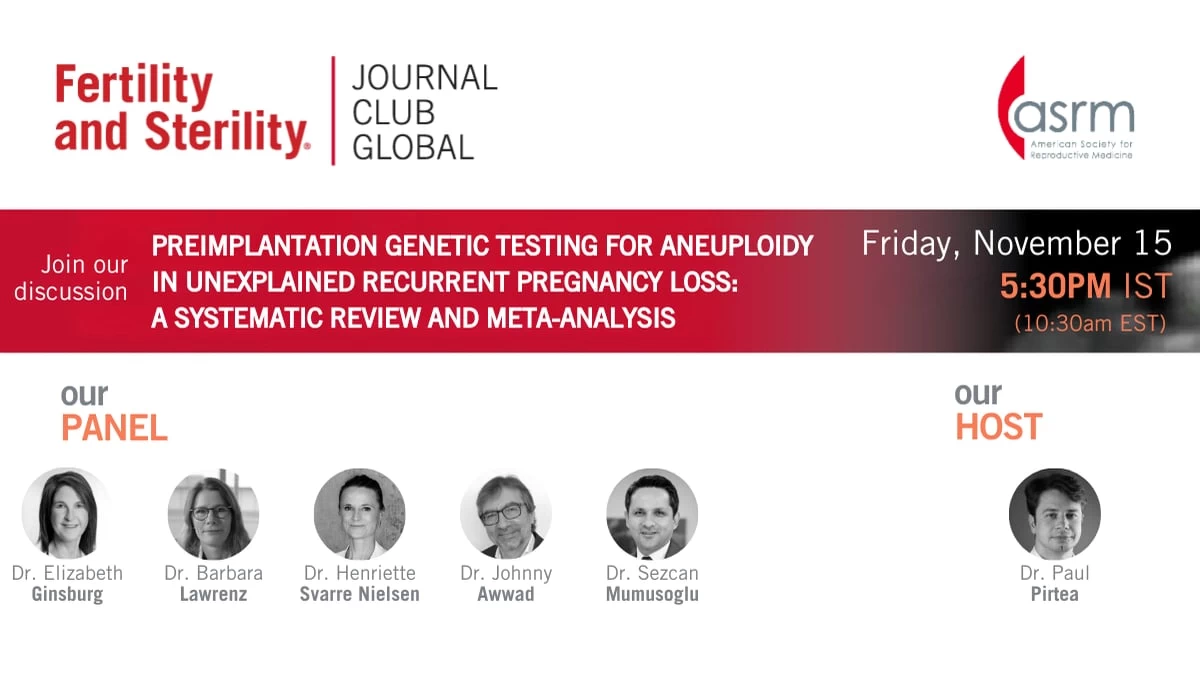
Journal Global Club From TSRM 2024: Preimplantation genetic testing for aneuploidy in unexplained recurrent pregnancy loss: A systematic review and meta-analysis
Explore the effectiveness of PGT-A in managing unexplained recurrent pregnancy loss, featuring systematic review findings, insights on miscarriage risks, and live birth rates.
Journal Club Global from MEFS 2024
Explore BMI's impact on IVF outcomes in a global fertility discussion, analyzing studies, obesity trends, and regional variations in reproductive health care.
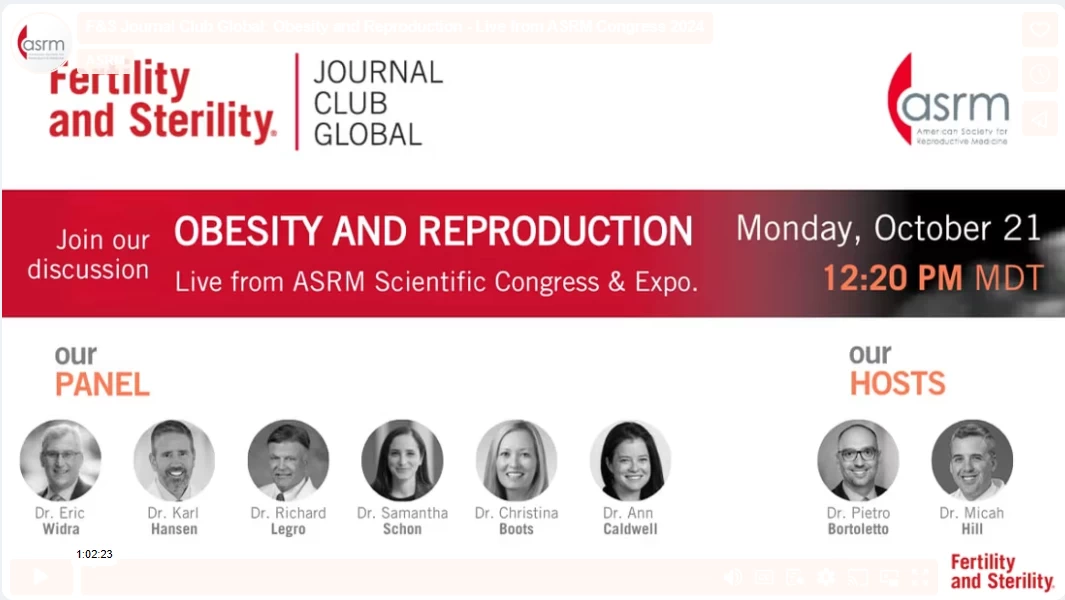
Journal Club Global from ASRM 2024: Obesity and Reproduction
Join experts from Fertility and Sterility Journal Club as they explore the impact of obesity on reproduction, weight loss interventions, and emerging treatments in fertility.
Journal Club Global en Español: De la Reunión de la SAMER 2024
Onsite de la Reunión de la Sociedad Argentina de Medicina Reproductiva (SAMER) de Córdoba, Argentina
Journal Club Global: SREI Fellows Retreat - Fellows vs Faculty Debate: Luteal Support in Programmed FET Cycles
Fertility and Sterility Journal Club debate on progesterone administration in frozen embryo transfers, featuring faculty vs fellows discussing IM vs vaginal routes.
Journal Club Global from ANZSREI 2024: Debate Unexplained infertility; Straight to IVF?
ANZSREI 2024 debate: Should unexplained infertility go straight to IVF? Experts discuss pros, cons, and alternative treatments. No clear consensus reached.
Journal Club Global: Falha de implantação: realidade ou ilusão estatística?
Fertility and Sterility Global Journal Club from Brazil
Journal Club Global en Espanol: Actualizacion sobre el síndrome de ovario poliquístico
Fertility & Sterility se enorgullece de traer un Journal Club Global en Español en vivo desde Cancún, Mexico
Journal Club Global: Oral Progestin For Ovulation Suppression During IVF
Live broadcast from the 2024 Midwest Reproductive Symposium
International in Chicago, IL
Journal Club Global: Recent clinical trials in Fertility and Sterility from the Asia Pacific region
Join ASPIRE 2024 for a Journal Club Global on PGT-A and IVF. Learn from top experts discussing recent clinical trial data and pregnancy outcomes
Journal Club Global en Español: Avances recientes en el tratamiento del síndrome de ovario poliquístico e Infertilidad
Un panel de expertos discutirá dos artículos recientes de Fertility and Sterility que estudian la infertilidad y el síndrome de ovario poliquístico.
Journal Club Global: Cost effectiveness analyses of PGT-A
Infertility treatments can be financially burdensome, often without insurance coverage, making understanding the cost effectiveness of PGT-A crucial.
Journal Club Global: The future of REI Fellowship training: debating opportunities and threats
This exciting collaboration discusses the controversy and future directions for the field of Reproductive Endocrinology and Infertility medicine.
Journal Club Global: Infertility and Subclinical Hypothyroidism
The impact of treating SCH on fertility, obstetric outcomes, and offspring neurocognitive development is debated in the literature.
Journal Club Global: Actualidad En Tratamientos De Fertilidad Para Pacientes Con Endometriosis
Live in Spanish from the 2024 Peruvian Fertility Society Meeting - Lima, Peru
Journal Club Global - Recurrent implantation failure: Reality or statistical mirage?
This exciting new collaboration brings authors and experts to discuss the controversy and future directions for recurrent implantation failure.
Journal Club Global - Evidence based guidelines for (PMOS) PCOS
This virtual event discusses the international guidelines for the assessment and management of PMOS (formerly PCOS), conducted by the International PCOS Network.
Journal Club Global - Recurrent implantation failure: Reality or statistical mirage?
This exciting new collaboration brings authors and experts to discuss the controversy and future directions for recurrent implantation failure.
Journal Club Global - The Association of Ovarian Reserve and Embryo Aneuploidy
Recent research suggests that the Antimullerian hormone (AMH) may not reliably predict embryo health in both infertility and non-infertility cases.
Journal Club Global - Actualización en la suplementación con progesterona en fase lútea para transferencias de embriones congelados
Efectividad del rescate de progesterona en mujeres que presentan niveles bajos de progesterona circulante alrededor del día de la transferencia de embriones
Journal Club Global - Revisiting the STAR trial: The Fellows debate PGT-A
We are excited to host a debate covering the pros and cons of PGT-A and how new technologies should be validated before clinical implementation.
Journal Club Global: Absolute uterine infertility a Cornelian dilemma: uterine transplantation or surrogacy?
Absolute uterine infertility presents as a Cornelian dilemma for patients and providers.
Journal Club Global: Transferencia de embriones frescos versus congelados: ¿Cuál es la mejor opción
Los resultados de nuevas técnicas de investigación clínica que utilizan información de bancos nacionales de vigilancia médica.
Journal Club Global: IVM in Clinical Practice: An Idea Whose Time Has Come?
In vitro maturation (IVM) has the potential to make IVF cheaper, safer, and more widely accessible to patients with infertility.
Journal Club Global - What is the optimal number of oocytes to reach a live-birth following IVF?
The optimal number of oocytes necessary to expect a live birth following in vitro fertilization remains unclear.
Journal Club Global: Surgical management of endometriosis in women diagnosed with infertility (Spanish language)
Journal Club Global: Natural versus Programmed FET Cycles
Journal Club Global: Moving leiomyoma research from bench to bedside
Journal Club Global: Does diminished ovarian reserve impact embryo aneuploidy or live birth rates?
Journal Club Global: Is PGT-P cutting edge or should we cut it out?
PGT for polygenic risk scoring (PGT-P) is a novel screening strategy of embryos for polygenic conditions and traits.
Journal Club Global: Should everyone freeze oocytes by age 33?
Oocyte cryopreservation is one of the fastest growing areas of reproductive medicine.
Journal Club Global: Management of poor ovarian response
A poor ovarian response to what should otherwise be a successful stimulation cycle presents a clinical conundrum for clinicians.
Journal Club Global: Non-invasive Diagnosis of Endometriosis
One of the most exciting developments in the field of endometriosis is the push towards earlier and less invasive approaches to diagnosis.
Journal Club Global: Prognosis in unexplained RPL
Recurrent pregnancy loss is one of the bigger challenges in the field of reproductive medicine.
Journal Club Global: Evidence for Immunologic Therapies in Women Undergoing ART
Reproductive immunology is perhaps one of the most controversial and promising fields within ART.
Journal Club Global Live from PCRS - Non-Invasive Embryo Selection Techniques
The next great frontier in reproductive medicine is how to non-invasively select an embryo with the highest reproductive potential for transfer.
Journal Club Global - To Operate Or Not To Operate: Debating Intramural Fibroids And Fertility
The event will debate the upcoming F&S Fertile Battle “Intramural myomas more than 3 to 4 cm should be surgically removed before IVF”.
Journal Club Global - PGT-A - Can non-invasive approaches based on spent medium analysis
PGT-A by trophectoderm biopsy aims to select available euploid embryos for transfer.
Journal Club Global - Obesity & Reproduction: An Update on Management and Counseling
Obesity can negatively impact reproduction in various ways, including ovulatory and menstrual function, natural fertility and fecundity rates, infertility treatment success rates, infertility treatment safety, and obstetric outcomes
Journal Club Global - Does the Endometrium Play a Major Role in Endometriosis-Associated Infertility
This will be a virtual event in the style of the "Fertile Battle" debate that took place at the 2019 SREI Fellows Symposium
Journal Club Global - Best Practices of High Performing ART Clinics
This Fertility and Sterility Journal Club Global discusses February’s seminal article, “Common practices among consistently high-performing in vitro fertilization programs in the United States: a 10 year update.”
Journal Club Global - Should Fellows Perform Live Embryo Transfers in Fellowship?
Few things are more taboo in reproductive medicine fellowship training than allowing fellows to perform live embryo transfers.
Journal Club Global - Fertilization rate as a novel indicator in ART results
This Journal Club Global discusses a provocative article recently published in Fertility and Sterility, discussing the results of a multicenter retrospective cohort study with the objective to appraise the fertilization rate as a predictive factor for cumulative live birth rate (CLBR).
Journal Club Global Live from ASRM - Optimal Management of the Frozen Embryo Transfer Cycle: Insights From Recent Literature
Three recent papers published in the Fertility and Sterility family of journals, all explore different aspects of optimizing frozen embryo transfer cycles.
Journal Club Global - Are We Approaching Automation in ART?
Some ART diagnostic devices are already available and offer objective tools of evaluation.
Journal Club Global Live from India - Adjuvants in IVF and IVF Add-Ons for the Endometrium
Many adjuvants have been utilized by IVF centers to improve their success rates.
Journal Club Global - Accuracy of Preimplantation Genetic Testing for Aneuploidies
Club Global Académico - ¿Cual debe de ser la primera línea de tratamiento en parejas con infertilidad inexplicable?
Nuestro debate se enfocará en el manejo óptimo de la infertilidad inexplicable, y como el problema debe de ser abordado en Latinoamérica basado en la literatura global reciente.
Journal Club Global - Recurrent Implantation Failures in ART: Myth or Reality?
Fertility and Sterility
F&S Reports
F&S Reports is an open-access journal that publishes peer-reviewed original scientific articles in clinical and translational research that have strong potential to transform clinical practice.
F&S Reviews
F&S Reviews publishes both systematic and comprehensive, authoritative review articles spanning reproductive medicine or science.
F&S Science
F&S Science publishes peer-reviewed original scientific articles in basic, laboratory, and translational research that has strong potential to transform clinical practice.
Fertility and Sterility
Fertility and Sterility® is an international journal for health professionals who treat and investigate problems of infertility and human reproductive disorders.

Journal Club Global
Fertility and Sterility Journal Club Global is an interactive online discussion of a hot topic or seminal article from Fertility and Sterility.