


The upcoming Journal Club Global will explore a provocative article on the cost effectiveness of PGT-A recently published in Fertility and Sterility. The article provides a systematic literature review of 22 published studies and summarizes the current cost effectiveness evidence on this topic. Infertility treatments are notoriously expensive and often not covered by insurance. PGT is expensive and the clinical efficacy varies in the existing published trials, at least in part due to heterogeneity in study design. Therefore, studying the cost-effectiveness of PGT is a challenging research question which we will explore.
View the Article being discussed: Cost-effectiveness analyses of preimplantation genetic testing
Questions to be addressed:
- What are the key steps to cost effectiveness analyses?
- What are the challenges in assessing cost effectiveness in general and specific to PGT-A?
- How should heterogenous studies be assessed and synthesized systematically?
- What are the main factors driving heterogeneity in the cost effectiveness of PGT-A?
Panelists:
Mina Popovic PhD
Kate Devine MD
Chaim Jalas PhD
Richard Scott, MD HCLD
Diego Marin PhD
Kristine McWilliams MD PhD HCLD
Moderators:
Paul Pirtea, M.D.
Dominique de Ziegler, MD.
Micah J. Hill, DO
Transcript
Good afternoon, good evening, wherever you are in the world. Welcome to Fertility and Sterility Journal Club Global. I'm Micah Hill, the Media Editor for Fertility and Sterility.
We have an amazing panel today here to talk about the cost-effectiveness of PGT, both PGTM and PGTA. We have the authors of the paper, and we have our host, FNS Interactive Associate, Paul Perttia, FNS Editor, Editorial Editor, Dom DeZiegler. Dr. DeZiegler, thank you for putting this talk together.
I'll turn it over to you and Paul to introduce our panel today. Thank you, Micah. I'm Dominic DeZiegler, and I want to congratulate the Editor-in-Chief of our journal called Monohut for setting up some of those Journal Club Global on the European time zone.
It is seven o'clock here in Europe, because we haven't changed to daylight saving time. We will on Saturday night, but we haven't yet. So seven o'clock in Europe, and we have a great topic to address.
This is the topic of cost-effectiveness of embryo diagnosis, both PGTA and PGTM. We might expand the discussion on the cost-effectiveness of ART in general, but this is going to be a possible extension. With this said, it is a great topic, and with this said, I will pass on the mic to Paul Perttia, who is working at Paris, France, at l'Hôpital Pogge, and he is going to introduce the participants, the presenters, and the discussants to this Journal Club Global.
So, Paul, the floor is yours. Thank you, Dominic, and thank you, Michael, for this kind invitation. And most of all, I would like to thank these nice people that have accepted to be present in this very hot topic, a very nice discussion on the cost-effectiveness of PGTA.
And I will start to introduce, first of all, our presenter today, Jessica Walter, which is the senior author of a paper that addresses the same topic, recently published in FNS. And then I would like to continue with Kate Devine, Medical Director at Shady Grove in the US, also accompanied by Mina Popovich, Medical Advisor in Eugene, Spain. We also have with us today Christine McWilliams, Medical Advisor in Genomics at Cooper Surgical.
Of course, we continue with the men in this panel, with Haim Chalas, CEO of Juno Genetics. And also, I would like to present Diego, Medical Advisor in Genomic Prediction. And of course, no introduction needed for Richard Scott, who has done so many papers on PGTA, and therefore, we are very happy to have him with us today in the discussion.
So, I will start with Jessica Walter. So, please, if you can explain to us the findings of your paper in a few words. And therefore, afterwards, we're going to have discussions.
Absolutely. Well, thank you so much. And I just want to say on behalf of myself and my co-authors, we're so grateful for the editors, for FNS, for publishing our work, and obviously for the panelists, you know, coming together today, hopefully to have a really thought-provoking conversation.
And I hope, like Dr. DeZiegler said, we expand the conversation a little bit more, even beyond just PGTA and M, just talk a little bit more about how we can advocate for our field and use cost-effectiveness in our favor to make these arguments. So, at the outset, just as a way of background, I don't have to tell this audience or these panelists, the use of pre-implantation genetic testing is really variable, depending on what clinic you practice in, what state in the United States, or what country you're coming from. It has variable use, and lots of proposed, you know, applications in different areas.
And I would say it's somewhat controversial in how we might decide to use this intervention. And like much of infertility care, it is expensive. So, because of all those things, it provides a nice opportunity to use cost-effectiveness analyses to understand if it's an intervention that helps to provide higher quality care, or if there's more controversy around this intervention.
So, cost-effectiveness analyses are, you know, as I'm sure we'll talk about, are one tool that we can use, again, to our defense, to understand, you know, and convince policymakers, people who are setting priorities in our institutions, whether or not the things that we do are worth the time and the money that they cost. So, we set out looking to perform a systematic review, identifying cost-effectiveness analyses, both for pre-implantation genetic testing for aneuploidy, and also for monogenic disorders. So, we queried available databases, including MBase, PubMed, and Cochrane Reviews to identify any of the studies that might be looking at this.
Our inclusion criteria required that these articles were published in English and a peer-reviewed journal, and had some comparator between two different arms, so not simply a cost analysis. And then they actually had to provide two costs. Then, once we identified our cohort of articles that were relevant, or studies that were relevant to this topic, we then looked through some of the tiers checklist, which is a sort of list, a checklist that we can use in how we report cost-effectiveness analyses to see how high quality and how high the adherence is to the recommended components of these analyses.
In our finding, we identified 22 studies that were relevant for this. 14 were on PGT for aneuploidy, and 8 were for PGTM. Overall, we found that PGTA studies had less good adherence to reporting the components of the tiers checklist, and were less likely to find that PGTA was cost-effective.
For PGTM studies, overall, the adherence was higher in reporting all of the required components, and all of them identified that the intervention was favorable. For both PGTA and PGTM, we did find that the studies addressed kind of narrow swaths of applications of these technologies, whether it was a specific heritable disease or for a specific age or diagnosis of infertility. And we found that there was heterogeneity in how effectiveness was determined for sort of the effectiveness part of the analysis.
Additionally, over time, we saw that there were more of these publications that were coming out. So, our big takeaways from the study is that, for specific heritable diseases, it seems that PGTA, it was probably easier to design these cost-effectiveness analyses, and it was easier to demonstrate that they were cost-effective. I think the evidence is next for PGTA, because it's a more complicated question.
And what I hope we have a little bit of time to cover sort of as a broader question for the group, not just this audience, but I think for our field in general, is thinking about what is the best way to measure effectiveness for any intervention we do in infertility? Is it cost per live birth? Or is that leaving a lot on the table? Is that not accounting for the loss of quality of life for patients who experience infertility, the benefits of potentially just being diagnosed or even attempting treatment? Or are we really tethered to having to achieve this positive outcome of a live birth to demonstrate value? And I hope that over time, we're going to have more robust methodologically rigorous answers to these questions, because I think it's going to help us advocate for our patients and prove that this is a disease that leads to morbidity, and we can really increase quality of health when we address these with the interventions that we have available. Okay, great. Thank you.
So now that we have a small summary of this paper, recent paper, I'll give the word to Dominic to put this first question on the table. We cannot hear Dominic. When we talk about cost effectiveness, the question is, what is the output? And there are several when it comes to PGTA, for example.
In essence, and I think Richard can confirm this, PGTA is meant to avoid doing unnecessary transfers. Of course, they are expensive, and they can calculate the cost. But at one point at the end of the discussion, we'll have also to address what it means for patients to undergo psychologically an IVF course with a transfer and a failure.
And this also includes the risk of giving up and abandoning their process. And this sometimes is hard to assess in terms of cost, but we also have to address that issue as well. So I think Paul has chosen a great list of participants to the discussion and analysis, so I will let you pass on the discussion to them.
Okay, so I would like to ask first, how can you assess the benefit of PGTA? Because this is very, it's a very complicated question. Because before saying that whether it's effective or not, how do you assess the benefit? Because just to give an example, one of the reasons why this analysis is forbidden is because it's considered to be too expensive. Haim, what do you think? The question on the benefits has been a usually debated topic between cumulative live birth or per transfer.
I don't think PGTA can improve the cumulative live birth. I never understood that question. PGTA doesn't change the outcome of the embryos.
If that's the question, PGTA can actually harm the embryos by over-diagnosis, where euploid or non-aneuploids are labeled as aneuploid, which is a problem in our field, depending on the methods in the laboratories. So the questions about benefits to the patient would be potentially a higher implantation rate and live birth rate per transfer, and the potential to reduce the miscarriage rate, and as well to reduce the unnecessary transfer of embryos that have almost no chance to be achieving their live birth. The only benefits, if people want to measure cumulative live birth rate, they shouldn't do anything.
Other opinions? Everyone agrees? No, I mean, I, oh, go ahead, Richard. This is a, sorry, sorry. It's a very good point, starting point for the discussion, and Richard is going to catch up.
PGTA does not increase the quality of embryos. It just selects out those that have no chance to implant. And therefore, the assessment of the benefit is the cost of the transfers, but also what people have to go through when they undergo an unsuccessful transfer.
Rich? You know, hold your hand up any time, Kate, and I'll defer to you at any point, but I think that if we're thinking about this, I think it's important to remember that virtually any diagnostic test done in medicine attains its predicted value in the abnormals, right? If you have chest pain and they run your cardiac enzymes, and they're fine, you might not be having an AMI, but it doesn't mean you don't have pain in a problem. So there are many other things to consider. And the cost effectiveness of this, and the wonderful job that Dr. Walter here did, you know, one is that prices have diminished over time.
We have to remember that when we're looking at a large aggregate of data like this, dramatically. But also, I think that we have to look at cost in a very global way, which is hard, not just from a single transfer, but really until the patient conceives and delivers. And quite frankly, may even be more than one delivery if we could do it ideally, although that's exceedingly difficult.
So all the futile cycles should be included. Long-term cryo-storage fees of embryos that are never going to lead to a baby, because they're all aneuploid, are going to have to, should be estimated. The cost of monitoring and care for unsuccessful pregnancies, including potential DNCs or analyses or whatever else, plus the potential burden of lost time, must be considered in all of this.
And when you do that, the picture becomes much clearer. In regards to the cumulative pregnancy rate, I mean, remember, morphology that we all do in our laboratories every day also doesn't raise cumulative delivery rates, right? Putting every embryo back is always getting all the pregnancy potential. Any diagnostic is not useful in that sense.
But patients who have six embryos or eight embryos or 10 embryos won't go through 10 cycles to try to find that one. So the dropout rate is extremely difficult to factor in here, but it's part of real life that we should all keep in mind. So I think across the board, my last one comment is that there is a tendency, including the paper from our group, quite frankly, so guilty as charged, there's a tendency to combine these technologies as all they were the same.
So in our own group, looking at when we were doing SNP arrays and then qPCR, and then two or three different types of preferential amplification and next-gen, to think they're all the same. It would be just like a breast surgeon doing self-exam thermography and xeromonography to look at which is effective and combining all those together. It's kind of silly.
They're wildly different in terms of their predictive values and impact. So I think that this is a great paper, but we have to try to look very globally, including the cost of all the adverse consequences as we put this together. I have one question.
Sorry. Go ahead, Haim. So I have one question.
It was Dr. Devine, not myself. Sorry. Sorry, Kate.
Go ahead. Please do. Well, I was first off going to agree with Richard that this is a great paper, not the least of which reason being that it very clearly and elegantly by a thorough evaluation of the literature demonstrates the unequivocal cost effectiveness of PGTM, which though I think probably none of us on this call would probably have argued with, it hopefully will be a useful tool to advocate for better coverage.
And such coverage would obviously alleviate a lot of human suffering, which is incredibly important. I think that PGTA is a much, much harder technology to assess the cost effectiveness for, because as Haim very astutely pointed out, it's not going to increase the cumulative live birth per retrieval. In fact, we'll slightly decrease it in most cases, and therefore it's not going to decrease the number of retrievals.
It may, so its value lies in potentially, as has been said, decreasing the number of transfers or the time to live birth and thereby improving the experience of patients, perhaps reducing their dropout from experiencing, you know, hardship. That said, when we're thinking about that potential benefit, of course, we need to weigh that against the potential for embryo wastage or the deselection of embryos that could potentially be useful. And it's very, very hard as well to balance what the value of that is.
And that really ought to be taken into account in terms of assessing the cost effectiveness as well. Thank you. Mina, what do you think? I might ask a question to the panel.
Obviously, we don't do PGTA in France because our government decided that we can't. But what is the role of PGTA in decreasing the number of multiple pregnancies? Because multiple pregnancies are horrendously expensive. Is this to be taken into account by allowing a single embryo transfer? Does anyone want to catch up on this? I'll take a quick stab.
I mean, I think in early days, PGTA did a huge amount of the work in terms of moving us towards elective single embryo transfer and reducing the number of multiple births. I just did about 20 embryo transfers this morning, about a third of which were untested embryos, and they were every single one a single embryo transfer. So I do think now, thankfully, as a field, at least in the United States, with blastocyst transfer, it's rare that we're transferring multiple blastocysts in many practices.
But I think early on, it was absolutely a crucial component to changing that practice pattern. I just want to add, this is Richard, I certainly agree with Dr. Vine. The reality is in the 21 SAR data, almost 20% of transfers involve two or more embryos.
And so while I have no doubt that her program is very disciplined, I'm not sure how uniform that is. And for a very long time, the ASRM transfer guidelines for really saying that one is the standard of care really only applies to PGTA screened embryos. Used effectively, and our utilization of PGTA in our program is about the same as hers.
We're about 70%. Across the board, getting a single embryo transfer is probably the most important thing that any diagnostic can do, whether it's PGTA or anything else. Because if you add in the cost impact of multiple gestation on this, then it's overwhelmingly massively cost effective.
I think that's extremely important. I wanted to make a comment about cost, but I believe Dr. Popovich, you had a comment first. Thanks, Chaim.
So I just wanted to add on to what was discussed before about the variability in testing. And in fact, that this makes really any cost effectiveness analysis extremely difficult, because what we have seen from our research and those of others is really that there is a lot of variability in testing. We know that variability amongst clinics, variability across genetic testing platforms, variability in genetic testing laboratories, and these can actually lead to the exclusion of embryos that may develop into healthy live embryos, which we were also touching upon.
And that, of course, we see even through diagnosis such as diagnosis of mosaicism, which is a very hot topic in PGTA. And we even see that even though now we are recommending the transfer of mosaic embryos, for instance, patients ultimately don't transfer these embryos because of the difficulties in understanding mosaicism and so on. So, in that sense, this variability does not only reduce the efficiency of the treatment, but also can raise concerns regarding the cost effectiveness as well.
So it adds really further complexities in evaluating the true cost and also even the true benefit of PGTA. So I think, yeah, heterogeneity is really a big problem when we are trying to evaluate PGTA overall. Thank you.
And I think also when we talk about costs, adding PGTA is not only about the cost of the assay or the cost of running the test. There's the cost of biopsy, the cost of cryo, the cost of thaw. And there's also various different add-on costs that sometimes clinics add.
There's also differences between the United States and in Europe, depending on who is selling the test. In many countries, the clinics sell the test and there's an add-on fee on top of the lab's fee. So when looking at costs, looking around the world, there's huge differences among it, depending on each country, what's legal to do.
There's also the emotional costs, which I don't know how to value or how to quantify, which is really important, especially for people undergoing losses and failed transfers. There's also the question about who is the payer. Is it a global situation where everyone has paid everything? So we can add in the question about who is paying for the multiples or who's paying for the losses.
Is the same insurance company that pays for the losses, that they pay for the IVF or pay for the PGT? I think there's a lot of variability, which of course, that's why we're here, because it's a hot topic and a question, but it's a really hard question. So again, I congratulate the author for trying at this, and I think it's really, really important. The other thing is on the platforms, there's really easy ways to lower the cost, but they will also have an impact on accuracy.
So do we look at platforms that are highly validated versus off the shelf that anyone can run? That's potentially even some IVF clinics we want to run in-house without proper validation. And that would lead to other types of costs, which would be the cost of treatment not happening ever, and the patient giving up, or the embryos going to the trash bin because somebody called it unemployed. So given the variability, I think it's really difficult, but of course, really necessary to perform these types of studies in a place where we can take the cost of the babies, the cost of the pregnancy, the cost of the IVF, and the cost of the testing all combined.
I was just going to say, I think, we're fortunate that some of these costs are shared with PGTM, cost of biopsy, of cryopreservation, and even the insurers, in often case, are similar payers that we're dealing with. So there certainly are some shared costs, but certainly also very unique circumstances to clearly evaluating what the benefit of PGTA is adding. If I could just add something.
First of all, I'm very happy that I think one of the outcomes of today would be that heterogeneity in assays and platforms is a big deal, because I think most of us have recognized that. And just to talk about examples of how that could impact, at least in our experience, PGT has always been seen as a concept. So this paper sees it as one concept, one type of test.
But it's remarkable when you see the same population from the same clinic at the same time, that euploidy rates could vary even to 20%. I remember once Dr. Oskow was giving a talk about that Jason Farnese paper of that curve, you know, of the aneuploidy rate, that now with more data points, with better technology assays, that trend is the same, but then it lowers a little bit. And that has an impact, because then you might have more euploid embryos to transfer with better platforms.
So that's certainly a case. And what Mina mentioned, inaccurate assays, inaccurate calls, also could affect the cause effectiveness, because, you know, even reporting policies, we know that vendors, as Haim mentioned, that's also a big deal, have reporting policies changing. Some would report some incidental findings that some don't.
Maybe some incidental findings are futile, they're useless for the treatment, and that can mark an embryo aneuploid, and we're throwing something, as Kate said, that would have a potential. So at least one of the conclusions, or what we could exhort people who make these kind of studies, is to pay attention to what type of platform it is, and hopefully to have the validated data available. I'd like to interject real quick, because I'm reading on the Q&A section of the journal club, and there is a person who actually talks about the robustness of the PTTA test, and the differences between different tests, and the person adds, could regulation play a role in helping standardizing the PTTA test? So who wants to take that? Well, I'll take the first crack at that, because I'm not affiliated with any genetics labs at the current time, or I don't have a commercial bias for the clinic or the lab.
So I think that at some point, if we don't address the issues that Dr. Popich put out, that we have to find, and Dr. Merritt put out, we have to find better ways to establish the validity of these tests before we're implementing them, then we're going to fall prone to regulation. Regulation could be useful here, but it may or may not be effective. Our professional societies need to step up, like actually did with PGTM.
They had a wonderful document a long time ago that's really outstanding for talking about validation and all of those things. We need the same for PGTA, and if not, then I suspect it will fall on the governments. It's easy for people utilizing these tests simply to say, whatever assay you're using, there's many out there, have they got a predictive value set? Have they demonstrated what procedures of reproductively complementary health set are discarded? And it varies quite dramatically from zero in Ashley Teague's study to Shen's recent paper, where it was a 13% delivery rate amongst abnormals.
Given that there are eupoids implanted about half the time, that would suggest that 26% of embryos labeled aneuploid were probably not. It's a massive, massive difference. So we need to just do a little better job within our industry, within our professional societies, riding these processes.
And Dr. Barnhart is putting together really a series of papers on this very topic, so I think the vision is there, and it's going to be very exciting. So just to perhaps add on to that, and again, not affiliated with any genetic testing laboratories here either, but just want to mention something about even counseling and in terms of the standardization, that maybe we have been over the years with the newer technologies and their sensitivity even over-complicating, conveying information. And I think that it's important to remember that in terms of reporting, for instance, it may be easier to discuss, well, it is easier to discuss absence of findings rather than the presence of findings.
So I think it's important to navigate some of the uncertainties that we have at the moment when we are faced with ambiguous findings, for instance, mosaicism and so on. So one approach maybe in standardization could actually involve reducing some of this confusion, especially for findings that we don't really have a clinical significance at this point. And perhaps this could streamline PGTA and focus on more clear-cut results for which we have validated, for instance, the presence of uniform abnormalities as an example.
So perhaps that's something to take into consideration as well. On the topic of regulation, I'm sure everyone knows there's a lot of differences among countries, ISO, CIVD, CLIA, CAP. There's also potential changes coming our way in the United States with the VALID Act and other acts that might change things about LDTs.
But what's also important for people to know is having a CLIA certificate depends also on which state you're in. And some states getting a CLIA license on any assay does not require many more studies than just doing a few cell lines or some genomic DNA and claiming validation. So it's really important also as a field, if we want to be taken serious when we compare things, to also have a self-regulatory body to establish what is the proper validation, what should every lab share as validation, and also potentially cross-platform validations.
It's really hard as an industry if you have the same type of call being called mosaic at one place, the other place decides that's aneuploid, and the other one calls it euploid. So the heterogeneity that the patient will go to clinic A, clinic B, clinic C, and depending on what is ordered and how it's ordered, the embryo can get a different call that doesn't look good for any of us. And this definitely calls in more regulation, which might be good.
But we always want to remember who makes the regulations is not necessarily always scientists. There's also politicians, and I'm not sure we need more politics in IVF at this point. So I think as an industry, it would be really good for self-regulation showing that we're serious about having some sort of standardization among labs, clinics, and using the same terminology that actually allows that.
Christine, what do you think about it? No, I definitely agree. One, two, sorry. Go ahead.
Go ahead. Go ahead, Christine. Oh, no, no.
Yeah, I was going to say I definitely agree with that. I think also adding to the heterogeneity is that you can have different clinics receiving results from the same laboratory may apply different standards of policies of what they would consider for transfer or not. And that certainly also impacts what we're talking about here in terms of the ability to determine value of the testing by outcomes.
Well, in the meantime, I have a question. Given that, I mean, PGA was available in the U.S. since more than 10 years now. I have a question.
How many people are using it in the U.S. right now, like taking all clinics together? Is it based on the SAR data that around half, based on the last survey of the 2021, around half of the cycles use PGTA? Could anyone? At least that's what I think. I think it depends highly on different clinics. There's some clinics that are close to 80, 90 percent and some clinics that are much lower.
There's a huge variety and also depending also worldwide or the United States. But PGTA has been around for much more than 10 years, Paul. And the problem has been is that the confidence in PGTA keeps on changing where people say this one is better than the last test.
And getting back to the validation thing is that it shouldn't be around for 20 years and we still debate it. It should have been proven before it was launched. Yeah.
Okay. I couldn't agree more. I couldn't agree more with that statement that, you know, if we had to do all over again, certainly we would validate this test differently and also would chime in with what others have said, that it really does behoove clinicians in the lab to understand what their PGT lab of choice, to the extent they have one, is doing in terms of validation.
How are they going about that? How frequently are their QA and QC, you know, parameters being carried out? So I agree with all that's been said there because I, as much as, you know, the FDA has made noise about potentially validate or regulating LDTs more, I think it's going to be a very hard thing to walk back from where we are right now. I completely agree, Dr. Klein. I do think though that that clinics could demand, whoever their provider is, that they provide either, you know, what we originally called non-selection studies or predicted value studies.
It is a, again, I have no, I have no dog in this hunt with any program in the lab, but it is a curiosity of me that programs utilize laboratories that have not demonstrated the predicted value of the test. And remember the predicted value is not to obtain a genetic result, it's to obtain a clinical result. It's got to be based on implantation rates.
Because no one really thinks you can look at five or seven cells from a biopsy and say with any degree of certainty with the genetic complement of the entire embryos. These tests are done to predict sustained implantation rates and specifically, as mentioned before, basically a sustained implantation rate appearing near zero. So you can exclude the that's how the test is used.
I don't know why, and looking at cost-effectiveness, maybe we should divide it into tests that have been validated that way and those that have not been validated to that standard to assess cost-effectiveness because it's a pretty, it's a pretty substantial difference in risk to the patients and therefore the magnitude. I think one interesting observation that was also, you know, we're also talking about PGTM here and what the uptake of PGTA is, if PGTM is already planned. So if there's already a planned biopsy, if there's already planned cryopreservation, the uptake of PGTA becomes quite high typically among patients, which I find to be very interesting and perhaps, you know, illustrate, you know, what the cost-benefit might be to those patients.
I could agree more, Dr. McWilliams. I mean, you know, when you tell a patient he's already going to have a biopsy, already going through the entire process. Remember that a 42-year-old doing PGTA has the same risk for an ongoing angioplasty gestation as a 24-year-old.
That's an appealing thing to these reproductive age couples and that affects, of course, their loss risk, but also their ongoing angioplasty. It's powerful. It's powerful.
Does anyone think that the number of oocytes obtained actually has an impact on the cost-effectiveness of PGTA? That would be more on the cumulative, not on the per-embryo transfer. The cost-effectiveness. If an embryo that is aneuploid has zero or near zero reproductive potential, the patient only has one embryo, wouldn't want to transfer that one, or it has a high risk of miscarriage or other costs.
So, this idea of if you only have one embryo, why choose? If the point of not transferring aneuploids is not about increasing the live birth rate, it's about reducing the futile transfers and potential increase in costs around losses. I never understood how the number of testable available embryos would matter. That would only be if you're trying to enrich the pool to help you pick the better one.
This is not about picking the better one. This is about excluding the ones who are no good. Okay, very good.
That's a good point. I wanted you to say that. The other thing, Don, just to support your point, and probably Jolyce's point, is to remember that when patients put back aneuploid embryos, 50% of those aneuploids, in Ashley Teague's study, approximately half, implanted.
So, now they're pregnant. That's an emotional rollercoaster that's horrible for these patients. But then they go through the monitoring.
It costs money. It costs them time. Then they go through the loss and recovery.
The delay from an initial establishment of an aneuploid gestation to the loss, and they get to the next cycle. And our clinic averaged almost six months. And, you know, when you're 41 or 42, even if you're going to have fewer oocytes in those age groups, that six months is a very, very costly biologic, in terms of the biologic burden of delays.
So, I think that all of those things, I don't know how to put them into Dr. Walter's formula, and I love the way she did it. So, I have a lot of good things to say about that. But those things also, there is a randomized trial that Jason Benasiak is working on in low responders, specifically to address this question.
And that could also result in dropout of patients, right? After two failed transfers, that could increase them just abandoning the treatment. So, that's, you know, another benefit of this test. Yeah, this is more of a point.
I mean, dropout is not just an issue of cost, just not an issue of money. There have been studies in France where IVF is fully covered, and the rate of dropout in IVF in general, it's just about the same as what it is in the U.S. So, it's not just an issue of cost, it's an issue of being exhausted psychologically, and how much people can give to going through the IVF process. The thing to think about cost would be, sorry, one more thing about cost would be, there's recently, over the years, been many add-ons on this add-on.
We all know PGTA is an add-on. You could perfectly do IVF without it. You don't need PGT.
PGT should just help, if possible. Has been add-on to PGTA, screening of various things, for example, mitoscore and other things, and now it's current of origin or routine fingerprinting, things where I have not seen really post-practice trials that it helps. But my understanding is that that increases the cost even more, and I think we should look at it asking, do we need add-ons on top of add-ons when there's no proven benefit today, at least not studied in a prospective manner? I think you had something, Jessica.
Dr. Walter, you go ahead. Yeah, I was just going to say, I really appreciate that we're talking in such depth about the test that we're actually evaluating and the cost associated with that. I think if we all brainstorm, we could come up with an exhaustive list of all the costs that we have to include, from cryopreservation to from end to end, we could think about quantifying that.
But I think the piece that we really have to work on, and I think these randomized control trials that are undergoing on are really an opportunity where we could try to understand for the patients that we see, what is the value added of the treatment? What does it mean to them to undergo a miscarriage? What does it mean to have to wait six months to have their next transfer or whatever? Perhaps there is value even in a transfer that is unsuccessful. I think that's the question we don't know. And those are the questions we need to answer if we are ever going to understand, because we can add up the costs, the out-of-pocket costs, the amount that an insurance company pays.
But what we don't have is that emotional piece that I think if we can start to try to quantify that, then we can understand if this, you know, regardless of the effectiveness of the treatment, perhaps it is providing benefit, or maybe it's not providing benefit. I think that's another piece that we have to start to untangle from what is already a really complex question from just the scientific assay perspective. Yeah, I couldn't agree more on that.
And I think that it's important to note that, you know, post-transfer, we go into essentially an information blackout for genetics until almost near the second trimester. And so when we talk about, you know, what it means to patients, patients' exhaustion, you know, the ability to go on and cope perhaps with a failed transfer or a pregnancy loss, sometimes the knowledge, I think, of knowing what was transferred, for example, was it a mosaic that was, you know, transferred and we knew that there was a lower potential, does that provide any comfort to the patient, any information that might, you know, enable them to go on with additional transfers? I might just add, in support of Dr. Walter, but just making one fine-tuning point. Remember that the most important validation study is the non-selection study, is the predictive value study.
Randomized trials are important, but all they really measure, if you already know that one you call abnormal never makes a baby or virtually never makes a baby, then it's mathematically impossible not to have a difference between the two populations. However, that doesn't mean it would be clinically beneficial, because you might have already through your morphology or your time, whatever, have already picked the right embryo. So all an RCT does is measure how often you change which embryo you select and the impact of that.
So you need both, and we have to be disciplined in, I think, in potentially breaking down these types of analyses in the future to maybe separate those assays that have done the validations with predictive value studies from those that have not, because it's likely going to be quite different. And then I have a challenge to Dr. Walter for her next study. Look at the continuation rate after a failed transfer for patients with euploid embryos, where they have a higher degree of confidence that they're going to implant in the liver, versus those where there's just put back another, put back another one, which to get to the same cumulative life birth rate, all with all of us agreeing to ultimately be the same, could potentially require much greater time, financial, and emotional burden on the patient.
So I look forward to attending that club with you presenting that in the future. Richard, I think the point you made is really important. For our audience that maybe is not familiar with the term that you use, non-selection studies, or that, you know, the term Kurt uses of predictive value or diagnostic accuracy studies, can you just tell us how do you do those for this technology? The correct name is definitely predictive value studies, and I use the other, and I'm shame on you.
So for everyone preparing for their boards, it's predictive value studies for sure. But the bottom line is, is that unlike in a clinical study, where you do a test on breast cancer, and you have somebody you say is, you know, has the disease, you actually find out eventually whether they do it, right? Or instead they don't, you get to follow the patient and ultimately determine the outcome. It's not true with embryos we call abnormal, they get discarded.
So we never really know whether we were right or not. So what you have to do is a study where you biopsy the embryo or sample with whatever technology you're using, and then put that sample away, don't even run it, don't even analyze it, don't think about it, until the patient's outcome is known. Then run the test and then unblind it to see whether your test result predicted your outcome.
And when you do that, there was a recent paper from New York, it showed a 13% delivered, again, that implies that an error rate is in the 20s, and yet others have shown near zero. The original, our original study like that with the SNP rate had an error rate of four and a half percent, which was we think too high. It's one of the reasons we switched technology.
So, but we need to look for studies where they did blinded assessments of the predicted value of both the normal and abnormal result. In the absence of those, I don't think you could consider any assay clinical value. Well, Richard, I want to expand upon that.
Do you think that patient in general should be more aware of this approach to testing the labs and they could actually shop around in terms of selecting one lab or another? Do you think there is some message to be passed out to the, to the couples? I do. I think the clinic, the providers, and maybe Kate can jump in or Christine can jump in and comment as well. But I think the providers ultimately, the embryologists and the clinical providers ultimately have to make that decision because they're so much more sophisticated when it comes to the science and the technology.
However, I do think that all patients should be counseled about what the predicted value of an abnormal result is. If you're going to throw my embryos out because this test is abnormal, tell me how sure you are that that embryo had no reproductive potential. And that doesn't always go on today.
Sometimes it doesn't. It doesn't always go on today. And I think that's, that's very dangerous.
But in the end, I would hope that the, that sophisticated clinicians and embryologists and scientists would be the ones helping to steer the patients there. But the information should be included in counseling for patients to consider when, when making a decision about whether to employ the technique. I mean, there's no question what clinical value there are in such elegant studies as Teague's and Capalbo.
And of course, it would be ideal if every lab had those studies. We also have to know that that's a certain platform at a certain point in time. So again, ongoing quality assurance measures are, are really necessary for every lab, no matter how beautiful a study they, they once did.
And just to kind of bring back a couple of points that have been raised when we're talking about the value of PGTA, which I think, you know, we've done a really good job of threshing out that really, it's kind of hard to talk about cost-effectiveness of PGTA. We probably are really talking about value and there is some subjective component to that. That said, something that plays very strongly into that value is the positive and negative predictive value of the test.
And that is associated with the prevalence of disease, right? So maybe more important than how many eggs you have in terms of affecting the cost-effectiveness, although, you know, I think we can argue both ways about that, is also what is the prevalence of disease in the population that you're talking about? Because the positive predictive value is increased and the negative predictive value is decreased. But here, when we're talking about positive predictive value, we're talking about deselection of embryos. So that we want to be really, really sure about.
And so that is high in a population of patients that has a high probability of or embryos that are not reproductively competent. So I think the value of PGTA to the extent that, you know, we have it is highest in older patients. And so that's something that's been shown time and time again, but as it becomes, you know, 80, 90% of patients that are going through this, we have to remember who our patient is when we're counseling them about the pros and cons of PGTA and of its value.
Of course, Dr. Devine, the prior probability will impact the post-test accuracy too, with the PPV and MPV, depending on the prior probability. If aneuploidy was 1% of embryos, none of us would be talking about it. There would be no test.
It wouldn't change anything in the outcomes. And of course it depends on that. But back on to the question about the platforms and the non-selection studies, I think it's important for our field to recognize that cell-free DNA is an example.
It's a cousin of ours. It's screening in pregnancy versus in embryos. Every single platform did a non-selection study or a predictive value study by recruiting patients and actually checking and knowing the outcomes.
There's one platform that included 22Q. They checked the negative and positive because there's outcome data. There's an amnio.
There's a baby born. There's a swap to be done. The idea of doing predictive value studies is not new.
Cancer does it all the time. There are companies now checking if cell-free DNA, if there's certain signatures that shows increased risk of certain cancers, they're not returning results. They're waiting to see what happens because without waiting to see what happens, you don't know what the outcomes is.
So you don't report things when you don't know what it means. It's not new in medicine, but for some reason in IVF, it's not utilized enough. And I know we all want to do the best for our patients, but certain tests have also the potential to do the most harm if not implemented correctly.
If it leads to destruction of embryos, it's really, really important that we know ahead of time. If it just changes the transfer order or if it makes other types of decisions, it at least doesn't lead to harm. So I think we should take it seriously about the predictive value studies or so-called non-selection studies because I know it's hard to do it.
I know it's not easy and it's expensive, but I don't think it's a reason not to do it. Speaking of this, Jim, there is a question about the ethical aspect of non-selection study. Does Richard want to say something that actually patients were not paying for that? Do you want to go ahead, Richard? Well, at least in the predictive value studies I know, the CAPALBO study, our studies, the patients were not charged for care.
So there were certainly no financial issues there. But I can tell you that IRBs and other groups fully embrace the concept of predictive value studies. There's no hesitance whatsoever.
It's probably easier to get this kind of study approved by a very rigorous IRB than a randomized trial because otherwise they're very cognizant of the fact that people are going to be discarding embryos without knowing what that means. And so certainly, I would almost turn it around. I genuinely question the ethics of marketing an assay that has not been through that type of validation.
That's a very important message. The whole issue is to select out embryos that have no chance to implant and to be sure that they really have no chance to implant. One thing that we might dwell a couple of seconds on is the possible complication of miscarriages.
Miscarriages is not just an unpleasant experience. It is not just a truly difficult thing to go through. But there are possible complications if the DNC has to be done and so on.
Does anyone want to say something about it? A question for Dr. Walter. In the studies that you included in your analysis, how many of them included things like the cost of pregnancy monitoring of unsuccessful pregnancies, DNCs, and losses? It was really a minority that looked at other costs sort of outside of achieving a live birth, sort of thinking about those potential complications. Cost of miscarriage, though considered in some, it was a minority.
But I think that's kind of the right path that we have to be thinking about holistically on what are the experiences of our patients that we have, either harms or benefits that we can avoid or increase that have costs to them and affect the quality of the life of the patient that we're actually treating. I think these are the right kinds of questions that we have to be thinking about in the same way that we thought as exhausted about sort of the costs that added or decreasing costs that we have by introducing PGT. I think we have to think about sort of this other piece of the equation, which is the effectiveness part and how it might affect quality of life.
And I think that it's important to highlight that, you know, unfortunately, in the United States, we're in a changing landscape of the, you know, even availability to those services, you know, which needs to be, I think, figured in, unfortunately, as well. Very good. We're getting close to our time frame.
Does anyone want to start to wrap up and come up with messages for the people? If I may, just a quick question, and let me know if this may be not the time, but we kind of at the beginning said that PGTM, it's Selenstone that is cost effective. But, and this is my ignorance, because I would like to see what you think. Lately, we get a request of doing PGTM or, for example, variants of a non-significant, for example, mutations that are predisposition or risk factors for something.
So, there are not quite a diagnosis. So, do you guys believe that that's something to be considered and could change potentially the cost effectiveness of PGTM studies? Your question is actually drifting over PGTP. Does anyone want to comment on that? I think I was just sticking to PGTM for now, and then this is a very brief comment.
It 100% depends on the specific disease that we're talking about. I don't think you can make a blanket statement that it's cost effective for biotidnase deficiency, for example. But, you know, I'm sorry for interrupting.
No, but that's a good point, because it depends on the study. Sometimes maybe there are variants that would actually make more harm than good if you test through it and go through all that process. So, I just want to say that, because at the beginning, it seemed to be very clear that M was the bomb and cost effectiveness was fine, but perhaps we have to also delimit it per the disease specifically.
I think we have to be cautious about not overstating what the study finds. You know, there were eight studies that were included of specific heritable diseases, you know, not trying to be exhausted of all the things that we can do PGTM for. So, I think it's a great point that we have to be thoughtful about what we extrapolate from these findings.
Paul, do you want to start the wrap-up? And maybe Micah wants to start. We'll let Micah do this this time. Okay.
Let's just go around for our panel, then. We'll give you each 30 to 60 seconds. Give us your high-level take-home point.
I'll just go on my screen. Dr. Popovich, we'll start with you. So, I just want to say thanks to everyone.
I think it's been a really great discussion, and thanks to Dr. Walter as well for presenting the paper and for the paper itself. I think it's a really nice attempt to summarize things and to bring this discussion to the forefront. Overall, I think we can all agree that it's a very complex and difficult question, and defining cost-effectiveness comes down really to defining the benefits.
And in this case, we were talking mostly about PGTA. I think because the benefit there is still unclear. And while direct costs of PGTA and its immediate financial benefits maybe are a bit more straightforward, so, for instance, healthcare costs associated with miscarriages or the care of children born with chromosomal disorders, this can be more straightforward to quantify.
There are other several complex factors that add depth. So, from all the indirect costs, from really making sure that we are providing the right, the accurate testing, making sure we're not excluding embryos, and then there's also various other implications of, well, factors that we have to take into consideration, such as the patient population region that we're talking about, and so on. So, I think, overall, it's very important to establish the benefit before we can go into all the details about the cost-effectiveness.
And I think in the heterogeneous landscape that we are in right now, maybe even impossible at this point. Diego? What I would say is that I think one of the take-home messages is that platforms, at least what I take, are very different. The cost-effectiveness are going to be, you know, very determined by that.
And just keep in mind that not all PGTs are the same, and that the predictive value study is the way to go. That's also something we have established. Ayaan? Well, thank you for having me, and I think I'll sum it up in one word.
You validate before you try to predict the cost-effectiveness, and I think we're in this situation where we're trying to predict cost-effectiveness where a lot of validation has been missing. So, one word is validation. That's the core of the message.
That, I think, is very important, and that is, I believe, the take-home message that all of us would like to pass on. I think we would like to thank everybody for participating. We'd like to thank, first of all, Kurt Bernhardt, the Editor-in-Chief who has installed those Journal Clubs Global on the European time.
Before, Europeans had to stay up until one o'clock in the morning. Now, they can participate in the Journal Club Global. So, this is great.
And I want to thank all the participants. I want to thank Micah for helping us. I want to thank Paul for organizing the discussion and the presentation of the speakers.
So, thanks to all of you, and we'll soon have another one on the European time. By then, we will be on the right setting time as well.
More JCG Videos
Journal Club Global (Portuguese): Access to fertility services by transgender and nonbinary persons
ASRM webinar explores transgender and non-binary fertility care, preservation options, gender dysphoria, ethics, and inclusive reproductive healthcare.
Journal Club Global: The Evidence-Practice Gap in Immunotherapy for Recurrent Pregnancy Loss
F&S Reviews is proud to once again partner with the Stanford REI Fellowship Program for an important discussion of The Evidence-Practice Gap in Immunotherapy for Recurrent Pregnancy Loss.
Journal Club Global: Healthy euploid dizygotic twin birth after transfer of nonmosaic aneuploid embryos
This interactive session will feature an in-depth discussion on the paper “Healthy euploid dizygotic twin birth after transfer of nonmosaic aneuploid embryos.”
Journal Club Global: Emulated Trials - A New Research Method With Insights Into Fertility Vitamin Supplements
Explore how emulated trials reveal the impact of vitamin D on fertility, featuring ASRM experts and real-world research insights from the FAST trial.
Journal Club Global: SREI Fellows Symposium 2025
Journal Club debate: do surgically retrieved sperm match ejaculated sperm in donor-egg IVF? Review of evidence, blastulation, fertilization, outcomes, equity.
Journal Club Global LIVE at ANZSREI 2025
ANZSREI panel reviews a PGT-A study on male age and sperm factors in blastulation and euploidy, finding female age dominates and calling for better research.
Journal Club Global en Español: AMMR 2025
Experts discuss chaotic embryo classification, PGT-A rebiopsy outcomes, embryo quality, biopsy techniques, and transfer protocols for mosaic embryos.
Journal Club Global LIVE at MRSi 2025: Sibling Oocyte Studies in ART
Experts discuss sibling oocyte trials, PIEZO-ICSI, and microfluidics in ART, evaluating outcomes, design limits, lab impact, and clinical implications.
Journal Club Global Portuguese: A relação entre Fertilidade e Saúde do Homem
Experts discuss male infertility, its health links, lifestyle impact, and treatment strategies, emphasizing proactive care and fertility preservation.
Journal Club Global en Español: Proyecto SOP 2025
Fertility and Sterility presents Journal Club Global at the 2nd International Congress of "Proyecto SOP"
Journal Club Global: Clinical Evaluation and Management of Chronic Endometritis and Its Impact on Fertility
Experts discuss chronic endometritis, its diagnosis, treatment, and impact on fertility, highlighting key findings, diagnostic methods, and future research needs.
Journal Club Global: Embriões mosaicos ao Teste Genético Pré-Implantacional para Aneuploidia (PGT-A): o que fazer?
Discutiremos embriões mosaicos ao teste genético pré-implantacional para aneuploidia (PGT-A)
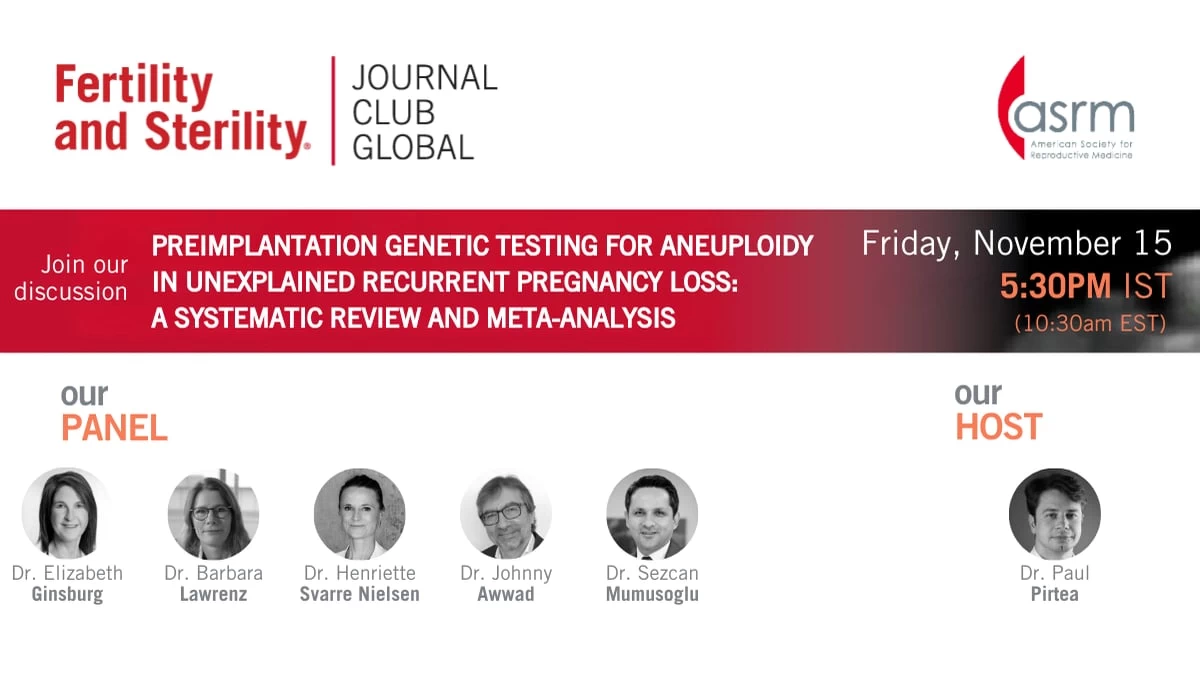
Journal Global Club From TSRM 2024: Preimplantation genetic testing for aneuploidy in unexplained recurrent pregnancy loss: A systematic review and meta-analysis
Explore the effectiveness of PGT-A in managing unexplained recurrent pregnancy loss, featuring systematic review findings, insights on miscarriage risks, and live birth rates.
Journal Club Global from MEFS 2024
Explore BMI's impact on IVF outcomes in a global fertility discussion, analyzing studies, obesity trends, and regional variations in reproductive health care.

Journal Club Global from ASRM 2024: Obesity and Reproduction
Join experts from Fertility and Sterility Journal Club as they explore the impact of obesity on reproduction, weight loss interventions, and emerging treatments in fertility.
Journal Club Global en Español: De la Reunión de la SAMER 2024
Onsite de la Reunión de la Sociedad Argentina de Medicina Reproductiva (SAMER) de Córdoba, Argentina
Journal Club Global: SREI Fellows Retreat - Fellows vs Faculty Debate: Luteal Support in Programmed FET Cycles
Fertility and Sterility Journal Club debate on progesterone administration in frozen embryo transfers, featuring faculty vs fellows discussing IM vs vaginal routes.
Journal Club Global from ANZSREI 2024: Debate Unexplained infertility; Straight to IVF?
ANZSREI 2024 debate: Should unexplained infertility go straight to IVF? Experts discuss pros, cons, and alternative treatments. No clear consensus reached.
Journal Club Global: Falha de implantação: realidade ou ilusão estatística?
Fertility and Sterility Global Journal Club from Brazil
Journal Club Global en Espanol: Actualizacion sobre el síndrome de ovario poliquístico
Fertility & Sterility se enorgullece de traer un Journal Club Global en Español en vivo desde Cancún, Mexico
Journal Club Global: Oral Progestin For Ovulation Suppression During IVF
Live broadcast from the 2024 Midwest Reproductive Symposium
International in Chicago, IL
Journal Club Global: Recent clinical trials in Fertility and Sterility from the Asia Pacific region
Join ASPIRE 2024 for a Journal Club Global on PGT-A and IVF. Learn from top experts discussing recent clinical trial data and pregnancy outcomes
Journal Club Global en Español: Avances recientes en el tratamiento del síndrome de ovario poliquístico e Infertilidad
Un panel de expertos discutirá dos artículos recientes de Fertility and Sterility que estudian la infertilidad y el síndrome de ovario poliquístico.
Journal Club Global: Cost effectiveness analyses of PGT-A
Infertility treatments can be financially burdensome, often without insurance coverage, making understanding the cost effectiveness of PGT-A crucial.
Journal Club Global: The future of REI Fellowship training: debating opportunities and threats
This exciting collaboration discusses the controversy and future directions for the field of Reproductive Endocrinology and Infertility medicine.
Journal Club Global: Infertility and Subclinical Hypothyroidism
The impact of treating SCH on fertility, obstetric outcomes, and offspring neurocognitive development is debated in the literature.
Journal Club Global: Actualidad En Tratamientos De Fertilidad Para Pacientes Con Endometriosis
Live in Spanish from the 2024 Peruvian Fertility Society Meeting - Lima, Peru
Journal Club Global - Recurrent implantation failure: Reality or statistical mirage?
This exciting new collaboration brings authors and experts to discuss the controversy and future directions for recurrent implantation failure.
Journal Club Global - Evidence based guidelines for (PMOS) PCOS
This virtual event discusses the international guidelines for the assessment and management of PMOS (formerly PCOS), conducted by the International PCOS Network.
Journal Club Global - Recurrent implantation failure: Reality or statistical mirage?
This exciting new collaboration brings authors and experts to discuss the controversy and future directions for recurrent implantation failure.
Journal Club Global - The Association of Ovarian Reserve and Embryo Aneuploidy
Recent research suggests that the Antimullerian hormone (AMH) may not reliably predict embryo health in both infertility and non-infertility cases.
Journal Club Global - Actualización en la suplementación con progesterona en fase lútea para transferencias de embriones congelados
Efectividad del rescate de progesterona en mujeres que presentan niveles bajos de progesterona circulante alrededor del día de la transferencia de embriones
Journal Club Global - Revisiting the STAR trial: The Fellows debate PGT-A
We are excited to host a debate covering the pros and cons of PGT-A and how new technologies should be validated before clinical implementation.
Journal Club Global: Absolute uterine infertility a Cornelian dilemma: uterine transplantation or surrogacy?
Absolute uterine infertility presents as a Cornelian dilemma for patients and providers.
Journal Club Global: Transferencia de embriones frescos versus congelados: ¿Cuál es la mejor opción
Los resultados de nuevas técnicas de investigación clínica que utilizan información de bancos nacionales de vigilancia médica.
Journal Club Global: IVM in Clinical Practice: An Idea Whose Time Has Come?
In vitro maturation (IVM) has the potential to make IVF cheaper, safer, and more widely accessible to patients with infertility.
Journal Club Global - What is the optimal number of oocytes to reach a live-birth following IVF?
The optimal number of oocytes necessary to expect a live birth following in vitro fertilization remains unclear.
Journal Club Global: Surgical management of endometriosis in women diagnosed with infertility (Spanish language)
Journal Club Global: Natural versus Programmed FET Cycles
Journal Club Global: Moving leiomyoma research from bench to bedside
Journal Club Global: Does diminished ovarian reserve impact embryo aneuploidy or live birth rates?
Journal Club Global: Is PGT-P cutting edge or should we cut it out?
PGT for polygenic risk scoring (PGT-P) is a novel screening strategy of embryos for polygenic conditions and traits.
Journal Club Global: Should everyone freeze oocytes by age 33?
Oocyte cryopreservation is one of the fastest growing areas of reproductive medicine.
Journal Club Global: Management of poor ovarian response
A poor ovarian response to what should otherwise be a successful stimulation cycle presents a clinical conundrum for clinicians.
Journal Club Global: Non-invasive Diagnosis of Endometriosis
One of the most exciting developments in the field of endometriosis is the push towards earlier and less invasive approaches to diagnosis.
Journal Club Global: Prognosis in unexplained RPL
Recurrent pregnancy loss is one of the bigger challenges in the field of reproductive medicine.
Journal Club Global: Evidence for Immunologic Therapies in Women Undergoing ART
Reproductive immunology is perhaps one of the most controversial and promising fields within ART.
Journal Club Global Live from PCRS - Non-Invasive Embryo Selection Techniques
The next great frontier in reproductive medicine is how to non-invasively select an embryo with the highest reproductive potential for transfer.
Journal Club Global Live from PCRS - ICSI for Non-Male Factor Infertility
While intracytoplasmic sperm injection (ICSI) has revolutionized the treatment of male factor infertility, a significant controversy still remains regarding its ubiquitous use in all IVF cycles.
Journal Club Global - To Operate Or Not To Operate: Debating Intramural Fibroids And Fertility
The event will debate the upcoming F&S Fertile Battle “Intramural myomas more than 3 to 4 cm should be surgically removed before IVF”.
Journal Club Global - PGT-A - Can non-invasive approaches based on spent medium analysis
PGT-A by trophectoderm biopsy aims to select available euploid embryos for transfer.
Journal Club Global - Obesity & Reproduction: An Update on Management and Counseling
Obesity can negatively impact reproduction in various ways, including ovulatory and menstrual function, natural fertility and fecundity rates, infertility treatment success rates, infertility treatment safety, and obstetric outcomes
Journal Club Global - Does the Endometrium Play a Major Role in Endometriosis-Associated Infertility
This will be a virtual event in the style of the "Fertile Battle" debate that took place at the 2019 SREI Fellows Symposium
Journal Club Global - Best Practices of High Performing ART Clinics
This Fertility and Sterility Journal Club Global discusses February’s seminal article, “Common practices among consistently high-performing in vitro fertilization programs in the United States: a 10 year update.”
Journal Club Global - Should Fellows Perform Live Embryo Transfers in Fellowship?
Few things are more taboo in reproductive medicine fellowship training than allowing fellows to perform live embryo transfers.
Journal Club Global - Fertilization rate as a novel indicator in ART results
This Journal Club Global discusses a provocative article recently published in Fertility and Sterility, discussing the results of a multicenter retrospective cohort study with the objective to appraise the fertilization rate as a predictive factor for cumulative live birth rate (CLBR).
Journal Club Global Live from ASRM - Optimal Management of the Frozen Embryo Transfer Cycle: Insights From Recent Literature
Three recent papers published in the Fertility and Sterility family of journals, all explore different aspects of optimizing frozen embryo transfer cycles.
Journal Club Global - Are We Approaching Automation in ART?
Some ART diagnostic devices are already available and offer objective tools of evaluation.
Journal Club Global Live from India - Adjuvants in IVF and IVF Add-Ons for the Endometrium
Many adjuvants have been utilized by IVF centers to improve their success rates.
Journal Club Global - Accuracy of Preimplantation Genetic Testing for Aneuploidies
Club Global Académico - ¿Cual debe de ser la primera línea de tratamiento en parejas con infertilidad inexplicable?
Nuestro debate se enfocará en el manejo óptimo de la infertilidad inexplicable, y como el problema debe de ser abordado en Latinoamérica basado en la literatura global reciente.
Journal Club Global - Recurrent Implantation Failures in ART: Myth or Reality?
Fertility and Sterility
F&S Reports
F&S Reports is an open-access journal that publishes peer-reviewed original scientific articles in clinical and translational research that have strong potential to transform clinical practice.
F&S Reviews
F&S Reviews publishes both systematic and comprehensive, authoritative review articles spanning reproductive medicine or science.
F&S Science
F&S Science publishes peer-reviewed original scientific articles in basic, laboratory, and translational research that has strong potential to transform clinical practice.

Fertility and Sterility
Fertility and Sterility® is an international journal for health professionals who treat and investigate problems of infertility and human reproductive disorders.

Journal Club Global
Fertility and Sterility Journal Club Global is an interactive online discussion of a hot topic or seminal article from Fertility and Sterility.
Topic Resources
Policy Update from the ASRM Office of Public Affairs: SART Membership Now Mandatory in Tennessee
ASRM-backed Tennessee law makes SART membership mandatory for ART clinic certification, strengthening fertility care standards and oversight. View the Policy Update on Tennessee lawFertility and Sterility On Air - TOC: May 2026
Fertility and Sterility On Air explores embryo mosaicism, PGT-P ethics, IVF protocols, and ASRM research integrity updates. Listen to the EpisodeFertility and Sterility On Air - TOC: March 2026
Explore the March 2026 Fertility and Sterility On Air episode covering exercise during FET cycles, metabolic health, IVF triggers, PGT insights, and ectopic pregnancy research. Listen to the EpisodeUse of preimplantation genetic testing for polygenic disorders (PGT-P): an Ethics Committee opinion (2026)
This document discusses the ethical implications as well as the current limits and potential benefits of the use of preimplantation genetic testing for polygenic disorders. View the Committee OpinionASRM Ethics and Practice Committees Release New Report Concluding Polygenic Embryo Screening Is Not Ready for Clinical Use
New analysis finds that PGT-P lacks proven clinical utility and raises significant scientific and ethical concerns. View the Press ReleaseFertility and Sterility On Air: Live from the 2025 ASRM Scientific Congress & Expo (Part 3)
Explore IVF lab automation, MRI-guided egg retrieval, sperm epigenetics, RhoGAM in early pregnancy, and at-home semen testing in this ASRM 2025 recap. Listen to the EpisodeFertility and Sterility On Air: Live from the 2025 ASRM Scientific Congress & Expo (Part 1)
Live from ASRM 2025: genetics in REI, embryo cost studies, ketorolac trial, AI embryo ranking, and F&S journal updates with top experts. Listen to the EpisodeJournal Club Global LIVE at ANZSREI 2025
ANZSREI panel reviews a PGT-A study on male age and sperm factors in blastulation and euploidy, finding female age dominates and calling for better research. View the VideoJournal Club Global en Español: AMMR 2025
Experts discuss chaotic embryo classification, PGT-A rebiopsy outcomes, embryo quality, biopsy techniques, and transfer protocols for mosaic embryos. View the VideoJournal Club Global LIVE at MRSi 2025: Sibling Oocyte Studies in ART
Experts discuss sibling oocyte trials, PIEZO-ICSI, and microfluidics in ART, evaluating outcomes, design limits, lab impact, and clinical implications. View the VideoUnlocking the Future of IVF: Navigating the Complex World of IVF Genomics
Explore the rise of IVF genomics, from PGT-A to WGS and polygenic risk scores, with insights on ethics, costs, and future implications for embryo screening. Read the Blog postTransfer of embryos affected by monogenic conditions: an Ethics Committee Opinion (2025)
Patient requests to transfer embryos with serious monogenic disorders detected in preimplantation testing are rare; this opinion discusses physician responses. View the Committee OpinionJournal Club Global: Embriões mosaicos ao Teste Genético Pré-Implantacional para Aneuploidia (PGT-A): o que fazer?
Discutiremos embriões mosaicos ao teste genético pré-implantacional para aneuploidia (PGT-A) View the VideoJournal Global Club From TSRM 2024: Preimplantation genetic testing for aneuploidy in unexplained recurrent pregnancy loss: A systematic review and meta-analysis
Explore the effectiveness of PGT-A in managing unexplained recurrent pregnancy loss, featuring systematic review findings, insights on miscarriage risks, and live birth rates. View the VideoGenetics: Counseling Fertility Couples About Their Evaluation
Caitlin Hebert discusses fertility counseling, the importance of carrier screening, and overcoming barriers for patients while highlighting the role of genetic counseling. View the ASRMed Talk VideoUse of preimplantation genetic testing for monogenic adult-onset conditions: an Ethics Committee opinion (2024)
Preimplantation genetic testing for adult-onset monogenic diseases is ethically allowed when fully penetrant or conferring disease predisposition. View the Committee OpinionCodes for Embryo Biopsy
When doing a preimplantation genetic test (PGT) biopsy, can you bill for each day a biopsy is performed or can you only bill once for the cycle? View the AnswerThe use of preimplantation genetic testing for aneuploidy: a committee opinion (2024)
PGT-A use in the U.S. is rising, but its value as a routine IVF screening test is unclear, with mixed results from various studies. View the Committee OpinionJournal Club Global: Recent clinical trials in Fertility and Sterility from the Asia Pacific region
Join ASPIRE 2024 for a Journal Club Global on PGT-A and IVF. Learn from top experts discussing recent clinical trial data and pregnancy outcomes View the VideoCoding for an endometrial biopsy/Mock cycle
We had patients request us to bill their insurance for the two monitoring visits and the Endo BX and change the diagnosis code to something that is payable. View the AnswerJournal Club Global: Cost effectiveness analyses of PGT-A
Infertility treatments can be financially burdensome, often without insurance coverage, making understanding the cost effectiveness of PGT-A crucial. View the VideoCoding PGT requisitions to the PGT lab
Do you have any recommended codes to use for PGT requisitions to the PGT lab? View the AnswerGenetics: Is Expanded Carrier Screening the Standard of Care?
Hannah Green, a genetic counselor at NYU, discusses the benefits and limitations of expanded carrier screening, highlighting its impact on clinical practice and patient care. View the ASRMed Talk VideoGenetics - Extra Testing, Passthrough or Money Maker?
Danielle Soltesz of RMA New York discusses the complex economics and ethical considerations of genetic testing in reproductive medicine, exploring costs, patient care, and sustainability. View the ASRMed Talk VideoClinical management of mosaic results from preimplantation genetic testing for aneuploidy of blastocysts: a committee opinion (2023)
This document incorporates studies about mosaic embryo transfer and provides evidence-based considerations for embryos with mosaic results on PGT-A. View the Committee OpinionJournal Club Global - Revisiting the STAR trial: The Fellows debate PGT-A
We are excited to host a debate covering the pros and cons of PGT-A and how new technologies should be validated before clinical implementation. View the VideoResults Review
What CPT code is most appropriate to submit for Physician Time to review CCS/PGS/PGD results? View the AnswerSperm DNA Fragmentation
Is there a CPT code for HALO DNA Fragmentation for sperm? View the AnswerICSI and Embryo Biopsy
How to bill for ICSI or embryo biopsies that occur in different days? View the AnswerEmbryo Biopsy
Have any new codes been introduced for the lab portion of PGT? View the AnswerEmbryo Biopsy Embryologist Travel Costs
Can we bill insurance for the biopsy procedure? Can we bill for travel expenses? View the AnswerEmbryo Biopsy PGS Testing
What codes are appropriate for PGS testing? View the AnswerGenetic Counseling
Does ASRM have any guidance for how to bill for genetic counseling services provided by a genetic counselor?View the Answer