Articles to be discussed:
- Antimüllerian hormone to determine polycystic ovarian morphology
- The effect of improved metabolic syndrome parameters on live birth
Fertility and Sterility Moderator
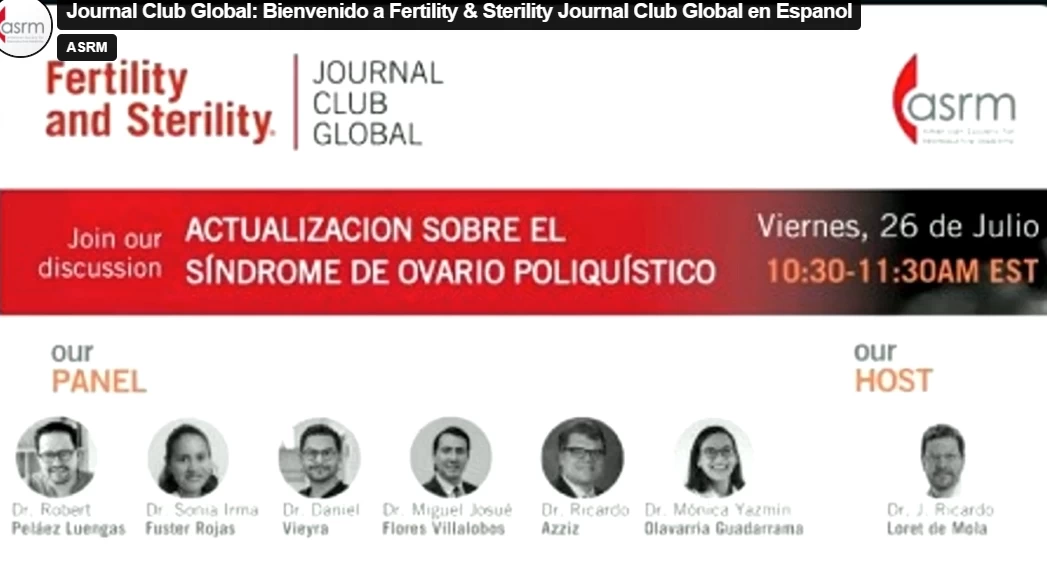
J. Ricardo Loret de Mola MD, FACOG, FACS, Professor and Chairman, Department of Obstetrics and Gynecology, Gynecologist-in-Chief and Medical Director for Women's Services HSHS St. Johns Hospital
Panelists:
Sonia Irma Fuster Rojas MD
Yazmín Olavarria Guadarrama, MD
Daniel Vieyra Cortés, MD
Miguel Josué Flores Villalobos, MD
Robert Peláez Luengas, MD
and
Dr. Ricardo Azziz, Research Professor, School of Public Health, Department of Health Policy, Management and Behavior, State University of New York at Albany
Transcripts
NOTE: This video discusses Polycystic Ovary Syndrome (PCOS) which has recently been renamed Polyendocrine Metabolic Ovarian Syndrome (PMOS).
Click here to learn more about the PCOS to PMOS name change
Good morning, everyone. From the United States, Latin America, and around the world, this is our Fertility and Sterility Journal Club Global in Spanish.
Welcome to our Journal Club in Spanish from Cancún, Mexico, during the meeting of the Mexican Association of Reproductive Medicine. It is a pleasure to have all of you with us.
Today we have an interesting discussion of two articles on polycystic ovary syndrome, and we are fortunate to have an excellent panel of presenters and discussants.
The two articles are:
- Anti-Müllerian hormone for determining polycystic ovarian morphology.
- The effect of improving metabolic syndrome parameters on live birth outcomes.
We are delighted to have a talented and relatively young team of discussants.
We have Dr. Ricardo Azziz with us, who needs little introduction. Dr. Azziz has contributed greatly to many of our current concepts regarding polycystic ovary syndrome.
We also have Dr. Robert Peláez-Luengas, Director of the Human Reproduction Center Ciclo Fértil by Uniliv in Oaxaca de Juárez, Mexico.
Dr. Daniel Vieira Cortés, Adjunct Professor in the Human Reproductive Biology Specialty Program at Hospital Ángeles del Pedregal in Mexico City.
Dr. Sonia Irma Fuster-Rojas, Medical Director of FIVVER in Veracruz.
Dr. Mónica Yasmín Olavarría Guadarrama, board member of the Mexican Association of Reproductive Medicine, Clinical Research Coordinator at Centro de Fertilidad México, and co-founder of Centro de Fertilidad Milquín.
Dr. Miguel Josué Flores Villalobos, Medical Director of the Center for Human Reproduction and Gynecology in Tuxtla Gutiérrez, Chiapas.
And I am your host, Ricardo Loret de Mola.
Today we will discuss several aspects of polycystic ovary syndrome that we hope will be of interest to all of you. These are some of the objectives of our session.
Let's begin with the first article.
Thank you all for joining us.
The first article examines the effect of metabolic treatment on live birth outcomes.
The authors are Dr. Spitzer, Dr. Michael Diamond, Robert Wild, Dr. Richard Legro, Dr. Jeppesen Sang, Fahmin Sun, Yin Sheng Lin, and Dr. Nanette Santoro.
This publication is actually a letter to the editor and represents a sub-analysis of a much larger study called FIT-PLESE.
The primary hypothesis of this sub-analysis was to investigate whether improving metabolic parameters increases live birth rates in obese women with unexplained infertility.
We already understand the connection between obesity, metabolic syndrome, and reproductive outcomes. The purpose was to determine whether improving metabolic health could positively affect unexplained infertility.
This was a multicenter study.
Initially, 2,105 patients were screened. Of these, only 586 consented to participate, and only 379 patients were ultimately randomized.
The image shown corresponds to the FIT-PLESE study.
Participants had to meet the following inclusion criteria:
Age 18 to 40 years.
Body mass index greater than 30.
More than one year of infertility.
Normal uterine and tubal anatomy.
Regular ovulation or at least nine menstrual cycles per year.
Normal ovarian reserve.
A male partner with at least 5 million motile sperm.
Participants were randomized into two groups.
The first group was called the Standard Lifestyle group. These participants received only lifestyle recommendations. They were instructed to increase their daily activity by 500 additional steps per day until reaching 10,000 steps daily and then maintain that level.
The second group was called the Intensive Lifestyle group. The goal was a daily intake of 1,200 kilocalories. Of those calories, 1,100 came from the structured diet and 100 were discretionary calories. Participants also received nutritional meal supplements, Orlistat, and the same exercise program as the standard group, increasing activity by 500 steps per day until reaching 10,000 daily steps.
A total of 191 women were assigned to the Standard Lifestyle group and 188 women to the Intensive Lifestyle group.
The intervention lasted three months.
Participants did not use contraception during this period.
Women who became pregnant during the intervention were included in the pregnancy outcomes analysis.
Women who did not conceive after three months underwent intrauterine insemination in an effort to improve pregnancy rates.
At the end of the study, there were 59 pregnancies in the Standard Lifestyle group and 63 pregnancies in the Intensive Lifestyle group.
However, the primary outcome was a healthy live birth, defined as a live-born infant without complications.
The results showed 29 healthy live births in the Standard Lifestyle group compared with 23 in the Intensive Lifestyle group.
Because of these findings, the investigators conducted a sub-analysis to determine whether improvements in metabolic syndrome parameters were associated with better live birth outcomes.
For this sub-analysis, researchers developed a Z-score incorporating waist circumference, glucose levels, triglycerides, and blood pressure. This score was used to classify the severity of metabolic syndrome.
Among participants, 94% were non-Hispanic, while only 2–3% were Hispanic.
Body mass index was similar between groups, approximately 33 versus 34.
Women with metabolic syndrome demonstrated the expected metabolic differences. Glucose levels were slightly higher, triglyceride levels were nearly double, blood pressure was approximately 10 points higher, and HDL cholesterol was lower.
This allowed the investigators to compare women with metabolic syndrome to those without metabolic syndrome.
Among women whose metabolic parameters improved, the live birth rate was 33.3%.
Among women whose metabolic parameters did not improve, the live birth rate was 19.9%.
However, this difference was not statistically significant.
When analyzed using the metabolic syndrome Z-score, women who improved their score had a live birth rate of 17.2%, while women who did not improve had a live birth rate of 20.8%.
When weight loss was evaluated, women who lost weight had a live birth rate of 20%, while women who did not lose weight had a live birth rate of 26%.
Again, none of these differences reached statistical significance.
A more detailed analysis showed that women in the Intensive Lifestyle group lost nearly six kilograms, while those in the Standard Lifestyle group lost between 0.3 and 3.2 kilograms.
Regarding metabolic syndrome, 52% of women in the Intensive Lifestyle group improved their metabolic syndrome status, compared with 53% in the Standard Lifestyle group.
A notable reduction in triglycerides was observed in the Intensive Lifestyle group.
Other metabolic changes included reductions in leptin levels in the Intensive group, increases in hemoglobin A1c in the Standard group, and changes in inflammatory markers such as C-reactive protein.
In other words, measurable metabolic improvements did occur.
The presenters also performed a quick analysis and calculated a number needed to treat of 34 women.
That concludes the presentation of the first article.
Thank you, Doctor. We can now begin the discussion of the article.
Hello, how are you? First of all, I apologize for my voice. Here in Mexico they would say I’ve been drinking cold beverages. That’s not the case, but I do apologize.
I think this is a very interesting article. It comes from a group that is clearly considered a leader in the field of polycystic ovary syndrome. When you first read the title and the objective, you naturally think, “Of course this makes sense.” If patients lose weight and improve their metabolic parameters, we should be able to achieve better reproductive outcomes.
Historically, since the 1990s, a small study by Kiddy demonstrated that when women lost more than 5% of their body weight, improvements were seen in menstrual cycle patterns and therefore ovulation, and there was also an increased probability of pregnancy.
Since then, we have always told our patients that they should lose weight before beginning fertility treatment.
However, when evaluating this study, we need to consider some important limitations. First, this is a sub-analysis of a primary study conducted by Dr. Richard Legro. When we analyze the original study, we see that the investigators did not find the results they were expecting. They believed that an intensive intervention consisting of Orlistat plus a structured diet would result in improved live birth outcomes, but that was not actually observed.
What they did find was that women who received the intervention showed improvements in metabolic syndrome parameters. This led them to conduct the sub-analysis to determine whether those improvements translated into better live birth outcomes.
As an intervention study, it was prospective, multicenter, controlled, and cohort-based, which certainly deserves recognition. However, the final sample size was only 379 patients. For a multicenter study, that seems relatively small.
Another thing that caught my attention is that Mónica presented three different analyses: women who lost weight, women evaluated using the severity index or Z-score, and women who improved metabolic parameters. Personally, I think it would have been better to focus on one comparison, perhaps comparing women who lost weight versus those who improved the severity index, rather than splitting the analysis into multiple groups.
Given the statistical power of the Z-score, I would probably have preferred focusing only on that measure.
Robert, you have already covered most of the article, but I also find it very interesting and promising. In our daily clinical practice, we all recommend a healthy lifestyle, weight loss, and optimization of metabolic parameters before pregnancy.
It is important not to misinterpret the fact that the results were not statistically significant. Otherwise, some clinicians might incorrectly conclude that improving metabolic health has no impact. The article discusses intrauterine insemination, and I worry that some readers might mistakenly believe they can proceed directly to fertility treatment without first helping patients improve weight and metabolic health simply because statistical significance was not achieved.
That is not the message I would want people to take away from this study.
Yes, and something very important is the patient population they studied. It almost sounds as though we should tell our patients to follow the less intensive lifestyle because they had more live births. That obviously raises questions.
We need to look carefully at the population they selected. These were patients with unexplained infertility. We do not know whether metabolic syndrome was actually the cause of their infertility. They may have had immunologic factors or other causes of infertility that were not identified.
One of the most important things to remember is that these women had obesity and unexplained infertility. The investigators were attempting to determine whether obesity-related factors, such as changes in adiponectin and leptin, might contribute to infertility.
Because this population consisted of women with unexplained infertility, we cannot generalize these results to all patient populations.
These women were ovulating regularly and having regular menstrual cycles.
Another important consideration is the very strict diet. They were limited to 1,200 kilocalories per day. This population is different from our Mexican population. We generally do not prescribe diets that restrictive.
If we impose such severe calorie restrictions, what metabolic consequences might occur? Could we potentially create nutritional deficiencies?
Another important point is that these patients were non-Hispanic. Therefore, we cannot simply apply these results directly to Mexico.
So what do we tell our patients? Do we tell them not to lose weight? That becomes the central discussion. We also have to consider what happens during pregnancy, because the article does not address pregnancy complications.
I don’t know if anyone else would like to comment.
Yes, absolutely. We certainly cannot tell patients not to lose weight. With what we know today about nutrigenomics, as Mónica mentioned, we need to individualize nutritional plans.
The question is whether we should leave with the conclusion that weight loss is unnecessary, or whether we should recognize that the methodology may have limitations despite the high quality of the investigators involved.
Perhaps a more personalized nutritional approach would yield different results. What one patient needs is not necessarily what another patient needs.
We have to understand the study appropriately. Trying to conclude from this article whether we should or should not recommend weight loss is a little like conducting a randomized trial on parachutes. Imagine throwing people out of an airplane, some with parachutes and some without, to determine whether parachutes are beneficial.
Clearly, improving lifestyle, nutrition, and body weight benefits patients.
This study is a sub-analysis of a sub-analysis of another study. Since I conduct many secondary analyses myself, I understand the limitations.
This study was not actually designed to determine whether improving nutrition improves fertility outcomes. The patients started with unexplained infertility. Their infertility was unexplained because no specific cause had been identified. It was not due to PCOS and not due to obesity.
The unidentified cause of infertility may simply not have been affected by improving metabolic parameters.
Second, the intervention lasted only three months. Metabolic conditions are long-term processes. A short intervention may have been insufficient to create meaningful reproductive changes. It may even have temporarily worsened patients’ metabolic state.
When people begin dieting, exercising, and taking medications, they often do not feel better immediately.
Therefore, this study does not truly test whether improving metabolic syndrome improves fertility. It has nothing to do with PCOS and does not directly evaluate obesity-related infertility.
That is why it was published as a letter to Fertility and Sterility rather than as a major original research article.
Whenever we read studies, we need to understand the original purpose and design. Researchers often publish analyses that explore questions beyond the original hypothesis.
I agree completely. It is far too early to conclude that improving metabolic parameters has no impact on achieving a healthy live birth.
These patients already had infertility, and the journey from infertility to a healthy newborn is often long and complicated.
The study does not address obstetric outcomes, but we all know that women who enter pregnancy with metabolic abnormalities are at much higher risk for adverse pregnancy outcomes.
Therefore, I would not accept the conclusion that metabolic improvement does not matter.
This type of analysis helps us think about the many factors involved between infertility treatment and the birth of a healthy child.
We should also remember that the results cannot necessarily be extrapolated to other scenarios. This study looked at a very specific patient population.
How would these findings apply to IVF? How would they apply to six months of intervention rather than three? We cannot answer those questions.
Certainly.
The study only examined women who underwent ovarian stimulation followed by intrauterine insemination. It did not evaluate women who conceived naturally, nor did it address more advanced fertility treatments.
However, given the global prevalence of overweight, obesity, and metabolic syndrome, we absolutely should continue encouraging patients to improve these parameters before pregnancy.
The reality, though, is that many of our Mexican patients arrive overweight or obese. We tell them they need to lose weight before treatment, but they return six months later having lost little weight or sometimes having gained more.
If we simply tell patients to lose weight without offering structured intervention, many come back in worse condition.
One thing I found appealing about this article is that when I first read it, I thought it seemed to contradict everything we have always taught—that patients should lose weight and improve their metabolic health.
That contradiction forces us to think critically about what we are reading, how it applies to our clinical practice, and how we should counsel patients.
Personally, I wonder whether stress may have played a role. We often joke that if a patient takes a vacation and relaxes, she will become pregnant.
These women were under significant stress from strict dieting, caloric restriction, and Orlistat treatment.
And if you remember, nearly 80 patients were never randomized. What happened to them? Did they become pregnant? Did they not? We do not know.
Let me remind everyone that every study begins with a hypothesis. Most of the time, the hypothesis is not confirmed.
In fact, if every hypothesis you test turns out to be correct, there is probably something wrong with your scientific process.
Statistically speaking, most studies should produce negative findings or generate new hypotheses rather than confirming the original one.
There is nothing unusual about this study failing to prove its hypothesis. The study was not designed to answer the question people are trying to apply it to.
A classic example is the Women’s Health Initiative study, which originally evaluated hormone therapy in postmenopausal women who did not have vasomotor symptoms. Later, people used the findings to draw much broader conclusions than the study was intended to support.
The same thing is happening here.
This study was designed for one purpose, but people may be tempted to interpret it for another.
The important message is that this study does not justify changing what we normally do with our patients.
Thank you very much.
Are there any additional comments on this study? If not, we can move on to the next article.
Well, let's move on to the next article.
Good morning, everyone. It is a pleasure to be here and to share the stage with all of you.
We are going to break down this article, which is very interesting and gives us plenty to discuss.
The article was also published in Fertility and Sterility in October 2021 and was authored by Dr. Alexandra Diez and colleagues.
Briefly, this was a retrospective, multicenter, case-control study conducted between 2018 and 2019 in two Roche centers located in Germany and Switzerland, as well as at Erasmus University Hospital, a center known worldwide for its highly regarded research publications.
The objective of the study was to validate a cutoff value for anti-Müllerian hormone (AMH) to identify polycystic ovarian morphology.
The study included cases and controls between 25 and 45 years of age.
AMH was measured using Roche's Elecsys assay.
All four phenotypes of polycystic ovary syndrome were initially included, resulting in a database of 939 patients that were ultimately used in the analysis we will discuss later.
Patients were excluded if they had androgen-producing tumors, had used hormonal contraception within the previous three months, or were pregnant.
The control group consisted of healthy women provided through Roche's database. These women were between 25 and 45 years old, had a body mass index up to 40, had no history of in vitro fertilization, had regular menstrual cycles between 25 and 35 days, and had an antral follicle count of fewer than 20 follicles per ovary.
We can see the patient inclusion algorithm here.
Initially, there were 4,334 patients from both the university hospital and the Roche database. Of these, 931 were excluded, leaving 3,189 participants.
It is important to pay attention to these numbers because they become relevant later in the discussion.
At this stage, the patients were separated according to the four PCOS phenotypes.
For the subsequent analysis, however, the investigators focused only on Phenotype A.
As the selection process continued, additional patients were excluded, resulting in a smaller final sample.
For the next stage of analysis, there were 2,014 participants, including 939 cases of Phenotype A PCOS.
These were then divided into two groups:
A development cohort.
A validation cohort.
Again, only Phenotype A patients were retained for these analyses.
Among the controls, 1,075 women remained. Previously there had been 1,549.
The other PCOS phenotypes were no longer included in the subsequent analyses.
The investigators then compared the characteristics of the patients in the development and validation cohorts.
They examined standard demographic and clinical characteristics.
The average age was significantly lower in the PCOS cases than in the controls.
Body mass index was also significantly different, although this was expected given the inclusion criteria.
AMH levels were significantly different as well.
AMH measurements were obtained between cycle days 2 and 4 using the Roche Cobas/Elecsys platform.
Additional measurements were performed, although they are not especially relevant to the primary findings.
Ultimately, the investigators identified an AMH cutoff value of 3.29 ng/mL, with what they considered acceptable sensitivity and specificity.
Once they established this cutoff, they compared it with various measures, including antral follicle count.
They found strong correlations in both the development and validation groups, with correlation coefficients greater than 0.8.
When comparing the different PCOS phenotypes, they observed that Phenotype A demonstrated the strongest association.
This is why they ultimately limited the main analysis to Phenotype A.
When the AMH cutoff of approximately 3.2 ng/mL was plotted, most Phenotype A patients had values above that threshold, which further supported the investigators' decision to focus on that phenotype.
The same pattern was observed when evaluating body weight.
Most cases were above the 3.2 cutoff, while most controls were below it.
The receiver operating characteristic (ROC) curves demonstrated excellent performance, with areas under the curve greater than 90%.
When comparing cases and controls in both the development and validation cohorts, the cutoff remained approximately 3.2 ng/mL, and the area under the curve again exceeded 90%.
The investigators also evaluated age.
Using the same 3.2 cutoff, they found that AMH levels declined as age increased.
As expected, younger women tended to have higher AMH levels.
The article included supplementary material in addition to the main publication.
One particularly interesting figure was a histogram demonstrating a very favorable distribution.
Using the 3.2 cutoff, most PCOS cases were above the threshold, while most controls were below it.
This generated a ROC curve with a sensitivity of 85% and a specificity of 86.4%.
The authors concluded that AMH measurement using Roche's Elecsys assay is a robust method for identifying a cutoff value of approximately 3.2 ng/mL for detecting polycystic ovarian morphology.
Very well.
Doctors, what are your thoughts on the article? Any comments?
Personally, I find the objective extremely interesting.
I think everyone here has had the experience of evaluating a patient with polycystic-appearing ovaries and wondering what her AMH level will be.
We have all made that connection mentally.
The idea of establishing a cutoff value that relates polycystic ovarian morphology to AMH levels is certainly appealing.
There will be plenty to discuss regarding limitations and potential biases, but as an objective, it is undoubtedly attractive.
One point mentioned early in the article involves healthcare systems where access to transvaginal ultrasound is limited.
Fortunately, in Mexico that is generally not a major problem.
Most gynecologists and fertility clinics have easy access to transvaginal ultrasound and can perform antral follicle counts routinely.
The article notes that in some countries patients must navigate many barriers before obtaining a transvaginal ultrasound.
Although that may be true in some places, it is not the reality for many of us.
Most patients who come to a fertility clinic or gynecologist's office can readily obtain a transvaginal ultrasound.
Even so, the possibility of establishing an AMH cutoff associated with polycystic ovarian morphology remains very interesting and promising.
I agree completely. The idea sounds very attractive—replacing an ultrasound with a simple blood test. Of course that would be appealing.
Looking at the structure of the study, however, we have to remember that this was a retrospective, non-interventional, multicenter study based on an existing database.
If we are going to establish a cutoff value for a diagnostic test, we first need more robust data, larger sample sizes, and analyses across different populations and patient groups.
We know that the most established use of AMH is predicting ovarian response to stimulation. What this article is proposing is something different: using AMH as a tool to diagnose polycystic ovarian morphology in patients suspected of having PCOS.
The question is how this applies to the patients we actually see in clinical practice.
Most of us work in reproductive medicine. A typical patient may be 35 or 37 years old, and when we measure AMH we are often seeing lower values because of age.
The patients for whom this test might be most useful, however, are often adolescents or very young women who have irregular cycles, amenorrhea, or who have been referred by a dermatologist because of acne and concern about possible PCOS.
If you look at the study population, the lower age cutoff was 25 years. Therefore, I think the findings would have been more applicable if younger women had been included.
Of course, one could argue that including women younger than 18 introduces additional considerations, but from a practical standpoint the study may have benefited from a younger population.
Several previous studies have already attempted to establish AMH cutoff values.
For example, Dr. Li Fang in 2017 proposed a cutoff around 5.5, particularly in younger women. Her goal was not to replace ultrasound but to improve the diagnosis of PCOS.
Another similar publication by Dr. Nicolás found a cutoff closer to 3.1.
One limitation of the present study is that it included only European populations. There was no Latin American population represented.
I agree. It is an article that immediately attracts attention because we all want something we can apply in our clinics.
The proposed AMH cutoff of 3.2 is certainly interesting.
However, if we think beyond fertility patients and consider general gynecology patients, I am not sure AMH would be the first laboratory test I would order.
If I suspect PCOS, I am probably going to evaluate glucose levels, insulin levels, vitamin D, androgen levels, and other metabolic parameters as well.
That is why I feel the proposal may be somewhat limited. Evaluating a patient with PCOS involves much more than simply measuring AMH.
I do think the concept is interesting, and while industry sponsorship introduces potential bias, collaboration with industry can also help generate data that we can later validate in our own patient populations.
One thing I find particularly interesting is the assay itself.
I do not know whether all AMH measurements in the United States use the Elecsys platform, but in Mexico I know they do not.
It has been demonstrated that AMH measured with the Elecsys assay tends to have greater specificity, particularly in patients with very low or very high ovarian reserve.
There have been studies suggesting differences among assay platforms, and the article itself references some of those findings.
I do not know whether using a single assay throughout the study should be considered a strength or a limitation.
On one hand, it standardizes the measurements. On the other hand, not every laboratory has access to the same technology.
Let me make a comment.
You have all mentioned that you have access to ultrasound and can easily perform ultrasounds. But imagine a physician practicing in a small rural community in Mexico, perhaps a general practitioner without access to ultrasound.
Could this type of test help direct patients down the right diagnostic pathway and facilitate appropriate referral? Or do you think it has no value in that setting?
No, I do not think so.
The reason is that if someone is practicing in a small rural town, they are unlikely to have access to AMH testing either.
In fact, they are probably more likely to have access to some type of ultrasound service than to AMH testing.
AMH is also much more expensive in Mexico.
A patient can usually go directly to an imaging center and request an ultrasound.
Access to ultrasound is relatively easy here, even if that is not the case everywhere.
Still, I agree that the idea is promising. The possibility of identifying polycystic ovarian morphology through a blood test instead of an ultrasound is appealing.
It may seem routine to us because we perform ultrasounds every day, but having a blood test alternative would certainly be interesting.
What the doctor mentioned is important. The situation may be different in Nicaragua, Colombia, or other countries.
Perhaps a test like this could help identify more patients and allow them to receive appropriate treatment sooner.
I agree, but we also need to think about how AMH is measured.
There are different methodologies. It can be measured using ELISA, immunoassays, and other techniques.
Some methods are less sensitive and less specific than others.
Perhaps if a lower-cost assay were available and produced an elevated result, it could at least alert a general practitioner that the patient should be referred to a specialist.
Remember that the 2023 International PCOS Guidelines now include AMH as a tool for evaluating polycystic ovarian morphology.
However, the guidelines deliberately do not provide a universal cutoff value.
The reason is that every assay has its own cutoff.
AMH is a large protein molecule, and measurement varies substantially depending on the methodology used.
Some assays use different antibodies, different calibration methods, and different analytical approaches.
As a result, specificity and precision vary significantly from one assay to another.
That is why companies conduct studies like this—to determine the cutoff value that applies to their specific assay.
So this cutoff of 3.2 applies only to this company's assay, in this patient population, under these specific circumstances.
It does not automatically apply to your patients or mine.
The second thing to remember is that PCOS is divided into four phenotypes.
Our group originally developed this classification system nearly twenty years ago because it helps define different clinical presentations.
For patients with Phenotype A or B, which together account for roughly half of all PCOS cases, neither ultrasound nor AMH is actually required to establish the diagnosis.
Those patients already meet the diagnostic criteria based on other findings.
Polycystic ovarian morphology—whether determined by ultrasound or AMH—is mainly useful for diagnosing Phenotype C and Phenotype D.
Phenotype C is the ovulatory form of PCOS.
Phenotype D is the non-hyperandrogenic form.
That is where ovarian morphology becomes particularly relevant.
The third point is that there are many regions around the world where access to ultrasound remains difficult.
I conduct epidemiologic studies in many countries, and obtaining reliable ultrasound examinations is often challenging.
In some cultures, transvaginal ultrasound is not readily accepted because of concerns related to virginity and cultural norms.
In some places, the equipment simply does not exist.
I have sent ultrasound machines to Africa for research projects, only to have them damaged immediately because they were connected to incompatible electrical systems.
Access to transvaginal ultrasound is not universal.
It is readily available to reproductive endocrinologists, but not necessarily to general gynecologists, internists, endocrinologists, or primary care physicians.
Many ultrasound reports are also of poor quality. Sometimes the report simply states that there are "many follicles," which is not a useful diagnostic description.
So this study is important, but we must understand what it is actually trying to accomplish.
The investigators are simply attempting to determine an assay-specific AMH threshold for their particular test.
I'd like to make more of a comment about the use of AMH in general rather than about the article itself.
From my perspective, using anti-Müllerian hormone for the diagnosis of polycystic ovary syndrome should be limited to very specific patient populations, such as adolescents. In adolescents, we cannot reliably use ultrasound because we generally need to wait several years after menarche before ovarian morphology becomes diagnostically useful.
No, but actually AMH has the same limitation as ultrasound in adolescents. The reason is that adolescent girls naturally have very high AMH levels and a high follicle count. Therefore, ovarian morphology—whether assessed by ultrasound or AMH—should not be used for diagnosing PCOS during adolescence.
It is simply not a diagnostic characteristic that can be reliably applied in that age group.
Certainly ultrasound is operator-dependent and equipment-dependent. Because of that, having a standardized cutoff value that could be applied consistently across different cities or regions would be very attractive.
Knowing that the same AMH threshold applies regardless of who performs the ultrasound could potentially provide more consistency than relying on follicle counts obtained by different operators using different machines.
And it's important to emphasize what Dr. Azziz mentioned: PCOS is fundamentally a clinical diagnosis. You do not need a laboratory test to diagnose it. You do not need ultrasound alone to diagnose it.
We need to do a better job of communicating that message to general practitioners, family physicians, and other healthcare providers.
Could we potentially develop a conversion factor or coefficient that would allow us to compare one AMH assay with two, three, four, or five others? Could we standardize the results so that values obtained from one company's assay could be interpreted similarly to those from another assay?
Just to remind everyone, I do not want anyone here to go home and start using 3.2 as a universal cutoff.
This 3.2 value applies only to this specific assay, in this specific European population.
It does not apply to your patients.
AMH cutoffs vary according to age. Women older than 35 years will have different expected values than women aged 25 to 35, who in turn will differ from women aged 18 to 25.
First, the cutoff depends on age.
Second, it depends on the assay.
Third, it depends on the population being studied.
So I do not want anyone listening today to leave believing that 3.2 is the definitive cutoff.
The only thing we can say at present is that if AMH is extremely elevated, that is informative and may suggest polycystic ovarian morphology. Beyond that, there is still no universally accepted threshold.
I would like to make one final observation.
While I agree that we cannot leave here using 3.2 as a cutoff, when we carefully reviewed the article we noticed that, in addition to the main paper, there were extensive supplementary materials.
In those supplementary materials, the patient inclusion algorithms raise several questions.
When we tried to follow the numbers, some of them did not add up. The final histogram and the reported sensitivity and specificity look impressive, and the 3.2 cutoff appears attractive. However, there are several stages of the analysis where patient numbers are unclear.
We do not always know where patients were excluded, where they came from, or exactly how the final populations were assembled.
The Roche database itself does not clearly specify the years from which the data were collected.
Additionally, the control patients were significantly older than the PCOS patients.
So once again, we cannot leave here believing that 3.2 is established fact.
The search for an appropriate cutoff remains important, but we are not there yet.
Well, I think they focused on Phenotype A because it is the most classic and recognizable presentation of PCOS.
Using the classic phenotype as a foundation may make sense if the goal is eventually to determine whether similar thresholds apply to the other phenotypes.
What interests me even more is the issue of healthy population data.
Most women who have AMH measured are either fertility patients or women being evaluated for possible PCOS.
We do not have enough data from truly healthy women.
What we really need is a large population study involving thousands of women with no reproductive disorders, normal fertility, and no known pathology.
Only then could we establish meaningful population percentiles and reference ranges.
Perhaps next year.
Very well.
We often become skeptical when a study is funded by a commercial company.
Should this study be treated differently?
As Dr. Azziz pointed out, the company is essentially trying to validate the performance of its own assay and establish a cutoff value.
Should we be suspicious of the results, or does this type of industry-sponsored study still provide meaningful information?
Personally, I think there is a clear conflict of interest because of the company's involvement.
The study feels somewhat directed toward obtaining a cutoff value.
As we have already concluded, we cannot generalize the 3.2 threshold.
Additional populations need to be studied.
That said, it is a useful starting point and may encourage us to conduct similar studies in Mexico using our own populations and our own assays.
Personally, I do not think there is necessarily a major source of bias here.
The investigators are not trying to prove whether the assay works or does not work. They are trying to identify a numerical threshold.
The cutoff might ultimately be slightly higher or lower, but the purpose of the study is not to prove the assay's usefulness; it is to establish a value for that particular immunoassay.
I think we should learn how to work constructively with industry.
We do not tell industry what to do, but we can use their resources and initiatives to generate data that can later be applied and validated in our own patient populations.
I think there is value in proposing this cutoff, especially because previous studies reported higher thresholds and this study lowered the value to around 3.2 while maintaining good sensitivity and specificity.
The important question is understanding where and how such a cutoff should be applied.
Well, thank you all very much for your contributions and comments.
On behalf of Fertility and Sterility and the American Society for Reproductive Medicine, I would like to thank you for your time and for spending the last hour with us.
Unfortunately, we have reached the end of our session.
From Cancún, we send our greetings to everyone listening online.
We hope you will join us again for the next Journal Club Global in Spanish, which will take place in Córdoba, Argentina, in September.
Thank you very much, and we wish you all the best.
NOTA: Este vídeo trata sobre el Síndrome del Ovario Poliquístico (SOP), que recientemente ha sido renombrado como Síndrome Metabólico Poliendocrino del Ovario (SOM).
Haz clic aquí para saber más sobre el cambio de nombre del SOP al PMOS
Good morning, everybody. From the U.S. and Latin America and around the world, this is our Fertility and Sterility Journal Club Global in Spanish. Bienvenidos a nuestro Journal Club en Español desde Cancún, México, durante la reunión de la Asociación Mexicana de Medicina Reproductiva, y es un placer tenerlos a todos con nosotros.
Tenemos una interesante discusión de dos artículos sobre ovario poliquístico, y tenemos el gran gusto de tener a un excelente panel de discutidores y presentadores. Tenemos, por un lado, estos son los dos artículos, hormona antimieleriana para determinar la morfología de ovario poliquístico y el efecto de mejorar los parámetros de síndrome metabólico en asidos vivos. Tenemos el grandísimo gusto de tener a un equipo muy joven de discutidores.
Tenemos al Dr. Ricardo Asís con nosotros, que para muchos no necesita presentación, pero el Dr. Asís es un gran publicador de información y muchos de nuestros conocimientos actuales sobre ovario poliquístico. Tenemos al Dr. Robert Peláez-Luengas, que es el director del Centro de Reproducción Humana Ciclo Fértil by Uniliv de Oaxaca de Juárez, México. El Dr. Daniel Vieira Cortés, que es profesor adjunto al curso de su especialización de biología de la reproducción humana en el Hospital Ángeles de Pedregal en la Ciudad de México.
La Dr. Sonia Irma Fuster-Rojas, que es la directora médica de Fiverr en Veracruz. La Dr. Mónica Yasmín Olavarría Guadarrama, que es la vocal de AMMR y coordinadora de investigación clínica del Centro de Fertilidad México y cofundadora del Centro de Fertilidad Milquín. El Dr. Miguel Josué Flores Villalobos, que es director médico del Centro de Reproducción Humana y Ginecología en Tuxtla Gutiérrez, Chiapas.
Y aquí su servidor, Ricardo Lórez de Mola. Pues muy bien, vamos a hablar más sobre ovario poliquístico y vamos a tocar algunos puntos que espero sean de interés de todos ustedes y estos son algunos de los objetivos de la charla. Vamos a empezar ahora con el primer artículo.
Bueno, pues muchas gracias por acompañarnos. El primer artículo es el efecto del tratamiento metabólico para ver los parámetros en recién nacido vivo. Los autores son el Dr. Spitzer, el Dr. Michael Diamond, Robert Wilde, el Dr. Richard Legro, el Dr. Jepin Sang, Fahmin Sun, Yin Sheng Lin y la Dra.
Nanette Santoro. Entonces, vamos a ver, este artículo en específico es una carta, es una carta al editor y es un… Bueno, este artículo en específico es un subanálisis de un artículo mucho más grande que se llama Feed Please. Entonces, en este subanálisis, la hipótesis principal fue, ¿cuál fue la hipótesis probada? Es investigar si al mejorar los parámetros metabólicos, mejora la tasa de recién nacidos vivos en pacientes obesas con infertilidad inexplicable.
Entonces, nosotros conocemos el vínculo entre obesidad, síndrome metabólico y los resultados reproductivos y la idea era ver si mejorar los parámetros metabólicos podría tener un efecto sobre la infertilidad inexplicable. Este es un estudio multicéntrico. Bueno, pues, este es… Bueno, este es un estudio multicéntrico que ocupó… Se trató de estandarizar a 2.105 pacientes.
De estas, solo 586 dieron su consentimiento y solo 379 pacientes se pudieron randomizar. Esta imagen que les muestro aquí es el estudio de Feed Please. ¿Cuáles eran las características de inclusión que debían de entender? Eran entre 18 y 40 años, un índice de masa corporal mayor de 30, más de un año de infertilidad.
Una de las características que tenían que tener es que fueran de anatomía normal, útero y salpinges, que ovularan de manera regular o al menos que tuvieran más de nueve ciclos al año, que tuvieran una reserva ovárica normal y que la pareja tuviera al menos de 5 millones de espermatozoides móviles. Se estandarizaron en dos grupos, uno que le llamamos Standard Lifestyle, en donde lo único que se hacían eran recomendaciones del estilo de vida y se sugería que aumentaran 500 pasos cada día hasta completar 10.000 pasos y mantenerse en este estándar. Y un grupo que se llamó Intensive Lifestyle, que el intensivo, el objetivo era lograr 1.200 kilocalorías.
De estas 1.100 kilocalorías establecidas, 100 calorías que fueran libres y se les agregaba un nutrimento, un suplemento nutricional para suplementar algunas comidas. Además, se les daba Orlistat y se les daba el mismo estilo, el mismo estilo de vida hacia ejercicio, que eran 500 pasos extras todos los días hasta completar 10.000 pasos. Se estandarizaron de esta manera, 191 en el estilo de vida estándar y 188 en el intensivo.
De estas, durante, fue, el tratamiento duró tres meses, no tenían método anticonceptivo y entonces aquellas pacientes que quedaban embarazadas durante el tratamiento también fueron consideradas dentro de este embarazo y aquellas pacientes que no lograban el embarazo después de tres meses se sometían a inseminaciones intrauterinas para mejorar los resultados. Al final lograron 59 embarazos en el grupo estándar y 63 embarazos en el grupo intensivo. Sin embargo, cuando ellos hablaban de que el resultado primario iba a ser el término good life birth, es decir, pacientes que hubieran tenido un nacimiento recién nacido vivo sin complicaciones, en donde encuentran que las pacientes que tenían recién nacidos vivos en el tratamiento normal eran 29 versus 23 del tratamiento intensivo.
Por eso es que se decide hacer un subanálisis para ver si, cuando tenían la mejora de los parámetros metabólicos, es decir, del síndrome metabólico, podía haber una diferencia en el recién nacido vivo. Entonces, se hace este subanálisis del Fit Please, en donde hacen una puntuación llamada Z-score, en donde van a poner los diferentes trastornos del síndrome metabólico, cintura, glucosa, triglicéridos y presión arterial, dándoles así una clasificación de gravedad a las pacientes con el síndrome metabólico. ¿Qué encontramos dentro de los datos? Una de las características es que el 94% de las pacientes eran no hispanas y 93% del lado del síndrome metabólico hispano, sólo había 2 y 3%.
Otra de las características es que el índice de masa corporal no había diferencias, era 33 versus 34, y en los parámetros metabólicos, aquellos pacientes que tenían síndrome metabólico, que son la columna que se encuentra de este lado, tenían ligeros cambios, 115 versus 117, 89 y 98, o sea, ligero aumento de glucosa, triglicéridos casi duplicaban 94 y 154, presión 10 puntos porcentuales arriba, y el HDL también era de 42 versus 37. Entonces, ya tenemos un grupo que tenía síndrome metabólico y un grupo que no tenía síndrome metabólico. ¿Qué encuentran como resultado primario de su subanálisis? Que el mejorar los parámetros metabólicos, aquellas que habían mejorado los parámetros tenían 33.3% de nacidos vivos versus 19.9, que no lo hicieron, sin embargo, no era estadísticamente significativo.
Cuando lo hicieron con la puntuación Z, aquellas pacientes que habían logrado mejorar la puntuación Z, es decir, disminuir el síndrome metabólico, habían logrado una tasa de 17.2 nacidos vivos versus 20.8, y en comparación de la pérdida de peso, 20% habían logrado un nacido vivo versus 26 de las que no habían bajado de peso. Entonces, parecía que no mejorar los parámetros metabólicos, y de hecho, ninguna de ellas es estadísticamente significativo. En un subanálisis un poquito más detallado, si perdían peso, el grupo intensivo perdió entre casi 6 kilos y el grupo estándar entre .3 y 3.2. En el síndrome metabólico, aquellas pacientes que están en el grupo intensivo disminuyeron el síndrome metabólico en el 52% versus el grupo estándar que lo disminuyó 53.
Triglicéridos, aquí sí hay una notable diferencia en la disminución de los triglicéridos en el grupo intensivo. De este lado, hay un aumento, una disminución de la leptina en el grupo intensivo, un aumento de la hemoglobina glicada en el grupo estándar y un aumento de la leptina en el grupo intensivo. O sea, sí había cambios metabólicos.
También hay una PCR aumentada en el grupo estándar. Entonces, los grupos que presentaban ciertas variaciones en aquellas que habían estado en un tratamiento intensivo. Al final, nosotros nos dimos la tarea de hacer un análisis rápido de cuál era el índice necesario tratar y era de 34 mujeres.
Ese es todo el primer artículo. Muchas gracias, doctora. Ahora podemos iniciar la discusión del artículo, doctor.
Hola, hola, ¿cómo está? Primero que nada, una disculpa por la voz. Aquí en México dirían que me las tome frías. No, no es así, pero una disculpa.
Este artículo creo que es muy interesante. Es un artículo de un grupo, pues evidentemente, líder de opinión en síndrome de ovario poliquístico y que en el momento en el que uno lee el título y lee el objetivo, pues uno se pregunta esto, claro que tiene sentido, el que si mejoran el peso, si mejoran los parámetros metabólicos, podamos nosotros tener mejores resultados. Históricamente, desde 1900, en la década de los 90, en un trabajo pequeño, Kiri demostró que cuando perdían más del 5% de peso, podríamos tener una mejora, primero que nada, en el patrón de los ciclos menstruales y por lo tanto en la ovulación y se encontró que había una mejora en la probabilidad de embarazar.
Desde entonces, siempre les hemos dicho a nuestras pacientes que deben bajar de peso antes de empezar un tratamiento reproductivo. Sin embargo, tenemos que pensar, teniendo en cuenta una crítica de este diseño o del arquetipo de este estudio, primero que nada, que es un subanálisis de un estudio primario, del Dr. Richard Legro, que cuando lo analizamos, observamos que definitivamente no encontraron los resultados que estaban esperando. Realmente ellos pensaban que mejorar mediante un tratamiento intensivo, un medicador, listad más una dieta, un plan alimenticio, iban a tener mejores resultados en recién nacido, y la realidad es que no fue así.
Lo que sí observaron es que encontraron, evidentemente, que en aquellas mujeres que se intervenían, había una mejora en los parámetros, sin duda, del síndrome metabólico, y entonces hicieron este subanálisis para poder ver si a estas pacientes tenían mejores resultados en el recién nacido vivo. Yo creo que para hacer un análisis, primero que nada, de intervención, es prospectivo, es de cohortes, es multicéntrico y además fue controlado, merece la pena que le demos el valor que esto representa, pero el tamaño de la muestra final fue solamente de 379 pacientes. Creo que para ser un multicéntrico es una muestra corta, nos queda corto.
Otra cosa que me llama la atención, sin duda alguna, es que si se dieron cuenta, Mónica presentó tres cosas. Aquellas pacientes que bajaron de peso, aquellas pacientes que se evaluó un índice de severidad, más bien a través del test score, y por otro lado también evaluaron quienes mejoraron los parámetros. Definitivamente yo considero que debieron decantarse solo, por ejemplo, comparar quienes pierden peso versus las que tienen una mejora en el índice o versus parámetros, pero creo que no merecía la pena hacerlo en dos grupos en ese momento.
Hubiese preferido, de acuerdo al poder que da este índice, decantarse solo por el índice, probablemente. Robert, tú acabas de prácticamente hablar sobre todo el artículo y a mí sí me parece bastante interesante y suena muy prometedor y creo que todos en nuestra práctica clínica diaria lo hacemos, recomendarle un estilo de vida adecuado a la paciente, disminuir de peso, encontrarla en los mejores parámetros para prepararla en el embarazo. Merece mucho la pena comentar y también de repente no malinterpretar el hecho de que no haya habido resultados significativos porque de repente nos puede hacer pensar en nuestra práctica clínica que no va a tener un impacto y en el artículo tocan mucho, o bueno vaya, se toca el tema de la inseminación intrauterina.
En mi percepción, de repente pudiera llegar a malinterpretarse el hecho de llevar a una paciente a un tratamiento de reproducción asistida, aunque sea de baja complejidad, sin prepararla en la disminución de estos parámetros, por ejemplo, o en mejorar los parámetros en el tema de disminución de peso, de índice de masa corporal, por el hecho de que no haya habido resultados estadísticamente significativos y eso es de repente lo que yo quisiera que no se sintiera o se malinterpretara en relación al análisis de este artículo. Sí, ahora algo muy importante, me gusta mucho cómo desglosaste la presentación del artículo como tal, pero sí, o sea, nos hace pensar que entonces vamos a recomendarle a nuestras pacientes que sigan el estilo malo para que se embaracen o vamos a sugerirles lo que siempre nos sugieren de bajar de peso, comer bien, dormir bien y pareciera que es lo contrario, ¿no? Pero entonces ahí empieza justo la pregunta, entonces, ¿cómo vamos a, posiblemente, nosotros a llevar a la práctica y desmenuzar un poquito qué población ocuparon, no? O sea, eran pacientes que como tal no sabía si el factor de síndrome metabólico era su factor de infertilidad, ¿no? O sea, no sabía si esa paciente a lo mejor era una posible infertilidad inexplicable o tenía un factor inmunológico, no sé, hay muchas cosas que puedes desmenuzar acerca de ese grupo, ¿no? Creo que de las partes principales que nos tenemos que quedar es que eran pacientes que tenían obesidad pero tenían infertilidad inexplicable, entonces ellos trataban de hacer ver que el factor de obesidad, este factor que pudiera generar más adiponectina, bueno, menos adiponectina, más leptina, era lo que estaba produciendo probablemente como factor inmunológico para la obesidad, o sea, para la infertilidad. Entonces, algo que tenemos que ver es que no podríamos generalizar estos datos en todas las poblaciones porque era una infertilidad inexplicable.
O sea, estas pacientes estaban ovulando mes con mes, o sea, estaban reglando mes con mes. Creo que parte también muy importante es que la dieta muy estricta eran 1,200 kilocalorías, o sea, era una población diferente a la de nosotras, a los mexicanos, pero nosotros no llevamos dietas de 1,200 kilocalorías, eso es algo muy importante. Y la otra parte es que si nosotros restringimos mucho, ¿qué factores metabólicos podríamos estar alterando? ¿Qué desnutrición podríamos estar produciendo en los pacientes que les vamos a bajar estas dotas? Y la otra parte que me gustaría comentarles es el que eran pacientes no hispanas.
Entonces, no podríamos nosotros traducir esta información a México, ¿no? Entonces, ¿que les decimos a las pacientes que no pierdan peso? Bueno, entonces, esa es la discusión, que no pierdan peso, y luego estamos hablando de qué va a pasar con el embarazo, porque aquí no se tocan las complicaciones del embarazo. Entonces, no sé si quieran hacer algún otro comentario, o el doctor Asís, Sonia. Sí, efectivamente, le decimos que no bajen de peso, la realidad es que todavía no podemos decir un no, ¿sí? Y con lo que sabemos hoy en día de la nutrigenómica, como dice Moni, les tenemos que estandarizar a todos el plan nutricional.
O sea, aquí pensar en la conclusión, nos tenemos que ir a casa con un no, o nos tenemos que plantear que a lo mejor la metodología, pese a que la potencia de quien nos escribe estos artículos, bueno, pues es ya, por ende, alta, pero nos tenemos que plantear, y si lo hacemos diferente, personalizar un poco más la nutrición, a lo mejor lo que ellas necesitan es lo que yo, y así diversamente, ¿no? Sí, hay que entender un poco el estudio, sí. El hecho de tratar de sacar conclusiones de este artículo sobre si recomendar o no recomendar la mejora de la vida, o sea, la medida de pérdida de peso, es un poco como decir, bueno, vamos a hacer un estudio de los paracaídas, ¿verdad? Vamos a tirar la gente, así lo hacemos randomizado, tiramos gente del avión sin paracaídas y algunos con paracaídas, a ver si los paracaídas ayudan. Claramente, la mejoría de la vida, la mejoría de la nutrición, la mejoría del peso, va a mejorar a la paciente.
Este estudio hay que entender lo que es un subanálisis de un subanálisis de otro subanálisis, ¿verdad? Yo, como hago mucha investigación también de subanálisis de subanálisis, yo entiendo las limitaciones. Este es un estudio que no tiene nada que ver con la mejoría nutritiva del outcome, de la parte de fertilidad. No se olviden que empezaron con pacientes con infertilidad inexplicable, que estaban inexplicables porque eran inexplicables, así que no era debido al SOP, no era debido a problemas de obesidad, eran inexplicables.
Y eso, esa causa inexplicable, es posible que no se haya mejorado con el problema metabólico. El segundo es que la intervención fue de tres meses nada más, bien así, cortita. Eso realmente nosotros sabemos que los problemas metabólicos son de largo plazo, así que esa intervención corta es muy posible que no haya hecho nada y haya mejor, haya empeorado el estado metabólico de la paciente en ese caso.
Porque ustedes saben que cuando uno se pone a dieta y hacer cosas y tomar ahorita, uno no se siente bien, eso no está así. Así que hay que entender que realmente el estudio, con todo respeto a mis colegas porque yo hago estudios similares, es un estudio que no está probando lo que ustedes asumen, que es la mejoría del síndrome metabólico, el estado metabólico mejora el SOP. Esto no tiene nada que ver con el SOP, no tiene nada que ver con el problema metabólico del paciente.
Esto es un subanálisis de un subanálisis, por eso es que es una carta al Fertility and Sterility y no un artículo en general. Así que hay que siempre entender de dónde empieza un estudio, porque nosotros que nos gusta publicar mucho, a veces publicamos cosas que no son exactamente, digamos, exactamente probando la hipótesis que empezamos. Así que, guay.
Concuerdo mucho con lo que usted dice, doctor, y yo también creo que es muy prematuro, por decirlo así, concluir o que nos vayamos de aquí con la idea de que no hay diferencia si la paciente mejora o no mejora sus parámetros en que vaya a tener un recién nacido sano, porque en una paciente que de entrada ya es una paciente con infertilidad, es un camino muchas veces larguísimo y pasan muchas cosas. No se toca nada el tema obstétrico, pero desde luego todos sabemos que la paciente que desde ya entra al embarazo con parámetros metabólicos alterados, es muy alta la probabilidad de que vaya a tener un desenlace obstétrico adverso. Entonces, no me quedaría yo tampoco con esa conclusión, hacer este tipo de subanálisis desde luego nos hace pensar en mucho de lo que puede llegar a pasar desde la paciente que llega con infertilidad hasta que hay un recién nacido sano.
Pero sí merece la pena, claro, hablar de las mejoras en los parámetros metabólicos y de qué tanto tiempo se va a intervenir con la paciente. Y también no es necesariamente extrapolar, ¿verdad? Esto fue un grupo muy específico. ¿Cómo aplica esta fertilización in vitro? ¿Cómo aplica esto a seis ciclos en vez de tres? No podemos contestar a esa pregunta.
Sí, sin duda. Solamente analizó a aquellas pacientes que se iban a someter a estimulación ovárica para posteriormente realizar inseminación. No, ni siquiera se evaluó a aquellas pacientes que inclusive lograban un embarazo de manera natural, o no hablemos de técnicas de mayor complejidad, no definitivamente.
Pero bueno, creo que es categórico. La prevalencia del sobrepeso, obesidad, síndrome metabólico es lo que más hay en el mundo y sin duda alguna eso tendríamos que alentar, sin duda alguna, a nuestras pacientes a mejorar todos estos parámetros antes de buscar un embarazo, ¿no? Aunque la realidad es, no nos dejarán mentir, la población mexicana, ¿no? Llegan con nosotros con sobrepeso, obesidad y les decimos, oye, ¿sabes qué? De pronto no puedes entrar a tratamientos y no bajas de peso, regresan seis meses después y justamente, o vienen igual o vienen peor. Si es que no se lleva a cabo una intervención específica, ¿no? Si en nuestra consulta solamente les decimos, tienes que bajar, la paciente regresa, la realidad es que con peores condiciones, ¿no? Sí, y creo que algo importante como, o sea, la parte romántica de este artículo es que cuando lo empezamos a, bueno, individualmente que lo empecé a leer, dije, pues esto, ¿cómo lo vamos a discutir? Si nos está diciendo lo contrario a lo que siempre hemos predicado, ¿no? De que baja de peso, mejora tus parámetros, no sé.
Entonces, eso se vuelve como, hay algo, pues, lindo para empezar a nosotros a discernir qué es lo que estamos leyendo, cómo lo podemos extrapolar a nuestra consulta, a nuestra población y poder así empezar a, pues, a recomendar a las pacientes qué es lo que hay que hacer. Que yo creo que para mí un factor más importante en este fue el factor estrés, ¿no? Que generalmente las pacientes, a veces si les dices, oye, pues, si te das unas vacaciones o te vas a la playa, seguramente te vas a embarazar y pasa mucho, ¿no? Estas pacientes estaban sometidas a mucho estrés de la dieta, la restricción calórica, el orlistado, no sé. Sí, y luego, si se acuerdan, casi 80 pacientes no fueron ranomizadas, o sea, no hicieron nada.
¿Qué pasó con esas pacientes? ¿Se embarazaron? ¿No se embarazaron? ¿Doctor Asís? Sí, es para acordarle al público, cuando uno empieza con un estudio, uno empieza con una hipótesis, siempre tiene que haber una hipótesis, que la hipótesis obviamente es lo que uno asume que va a pasar. Y la mayoría de las veces que uno hace un estudio, la hipótesis no está probada. Si ustedes tienen hipótesis que siempre se prueban, hay algo malo en su estudio científico, porque el 90% estadísticamente de sus estudios tendrían que ser negativos.
En otras palabras, el estudio tendría que no probar la hipótesis o simplemente indicarle otra hipótesis, ¿verdad? Así que no hay nada raro de que este estudio no confirme la hipótesis inicial que era un tratamiento metabólico, porque el diseño de ese estudio no fue diseñado para contestar la pregunta. Les voy a simplemente darle el ejemplo del estudio metabólico de Werher, que se hizo hace muchos años, ¿verdad? Se hizo un estudio para ver si un medicamento oral en la menopausia de mujeres que no tenían problemas vasomotores, si les mejoraba la condición cardíaca. Y de repente hemos usado esos mismos datos para decir que la medicina menopáusica es mala para mujeres, pero el estudio ese se hizo para una cosa y de repente la interpretamos para otra.
Lo mismo acá, el estudio este se hizo para una cosa, no es para interpretarse como para decir, sí, si me tiro del avión sin paracaídas estoy en fenómeno. No, esto simplemente indica que en ese estudio particular no se pudo probar la hipótesis y eso ocurre la mayor parte del tiempo. Así que no hay que preocuparse mucho de este estudio, estudio interesante, pero no es un estudio que debería cambiar lo que hacemos naturalmente con nuestra paciente.
Muchas gracias. ¿Algún otro comentario de este estudio? Y si no, pues nos movemos al siguiente artículo. Bueno, doctora, presentamos el siguiente artículo.
Bueno, ¿cómo va este? Bueno, buenos días. Mucho gusto estar por acá, es un placer y compartir el podio. Vamos a desmenuzar este artículo que es muy interesante y que nos da mucho de qué charlar.
Publicado también en el Fertility and Sterility en octubre del 2021, o escrito por la doctora Alexandra Diez y otros colaboradores. A modo de pinceladas diré, de forma intentando ser breve, que es un estudio retrospectivo, multicéntrico, casos y controles llevado a cabo entre el 2018 y 2019 en dos centros de Roche, Alemania y Suiza, y a su vez en el Hospital Universitario de Erasmus, que es un hospital con alto ranking de publicaciones interesantes a nivel mundial, cuyo objetivo fue validar el punto de corte de la hormona antimuleriana para identificar morfología de síndrome de ovario poliquístico. Llevado a cabo entre dos grupos, casos y controles entre los 25 y 45 años de edad.
Obviamente, la medición de la antimuleriana desarrollada por la prueba de Lexis de Roche. Tenemos que ingresaron los cuatro subtipos de pacientes de ovario poliquística, quedándonos con una base de datos de 939 como N, marcada en el algoritmo que veremos adelante, sacando a las que no se quisieron, excluyendo obviamente las que tenían alguna patología, tumores androgénicos, anticoncepción por tres meses o embarazo. Llegaron las sanas que fueron proporcionadas por Roche entre 25 y 45 años hasta el índice de masa corporal de 40, sin antecedentes de fecundación in vitro, con ciclos regulares entre los 25 y 35 días, con un conteo de folículos centrales menor de 20 por ovario.
Aquí podemos ver el algoritmo de su inclusión de pacientes, donde tenemos un número de 4.334 pacientes proporcionadas en los dos grupos, tanto el hospital universitario como la base de datos de Roche. De estas pacientes se excluyen 931 y nos quedamos con un número de 3.189. Hay que tomar en cuenta estos números, no voy a ir diciendo más porque eso va a formar parte de la discusión, pero tomemos en cuenta los números que nos van manejando, que incluyen en este punto del algoritmo, incluyen en esta tabla y la separan entre los cuatro subtipos de los fenotipos de ovario poliquístico. Tenemos que para el análisis siguiente nos vamos a quedar ya solamente con el fenotipo A. Aquí podemos ver en ese punto donde tenemos que se perdieron las pacientes perdidas y quedándonos con una N menor, obviamente.
Sin embargo, seguimos el algoritmo y tenemos ya para el siguiente análisis un 2014 con una N de casos de 939 pacientes y éstas se separan en dos grupos. El de desarrollo de cortes y el de validación. Repito, ya solamente nos quedamos con el fenotipo A de ovario poliquístico.
Continuamos con los controles que permanecen 1075, en el anterior teníamos 1549. Ya los otros fenotipos de ovario poliquístico ya no los vamos a tomar en cuenta para los análisis subsecuentes. Ingresan en una tabla las pacientes divididas en los dos tipos de desarrollo y de validación con esa N de 939 casos del A. Y realizando los análisis de las características de los pacientes, pues los normales de cualquier artículo.
La media de la edad, que para esto fue significativamente menor la edad en el grupo de los casos y obviamente mayor en los controles. El índice de masa corporal también fue significativamente diferente, pero era esperado por la inclusión del índice de masa corporal menor hasta 40. Y obviamente la diferencia entre la hormona antimuleriana, que también fue significativa.
¿Qué realizaron? Pues midieron la antimuleriana entre el día 2 al 4 con el método Cobas de Roche, de Lexis. También algunas otras cosas que midieron posterior que no son realmente tan relevantes, quedando con un punto de corte del 3.29 de antimuleriana, tomándolo aquí con una sensibilidad y especificidad adecuada, muy buena. Ya que tenían este 3.2, pues realizaron los análisis pertinentes entre, pues vamos a irlo comparando con diferentes cosas.
¿Por qué no el conteo de folículos centrales? Para lo cual hacen esta correlación. Podemos ver que nos muestran en los grupos de desarrollo y de validación un punto mayor de punto 8. Contra los diferentes fenotipos, y es por eso que solamente se quedan con el fenotipo A, en la primera, en la de aquí, podemos ver los cuatro fenotipos, en la primera podemos ver los cuatro fenotipos y en la segunda ya sólo el A. Aquí les he puesto el punto de corte 3.2 que no estaba y con esta línea pueden ver cómo arriba de ese 3.2 el fenotipo A es el que tiene pues mayor cantidad y es por eso que se quedan con el análisis y los demás ya no son tomados en cuenta para los análisis subsecuentes. También fue con el peso.
Aquí tenemos el punto de corte 3.2 en la tabla, por encima los casos y por debajo los controles en su mayoría. Tomen en cuenta la N por si la quieren sumar y las curvas ROC con el área por debajo de la curva, muy adecuada, por encima de un 90%. Si nos vamos a los casos, comparando literal los casos y controles de desarrollo y validación, también podemos ver que tenemos el punto de corte del 3.2, el área bajo la curva por encima de un 90% en ambos casos y con la edad también tenemos el 3.2 de corte donde podemos observar, nos lleva a la graficación del área bajo la curva, adecuada por encima de un 90%.
Significativamente interesante podemos ver cómo la edad, menor edad y la antimuleriana desciende a mayor edad. Tenemos recordar aquí están los casos y aquí los controles. Este es el caso y estos son los controles en ambos grupos de edades.
Podemos recordar, solo a modo de pinceladas, que en la inclusión de pacientes los controles eran significativamente de mayor edad. Grafican al final en el artículo y eso es algo interesante, que el artículo tiene el artículo y datos suplementarios. Entonces, en esta gráfica, en este histograma podemos ver cómo se ve una curva muy, muy aceptablemente como para quedarnos con ello.
Tenemos el 3.2 de corte y las pacientes de los casos están por encima de ese 3.2 en su mayoría y los controles por debajo, llegando con ese histograma a la curva ROC, que nos muestra una sensibilidad y especificidad de 85 y 86.4%, respectivamente, concluyendo que la medida de la antimuleriana, usando el método de Lexis de Roche, pues es un método robusto para identificar el punto de corte de la antimuleriana en el 3.2 de parámetro para detección de esta morfología de ovario poliquístico. Muy bien. Doctores, ¿qué piensan del artículo? ¿Sus comentarios? Bueno, yo quisiera partir del objetivo.
En lo particular, a mí el objetivo se me hace súper interesante. Creo que todos los que estamos aquí no me dejarán mentir. Cuando estamos viendo pacientes con ovarios de morfologística, estamos pensando en cómo va a salir una antimuleriana.
Siempre, yo creo que todos hemos tenido esa idea en la mente y suena bastante prometedor poder tener un punto de corte para poder establecer la relación entre ovarios de morfología poliquística y la hormona antimuleriana. Habrá mucho de qué platicar durante los próximos minutos, limitaciones, sesgos, etcétera, pero de entrada es un objetivo que suena bastante prometedor. Hay una parte en el artículo, prácticamente donde está iniciando, donde habla de ciertas limitaciones en algunos países.
Creo que afortunadamente en México es una limitación que en su mayoría no tenemos y es que la mayoría de los ginecólogos, las clínicas en nuestros consultorios, un muy fácil acceso y alcance a hacer un ultrasonido transvaginal y poder hacer un conto de folículos centrales. En el artículo en un inicio menciona cierta limitación en algunos países en los cuales la paciente tiene que pasar muchos filtros para poder llegar a que le hagan un ultrasonido transvaginal. Entonces, aunque esta limitación puede haber en muchos lugares, pues en muchos creo que no existe o es muy poca el porcentaje de pacientes que llegan a una clínica de reproducción, a un consultorio con un ginecólogo, que no van a tener acceso a hacer un ultrasonido transvaginal.
Pero sí es muy interesante y bastante prometedor poder establecer un punto de corte en relación a antimuleriana y ovario poliquístico, que es algo que sí quisiera destacar en el artículo y que todos hemos tenido en mente. De acuerdo, sin duda, creo que en cuanto leemos el título decimos, suena muy bonito, sustituir el ultrasonido por una simple toma de muestra de sangre, claro, por supuesto. Un poquito viendo el arquetipo de este estudio, sin duda alguna, a empezar es un estudio de no intervención, es un estudio retrospectivo, multicéntrico, de una base de datos, a final del día lo tomaron de allí.
Creo que para establecer un cut-off, para una prueba, tendríamos primero que nada tener datos más robustos respecto al número de muestra y sobre todo también hacer análisis poblacionales y sobre todo también de grupo. Porque a ver, recordemos, la hormona antimuleriana ha sido demostrada y creo que es el uso evidentemente más fuerte, el poder predecir la respuesta a la estimulación ovárica. Pero aquí nos están presentando ahora mismo como un instrumento para poder diagnosticar la morfología poliquística en aquellas pacientes que sospechamos el síndrome del ovario poliquístico.
La pregunta es, ¿en qué escenario llega la paciente con nosotros hoy día a nuestra clínica? Pues hay dos, la mayoría de los que estamos aquí estamos haciendo reproducción y llega una paciente de 35-37 años a quien le medimos la hormona antimuleriana y normalmente estamos viendo hormonas antimulerianas bajas. Sin embargo, la realidad es que la aplicabilidad de esta intervención tendría que ser, ¿cuándo llegan con nosotros? La mayoría son mujeres adolescentes o mujeres muy jóvenes a quienes no tienen ciclos regulares, tienen amenorrhea o el dermatólogo nos las envió porque tiene acné y quiere descartar que tenga síndrome del ovario poliquístico. Entonces, si se dan cuenta, en la muestra tomaron un producto de corte inferior 26 años.
Entonces yo creo que para poder tener un poquito de mayor aplicabilidad debieron incluir a mujeres más jóvenes. Claro, aquí estaríamos pensando, pues sí, pero es que 18 años de edad para ser mayores tendríamos que incluirlas de esa manera. Yo creo que definitivamente no podemos tomar en cuenta solamente, bueno, eso no va con relación a la parte biológica, pues no, eso quería decir.
Por otro lado, ya desde hace tiempo, por ejemplo, la doctora Lifong en 2017 había tratado de evaluar cuál era el punto de corte de los valores de la hormona antimuleriana y estableció aproximadamente 5.5, claro, en mujeres más jóvenes, pero la intención de ella en su momento fue llevar a cabo el diagnóstico del síndrome del ovario poliquístico, no sustituir al ultrasonido con una toma de muestra. El que hizo una publicación parecida y llegó a un punto de corte más o menos adecuado fue el doctor Nicolás, en donde más o menos había encontrado un punto de 3.1. Dentro de esta base de datos, no hay población latina, es solamente población europea. Bueno, sí, igual creo que es un artículo que llama mucho la atención para poderlo aplicar a nuestra clínica, con ese punto de corte de la antimuleriana de 3.2, me gusta cómo lo desmenuzaste Robert, solamente que creo que para nosotros, para nuestra población, posiblemente pedir una hormona antimuleriana, o sea, no hablando de la paciente como tal de reproducción, sino tratarlo de generalizar a la paciente ginecológica.
Creo que si tienes, o sea, como decía Miguel, si tienes la herramienta del ultrasonido, posiblemente uno de los valores de antimuleriana no sería un laboratorio que yo pediría como principal, no sé, yo creo que si estás pensando en una paciente con síndrome de ovario poliquístico y ya le vas a pedir laboratorios, pues posiblemente también le pidas cómo está la glucosa, cómo está la insulina, cómo está la vitamina D, pedirle los niveles de andrógenos, entonces creo que también ese es un punto que, o sea, pasarlo a nuestra práctica diaria, creo que se puede quedar corto, o sea, solamente pedirle el valor de hormona antimuleriana. Aunque sí, empieza la propuesta, se me hace bastante interesante y bueno, yo creo que un sesgo, una limitación fue que estuvo patrocinado por la industria, que es mismo el laboratorio que lo procesa, pero creo que son apoyarnos de la industria para que podamos empezar a traspolarnos esos resultados a nuestra práctica, pues sí, sí es de validar, o sea, para que se empiece a poder lo poner con nuestras pacientes. Solamente que la propuesta, yo siento que se queda un poco corta en cuanto a la evaluación de la paciente con síndrome ovario-poliquístico, creo que pues no es de primera instancia que pidas antimuleriana, o sea, creo que hay otras cosas que no es solamente el control de folículos centrales.
A mí, Dani, me parece bien interesante el hecho del ensayo con el cual se hace la antimuleriana, no lo sé en Estados Unidos si todas sean por el exis, pero por lo menos aquí en México sé que no. Está bien demostrado que la antimuleriana que se procesa por un ensayo el exis tiene muchísima más especificidad, sobre todo en aquellas pacientes en las cuales puede haber un sesgo en bajas reservas o sí, en reservas muy altas, no lo sé, no he encontrado yo datos en ese sesgo, pero sí hay estudios y fue un punto de corte muy parecido hecho con Beckman-Coulter y lo mencionan en el artículo. No sé si esto signifique un sesgo o un punto positivo en el hecho de que todas las antimulerianas se procesen por el exis, porque también no sé la accesibilidad que haya en todos lados a que una antimuleriana realmente se procese por el exis.
Un comentario. Bueno, ustedes hablaban de, pues ustedes tienen un ultrasonido, pueden hacer un ultrasonido, no vamos a hablar de las diferencias que puede haber en los estudios, el equipo moderno contra el antiguo, etcétera. Pero si ustedes están en un pueblito en México y son médicos generales y no tienen acceso a un ultrasonido, ¿esto es una manera de poder dirigir a la paciente en el camino correcto y poder ayudar a hacer un diagnóstico? ¿O definitivamente ustedes dicen que esto no tiene valor para ese tipo de situaciones? No, la respuesta es no.
La respuesta es no porque de hecho incluso en el pueblito, en el pueblito no va a haber antimuleriana. Para empezar no va a haber antimuleriana. A lo mejor sí que consigan que haya un médico general que se dedique a ecografías y que sí pueda conseguir y que nos diga si tiene un aspecto poliquístico, pero no va a conseguir antimuleriana.
Aparte de que es mucho más costosa una antimuleriana aquí en México. Cualquier paciente, aunque no vaya a un ginecólogo, puede ir a un centro de laboratorios y decir, pues quiero un ultrasonido. Ah, pero le vendemos también todo el paquete de todo esto de lo demás.
Entonces, aquí es muy fácil el acceso a un ultrasonido que, pues sí, en otros países no lo es, ¿no? Pero si es prometedor. Digo, desde mi punto de vista, pues qué bien que a través de una prueba de sangre pudieras tener información ya de una paciente que va a tener ovarios de morfología poliquística sin tener que hacer, a final de cuentas, no sé, es más invasivo hacer un ultrasonido. Es algo que hacemos todos los días y a todas horas, pero sí es prometedor desde mi punto de vista poder tener el acceso a una prueba de sangre y establecer un punto de corte.
Pero es interesante lo que dice la doctora, que en México esa puede ser esta realidad, pero a lo mejor en Nicaragua no es la misma realidad. En Colombia a lo mejor no es la misma realidad y podría este estudio ayudarnos a incrementar el punto, el número de pacientes que puedan ser diagnosticadas para que reciban el tratamiento adecuado. Yo creo que, o sea, sí estoy de acuerdo con que es más fácil que llegan a un ultrasonido, pero si solamente hablas de valor de antimolariana, entonces me gustaría que nos pusiéramos a pensar cómo la están procesando, porque hay tres formas, ¿no? Se puede hacer por PCR, puede ser por ELISA o por inmuno.
Entonces, obviamente las primeras dos se vuelven mucho menos sensibles o específicas para la paciente. Entonces, yo creo que si en algún punto es mucho más barato hacerlo quizá por PCR y la prueba si sale alta, pues por lo menos ya tienes un camino para que el médico general la pueda enviar con un especialista, ¿no? No se olviden que las guías internacionales del 2023, ahora agregamos el uso del AMH para la detección del ovario poliquístico, ¿verdad? Lo que no hicimos es que no dimos ningún corte. Y la razón que no hicimos y pusimos ningún corte es que realmente cada ensayo tiene su corte específico.
La antimolariana es una proteína grande y entonces realmente, dependiendo del método que se use, se puede usar más espectrómetría, ¿verdad? O sea, espectrómetría de masa para proteína, eso es muy caro, pero se puede hacer o se hace inmunoensayos. Y ya cuando uno empieza a hacer inmunoensayos para proteínas, varía tremendamente la especificidad, la precisión, etcétera del ensayo. Por eso es que las compañías están haciendo estudios para determinar su corte.
Así que este corte de 3.2 para esta compañía, en este grupo de pacientes, etcétera, es para este grupo, no es para el suyo, ni el otro, ni el otro tampoco. Eso es lo primero que hay que entender. Lo segundo es que no se olviden, nosotros clasificamos el SOP en cuatro fenotipos.
Y eso es un estudio realmente que nosotros, nuestro grupo, iniciamos hace casi 20 años. Y la razón es que nos ayuda a determinar qué tipo de evaluación tienen las pacientes. Así que no se olviden que la paciente con fenotipo A o B, que es lo mismo, o el fenotipo, esas tienen A y B, no se necesita hacer un ultrasonido, ni tampoco se necesita hacer un AMH, ¿verdad? Porque ya tienen SOP.
Y el A y B es más o menos un 50% de los pacientes que se ven o en la clínica o en estudios epidemiológicos. Así que el SOP, la morfología ovárica, ya sea por ultrasonido o AMH, se usa para determinar el diagnóstico del SOP C y D. O sea, C siendo el tipo ovulatorio del SOP y el D el tipo no hiperantrogénico. Eso es lo segundo.
Y lo tercero que hay que acordarse realmente es que hay muchos lugares en el mundo, yo hago muchos estudios epidemiológicos en muchas partes del mundo, es difícil conseguir un ultrasonido. Por razones culturales, ¿verdad? Muchas mujeres no quieren tener una invasión vaginal en una cultura donde la virginidad se valora de un punto de vista extraordinario. No hay máquinas.
Yo he mandado varias máquinas a África para hacer estudios y después me las queman inmediatamente porque la enchufan en 220 y ahí le quema la máquina. Así que es muy difícil. Hay que entender que la técnica transvaginal de ultrasonido transvaginal no sirve tanto.
No sirve para nosotros que somos gente infertiólogos, pero al ginecólogo general tampoco no le sirve. Al endocrinólogo médico no le sirve. Al generalista no le sirve.
Entonces y después nos mandan a hacer ultrasonidos a la gente al centro regional y hacen un estudio tremendo. Dicen muchos, muchos bolígrafos. ¿Qué quiere decir muchos bolígrafos? No quiere decir nada.
Así que esto es un estudio importante pero simplemente lo único que este estudio está tratando de hacer es que para esta compañía están tratando de determinar su nivel, su corte de nivel. A mí me gustaría hacer más que un comentario del artículo, como un comentario enfocado en eso, que desde mi perspectiva el uso de la hormona antimolariana para diagnóstico de síndrome de bariopeliquístico debería de ser enfocado en un grupo muy específico de pacientes, por ejemplo adolescentes, en donde no tenemos, de hecho no podemos hacer ultrasonido porque tenemos que esperar 8 años, o sea por lo menos 8 años de la menarca para poder hacerlo. No, pero justamente el AMH es lo mismo que el ultrasonido, no se puede realmente usar en adolescentes y la razón es que la adolescente ya tiene de naturaleza muchísimo AMH y muchísimo folículo, por eso que realmente la morfología ovárica, ya sea por ultrasonido o AMH, no se debería usar en la adolescencia.
Simplemente es una categoría, es una característica que no se puede usar. Y ciertamente el ultrasonido es operador dependiente y equipo dependiente también, entonces creo que poder tener un punto de corte en una población que sepas que ese punto de corte es el mismo para pacientes en diferentes ciudades, por ejemplo en un país, sería muchísimo más interesante que poder saber si realmente está adecuadamente medida el contenido de folículos o vaya, cómo lo está haciendo el operador del ultrasonido. Y es importante lo que dijo el doctor Asís, que el diagnóstico es un diagnóstico clínico, no necesitas una prueba de laboratorio, no necesitas un laboratorio para poder hacer esto ultrasonido, es un diagnóstico clínico y tenemos que diseminar esa información al médico general, al médico familiar, etcétera.
Pero no podríamos entonces tener un coeficiente donde podamos comparar, por ejemplo, este particular ensayo con 2 o 3 o 4 o 5 más y poder utilizar un coeficiente para calcular si efectivamente ese valor de ese particular estudio hecho por esta particular compañía que hace el mismo ensayo pudiera utilizarse de manera igual, no sé qué piensen ustedes. Para simplemente acordarle, este 3.2 yo no quiero que nadie acá esté usando 3.2, así que este 3.2 es 3.2 para esta población con este ensayo en Europa, no es acá, los cortes del MH van a variar con edad, realmente tendríamos que tener edad, las mujeres más de 35 tienen X, las mujeres de 25 a 35 otro, 18 a 25 otro, eso es lo primero, lo segundo que depende del ensayo, tercero depende de la población, así que este 3.2 nadie, no quiero que nadie que esté escuchando ni en la audiencia se vaya a su casa y diga 3.2 el corte, no es 3.2, el único valor que el MH tiene hoy día es, si es bien alto, estupendo, ya sabes no tenés que hacer ultrasonido, pero si no es bien alto, no sabes dónde está el corte. Sí, quiero hacer una última anotación ahí, efectivamente de acuerdo que no nos podemos ir a casa con el 3.2, pero aparte cuando estábamos analizando el artículo y vemos, pues este es el artículo y luego hay un montón de cosas suplementarias que precisamente en los suplementarios están los algoritmos de inclusión, donde al hacer las sumas, las restas, por algún motivo las cenas no nos cuadran, o sea finalmente el histograma final de sus conclusiones, su sensibilidad y especificidad es muy bueno, decir bueno tengo el 3.2 de corte, pero tengo varias zonas donde no tengo N en la parte de los análisis, no tengo el punto de corte puesto, en el algoritmo no tengo dónde se fueron las pacientes, de dónde llegaron, la base de datos de Roche no dice de qué año es esa base de datos, o sea y obviamente la edad de las pacientes controles es significativamente mayor, entonces no nos podemos ir a casa con el 3.2 y está muy padre, vamos a buscar un punto de corte, aparte es para las A, o sea entra por la puerta una y pues ni ultrasonido ni nada, ya no lo necesitamos, entonces nos tenemos que ir con las edades claras y ver hacia dónde va, es muy bueno seguir buscando un punto de corte.
Bueno, a mí me parece que escogieron a la A, porque va a ser tu base, o sea es como el más clásico y entonces a partir del más clásico podrías ya determinar si el resto podría tener ese punto de corte, a mí lo que es más interesante es que si deberíamos de tener como, el asunto de tener estas antimolarianas es que la gran mayoría de las pacientes que la tienen o que se la hacen es por infertilidad o por sospechas de un mal barrio pliquístico, pero no tenemos población sana, o sea a mí me interesa, o sea tendríamos que hacer un corte de, a ver todas las mujeres, dos mil, cien mil mujeres que no tengan ninguna patología, que tengan hijos, vamos a hacer antimolarianas para poder establecer desde el uno hasta el cien, o sea la percentil. Espera el año que viene. Muy bien, tú Vicentino.
Bueno, y siempre vemos con duda cuando un estudio es pagado por una compañía, ¿sí? ¿Sería este estudio la excepción? Porque como dijo el doctor Asís, están tratando de demostrar el valor de su ensayo, es claro que ellos dicen esto es nuestro ensayo, estamos buscando el valor de corte, ¿debemos de ser sospechosos de estos resultados? ¿O esta es la excepción donde un estudio de compañía realmente tiene un valor para el público? Yo la realidad es que creo que existe un claro conflicto de interés, para empezar, por la compañía, me parece que está un poquito forzado el estudio para tomar un punto de corte, mi perspectiva es que no podemos generalizar como ya hemos concluido este 3.2, se necesita evidentemente incluir población diferente, creo que es un buen inicio para que nosotros de pronto también aquí en México hagamos algo con lo que tenemos. A mí en lo particular, me parece que no puede haber tanto sesgo, porque en este tipo de estudios, aunque sea orientado hacia una casa comercial, no está tratando de mostrar si sirve o no sirve, sino más bien poner un número, entonces te puede salir un poquito más alto, un poquito más bajo, no están tratando de decir si sirve o no sirve, sino poner un número con su inmune ensayo. Yo creo que siempre, como lo mencionaste hace unos momentos, siempre la industria hay que saberla cómo dirigir y no es como que nosotros les digamos qué hacer, pero sí tomar esas iniciativas de que hay los recursos para poder aplicarlo a nuestras poblaciones, y creo que sí es muy valioso el que se haya propuesto este punto de corte, aunque se han hecho otros estudios que se bajó el punto de corte a 3.2, pues lo hace un poquito más interesante en cuanto a la sensibilidad y especificidad, pero creo que sí lo importante es saber a dónde lo aplicas.
Pues muy bien, muchísimas gracias a todos por su contribución y por sus comentarios. Realmente en nombre de Fertility and Sterility y a SRM les agradezco su tiempo y que nos dedicaron una hora de sus vidas para estar con nosotros. Desgraciadamente ya el tiempo se nos ha acabado.
Desde Cancún les mandamos a todos los que están oyéndonos en línea muchos saludos. Esperemos que nos puedan ver en el siguiente General Club Global en español, que lo vamos a hacer desde Córdoba, Argentina, en septiembre. Les mandamos muchísimas saludos y muchísimas gracias por su atención.

More JCG Videos
Journal Club Global (Portuguese): Access to fertility services by transgender and nonbinary persons
ASRM webinar explores transgender and non-binary fertility care, preservation options, gender dysphoria, ethics, and inclusive reproductive healthcare.
Journal Club Global: The Evidence-Practice Gap in Immunotherapy for Recurrent Pregnancy Loss
F&S Reviews is proud to once again partner with the Stanford REI Fellowship Program for an important discussion of The Evidence-Practice Gap in Immunotherapy for Recurrent Pregnancy Loss.
Journal Club Global: Healthy euploid dizygotic twin birth after transfer of nonmosaic aneuploid embryos
This interactive session will feature an in-depth discussion on the paper “Healthy euploid dizygotic twin birth after transfer of nonmosaic aneuploid embryos.”
Journal Club Global at Turkish Society of Reproductive Medicine Meeting
Fertility & Sterility is proud to once again partner with the Turkish Society of Reproductive Medicine. The panel will discuss the evidence behind an association between endometrial thickness and chance of live birth.
Journal Club Global: Emulated Trials - A New Research Method With Insights Into Fertility Vitamin Supplements
Explore how emulated trials reveal the impact of vitamin D on fertility, featuring ASRM experts and real-world research insights from the FAST trial.
Journal Club Global: SREI Fellows Symposium 2025
Journal Club debate: do surgically retrieved sperm match ejaculated sperm in donor-egg IVF? Review of evidence, blastulation, fertilization, outcomes, equity.
Journal Club Global LIVE at ANZSREI 2025
ANZSREI panel reviews a PGT-A study on male age and sperm factors in blastulation and euploidy, finding female age dominates and calling for better research.
Journal Club Global en Español: AMMR 2025
Experts discuss chaotic embryo classification, PGT-A rebiopsy outcomes, embryo quality, biopsy techniques, and transfer protocols for mosaic embryos.
Journal Club Global LIVE at MRSi 2025: Sibling Oocyte Studies in ART
Experts discuss sibling oocyte trials, PIEZO-ICSI, and microfluidics in ART, evaluating outcomes, design limits, lab impact, and clinical implications.
Journal Club Global Portuguese: A relação entre Fertilidade e Saúde do Homem
Experts discuss male infertility, its health links, lifestyle impact, and treatment strategies, emphasizing proactive care and fertility preservation.
Journal Club Global en Español: Proyecto SOP 2025
Fertility and Sterility presents Journal Club Global at the 2nd International Congress of "Proyecto SOP"
Journal Club Global: Clinical Evaluation and Management of Chronic Endometritis and Its Impact on Fertility
Experts discuss chronic endometritis, its diagnosis, treatment, and impact on fertility, highlighting key findings, diagnostic methods, and future research needs.
Journal Club Global: Embriões mosaicos ao Teste Genético Pré-Implantacional para Aneuploidia (PGT-A): o que fazer?
Discutiremos embriões mosaicos ao teste genético pré-implantacional para aneuploidia (PGT-A)
Journal Global Club From TSRM 2024: Preimplantation genetic testing for aneuploidy in unexplained recurrent pregnancy loss: A systematic review and meta-analysis
Explore the effectiveness of PGT-A in managing unexplained recurrent pregnancy loss, featuring systematic review findings, insights on miscarriage risks, and live birth rates.
Journal Club Global from ASRM 2024: Obesity and Reproduction
Join experts from Fertility and Sterility Journal Club as they explore the impact of obesity on reproduction, weight loss interventions, and emerging treatments in fertility.
Journal Club Global en Español: De la Reunión de la SAMER 2024
Onsite de la Reunión de la Sociedad Argentina de Medicina Reproductiva (SAMER) de Córdoba, Argentina
Journal Club Global: SREI Fellows Retreat - Fellows vs Faculty Debate: Luteal Support in Programmed FET Cycles
Fertility and Sterility Journal Club debate on progesterone administration in frozen embryo transfers, featuring faculty vs fellows discussing IM vs vaginal routes.
Journal Club Global from ANZSREI 2024: Debate Unexplained infertility; Straight to IVF?
ANZSREI 2024 debate: Should unexplained infertility go straight to IVF? Experts discuss pros, cons, and alternative treatments. No clear consensus reached.
Journal Club Global: Falha de implantação: realidade ou ilusão estatística?
Fertility and Sterility Global Journal Club from Brazil
Journal Club Global en Espanol: Actualizacion sobre el síndrome de ovario poliquístico
Fertility & Sterility se enorgullece de traer un Journal Club Global en Español en vivo desde Cancún, Mexico
Journal Club Global: Oral Progestin For Ovulation Suppression During IVF
Live broadcast from the 2024 Midwest Reproductive Symposium
International in Chicago, IL
Journal Club Global: Recent clinical trials in Fertility and Sterility from the Asia Pacific region
Join ASPIRE 2024 for a Journal Club Global on PGT-A and IVF. Learn from top experts discussing recent clinical trial data and pregnancy outcomes
Journal Club Global en Español: Avances recientes en el tratamiento del síndrome de ovario poliquístico e Infertilidad
Un panel de expertos discutirá dos artículos recientes de Fertility and Sterility que estudian la infertilidad y el síndrome de ovario poliquístico.
Journal Club Global: Cost effectiveness analyses of PGT-A
Infertility treatments can be financially burdensome, often without insurance coverage, making understanding the cost effectiveness of PGT-A crucial.
Journal Club Global: The future of REI Fellowship training: debating opportunities and threats
This exciting collaboration discusses the controversy and future directions for the field of Reproductive Endocrinology and Infertility medicine.
Journal Club Global: Infertility and Subclinical Hypothyroidism
The impact of treating SCH on fertility, obstetric outcomes, and offspring neurocognitive development is debated in the literature.
Journal Club Global: Actualidad En Tratamientos De Fertilidad Para Pacientes Con Endometriosis
Live in Spanish from the 2024 Peruvian Fertility Society Meeting - Lima, Peru
Journal Club Global - Recurrent implantation failure: Reality or statistical mirage?
This exciting new collaboration brings authors and experts to discuss the controversy and future directions for recurrent implantation failure.
Journal Club Global - Evidence based guidelines for (PMOS) PCOS
This virtual event discusses the international guidelines for the assessment and management of PMOS (formerly PCOS), conducted by the International PCOS Network.
Journal Club Global - Recurrent implantation failure: Reality or statistical mirage?
This exciting new collaboration brings authors and experts to discuss the controversy and future directions for recurrent implantation failure.
Journal Club Global - The Association of Ovarian Reserve and Embryo Aneuploidy
Recent research suggests that the Antimullerian hormone (AMH) may not reliably predict embryo health in both infertility and non-infertility cases.
Journal Club Global - Actualización en la suplementación con progesterona en fase lútea para transferencias de embriones congelados
Efectividad del rescate de progesterona en mujeres que presentan niveles bajos de progesterona circulante alrededor del día de la transferencia de embriones
Journal Club Global - Revisiting the STAR trial: The Fellows debate PGT-A
We are excited to host a debate covering the pros and cons of PGT-A and how new technologies should be validated before clinical implementation.
Journal Club Global: Absolute uterine infertility a Cornelian dilemma: uterine transplantation or surrogacy?
Absolute uterine infertility presents as a Cornelian dilemma for patients and providers.
Journal Club Global: Transferencia de embriones frescos versus congelados: ¿Cuál es la mejor opción
Los resultados de nuevas técnicas de investigación clínica que utilizan información de bancos nacionales de vigilancia médica.
Journal Club Global: IVM in Clinical Practice: An Idea Whose Time Has Come?
In vitro maturation (IVM) has the potential to make IVF cheaper, safer, and more widely accessible to patients with infertility.
Journal Club Global - What is the optimal number of oocytes to reach a live-birth following IVF?
The optimal number of oocytes necessary to expect a live birth following in vitro fertilization remains unclear.
Journal Club Global: Surgical management of endometriosis in women diagnosed with infertility (Spanish language)
Journal Club Global: Natural versus Programmed FET Cycles
Journal Club Global: Moving leiomyoma research from bench to bedside
Journal Club Global: Does diminished ovarian reserve impact embryo aneuploidy or live birth rates?
Journal Club Global: Is PGT-P cutting edge or should we cut it out?
PGT for polygenic risk scoring (PGT-P) is a novel screening strategy of embryos for polygenic conditions and traits.
Journal Club Global: Should everyone freeze oocytes by age 33?
Oocyte cryopreservation is one of the fastest growing areas of reproductive medicine.
Journal Club Global: Management of poor ovarian response
A poor ovarian response to what should otherwise be a successful stimulation cycle presents a clinical conundrum for clinicians.
Journal Club Global: Non-invasive Diagnosis of Endometriosis
One of the most exciting developments in the field of endometriosis is the push towards earlier and less invasive approaches to diagnosis.
Journal Club Global: Prognosis in unexplained RPL
Recurrent pregnancy loss is one of the bigger challenges in the field of reproductive medicine.
Journal Club Global: Evidence for Immunologic Therapies in Women Undergoing ART
Reproductive immunology is perhaps one of the most controversial and promising fields within ART.
Journal Club Global Live from PCRS - Non-Invasive Embryo Selection Techniques
The next great frontier in reproductive medicine is how to non-invasively select an embryo with the highest reproductive potential for transfer.
Journal Club Global Live from PCRS - ICSI for Non-Male Factor Infertility
While intracytoplasmic sperm injection (ICSI) has revolutionized the treatment of male factor infertility, a significant controversy still remains regarding its ubiquitous use in all IVF cycles.
Journal Club Global - To Operate Or Not To Operate: Debating Intramural Fibroids And Fertility
The event will debate the upcoming F&S Fertile Battle “Intramural myomas more than 3 to 4 cm should be surgically removed before IVF”.
Journal Club Global - PGT-A - Can non-invasive approaches based on spent medium analysis
PGT-A by trophectoderm biopsy aims to select available euploid embryos for transfer.
Journal Club Global - Obesity & Reproduction: An Update on Management and Counseling
Obesity can negatively impact reproduction in various ways, including ovulatory and menstrual function, natural fertility and fecundity rates, infertility treatment success rates, infertility treatment safety, and obstetric outcomes
Journal Club Global - Does the Endometrium Play a Major Role in Endometriosis-Associated Infertility
This will be a virtual event in the style of the "Fertile Battle" debate that took place at the 2019 SREI Fellows Symposium
Journal Club Global - Best Practices of High Performing ART Clinics
This Fertility and Sterility Journal Club Global discusses February’s seminal article, “Common practices among consistently high-performing in vitro fertilization programs in the United States: a 10 year update.”
Journal Club Global - Should Fellows Perform Live Embryo Transfers in Fellowship?
Few things are more taboo in reproductive medicine fellowship training than allowing fellows to perform live embryo transfers.
Journal Club Global - Fertilization rate as a novel indicator in ART results
This Journal Club Global discusses a provocative article recently published in Fertility and Sterility, discussing the results of a multicenter retrospective cohort study with the objective to appraise the fertilization rate as a predictive factor for cumulative live birth rate (CLBR).
Journal Club Global Live from ASRM - Optimal Management of the Frozen Embryo Transfer Cycle: Insights From Recent Literature
Three recent papers published in the Fertility and Sterility family of journals, all explore different aspects of optimizing frozen embryo transfer cycles.
Journal Club Global - Are We Approaching Automation in ART?
Some ART diagnostic devices are already available and offer objective tools of evaluation.
Journal Club Global Live from India - Adjuvants in IVF and IVF Add-Ons for the Endometrium
Many adjuvants have been utilized by IVF centers to improve their success rates.
Journal Club Global - Accuracy of Preimplantation Genetic Testing for Aneuploidies
Club Global Académico - ¿Cual debe de ser la primera línea de tratamiento en parejas con infertilidad inexplicable?
Nuestro debate se enfocará en el manejo óptimo de la infertilidad inexplicable, y como el problema debe de ser abordado en Latinoamérica basado en la literatura global reciente.
Journal Club Global - Recurrent Implantation Failures in ART: Myth or Reality?
Fertility and Sterility
F&S Reports
F&S Reports is an open-access journal that publishes peer-reviewed original scientific articles in clinical and translational research that have strong potential to transform clinical practice.
F&S Reviews
F&S Reviews publishes both systematic and comprehensive, authoritative review articles spanning reproductive medicine or science.
F&S Science
F&S Science publishes peer-reviewed original scientific articles in basic, laboratory, and translational research that has strong potential to transform clinical practice.
Fertility and Sterility
Fertility and Sterility® is an international journal for health professionals who treat and investigate problems of infertility and human reproductive disorders.
Journal Club Global
Fertility and Sterility Journal Club Global is an interactive online discussion of a hot topic or seminal article from Fertility and Sterility.