Journal Club Global - What is the optimal number of oocytes to reach a live-birth following IVF?
Panelists
Nathalie Sermondade, MD, PhDDr. Sermondade specializes in reproductive biology. She currently works at the Tenon Hospital in Paris. Her clinical activity focuses on IVF techniques, gamete donation and fertility preservation. Her current research focuses on nutrition and fertility.
LaTasha Craig, MD
Dr. Craig is a Professor in the Department of Obstetrics & Gynecology and is also the Section Chief & Fellowship Director of the Reproductive Endocrinology & Infertility fellowship program at the University of Oklahoma Health Sciences Center.
Karl Hansen, MD, PhD
Dr. Hansen is Professor and Chair for the Department of Obstetrics and Gynecology, The James A. Merrill Chair in Obstetrics and Gynecology/Reproductive Endocrinology and Infertility fellowship program at the University of Oklahoma Health Sciences Center.
Heather Burks, MD
Dr. Burks is an assistant professor in the Department of Obstetrics & Gynecology/Reproductive Endocrinology & Infertility fellowship program at the University of Oklahoma Health Sciences Center.
Pardis Hosseinzadeh, MD
Dr. Hosseinzadeh is a third-year fellow in the Department of Obstetrics & Gynecology/Reproductive Endocrinology & Infertility fellowship program at the University of Oklahoma Health Sciences Center.
Ashley Kim, MD
Dr. Kim is a second-year fellow in the Department of Obstetrics & Gynecology/Reproductive Endocrinology & Infertility fellowship program at the University of Oklahoma Health Sciences Center.
Ashley Ulker, MD
Dr. Ulker is a first-year fellow in the Department of Obstetrics & Gynecology/Reproductive Endocrinology & Infertility fellowship program at the University of Oklahoma Health Sciences Center.
Charlotte Sonigo, MD, PhD
Dr. Sonigo is an assistant professor in the Department of Reproductive Medicine and Fertility Preservation at Antoine-Béclère Hospital, where she focuses on PGT-M and reproductive health. Her prior work has examined the potential mechanisms involved in the ovarian toxicity of cancer treatments.
Moderators
Anne Steiner, MD, PhDDr. Steiner is the Editor-In-Chief of F&S Reviews.
Blake Evans, DO
Dr. Evans is the Media Editor for F&S Reviews. He is also an assistant professor in the Department of Obstetrics & Gynecology/Reproductive Endocrinology & Infertility fellowship program at the University of Oklahoma Health Sciences Center.
Transcript
Welcome everyone to Fertility and Sterility Journal Club Global. I'm your host, Blake Evans, media editor for FNS Reviews, also one of the interactive associates for FNS and one of the faculty at University of Oklahoma. Tonight we'll be discussing one of the recently published articles from FNS Reviews highlighting the optimal number of OSIs to reach a live birth after in vitro fertilization.
In the handout section of note, the paper is there to download for our attendees, if you want to download that and look at the article. Today I'm joined by a wonderful group of panelists, which I'm excited to introduce. In the conference room, actually just adjacent to where I am right now here at OU, we have Dr. Carl Hansen.
He is the professor and chair for the Department of OBGYN, as well as the section of Reproductive Endocrinology and Fertility here at the University of Oklahoma. We have Dr. Heather Burks, assistant professor, also in the Department of OBGYN and section of Reproductive Endocrinology and Fertility. And we have our wonderful fellows that will be summarizing this article today.
If the fellows could wave, Dr. Hussain Saadeh is our third year fellow. We have Dr. Ashley Kim, our second year fellow, and we have Dr. Ashley Olker, our first year fellow. And again, they're going to be giving a nice summary of the article momentarily.
I'm also joined by my co-host, Dr. Ann Steiner, who is the editor of Fertility and Sterility Reviews, who will be introducing the first author of today's paper that we are very excited to have here today. Dr. Steiner, welcome. Hello.
Thanks so much, Blake. I am very excited that Journal Club Global will be highlighting an article from FNS Reviews today in such a high quality, wonderful paper. Just want to remind everybody about FNS Reviews.
We publish systematic reviews and narrative reviews in the area of reproductive medicine and reproductive science. And I just want to highlight it's very important to us to promote the excellent review articles published in our journal and all the hard work done by our authors. We spend time making sure that it gets promoted through podcasts and through a lot of alerts sent out through social media and through ASRM.
So I just want to make sure that everybody is aware about these wonderful opportunities to hear about our journal and the papers in our journal and to highlight the wonderful work that our authors are doing. An example of this is a work by Dr. Sermondade, who is a clinical embryologist at Hospital Tenon in Paris. And we just want to thank her so much for being here at 1 a.m. her time and spending time with us and telling us about her paper today.
Thank you, Blake. All right. At this time, fellows, go ahead and take it away.
The goal of controlled ovarian stimulation is to increase the number of oocytes available for fertilization and thus maximize the number of embryos worth transfer. The retrieval of a higher number of oocytes is known to be associated with increased risk of ovarian hyperstimulation syndrome for the patients. In the recent years, new strategies have been developed to minimize the risk of OHSS by identifying at-risk patients prior to treatment and the use of GnRH agonist only trigger, as well as cryopreservation of all embryos with delayed embryo transfer.
With that, the question has become, is more oocytes really the barrier in terms of success with IVF sites? There are some data to suggest that super pathologic oestrogen levels in cycles with higher number of oocytes will impair endometrial receptivity and thus lead to lower live birth rates following breast transfer. Some investigators have suggested lower oocyte quality with higher number of oocytes retrieved contributing to reduced pregnancy rates. In the last decade, there has been much effort devoted to understanding whether there is an optimal oocyte number that would maximize the chances for successful IVF outcomes.
Some studies have demonstrated 10 to 15 oocytes as the optimal number to achieve maximum live birth rates following fresh embryo transfers. The systematic review and meta-analysis seeks to answer the question of whether the more oocytes the better in terms of both fresh and cumulative live birth rates from IVF cycles. So, a systematic review and meta-analysis was performed.
All studies that included women undergoing and retrieval for IVF or fertility preservation and reported live birth rates according to the number of mature oocytes retrieved were included. Research was limited to articles published in English or French between January 2004 and March 2021. Two independent reviewers performed study selection and data extraction according to Cochrane records.
The mean weighted threshold of optimal oocyte number was estimated from documented thresholds followed by a one-stage meta-analysis on articles with documented or estimable relative risks. Several sensitivity analyses were also performed adjusting for female age. Of the 1,090 records screened, 102 full-text articles were assessed for eligibility and 45 studies were ultimately eligible for assessment.
When assessing the live birth rate, 27 studies were included. However, only three studies evaluated the relationship between mature oocytes and live birth rate. Thus, a meta-analysis could not be performed on that specific topic.
The association between number of total retrieved oocytes, both mature and immature, and live birth rates was evaluated by assessing 24 studies including over 1 million patients and nearly 3 million IVF cycles corresponding to clinics in four continents. 22 studies were ultimately included in the meta-analysis. Full dose outcome revealed live birth rates after fresh embryo transfer increases with increasing number of oocytes but reaches a plateau after 15 and even showed a slight decline beyond 20 to 25 oocytes.
When assessing cumulative live birth rate, 26 studies were included. However, again, only three studies evaluated the relationship between the number of mature oocytes received and cumulative live birth rate. Thus, a meta-analysis could not be performed specifically regarding mature oocytes.
The association between the number of retrieved oocytes, both mature and immature, and cumulative live birth rate was evaluated by assessing 23 studies including a total of over 600,000 patients and over 900,000 IVF cycles spanning four continents. 21 studies were eventually included in the meta-analysis. In total, the full dose outcome revealed that cumulative live birth rate increased with increasing numbers of oocytes retrieved, showing an inflection after 10 to 15 oocytes but continuing to increase beyond 15 oocytes rather than plateau.
A sensitivity analysis according to age groups was performed because a strong interaction with female age was suggested. However, all statistical models had limited interpretability, likely due to small sample sizes, particularly at high oocytes. So, in conclusion, the systematic review and meta-analysis shows a non-linear relationship between the number of oocytes retrieved and both live birth rate and cumulative live birth rate.
Above 15 oocytes retrieved, the live birth rate after fresh and later transfers likely plateaus. Therefore, the authors propose a possible pre-resolve strategy be offered for greater than 15 to 20 oocytes retrieved. In contrast, for cumulative live birth rate, continuous increase is seen beyond 15 oocytes retrieved.
This may demonstrate that high oocyte yields do not have deleterious effects on oocyte quality, a concern that is strongly debated in the current literature. The authors caution that the quality of the statistical model used in this study does not allow formal conclusions to be drawn, especially for a higher number of oocytes. These results can reflect actually good prognosis confounding factors, rather than efficient variance diminution.
A careful evaluation of risks and benefits should be done prior to routinely implementing high FSH starting doses for all patients. The study contributes to the literature with a meta-analysis regarding the optimal number of oocytes retrieved and live birth rate and cumulative live birth rate, a frequent and common question in ALI-I gap practice. Excellent.
Thank you all so much for the summary. Before we get to our questions for our author, we're going to have just a couple of poll questions for the audience. Thea, if you don't mind putting that up and we'll have all of our attendees vote.
There should be a box that pops up here momentarily. So the first one is, do you offer fresh embryo transfers? Either yes, no, only frozen embryo transfers, or third option is only in select cases. And we'll have that up for just about 10 seconds.
Okay. So it looks like 60% do offer fresh embryo transfers, 11% say no, only frozen embryo transfers, and 29% of our attendees say only in select cases. And we're going to put up our second question really quick and then move on to questions for our author.
The next is, if you do offer fresh embryo transfers, do you consider a freeze-all strategy for retrieved oocyte yield greater than 15 to 20? Option one, yes. Option two, no, unless symptoms for OHSS are present. Obviously there's many other reasons aside from that, but we've got two options here.
Okay. 74% say yes, they offer fresh transfers. 26% say no, they do not offer fresh transfers unless symptoms for OHSS are present.
Okay. Excellent. So in the OU group, if someone could, or whoever's going to read the first question, please go ahead and do that.
First question. So given that your findings advocate for a freeze-all strategy, what would be your recommendation in an area that does not have mandated IVF insurance coverage? Well, to start, I would like to thank you for giving our article the opportunity to be discussed during this journal club. So it's a real pleasure to be here.
And I'm going to try to answer your question, which is a very interesting question. As you may know, in France, IVF items are fully reimbursed by the national health insurance. So we are not necessarily very used to thinking in terms of cost effectiveness, but indeed freeze-all strategies involve some extra costs related to treatments as well as non-medical extra costs.
So I guess that freeze-all should only be proposed only in some well-defined indication in which its benefits have been formally demonstrated. And according to our findings, there is a plateau for the live birth rate after fresh embryo transfer above a threshold of around 15 retrieved oocytes. And some of our statistical models even observe a decrease beyond rather 20 oocytes, I would say.
So in order to avoid those extra costs linked to systematic freeze-all, one of the compromise we could propose would be to perform a freeze-all beyond 20 oocytes. And not only for the efficiency of the fresh transfer, because the live birth rate may drop beyond 20, but obviously also for the safety of the women, because of the major risk of ovarian stimulation syndrome. And on the other end, I would say that between 15 and 20 oocytes, it would not be unreasonable to me to maintain a fresh transfer if the clinical conditions allow it, because even if the clinical live birth rate stagnates, they probably remain quite good, and probably as good as for less than 15 oocytes.
And finally, of course, the situation has to be analysed on a case-by-case basis. But I would say after 20 oocytes, probably a freeze-all would be a good strategy, and between 15 and 20, it has to be discussed, but it's not mandatory. Excellent.
Thank you so much. All right. Our next question.
As a follow-up study to this paper, have you all considered a cost-effective analysis for freezing all embryos if greater than 15 oocytes were retrieved versus proceeding with fresh transfer? Well, indeed, a cost-effectiveness study would really be very relevant and would probably answer a lot of questions, especially to have a more precise threshold of the number of oocytes retrieved beyond which a freeze-all strategy should be proposed. Unfortunately, it's not planned by our team, but we could imagine a study with different subgroups, with different thresholds of number of oocytes, for example, 15 or 20 oocytes as in our study, but also 10 oocytes, and to check the cost-effectiveness results of proposing this type of threshold. And, you know, of course, we have these questions as well at our facility.
We do not have mandated coverage, as we had mentioned earlier, and so oftentimes, we are dealt with the decision of if we do freeze all embryos, that does, in fact, add extra time and cost to our patients. So, we have to be cognizant of that too. So, it's very interesting to hear your input.
Okay, and our next question, please. What would you say is, and you may have alluded to this earlier, but the biological explanation for the live birth rate drop-off after 15 oocytes retrieved, perhaps an increased progesterone level in the shifting of the window of implantation, or superphysiologic estradiol levels, or the increased risk of OHSS, and do you think that this explanation can apply to all age categories? Well, so, first of all, what you are detailing here are, in fact, the consequences of a strong response to ovarian stimulation, which will increase estradiol levels, increase progesterone at the end of the stimulation, and increase the risk of OHSS. And the main hypothesis to explain the decrease of the live birth rate following a fresh transfer beyond 20 oocytes are both the increase in progesterone at the end of the stimulation and the supraphysiologic estradiol, because both of them will impair the endometrial receptivity by shifting the implantation window.
And so, probably both of them, but on the other hand, I think we should not forget the second hypothesis, which is the one of oocyte quality. And indeed, some authors have mentioned a potential deleterious effect of stimulation on the quality of oocytes, and therefore on the quality of embryos, with, in particular, a risk of an increase in the aneuploidy rate. And this explains why in the years 2005-2010, there was a growing interest in mice stimulation protocols.
But more recent studies contradict this hypothesis. First, we have some PGTA studies that showed that the number of leupoid embryos is correlated to its oocyte number. Second, the fact that we observe that cumulative live birth rates increase with oocyte number, including for high numbers.
And we also have the results of the oocyte donation studies and model with a really recent study, which was really interesting because it showed that live birth rates in recipients are not negatively impacted by high oocyte yields in the donor. So, a strong response to ovarian stimulation seems unlikely to impair oocyte quality. And we rather conclude on the endometrial consequences of the strong response to stimulation to explain the drop of live birth rate following fresh embryo transfer beyond 20 oocytes.
And you were asking about the age effect, I guess. Yes. So, the question of age is crucial.
And because some studies have shown different gains in terms of live birth, the additional oocyte depending on age, the probability of achieving a live birth with each additional retrieved oocyte appears to be very different according to age and to decrease when age, female age increases. And indeed, in our study, we showed a strong interaction with female age, and we wanted to perform sensitivity analysis according to age groups. But unfortunately, all our statistical models that we tried to test show limited interpretability, possibly because we had very small sample sizes available, especially for high numbers of oocytes beyond 38 years of age.
So, we cannot conclude completely formally, but probably it's a bit different below 35 and after 35. And we should perform other studies to study this age effect. Thank you very much.
So, Dr. Sermondat, I have a question from one of our participants. And although I don't believe that the diagnosis was stratified in your study, but one of the questions that they had asked kind of in line with what you were just discussing was that, is it possible that the drop in live birth rates after 20 oocytes collected could result from a higher concentration of patients with PCOS, which may generate poor quality oocytes? Yeah, that's a pretty good question. In fact, I would say probably no, because the cumulative live birth rate doesn't drop.
So, if we selected a special group of PCOS women that have more than 30 oocytes, which retrieve oocytes, we would also see if the oocyte quality hypothesis was the right one, that the cumulative live birth rate would have dropped as well. So, I would say it's probably not that. On the contrary, maybe, I'm sorry, I have issues with my headphone.
On the contrary, maybe we have selected some good prognosis women that have more than 20 oocytes retrieved, and that would explain higher cumulative live birth rates. Excellent, thank you. And can we have our next question, please, from the OU group? Although present barrier transfers are becoming increasingly common, many clinics still perform fresh transfers.
Based on the findings of your study, would you recommend a more dental stimulation approach to where we aim to retrieve less than 50 oocytes if we need a fresh transfer? Well, indeed, most centers perform fresh transfer, and we have seen this just with the first question. And I get that right, because it works. So, why stop this? And we can recall that available data are too inconsistent to recommend a systematic phrasal approach for all patients.
And especially a previous cost-effectiveness study published in 2018, I guess, concluded that there is a low probability that the phrasal strategy would be cost-effective as of the fresh embryo transfer strategy for non-PCOS women undergoing IVF. So, I think you are right to perform some fresh embryo transfers. Back to your question, which is really relevant, thank you.
Like other studies before us, our findings suggest a plateau in terms of live birth rate beyond 50 oocytes. So, one of the approaches could, therefore, to apply more dental stimulation in order to target 50 oocytes in high-responder women. And this could be a good compromise in terms of safety to avoid OHSS, to perform a fresh transfer, and still have a good cumulative live birth rate, especially since our data also suggest that the gain per oocyte in terms of cumulative live birth rate becomes less important as the number of oocytes increases.
On the other hand, the disadvantage of this strategy aiming to obtain only 15 oocytes would probably that a few live births will be missed. I don't know if I can say that. You see what I mean.
Maybe for the first child, but also maybe to obtain a second or even a third child, if we try to have a one-and-done approach, maybe we will have less embryos, and then women will have to come back again to have their second child and to have another oocyte retrieval. But I would say also that finally, in daily practice, these questions only concern very high-responders women, who are probably not the most frequent cases in daily practice, because in a lot of situations, we won't have 15 oocytes. But it sounds like a quite good compromise to try to reach 15 oocytes, even for high-responders, in order to be able to perform a fresh transfer.
Excellent. Very good points. Okay.
Do we have our next question from the AU group? Thank you. Since the studies in this meta-analysis included patients from four different continents, do you think that may affect the generalizability of this study, or is it something you would consider more of a strength? Well, I would rather say that we consider it as a strength of the study, and precisely allowing us to consider that our results are quite generalizable, even if ovarian stimulation protocols may vary a little across different countries, and possibly also varies depending on the centers in the same countries. But we think that it's maybe a strength of our study, and probably our results are generalizable to every country.
And correct me if I'm wrong, Dr. Sermandade, but it's in this study, and for our participants, it's over 1 million patients total in your study, which included over 3 million IVF cycles. Yeah. Obviously, very, very strong numbers to support this data, too.
So, very impressive. Okay. All right.
Excellent. Thank you, Dr. Burks. And our next question, we have Dr. Hansen has for us.
Yes. Thank you very much. I really enjoyed this paper.
The question I had has to do with figure three in the paper, and I'm realizing now that not everyone has the paper in front of them to look at the figure, but it plots the relative risk of live birth against the number of oocytes that are retrieved with a fresh embryo transfer. Sometimes the relative risk can be hard to transfer into absolute terms, and then this graph is also plotted on a log scale, so it's hard to see how much that line falls down. But for those that don't have it in front of them, this curve goes up till around 15 to 20 oocytes retrieved, then it plateaus, and then it begins to fall off, but it falls off fairly gently.
And so, my question would be, can we put that into absolute differences in outcomes? For example, if I had a good prognosis patient, perhaps a 45, 50 percent chance of live birth after a single embryo transfer, if that patient had 15 oocytes retrieved, which would be the peak compared to maybe 30 or 35, what would you say that difference might be in absolute terms? Well, this is a very tough one. So, in fact, those figures, just to remind you, they are here to show the type of relationship. So, they are not supposed to be used in order to have some absolute numbers.
But just a few words about the methodology methodology we used in this meta-analysis. So, briefly, and very schematically, because I'm not a statistician, the statistics that have been used here are a dose response model, much like in pharmacology, in fact, with the dose being the number of retrieved oocytes, and the response of the outcome being the live birth rate. And indeed, we use the log scale to favour visualisation.
So, each relative risk does not correspond to a live birth, but it's related to the chance to obtain a live birth when comparing it with the live birth with only one oocyte. So, it's impossible to give an equivalence in live birth rate in relation to a number of oocytes with these curves, but it's possible to try to approach the difference between two risk ratios. So, for example, I have tried to calculate the difference with your example, and we could calculate 3.2 minus 3.5 divided by 3.5. So, the risk ratio for 13, 30 oocytes minus the risk ratio for 15 oocytes, and it corresponds to a decrease of about 10%.
But it's difficult to interpret because we do not have the absolute risks, and we do not have the confidence interval. And as you have seen, for 15 oocytes onwards, there is a widening of the curves corresponding to the limits of the confidence interval, and it's quite huge. So, it's really difficult to have some absolute numbers, but I would say about 10% between those two groups of oocyte numbers.
Thank you. Appreciate the work that went into that. But I think my statistician will not be very happy with my conclusion, but I'm trying.
Thank you. I think you phrased it very well. And Dr. Steiner had a question for you as well.
So, I'll actually put this out kind of to the group as a whole. You, Dr. Simonade, and also Dr. Hanson, Dr. Burks. Excuse me.
So, recently, it just seems over the past couple of years, we've had this multiple RCTs out now comparing fresh versus frozen embryo transfer. And repetitively, they seem to be showing no benefit to the frozen embryo transfer. So, how do we rectify this in an evidence-based way? How do we put this all together, having the information that we've just learned from you in your paper, which is very informative, and also confronted by these RCTs that suggest there is no benefit to frozen embryo transfer? So, I'd just love to hear everybody's thoughts on it.
I'll let people jump in as it comes to mind, the answer comes to their head. Maybe I can try to give a piece of answer here. I think the objective of our study was absolutely not to compare fresh embryo transfer and frozen.
So, it's not the point here. The point was to evaluate the association between the oocyte number and the live birth rates. And we observed that the type of relationship showed a drop.
So, our conclusion would be to propose a frizzle in this situation, because we see this drop in live birth rates. But this is completely different studies. So, I think we can... You see what I mean? I don't know how to end this sentence.
But the objectives are different. And so, we cannot conclude with this study that there is a superiority of frizzle over fresh embryo transfer, or no superiority, because it was not the objective of the study, in fact. Yeah, I think that's a really good point.
And it's a hard question to answer. But certainly, when we look at the RCTs, looking at a freeze-only strategy, there are little differences in patient populations. Some of them are day three, some of them are blast transfers.
And we never look at the question in those papers that you're raising today. And that is, we don't ask how many oocytes they were treated, and how that might pose the outcomes of those studies. So, they're just have enough differences that it's hard to apply them to the exact same situation.
Yeah, that's kind of been my take home on this. I think a lot of the RCTs, or some of them, have even said they were going to exclude women that had an excessive response. Now, everybody's going to have a different definition of that.
And so, I'm just kind of thinking maybe that in these RCTs, women that had more than 15 eggs weren't included in the trials, or they weren't enough represented that we weren't seeing these differences in success rates of fresh versus frozen. And I think most of the trials have been conducted in Europe, where maybe not quite as aggressive stimulation as maybe in the US, I don't know. But trying to better understand, to rectify some of these findings in my head.
But that's the only, I kind of agree with everyone. I think I'm agreeing with everyone that maybe we're just not, those RCTs aren't representative of really what we're talking about today. Yeah, maybe one of the, one of a piece of answer as well, would be to have subgroups inside those RCTs, depending on the number of oocyte retrieved, to see if there is an interest in some specific subgroups, for example, for high oocyte use.
We've got your next meta-analysis and systematic review for you to submit to FNS. Yes, go ahead and get that started if you could. So, we do have a question from one of our audience participants.
And although we kind of discussed this a little bit earlier, Dr. Sermondade, but one of our participants had asked, do live birth rates drop if we do a fresh transfer, even though we do not have OHSS signs or symptoms? I mean, obviously, there's a lot of other factors that play into that premature progesterone rise, we discussed superphysiologic estradiol levels, but anything additional you might have to say to this person asking the question? Well, in fact, again, this study was not designed to look at OHSS or other complications of the ovarian stimulation. So, probably the drop of this live birth rate following embryo transfer is due to supraphysiologic estradiol and elevation of progesterone at the end of the stimulation in case of a high response. But it's independently of OHSS because it was not evaluated here.
Excellent. Thank you. And then, although you've, you again kind of alluded to some of the answer to this question, but one of our participants also had asked what percentage of French women wish to have families with more than two children? And is there any reason to aim at 15 or more OHSS sites according to family project or desired family size? So, I don't think part of your analysis, but just curious as your thoughts.
Well, it's impossible for me to tell you how the percentage of French families with more than two children. I really don't know at all. But what I was saying there is in a one and done approach, it could be interesting to have more than 15 or 20 OHSS sites.
And it's not evaluated in the cumulative life birth rate, in fact, because the cumulative life birth rate stops with the first child. And probably if we target 15 OHSS sites only again, only sorry, maybe we miss some life births. That's it.
Excellent. Probably for a very small percentage of OHSS sites. Yeah.
Great. Excellent. Well, thank you.
So, there's one more poll question. Before I put that up, I was going to see, does anyone else, any of our panelists have any other final remarks or comments or questions? And if not, I can pull up the poll question. I really enjoyed it.
Thank you so much. Yeah, thank you. All right.
So, the last poll question we have after this journal club, will you offer a freeze all strategy for retrieved OHSS site yields greater than 15 to 20? Yes, no, or I will consider it. And the results are in. 67% say yes, they will consider.
4% say no, or excuse me, 67% say yes, 4% say no, and 30% say I'll consider it. Excellent. Well, again, behalf of FNS Reviews, and us here at the University of Oklahoma, Dr. Sanner, we really appreciate your excellent work.
We've really enjoyed this journal club. And thank you for staying up very late to talk with us. We greatly appreciate it.
Hopefully, you can get so much. Thank you for the invitation. Absolutely.
And thank you to all of our audience for attending today. And we appreciate your time. This recording will be archived.
And so, you can go back and watch it later. If you want to share it with anyone, it will be on the fertility and sterility website. Our next FNS Journal Club Global will be June the 10th at the MRSI meeting in Chicago, discussing in vitro maturation versus in vitro fertilization.
So, with that, again, thank you, everyone. Everyone have a good night or morning. Thank you for Dr. Sarmanade.
Thank you.
More JCG Videos
Journal Club Global (Portuguese): Access to fertility services by transgender and nonbinary persons
ASRM webinar explores transgender and non-binary fertility care, preservation options, gender dysphoria, ethics, and inclusive reproductive healthcare.
Journal Club Global: The Evidence-Practice Gap in Immunotherapy for Recurrent Pregnancy Loss
F&S Reviews is proud to once again partner with the Stanford REI Fellowship Program for an important discussion of The Evidence-Practice Gap in Immunotherapy for Recurrent Pregnancy Loss.
Journal Club Global: Healthy euploid dizygotic twin birth after transfer of nonmosaic aneuploid embryos
This interactive session will feature an in-depth discussion on the paper “Healthy euploid dizygotic twin birth after transfer of nonmosaic aneuploid embryos.”
Journal Club Global at Turkish Society of Reproductive Medicine Meeting
Fertility & Sterility is proud to once again partner with the Turkish Society of Reproductive Medicine. The panel will discuss the evidence behind an association between endometrial thickness and chance of live birth.
Journal Club Global: Emulated Trials - A New Research Method With Insights Into Fertility Vitamin Supplements
Explore how emulated trials reveal the impact of vitamin D on fertility, featuring ASRM experts and real-world research insights from the FAST trial.
Journal Club Global: SREI Fellows Symposium 2025
Journal Club debate: do surgically retrieved sperm match ejaculated sperm in donor-egg IVF? Review of evidence, blastulation, fertilization, outcomes, equity.
Journal Club Global LIVE at ANZSREI 2025
ANZSREI panel reviews a PGT-A study on male age and sperm factors in blastulation and euploidy, finding female age dominates and calling for better research.
Journal Club Global en Español: AMMR 2025
Experts discuss chaotic embryo classification, PGT-A rebiopsy outcomes, embryo quality, biopsy techniques, and transfer protocols for mosaic embryos.
Journal Club Global LIVE at MRSi 2025: Sibling Oocyte Studies in ART
Experts discuss sibling oocyte trials, PIEZO-ICSI, and microfluidics in ART, evaluating outcomes, design limits, lab impact, and clinical implications.
Journal Club Global Portuguese: A relação entre Fertilidade e Saúde do Homem
Experts discuss male infertility, its health links, lifestyle impact, and treatment strategies, emphasizing proactive care and fertility preservation.
Journal Club Global en Español: Proyecto SOP 2025
Fertility and Sterility presents Journal Club Global at the 2nd International Congress of "Proyecto SOP"
Journal Club Global: Clinical Evaluation and Management of Chronic Endometritis and Its Impact on Fertility
Experts discuss chronic endometritis, its diagnosis, treatment, and impact on fertility, highlighting key findings, diagnostic methods, and future research needs.
Journal Club Global: Embriões mosaicos ao Teste Genético Pré-Implantacional para Aneuploidia (PGT-A): o que fazer?
Discutiremos embriões mosaicos ao teste genético pré-implantacional para aneuploidia (PGT-A)
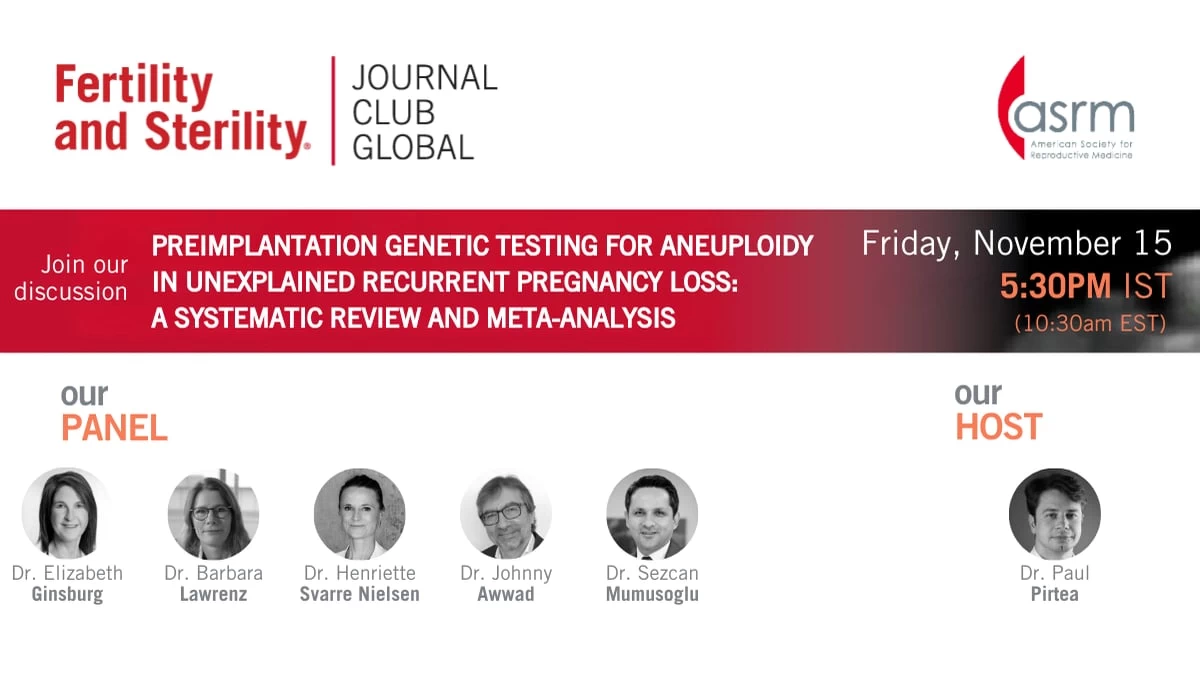
Journal Global Club From TSRM 2024: Preimplantation genetic testing for aneuploidy in unexplained recurrent pregnancy loss: A systematic review and meta-analysis
Explore the effectiveness of PGT-A in managing unexplained recurrent pregnancy loss, featuring systematic review findings, insights on miscarriage risks, and live birth rates.
Journal Club Global from MEFS 2024
Explore BMI's impact on IVF outcomes in a global fertility discussion, analyzing studies, obesity trends, and regional variations in reproductive health care.
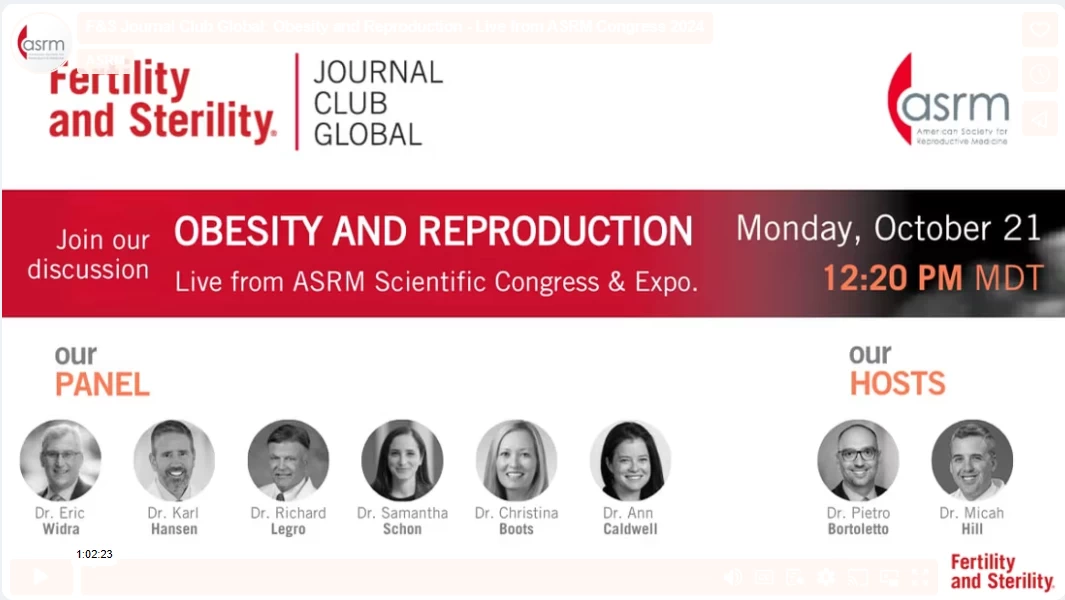
Journal Club Global from ASRM 2024: Obesity and Reproduction
Join experts from Fertility and Sterility Journal Club as they explore the impact of obesity on reproduction, weight loss interventions, and emerging treatments in fertility.
Journal Club Global en Español: De la Reunión de la SAMER 2024
Onsite de la Reunión de la Sociedad Argentina de Medicina Reproductiva (SAMER) de Córdoba, Argentina
Journal Club Global: SREI Fellows Retreat - Fellows vs Faculty Debate: Luteal Support in Programmed FET Cycles
Fertility and Sterility Journal Club debate on progesterone administration in frozen embryo transfers, featuring faculty vs fellows discussing IM vs vaginal routes.
Journal Club Global from ANZSREI 2024: Debate Unexplained infertility; Straight to IVF?
ANZSREI 2024 debate: Should unexplained infertility go straight to IVF? Experts discuss pros, cons, and alternative treatments. No clear consensus reached.
Journal Club Global: Falha de implantação: realidade ou ilusão estatística?
Fertility and Sterility Global Journal Club from Brazil
Journal Club Global en Espanol: Actualizacion sobre el síndrome de ovario poliquístico
Fertility & Sterility se enorgullece de traer un Journal Club Global en Español en vivo desde Cancún, Mexico
Journal Club Global: Oral Progestin For Ovulation Suppression During IVF
Live broadcast from the 2024 Midwest Reproductive Symposium
International in Chicago, IL
Journal Club Global: Recent clinical trials in Fertility and Sterility from the Asia Pacific region
Join ASPIRE 2024 for a Journal Club Global on PGT-A and IVF. Learn from top experts discussing recent clinical trial data and pregnancy outcomes
Journal Club Global en Español: Avances recientes en el tratamiento del síndrome de ovario poliquístico e Infertilidad
Un panel de expertos discutirá dos artículos recientes de Fertility and Sterility que estudian la infertilidad y el síndrome de ovario poliquístico.
Journal Club Global: Cost effectiveness analyses of PGT-A
Infertility treatments can be financially burdensome, often without insurance coverage, making understanding the cost effectiveness of PGT-A crucial.
Journal Club Global: The future of REI Fellowship training: debating opportunities and threats
This exciting collaboration discusses the controversy and future directions for the field of Reproductive Endocrinology and Infertility medicine.
Journal Club Global: Infertility and Subclinical Hypothyroidism
The impact of treating SCH on fertility, obstetric outcomes, and offspring neurocognitive development is debated in the literature.
Journal Club Global: Actualidad En Tratamientos De Fertilidad Para Pacientes Con Endometriosis
Live in Spanish from the 2024 Peruvian Fertility Society Meeting - Lima, Peru
Journal Club Global - Recurrent implantation failure: Reality or statistical mirage?
This exciting new collaboration brings authors and experts to discuss the controversy and future directions for recurrent implantation failure.
Journal Club Global - Evidence based guidelines for (PMOS) PCOS
This virtual event discusses the international guidelines for the assessment and management of PMOS (formerly PCOS), conducted by the International PCOS Network.
Journal Club Global - Recurrent implantation failure: Reality or statistical mirage?
This exciting new collaboration brings authors and experts to discuss the controversy and future directions for recurrent implantation failure.
Journal Club Global - The Association of Ovarian Reserve and Embryo Aneuploidy
Recent research suggests that the Antimullerian hormone (AMH) may not reliably predict embryo health in both infertility and non-infertility cases.
Journal Club Global - Actualización en la suplementación con progesterona en fase lútea para transferencias de embriones congelados
Efectividad del rescate de progesterona en mujeres que presentan niveles bajos de progesterona circulante alrededor del día de la transferencia de embriones
Journal Club Global - Revisiting the STAR trial: The Fellows debate PGT-A
We are excited to host a debate covering the pros and cons of PGT-A and how new technologies should be validated before clinical implementation.
Journal Club Global: Absolute uterine infertility a Cornelian dilemma: uterine transplantation or surrogacy?
Absolute uterine infertility presents as a Cornelian dilemma for patients and providers.
Journal Club Global: Transferencia de embriones frescos versus congelados: ¿Cuál es la mejor opción
Los resultados de nuevas técnicas de investigación clínica que utilizan información de bancos nacionales de vigilancia médica.
Journal Club Global: IVM in Clinical Practice: An Idea Whose Time Has Come?
In vitro maturation (IVM) has the potential to make IVF cheaper, safer, and more widely accessible to patients with infertility.
Journal Club Global - What is the optimal number of oocytes to reach a live-birth following IVF?
The optimal number of oocytes necessary to expect a live birth following in vitro fertilization remains unclear.
Journal Club Global: Surgical management of endometriosis in women diagnosed with infertility (Spanish language)
Journal Club Global: Natural versus Programmed FET Cycles
Journal Club Global: Moving leiomyoma research from bench to bedside
Journal Club Global: Does diminished ovarian reserve impact embryo aneuploidy or live birth rates?
Journal Club Global: Is PGT-P cutting edge or should we cut it out?
PGT for polygenic risk scoring (PGT-P) is a novel screening strategy of embryos for polygenic conditions and traits.
Journal Club Global: Should everyone freeze oocytes by age 33?
Oocyte cryopreservation is one of the fastest growing areas of reproductive medicine.
Journal Club Global: Management of poor ovarian response
A poor ovarian response to what should otherwise be a successful stimulation cycle presents a clinical conundrum for clinicians.
Journal Club Global: Non-invasive Diagnosis of Endometriosis
One of the most exciting developments in the field of endometriosis is the push towards earlier and less invasive approaches to diagnosis.
Journal Club Global: Prognosis in unexplained RPL
Recurrent pregnancy loss is one of the bigger challenges in the field of reproductive medicine.
Journal Club Global: Evidence for Immunologic Therapies in Women Undergoing ART
Reproductive immunology is perhaps one of the most controversial and promising fields within ART.
Journal Club Global Live from PCRS - Non-Invasive Embryo Selection Techniques
The next great frontier in reproductive medicine is how to non-invasively select an embryo with the highest reproductive potential for transfer.
Journal Club Global - To Operate Or Not To Operate: Debating Intramural Fibroids And Fertility
The event will debate the upcoming F&S Fertile Battle “Intramural myomas more than 3 to 4 cm should be surgically removed before IVF”.
Journal Club Global - PGT-A - Can non-invasive approaches based on spent medium analysis
PGT-A by trophectoderm biopsy aims to select available euploid embryos for transfer.
Journal Club Global - Obesity & Reproduction: An Update on Management and Counseling
Obesity can negatively impact reproduction in various ways, including ovulatory and menstrual function, natural fertility and fecundity rates, infertility treatment success rates, infertility treatment safety, and obstetric outcomes
Journal Club Global - Does the Endometrium Play a Major Role in Endometriosis-Associated Infertility
This will be a virtual event in the style of the "Fertile Battle" debate that took place at the 2019 SREI Fellows Symposium
Journal Club Global - Best Practices of High Performing ART Clinics
This Fertility and Sterility Journal Club Global discusses February’s seminal article, “Common practices among consistently high-performing in vitro fertilization programs in the United States: a 10 year update.”
Journal Club Global - Should Fellows Perform Live Embryo Transfers in Fellowship?
Few things are more taboo in reproductive medicine fellowship training than allowing fellows to perform live embryo transfers.
Journal Club Global - Fertilization rate as a novel indicator in ART results
This Journal Club Global discusses a provocative article recently published in Fertility and Sterility, discussing the results of a multicenter retrospective cohort study with the objective to appraise the fertilization rate as a predictive factor for cumulative live birth rate (CLBR).
Journal Club Global Live from ASRM - Optimal Management of the Frozen Embryo Transfer Cycle: Insights From Recent Literature
Three recent papers published in the Fertility and Sterility family of journals, all explore different aspects of optimizing frozen embryo transfer cycles.
Journal Club Global - Are We Approaching Automation in ART?
Some ART diagnostic devices are already available and offer objective tools of evaluation.
Journal Club Global Live from India - Adjuvants in IVF and IVF Add-Ons for the Endometrium
Many adjuvants have been utilized by IVF centers to improve their success rates.
Journal Club Global - Accuracy of Preimplantation Genetic Testing for Aneuploidies
Club Global Académico - ¿Cual debe de ser la primera línea de tratamiento en parejas con infertilidad inexplicable?
Nuestro debate se enfocará en el manejo óptimo de la infertilidad inexplicable, y como el problema debe de ser abordado en Latinoamérica basado en la literatura global reciente.
Journal Club Global - Recurrent Implantation Failures in ART: Myth or Reality?
Fertility and Sterility
F&S Reports
F&S Reports is an open-access journal that publishes peer-reviewed original scientific articles in clinical and translational research that have strong potential to transform clinical practice.
F&S Reviews
F&S Reviews publishes both systematic and comprehensive, authoritative review articles spanning reproductive medicine or science.
F&S Science
F&S Science publishes peer-reviewed original scientific articles in basic, laboratory, and translational research that has strong potential to transform clinical practice.
Fertility and Sterility
Fertility and Sterility® is an international journal for health professionals who treat and investigate problems of infertility and human reproductive disorders.

Journal Club Global
Fertility and Sterility Journal Club Global is an interactive online discussion of a hot topic or seminal article from Fertility and Sterility.