Registration for ASRM 2026 is Now Open!

Menu
Close Close Icon
Journal Club Global Teaser

Recent clinical trials in Fertility and Sterility from the Asia Pacific region

View more Journal Club Global videos

Video

Presented in Partnership with Fertility and Sterility and the Asia Pacific Initiative on Reproduction (ASPIRE)

Fertility & Sterility is proud to partner with ASPIRE to bring a Journal Club Global from the 2024 annual meeting in Manilla, Philippines! This exciting new collaboration brings authors and experts from around the world to discuss the literature and controversy about PGT-A, using recent clinical trial data from this global region. If

Article: Comparative analysis of pregnancy outcomes in preimplantation genetic testing for aneuploidy and conventional in vitro fertilization and embryo transfer: a stratified examination on the basis of the quantity of oocytes and blastocysts from a multicenter randomized controlled trial


Questions to be addressed:

  • What are the recent outcomes of PGT-A trials?
  • How does trial design influence discrepancies in trial outcomes?
  • Do patient factors such as age and ovarian reserve influence PGT-A trials?
  • What are the benefits and limitations of secondary analyses of clinical trials?


Presenters and Discussants: 

Dr. Ben Mol, Australia
Dr. Zi-Jiang Chen, China
Dr. Ho Mahn Tuong, Vietnam
Dr. Richard Paulson, USA

Moderators:
Dr. Kurt Barnhart, Editor in Chief, Fertility and Sterility (USA)
Dr. Clare Boothroyd, President, Asia Pacific Initiative in Reproduction (Australia)

Transcript

The following transcript was automatically generated.

Hello everybody, my name is Kurt Barnhart. I'm the Editor-in-Chief for Fertility and Sterility and it is my pleasure to travel here to be part of Aspire to introduce a fertility and sterility sponsored journal club global. We envisioned these journal club globals a few years ago to be able to highlight papers in fertility and sterility and highlight local authors and highlight the quality of the science that's done across the world and give our authors and experts a chance to talk about that.

So these journal club globals I enjoy because it's a combination of talking about the science but then a really good conversation about where it can take us and how we can collaborate together. This one I think I'm going to be very much enjoying because we're really not only talking about the science but we're really talking about what are the recent RCTs in the Asia-Pacific region, how do we improve the quality, which is hard because they're already good quality, and how do we use this as an example to increase the amount of really good evidence-based research out of this region and the region in general. So I'm going to hand it over to my co-chair Claire who I think it was wonderful putting this together and I look forward to this so thank you very much.

Thank you, it's a great honor. I'm going to introduce our live panel first. We have Professor Ben Moll from Australia and Professor Richard Paulson from USA and we have Dr Ho Man Tuong from Vietnam.

But we're going to begin with our virtual speaker and we're very grateful to you Professor Zijian Chen for giving some time to us and we have about, you probably can't see us Professor Chen, but we've got about 80 people in the room and of course this session is being recorded so the audience is potentially exponential. But I'd like to invite you first to speak about your recent publication and its underpinning publication, the recent publication in Fertility and Sterility and its underpinning primary publication in the New England Journal of Medicine. So could you please begin your presentation, welcome.

Okay thank you, can you hear me? Yes we can, yeah it's great we can hear you. Okay thank you, thank you for your invitation and thanks to the organization and thanks to the president of TCV. I'm happy to see you Professor Barnhart and also other professors, old friends, Ben Moll, Paulson and Ho.

So it's my pleasure to participate in this fabulous panel discussion. So we are going to discuss about the work of recent RCT in the Asia-Pacific region. Can I show, oh I'm sorry I cannot show my PPT, I'm sorry we need to Can you, are we using Zoom? Oh I'm sorry, are we using Zoom? Yeah can you just share your screen? I don't know what's wrong.

Maybe describe it for us Prof Chen, would that be okay? Yeah okay, I described, sorry. It's okay. I'm from a reproductive medical center from Shandong University in China.

So I would like to introduce the you know the two RCT and the secondary analysis from this RCT was published this year in the Pacific Sterility. We know in recent years single embryo transfer has been widely adopted in clinical practice. The best embryo for the first transfer has been widely sought.

Embryo aneuploidy is considered to be associated with the implantation failure at the miscarriage. So PGT for aneuploidy screen is commonly used in clinic. However compared with conventional IVF, whether PGTA could improve the pregnancy outcome especially in the terms of accumulating live birth rate is unclear before we conduct our RCT data.

So we conducted the micro center RCT in 14 reproductive centers in China. The total 1,212 fertile women aged between 20 and 37 years old. The primary outcome of this RCT was accumulated live birth rate that resulted from up to three embryo transfer.

So in PGT group the embryo was selected by the aneuploidy with the NGS. In IVF group we just use the common live morphology. Our results show that accumulate live birth rate was lower in PGTA group than the IVF group.

The risk of accumulate clinical pregnancy loss was significantly lower in PGTA group than the conventional IVF group. So it was conducted that conventional IVF treatment was inferior to PGTA and result in a higher accumulative live birth rate in women with a prognosis of live birth. So that's what published in the New England Journal in 2021.

And as a common editorial in the same issue we learned that for the PGTA trials was responsible innovation requires normal potential risk reproductive technology be the subject of careful research. After the publication of primary study we performed a secondary analysis to invest the variation in pregnancy outcome between PGTA and conventional IVF treatment across these key groups cataloged categorized by the oocyte cuts. Participants were divided into two subgroups based on the quantity of the number of the oocyte retriever.

Among each group the pregnancy outcome was compared with the PGT and the conventional IVF we did. We found that there was an interaction between whether the performer PGTA the oocyte number catalog on the accumulated clinical pregnancy loss. The PGTA group had a lower accumulated pregnancy of clinical pregnancy loss compared with the IVF group when the number of oocyte retriever was less than 15.

So it was conducted that one I mean by this secondary analysis we found that when the number of a retriever egg was less than 15 of the PGTA group existed a lower accumulated clinical pregnancy loss rate but no higher accumulated life birth rate compared with the conventional group. So this is the two actually the two publications. The first data published in the journal and the second that we published in the reality.

Thank you very much. Thank you very much for that synopsis. That was perfect.

That was terrific. Can I ask our panel to make comment on this paper? You've all had a chance to have a look at it. Tuong would you like to go first? The paper I saw that actually the study compared between the two screening method for selection embryo for transfer.

The first one is morphology and actually the second one is a combined method morphology and PGTA not one by one but one with two. So the PGTA group actually they already screen the embryos by morphology first and then they picked up the morphology base embryos and then they do PGT. So actually in the PGTA group this is the combined method of embryo selection and regarding to the number of eggs less than 15 maybe the group that have lower number of oocytes are the age more age group.

So they have higher risk of unemployment. That's why we find better results and lower loss with the PGTA. Thank you.

That was a good explanation because I wanted to make clear why there was a secondary analysis. So the first study basically showed the non-inferiority of the two groups or of the screening method but one of the questions that remained was are there groups of people where PGTA is going to be more beneficial or less beneficial and the surrogate marker that wasn't so clear was number of oocytes can result to the prognosis of the patient because many are making the argument that the lower the prognosis of the patient the more PGTA might be helpful. Does that make sense Rick? Did you want to comment on that? Yes, well thanks for that Kurt and I mean I think the most important thing is this group should be congratulated for actually conducting a randomized clinical trial which is so difficult to do in IVF and the data are really unique and they should be commended for that.

Trying to do a subgroup that is slightly less good prognosis in this particular study is challenging. This was an experiment that was done in a very extremely good prognosis group. There was less than 25% of the patients who had less than 15 oocytes.

I mean this was a great, great group. They had a follicle count of 22, the estradiol at the time of trigger was 5,900. I mean this was a very good prognosis group.

I would point out that the study asked the clinical question of non-inferiority and what they called a cumulative pregnancy rate but what they really meant was the probability of pregnancy, first pregnancy, in up to three embryo transfers. That's not the same question as saying what is the cumulative pregnancy rate of all of the different embryos that are there because if you became pregnant after the first embryo transfer of course you still had two more embryos left and we are not taking into consideration the implantation potential of those two remaining embryos. Without getting too much into the weeds, the bottom line was that the pregnancy rate was essentially the same in both groups.

It was a non-inferiority study but the one group, I think the PGTA, was 77% after all of the embryos were transferred and the standard group was 81.8 so very similar. I had a very hard time understanding how that was possible because of course PGTA cannot have that low a loss rate. There must be a greater degree of damage from false positives in the embryo biopsy and this is an artifact of a number, a mathematical artifact of trying to look at how many embryos you need to get to that first pregnancy.

This is not the same as the full implantation potential of the two groups which I think is less in the PGTA group. They just turned out that they happen to be equal. So those are the two points I wanted to make.

This was an extremely good prognosis group. The two groups were very similar in terms of outcome but remember that does not mean that there was not damage that took place to the embryos from pre-implantation genetic testing which there was and there was probably a loss rate of somewhere. I tried to go through the numbers of probably around 15 to 20 percent in the PGTA group of potential losses of implantation.

Ben, you want to make a comment? Yeah, thank you and first of all thanks for being a member of this panel. I'm really privileged to sit here and congratulations to Prof Chen and our team to do this type of studies. I've worked in Netherlands.

I did multi-center trials there. I looked at Germany then and I thought, are any Germans in the room by the way, I thought wow if we could get Germany to randomize we would be five times as strong but China doing this study is 50 times as strong. So that is so incredibly important to do.

That's the first thing I want to say and I want to encourage Professor Chen, she's doing that but I just want to underline keep on doing these big studies because we need them. Then to the study itself I think the strengths are the large sample size and the second strength is the cumulative life birth rate as compared to many studies that we have seen in this area that focus only on the first transfer and if you're going to do embryo selection of course your first transfer is going to be better and you think that the technique is actually better but the key outcome for all of us in reproductive medicine is the cumulative life birth rate. The pain of infertility is lifelong so we should really focus on getting the cumulative life birth rate as high as possible and then maybe do it as quickly as possible and reduce pregnancy loss and the pain of death but in that order.

That's also the reason that the authors correctly choose a non-inferiority study. I've seen superiority studies for PGTA but any type of embryo selection is never going to increase the pregnancy rate. We should realize that so superiority studies for embryo selection have a design issue in itself and that's not happening here.

Then I think it's very important to underline that if you read the New England conclusion and I wrote that down conventional IVF was non-inferior to PGTA so if you only looked at the last line you think there was no difference or it was comparable but it's not. It's 4.6 percent less so to say so that is really an important thing that we should consider in safety and non-inferiority studies are difficult to interpret. I have had my battles also with journals who wants you to write down these impossible non-inferiority sentences but we should basically say it is five percent less and then to the subgroup analysis in the fertility real paper it's always good to look into subgroup analysis but realize that because you go into subgroup analysis in four different groups you lose statistical power.

So the pregnancy loss in each of the subgroups is still there but it doesn't reach statistical significance and just by maybe coincidence maybe there is a mechanism the pregnancy loss rate is lower in one subgroup but I would be very careful in translating that to clinical conclusion. It's useful to look in this data. It's good to have been presented in fertility sterility but I would really go with the primary conclusion of the paper that PGTA is reducing pregnancy loss a little bit but it is doing harm also in my opinion and that is a very important conclusion that I have not seen from any study from the west.

That's my first comment. Thank you Ben. One of the advantages of the Journal Club Global is we get to talk to the author.

Apparently not at the very moment because the video cut out but I'll ask the panel this question because I really want to ask Dr. Chen. One of the criticisms of this paper that's acknowledged in both papers is that they only biopsy the three best embryos and not the whole cohort. So I'm curious your opinion and hopefully Dr. Chen's.

How do you think that changes the results or helps us interpret this? As I said the PGT group actually they apply the combined method of choice. Both morphology go to pick up the three best and then they do biopsy and PGT. That is a combined method.

The thing is that because they in the PGTA group they only use up three best embryos. So if there are aneuploidy or mosaic embryo they will lose some embryos. In the other group they can use up all three embryos beyond the morphology.

So the design will have bear some kind of unequal between the two groups. So let me ask the question slightly differently and let Rick and Ben decide too. How do we interpret this in that the practice usually would be to biopsy all embryos and have more available to you.

So should we look at this as we expected a smaller difference because we only had three embryos biopsied or we expected a larger difference or how should we interpret this when we compare to other studies? So from a pure study design perspective I thought the design was excellent. So you had to make sure before you randomized the patients that they had to have at least three blastocysts. So that's what they did.

So there's a side effect of that and that is that you've got this incredibly good prognosis group that is difficult to extrapolate the results from that to 40 plus year olds. But in terms of the study design I thought all of that was very well done. I want to comment on something that Ben said just a second ago and that was the final sentence of the New England Journal study which said that it was non-inferior and then he points out the difference that it's three or four percent different.

I really think that that hugely understates the degree of damage that PGTA does to embryos and it is a mathematical byproduct of calling this a cumulative pregnancy rate. It's not really the total pregnancy potential of that cohort of embryos. It is how long did it take you to get to the first pregnancy.

It ignores all of the embryos that are left over and and and that's actually that's my only beef with this study. My only beef with this study is is that it it underestimates the the cost that you pay to get the benefit of the of the decreased miscarriage rate and the and the higher implantation rates with PGTA. So I thought the study design was great.

So I'm going to direct this question at Ben which is this the same kind of question. I'm going to be the advocate of the devil here. Many of my colleagues say really all they want to achieve in an IVF cycle is getting to the first pregnancy as fast as they can and that is the ultimate goal and I know Ben you're going to say that's not the goal of the woman but but how do we reconcile this because our field wants to go towards the best earliest outcome which may not be in my opinion the best outcome.

So what was I going to say you said? So I would I thought you were going to disagree with that. Sorry? I thought you would disagree with the premise I'm setting up. It's not it's not what I think it's what our patients think and there is a very good study from the Netherlands actually in human reproduction that asks patients what do you think is more important the number of embryos the number of miscarriage the time to pregnancy or the cumulative life birth rate and the scale of that result is such that they can hardly print it in human reproduction right.

So so so the importance of cumulative life birth rate is completely left and all the other things are much less and the reason that we all say to ourselves no no it's about time to pregnancy and reducing recurrent that is bullshit of course right. It is the cumulative life birth rate and if you say something you probably have a conflict of interest with your own wallet. Let me be very clear right.

It is the cumulative life birth rate that counts. Let me give many of us if they're obstetricians they're also have been on a labor ward right. So if you're on a labor ward and and there is a multi-pair of women who has six or seven centimeters centimeters to close then she she says I want to deliver now do a cesarean etc but you know that this woman is going to deliver in 15 or 30 minutes from now.

So it's your professional obligation so to say to coach and mentor that women through it and similarly we have to say to infertile patients in their own interest it is about the cumulative life birth rate. So I'm sorry it might be a little bit longer. So I'm just going to summarize that very important discussion we just had is that there's there is a debate is I guess a kind word to what is the right outcome when you're using PGTA that a lot of the literature is pointing to first transfer success immediate time to pregnancy and Dr. Molen many of us are making an argument that perhaps that's the wrong outcome and this trial got closer to what is a patient-centered outcome which is it's not just the first encounter that I'm worried about it's the overall encounter and how many embryos I have.

So that's the point I wanted to make and I'm glad we made that both in the primary paper and also the secondary analysis and I'm now going to take the chair's prerogative and change a little bit because this topic was not only about this paper but about trials in the region and I really wanted to ask Dr. Teong you you've also your group has made some very significant contributions in this area and I would love for you to describe a little bit them and but also say how you were able to succeed and and conduct such well conducted important trials. Actually 10-15 years ago we decided to do clinical research as our kind of strategy because we found that it is the if we could do good clinical research this is a good way for us to learn and then we can have better practice when we do clinical good clinical research and also we can develop ourselves better with how we have strong background of clinical research so we decided to do and we was a very young group and we don't have that kind of strong academic background so we decided to ask for help so we go for collaboration with our friends and mentor who have a lot of experience with doing clinical trials and we learn a lot and that's how we can we can move quite rapidly during the past 10 years and we provide some good trials and publish so I think that we we should do clinical research and publish and we can get the assistance and the help of our colleges and our professors from all over the world to help us and I think in Asia we have Asia Pacific we have more IVF cycles in more than any other areas in the world so we should contribute something to the to the data and the evidence of in this field this is what we have done. Thank you you you mentioned that one of the barriers was expertise and you found that overseas were there any barriers in recruitment because as I understand it you don't have funded IVF in Vietnam is that right can you talk a little bit about that? Actually we we have Vietnam we have a lot of IVF cycles and we now have more IVF cycles than any other countries in Southeast Asia we can have but we can serve more patients IVF is expensive of course but we can serve more patients because we can control quite well the cost of treatment for our patients even they have to pay their own pocket so they will have more patients and when we have more patients the cost will be lower so and the patients they believe in us and we have more patients we have numbers and we have the expertise and patients rely on us our profession and then when the they ask them to join us for trial so many of them ready to join us and it is why we have good recruitment rate and we can provide good set of data from our practice.

As a clinician when I read these trials we have to make a decision about how extrapolatable the findings are to our own practices do you see any issues for that Tuong and Rick and Ben the extrapolate ability of the findings to clinical practice can you speak about that particularly for this paper that we're discussing today? Well I mean you're always going to have a problem in that the recruitment is going to be specific to your patient population and your geographic area or whatever the other demographics are which is why it's critical to have appropriate control and this was a randomized clinical trial that had randomization and they were able to demonstrate that in fact the two groups were similar so I your point is well taken how can we extrapolate from one ethnic group to another and there may very well be differences. I worry more in the case of for example PGTA and other fertility treatments is that we typically study the group that has the best possible outcome because that's what gives you maximum power it's a lot easier to demonstrate a difference between I don't know 40 and 60 percent than it is between five and and ten percent where that would actually be a doubling and and yet that's you're going to need many more numbers so we always look at the group that has the highest success rate in order to have study power and then we go and we extrapolate so I'm always worried to bring the conversation back to PGTA is that all of our data are in these excellent prognosis patients. We don't have any idea whether a 41 or a 42 year old patient for example can grow embryos to blastocyst in vitro and and how well those older blastocysts tolerate the biopsy procedure and whether in fact the data that we get from the trophectoderm biopsy can be extrapolated to the so I worry more about extrapolation from a good prognosis group to the poor prognosis groups to whom is being applied more so than I think within the different ethnic groups.

Yeah I think one of the points I bring out here is that there are very specific questions in our practice that faces the patient I'm facing in front of me the patients I see in Philadelphia the patients that are 39 to 41 years old the patients that I have trouble getting one or two blastocysts that's a very different question and I want to know the answer. I don't necessarily think I can get it from the experience in this but what I can get from the experience of this is the true efficacy of the intervention. It might not tell me how to peak trace an A but it'll tell me that PGTA is or is not a benefit in general and that I think is the benefit of the science not only this question but the other questions you've done on ICSI or no ICSI or fresh versus frozen those are still techniques that are can be evaluated across the world and whatever the population is and even the next question.

I want to shift gears a little bit to say the value of doing a randomized trial though because look what this spun off right not only is a randomized trial giving us the best most unbiased answer to that specific question but it spun off secondary analysis in areas. It spun off collaborations with epigenetics between our colleagues. It spun off many other great collaborative science and that's the kind of science we need for our field and I want to again congratulate the studies have been done in the Asia-Pacific region because they're very difficult to do in the United States and Europe now.

Ben you gave me an anecdote earlier today about and you mentioned it a little bit today how difficult it is to randomize trial in some of the more developed areas where I can't enroll people in a randomized trial and you said you were having trouble yourself. Yeah I mean that's a reality the amount of paperwork that you have to do to do trials in the settings where I work in Australia and also what I mean the Netherlands where I left 10 years ago has had much more bureaucracy introduced also. That's a reality that luckily is not that stringent in Asia and so if I talk to colleagues from Vietnam or China they say to me oh we have a protocol and now we have to go to ethics and that's going to take a long time right and then you see them worrying and my goodness so how long it's going to take and then they say six weeks right.

I said listen in our setting we take six months right plus and I honestly don't know how this study are actually done in terms of the budget also there is there is no comparison in how efficient you do the studies because you integrate them with your clinical care, you motivate your whole team to do that, you collect the data within your database, there are all kinds of factors that make these studies feasible and in the west we should really reconsider what we try to achieve with all our all our bureaucracy to keep the research as good and safe as possible. Dr. Chiang I was going to ask you and also Dr. Chen who unfortunately we've lost how can you give us a little example of how you were able to recruit so efficiently and so successfully it would be we could all learn from that. Yeah usually we prepare we prepare very carefully the protocol very in details and we discuss in a group we train a group of people we have some good recruiter who can talk with patient who can discuss and who can convince and who can explain to our patient we have that group of people in our centers so we discuss together very carefully before we start to recruitment and actually we we have a privilege that because we are the quite a British group in Vietnam and most of patients know that we are the best in in in Vietnam for that kind of treatment and we have a prestigious of professional activities and we have names and that it that make it easier for us to recruit patient and patient rely to what we have done.

Professor Chen it's lovely to have you back again can you hear us yes we just like to ask ask you the same question that we've just asked Dr. Tuong and that is can you tell us about the barriers to recruitment how do you how do you manage to recruit such a large number of subjects can you take us through that please. Okay thank you thank you also thank you Dr. Ben-Mos comments yeah we actually the similar like Vietnam colleagues there in China we are big population and also we we did several I did several trials on the big sample size I think this very significant and for the clinical for change practice in I think the RCT is very important for all practice in the clinic and in China we have some benefit that we have big population we have a lot of big centers for IVF centers so when they organize this RCT I based on our international colleagues you know some friends help we have an international DSP committee letter committee yeah and the DSP data safety safety committee and we have a proposal committee we have a in a steering committee this big committee and we have some international professors and experts involved and at the beginning now when we started to do our research we train center by center face by face how to recruit a patient how to do our do our research the patient concern form and formation form and also we use the the third independent database the center in China we have all all you know statistic data centers so that is in the past more than 10 years we actually we completed more than six big you know trials this all of them is micro centers at the beginning we are difficult but getting better and better you know our doctors many many doctors or more and more centers are interested in the clinical trial right now because they realize how important the trials the clinical studies to to help us to improve our clinical practice and how important for our made our guidelines of clinical you know consensus thank you so that's a very important message we're I'm talking to two of the largest centers and most successful centers in Asia with these trials I'm I'm in awe at how you can do these so well but there are many people listening in this audience and and when they see this broadcast that might be interested in clinical trials I want to ask you both you said training was important but what what advice do you have for the centers that want to start doing trials that was the most surprising to you or the most paramount to keep this data so the integrity of this data so good and the quality so high what can you share to the smaller clinics that are interested in doing trials I try understand I cannot hear clearly clearly from you yeah we do we you know yeah I force one by one you know and we have class and each center we have you know some doctors we have a group for study from you know primary doctor clinical doctors nurses assistant and and you know they get together and even then learn how to do case by case from beginning how to talk with the case from beginning you know we have a center we have a different committees to do the quality quality control and also we do inside inspection one center by one center beginning then yeah I'm sorry because I cannot get you all what's cannot hear you clean no that answered it wonderfully Dr. Tiang what do you think was the largest barrier to your staff to do a randomized trial was it accepting the concept was it the idea of randomization what needed to be overcome I think we the thing is the most important thing is that all people all staff in our clinic in our hospital have to agree that we have to do it the right way so if someone some people some department they are not how they do not have interest in that and they don't want to do it like that we will fail so the most important thing that we have to agree in our it's it's one of our culture that we have to do research and we have to do the right way actually we we had a lot of mistake at the beginning when we start and Ben was with us at the from very beginning and and we learn we improve from time to time if the whole team decided to to do and decided to improve we will get there with the good help of our friends from experienced friends from many part of the world and maybe add to that the importance and the opportunity of this meeting is that it's actually 10 years ago that we were introduced to each other by Rob Norman at the meeting in Brisbane and I would encourage everyone to to reach out to people with expertise because we're going to go to a setting where the expertise doesn't have to come from abroad or outside Asia anymore it's just widely I mean you having done all these studies um uh the work of Professor Chen other people in the room I see doing the studies the expertise is here also so so if that could expand to other standards and they're gonna with that with that statistical power bring that quality that would be great one other comment about interpretation of the studies and the fact that it's not applicable to your population let us not forget that the first law of medicine is first do no harm so the obligation to show that something works is with every doctor that does these interventions and I don't think that we have the luxury to say we deny the finding that PGTA potentially harms or that ICSI is less than IVF and therefore I continue to do my practice if you say that you have to do the study in your own setting and and and if you're not doing that you're potentially in conflict with Hippocrates chew a little bit on that so I wanted to summarize I asked two world experts here and conducting wonderful clinical trials in reproductive medicine and they both told me the hardest part was to get the doctors to agree that a randomized trial was the right thing to do I didn't hear that you had trouble just talking to the patients is that is that true the patients adopt if if your staff agreed it was the right thing to do your patients agreed uh we have uh an advantage that all most of our doctors they came to us as fresh and they are trained under the same roof so we are very we quite easily to work together and to start something so we we mostly have no problem to have a kind of consensus of doing something and as I said that we have a group of assistants who help because doctors sometimes we don't have enough time to discuss to explain to our patients so after we have a consensus between our doctors and we working with that group of assistants now we will discuss what we're going to tell our patient and they what our assistant will tell to the patient and when they come to doctors so what we're going to add on that to explain and to convince our patient that they they had they should join us to in this trial so we work together as I said that the most important thing that is a culture of the group so they we decided to do it and we do it together. We're a little bit short on time so I'm going to ask everybody to give a final comment and I'm going to start with Dr. Chen.

Dr. Chen congratulations again on all of your studies are you finding it harder or easier and do you have any comment about this trial in general you want to share with us? Oh thank you I don't I don't think it's easier it's still hard if you want to get you know high quality trials you can't keep that it's not easy we have to you know work hard with one cases and the one complete one call and we need we need to negotiate with patients we need to got more trust for our patient and also we need a good team you know train the team to learn how to put quality trials thank you. Why don't we go around the panel just looking at the end Ben why don't you give us a summary of what you think you learned from this session and some advice you can give about trials in in this area? Well what I learned from this session is that that it's very clear that these large RCTs where in many areas of the world people say these studies are not possible they are possible and they're done here so I would encourage everyone to feel inspired by the leadership that we have seen from Vietnam and China here see if you can achieve that the same and I want to congratulate but at the same time challenge aspire being being a host of this to to to endorse this and to create a platform where these studies can continue to happen. So my parting words will be to again congratulate Dr. Chen on her study and to tell you that I'm absolutely in awe of your database and of your ability to complete a study like this and if I could try to convince you to go back and try to analyze the data to even a greater extent so you answered the basic question of the cumulative pregnancy rate but for those I spent a lot of time going through that study trying to reverse engineer what the implantation rates were and how it must have been and how many transfers were in one group and how many transfers were in the other group can you reveal that can you go back and and maybe publish another paper or two and and extract it and say this is what the implantation rate was in the first transfer this is what the implantation rate was in the second and in the third and how many transfers were there in the PGTA group given the fact that the euploidy rate was about 68 or 69 percent.

So please satisfy some of us super curious math nerds who can't get enough of this kind of data and congratulations again. Thank you for the suggestion. We we so after more than 15 years doing this we we think that the one who benefit the most from our clinical trial is our patient who who trust in it who give trusted us and our staff who can learn and do it the right way the better way for our patients.

We're going to have to close this session we're actually over time but it has been very stimulating I'm sure all of the audience will agree and of course there's going to be a virtual audience which is probably going to be enormous but I think 60 percent of the world's population live in Asia-Pacific and to see talented leaders like you harness that potential to study the medical intervention you are absolutely wonderful and again congratulations and let us thank all our presenters the investigators and our panelists and of course visiting editor-in-chief from fertility and sterility thank you my pleasure and I just want to again say thank you for attending a journal club global by fertility and sterility this will be catalogued online both at the fertility and sterility website as well as I hope aspire as well so please share the information and I hope I'll see you again at another menu

More JCG Videos

Journal Club Global Teaser
Video

Journal Club Global (Portuguese): Access to fertility services by transgender and nonbinary persons

ASRM webinar explores transgender and non-binary fertility care, preservation options, gender dysphoria, ethics, and inclusive reproductive healthcare. 

View the Video
Journal Club Global Teaser
Video

Journal Club Global: The Evidence-Practice Gap in Immunotherapy for Recurrent Pregnancy Loss

F&S Reviews is proud to once again partner with the Stanford REI Fellowship Program for an important discussion of The Evidence-Practice Gap in Immunotherapy for Recurrent Pregnancy Loss.

View the Video
Journal Club Global Teaser
Video

Journal Club Global: Healthy euploid dizygotic twin birth after transfer of nonmosaic aneuploid embryos

This interactive session will feature an in-depth discussion on the paper “Healthy euploid dizygotic twin birth after transfer of nonmosaic aneuploid embryos.”

View the Video
Journal Club Global Teaser
Video

Journal Club Global at Turkish Society of Reproductive Medicine Meeting

Fertility & Sterility is proud to once again partner with the Turkish Society of Reproductive Medicine. The panel will discuss the evidence behind an association between endometrial thickness and chance of live birth.

View the Video
Journal Club Global Teaser
Video

Journal Club Global: Emulated Trials - A New Research Method With Insights Into Fertility Vitamin Supplements

Explore how emulated trials reveal the impact of vitamin D on fertility, featuring ASRM experts and real-world research insights from the FAST trial.

View the Video
Journal Club Global Teaser
Video

Journal Club Global: SREI Fellows Symposium 2025

Journal Club debate: do surgically retrieved sperm match ejaculated sperm in donor-egg IVF? Review of evidence, blastulation, fertilization, outcomes, equity.

View the Video
Journal Club Global Teaser
Video

Journal Club Global LIVE at ANZSREI 2025

ANZSREI panel reviews a PGT-A study on male age and sperm factors in blastulation and euploidy, finding female age dominates and calling for better research.

View the Video
Journal Club Global Teaser
Video

Journal Club Global en Español: AMMR 2025

Experts discuss chaotic embryo classification, PGT-A rebiopsy outcomes, embryo quality, biopsy techniques, and transfer protocols for mosaic embryos.

View the Video
Journal Club Global Teaser
Video

Journal Club Global LIVE at MRSi 2025: Sibling Oocyte Studies in ART

Experts discuss sibling oocyte trials, PIEZO-ICSI, and microfluidics in ART, evaluating outcomes, design limits, lab impact, and clinical implications.

View the Video
Journal Club Global Teaser
Video

Journal Club Global Portuguese: A relação entre Fertilidade e Saúde do Homem

Experts discuss male infertility, its health links, lifestyle impact, and treatment strategies, emphasizing proactive care and fertility preservation.

View the Video
Journal Club Global Teaser
Video

Journal Club Global en Español: Proyecto SOP 2025

Fertility and Sterility presents Journal Club Global at the 2nd International Congress of "Proyecto SOP" 

View the Video
Journal Club Global Teaser
Video

Journal Club Global: Clinical Evaluation and Management of Chronic Endometritis and Its Impact on Fertility

Experts discuss chronic endometritis, its diagnosis, treatment, and impact on fertility, highlighting key findings, diagnostic methods, and future research needs.

View the Video
Journal Club Global Teaser
Video

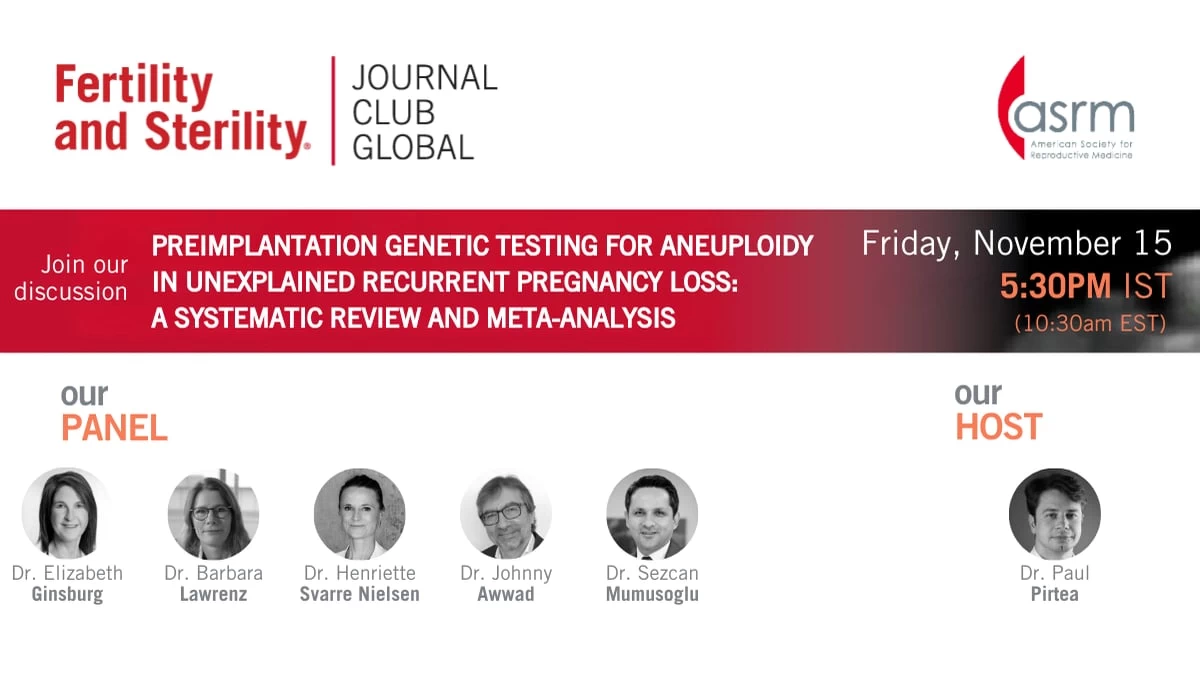
Journal Club Global: Embriões mosaicos ao Teste Genético Pré-Implantacional para Aneuploidia (PGT-A): o que fazer?

Discutiremos embriões mosaicos ao teste genético pré-implantacional para aneuploidia (PGT-A)
View the Video
Journal Club Global Teaser
Video

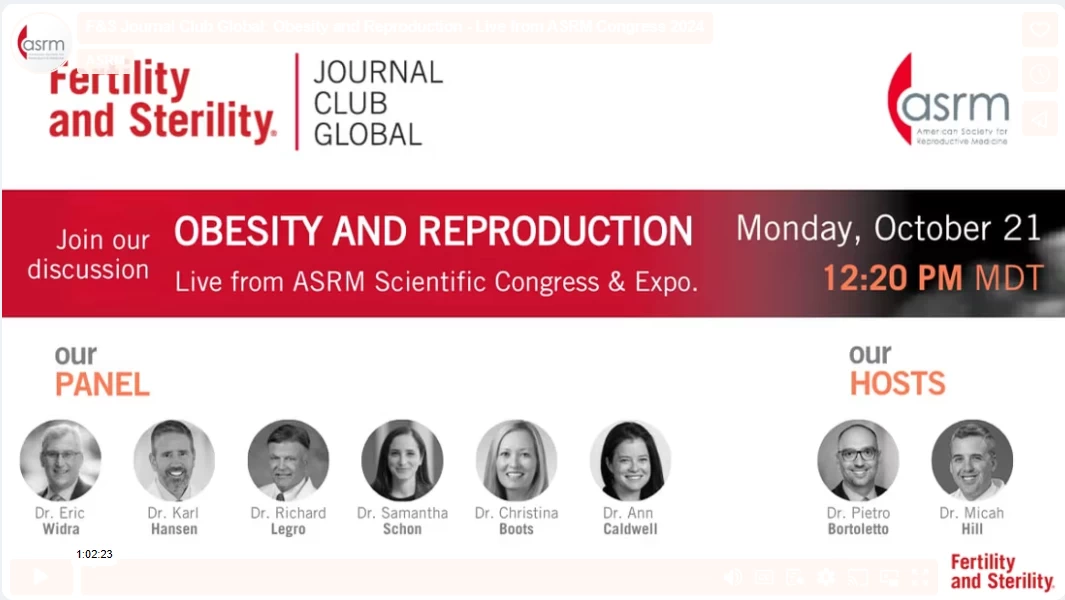
Journal Club Global from MEFS 2024

Explore BMI's impact on IVF outcomes in a global fertility discussion, analyzing studies, obesity trends, and regional variations in reproductive health care.
View the Video
jcg ASRM 2024 thumbnail
Video

Journal Club Global from ASRM 2024: Obesity and Reproduction

Join experts from Fertility and Sterility Journal Club as they explore the impact of obesity on reproduction, weight loss interventions, and emerging treatments in fertility.

View the Video
JCG SAMER 2024 teaser thumbnail
Video

Journal Club Global en Español: De la Reunión de la SAMER 2024

 Onsite de la Reunión de la Sociedad Argentina de Medicina Reproductiva (SAMER) de Córdoba, Argentina

View the Video
Journal Club Global Teaser
Video

Journal Club Global: SREI Fellows Retreat - Fellows vs Faculty Debate: Luteal Support in Programmed FET Cycles

Fertility and Sterility Journal Club debate on progesterone administration in frozen embryo transfers, featuring faculty vs fellows discussing IM vs vaginal routes.

View the Video
Journal Club Global Teaser
Video

Journal Club Global from ANZSREI 2024: Debate Unexplained infertility; Straight to IVF?

ANZSREI 2024 debate: Should unexplained infertility go straight to IVF? Experts discuss pros, cons, and alternative treatments. No clear consensus reached.

View the Video
Journal Club Global Teaser
Video

Journal Club Global en Espanol: Actualizacion sobre el síndrome de ovario poliquístico

Fertility & Sterility se enorgullece de traer un Journal Club Global en Español en vivo desde Cancún, Mexico

View the Video
Journal Club Global Teaser
Video

Journal Club Global: Oral Progestin For Ovulation Suppression During IVF

Live broadcast from the 2024 Midwest Reproductive Symposium
International in Chicago, IL

View the Video
Journal Club Global Teaser
Video

Journal Club Global: Recent clinical trials in Fertility and Sterility from the Asia Pacific region

Join ASPIRE 2024 for a Journal Club Global on PGT-A and IVF. Learn from top experts discussing recent clinical trial data and pregnancy outcomes

View the Video
Journal Club Global Teaser
Video

Journal Club Global en Español: Avances recientes en el tratamiento del síndrome de ovario poliquístico e Infertilidad

Un panel de expertos discutirá dos artículos recientes de Fertility and Sterility que estudian la infertilidad y el síndrome de ovario poliquístico.

View the Video
Journal Club Global Teaser
Video

Journal Club Global: Cost effectiveness analyses of PGT-A

Infertility treatments can be financially burdensome, often without insurance coverage, making understanding the cost effectiveness of PGT-A crucial.

View the Video
Journal Club Global Teaser
Video

Journal Club Global: The future of REI Fellowship training: debating opportunities and threats

This exciting collaboration discusses the controversy and future directions for the field of Reproductive Endocrinology and Infertility medicine.

View the Video
Journal Club Global Teaser
Video

Journal Club Global: Infertility and Subclinical Hypothyroidism

The impact of treating SCH on fertility, obstetric outcomes, and offspring neurocognitive development is debated in the literature.

View the Video
Journal Club Global Teaser
Video

Journal Club Global: Actualidad En Tratamientos De Fertilidad Para Pacientes Con Endometriosis

Live in Spanish from the 2024 Peruvian Fertility Society Meeting - Lima, Peru

View the Video
Journal Club Global Teaser
Video

Journal Club Global - Recurrent implantation failure: Reality or statistical mirage?

This exciting new collaboration brings authors and experts to discuss the controversy and future directions for recurrent implantation failure.

View the Video
Journal Club Global Teaser
Video

Journal Club Global - Evidence based guidelines for (PMOS) PCOS

This virtual event discusses the international guidelines for the assessment and management of PMOS (formerly PCOS), conducted by the International PCOS Network.

View the Video
Journal Club Global Teaser
Video

Journal Club Global - Recurrent implantation failure: Reality or statistical mirage?

This exciting new collaboration brings authors and experts to discuss the controversy and future directions for recurrent implantation failure.

View the Video
Journal Club Global Teaser
Video

Journal Club Global - The Association of Ovarian Reserve and Embryo Aneuploidy

Recent research suggests that the Antimullerian hormone (AMH) may not reliably predict embryo health in both infertility and non-infertility cases.

View the Video
Journal Club Global Teaser
Video

Journal Club Global - Actualización en la suplementación con progesterona en fase lútea para transferencias de embriones congelados

Efectividad del rescate de progesterona en mujeres que presentan niveles bajos de progesterona circulante alrededor del día de la transferencia de embriones

View the Video
Journal Club Global Teaser
Video

Journal Club Global - Revisiting the STAR trial: The Fellows debate PGT-A

We are excited to host a debate covering the pros and cons of PGT-A and how new technologies should be validated before clinical implementation.

View the Video
Journal Club Global Teaser
Video

Journal Club Global: Absolute uterine infertility a Cornelian dilemma: uterine transplantation or surrogacy?

Absolute uterine infertility presents as a Cornelian dilemma for patients and providers.

View the Video
Journal Club Global Teaser
Video

Journal Club Global: Transferencia de embriones frescos versus congelados: ¿Cuál es la mejor opción

Los resultados de nuevas técnicas de investigación clínica que utilizan información de bancos nacionales de vigilancia médica.  

View the Video
Journal Club Global Teaser
Video

Journal Club Global: IVM in Clinical Practice: An Idea Whose Time Has Come?

In vitro maturation (IVM) has the potential to make IVF cheaper, safer, and more widely accessible to patients with infertility.

View the Video
Journal Club Global Teaser
Video

Journal Club Global - What is the optimal number of oocytes to reach a live-birth following IVF?

The optimal number of oocytes necessary to expect a live birth following in vitro fertilization remains unclear.

View the Video
Journal Club Global Teaser
Video

Journal Club Global: Surgical management of endometriosis in women diagnosed with infertility (Spanish language)

Fertility and Sterility is excited to partner with our global professional colleagues to begin broadcasting regular Journal Club Global events in Spanish.

View the Video
Journal Club Global Teaser
Video

Journal Club Global: Natural versus Programmed FET Cycles

A significant portion of IVF cycles now utilize frozen embryo transfer.

View the Video
Journal Club Global Teaser
Video

Journal Club Global: Moving leiomyoma research from bench to bedside

Uterine leiomyomata are benign tumors that develop during the reproductive years with a 70-80% prevalence by menopause.

View the Video
Journal Club Global Teaser
Video

Journal Club Global: Does diminished ovarian reserve impact embryo aneuploidy or live birth rates?

Do patients with diminished ovarian reserve (DOR) have poor outcomes because of lower ovarian response, or because of additional factors that affect the egg quality.

View the Video
Journal Club Global Teaser
Video

Journal Club Global: Is PGT-P cutting edge or should we cut it out?

PGT for polygenic risk scoring (PGT-P) is a novel screening strategy of embryos for polygenic conditions and traits.

View the Video
Journal Club Global Teaser
Video

Journal Club Global: Should everyone freeze oocytes by age 33?

Oocyte cryopreservation is one of the fastest growing areas of reproductive medicine.

View the Video
Journal Club Global Teaser
Video

Journal Club Global: Management of poor ovarian response

A poor ovarian response to what should otherwise be a successful stimulation cycle presents a clinical conundrum for clinicians.

View the Video
Journal Club Global Teaser
Video

Journal Club Global: Non-invasive Diagnosis of Endometriosis

One of the most exciting developments in the field of endometriosis is the push towards earlier and less invasive approaches to diagnosis.

View the Video
Journal Club Global Teaser
Video

Journal Club Global: Prognosis in unexplained RPL

Recurrent pregnancy loss is one of the bigger challenges in the field of reproductive medicine.

View the Video
Journal Club Global Teaser
Video

Journal Club Global: Evidence for Immunologic Therapies in Women Undergoing ART

Reproductive immunology is perhaps one of the most controversial and promising fields within ART.

View the Video
Journal Club Global Teaser
Video

Journal Club Global Live from PCRS - Non-Invasive Embryo Selection Techniques

The next great frontier in reproductive medicine is how to non-invasively select an embryo with the highest reproductive potential for transfer.

View the Video
Journal Club Global Teaser
Video

Journal Club Global Live from PCRS - ICSI for Non-Male Factor Infertility

While intracytoplasmic sperm injection (ICSI) has revolutionized the treatment of male factor infertility, a significant controversy still remains regarding its ubiquitous use in all IVF cycles.

View the Video
Journal Club Global Teaser
Video

Journal Club Global - To Operate Or Not To Operate: Debating Intramural Fibroids And Fertility

The event will debate the upcoming F&S Fertile Battle “Intramural myomas more than 3 to 4 cm should be surgically removed before IVF”.

View the Video
Journal Club Global Teaser
Video

Journal Club Global - PGT-A - Can non-invasive approaches based on spent medium analysis

PGT-A by trophectoderm biopsy aims to select available euploid embryos for transfer.

View the Video
Journal Club Global Teaser
Video

Journal Club Global - Obesity & Reproduction: An Update on Management and Counseling

Obesity can negatively impact reproduction in various ways, including ovulatory and menstrual function, natural fertility and fecundity rates, infertility treatment success rates, infertility treatment safety, and obstetric outcomes

View the Video
Journal Club Global Teaser
Video

Journal Club Global - Does the Endometrium Play a Major Role in Endometriosis-Associated Infertility

This will be a virtual event in the style of the "Fertile Battle" debate that took place at the 2019 SREI Fellows Symposium

View the Video
Journal Club Global Teaser
Video

Journal Club Global - Best Practices of High Performing ART Clinics

This Fertility and Sterility Journal Club Global discusses February’s seminal article, “Common practices among consistently high-performing in vitro fertilization programs in the United States: a 10 year update.”

View the Video
Journal Club Global Teaser
Video

Journal Club Global - Should Fellows Perform Live Embryo Transfers in Fellowship?

Few things are more taboo in reproductive medicine fellowship training than allowing fellows to perform live embryo transfers.

View the Video
Journal Club Global Teaser
Video

Journal Club Global - Fertilization rate as a novel indicator in ART results

This Journal Club Global discusses a provocative article recently published in Fertility and Sterility, discussing the results of a multicenter retrospective cohort study with the objective to appraise the fertilization rate as a predictive factor for cumulative live birth rate (CLBR).

View the Video
Journal Club Global Teaser
Video

Journal Club Global Live from ASRM - Optimal Management of the Frozen Embryo Transfer Cycle: Insights From Recent Literature

Three recent papers published in the Fertility and Sterility family of journals, all explore different aspects of optimizing frozen embryo transfer cycles.

View the Video
Journal Club Global Teaser
Video

Journal Club Global - Are We Approaching Automation in ART?

Some ART diagnostic devices are already available and offer objective tools of evaluation.

View the Video
Journal Club Global Teaser
Video

Journal Club Global Live from India - Adjuvants in IVF and IVF Add-Ons for the Endometrium

Many adjuvants have been utilized by IVF centers to improve their success rates.

View the Video
Journal Club Global Teaser
Video

Journal Club Global - Accuracy of Preimplantation Genetic Testing for Aneuploidies

One of the highest aspirations in reproductive medicine is to develop a technology allowing for ID of embryos that have true reproductive potential.

View the Video
Journal Club Global Teaser
Video

Club Global Académico - ¿Cual debe de ser la primera línea de tratamiento en parejas con infertilidad inexplicable?

Nuestro debate se enfocará en el manejo óptimo de la infertilidad inexplicable, y como el problema debe de ser abordado en Latinoamérica basado en la literatura global reciente.

View the Video
Journal Club Global Teaser
Video

Journal Club Global - Recurrent Implantation Failures in ART: Myth or Reality?

Classically, implantation failures in ART were believed to result from alterations in embryo or endometrium quality.

View the Video

Fertility and Sterility

F&S Reports cover image
Journal

F&S Reports

F&S Reports is an open-access journal that publishes peer-reviewed original scientific articles in clinical and translational research that have strong potential to transform clinical practice.

Read F&S Reports
F&S Reviews cover image
Journal

F&S Reviews

F&S Reviews publishes both systematic and comprehensive, authoritative review articles spanning reproductive medicine or science.

Read F&S Reviews
F&S Science cover image
Journal

F&S Science

F&S Science publishes peer-reviewed original scientific articles in basic, laboratory, and translational research that has strong potential to transform clinical practice.
Read F&S Science
Fertility and Sterility journal cover image
Journal

Fertility and Sterility

Fertility and Sterility® is an international journal for health professionals who treat and investigate problems of infertility and human reproductive disorders.
Read Fertility and Sterility
Journal Club Global video conference image
Video

Journal Club Global

Fertility and Sterility Journal Club Global is an interactive online discussion of a hot topic or seminal article from Fertility and Sterility. 

Watch the Journal Club Global videos

Topic Resources

View more on the topic of genetic screening/testing
Newspaper Icon

Policy Update from the ASRM Office of Public Affairs: SART Membership Now Mandatory in Tennessee

ASRM-backed Tennessee law makes SART membership mandatory for ART clinic certification, strengthening fertility care standards and oversight. View the Policy Update on Tennessee law
Podcast Icon

Fertility and Sterility On Air - TOC: May 2026

Fertility and Sterility On Air explores embryo mosaicism, PGT-P ethics, IVF protocols, and ASRM research integrity updates. Listen to the Episode
Podcast Icon

Fertility and Sterility On Air - TOC: March 2026

Explore the March 2026 Fertility and Sterility On Air episode covering exercise during FET cycles, metabolic health, IVF triggers, PGT insights, and ectopic pregnancy research.  Listen to the Episode
Document Icon

Use of preimplantation genetic testing for polygenic disorders (PGT-P): an Ethics Committee opinion (2026)

This document discusses the ethical implications as well as the current limits and potential benefits of the use of preimplantation genetic testing for polygenic disorders. View the Committee Opinion
PR Bulletin Icon

ASRM Ethics and Practice Committees Release New Report Concluding Polygenic Embryo Screening Is Not Ready for Clinical Use

New analysis finds that PGT-P lacks proven clinical utility and raises significant scientific and ethical concerns. View the Press Release
Podcast Icon

Fertility and Sterility On Air: Live from the 2025 ASRM Scientific Congress & Expo (Part 3)

Explore IVF lab automation, MRI-guided egg retrieval, sperm epigenetics, RhoGAM in early pregnancy, and at-home semen testing in this ASRM 2025 recap. Listen to the Episode
Podcast Icon

Fertility and Sterility On Air: Live from the 2025 ASRM Scientific Congress & Expo (Part 1)

Live from ASRM 2025: genetics in REI, embryo cost studies, ketorolac trial, AI embryo ranking, and F&S journal updates with top experts. Listen to the Episode
Videos Icon

Journal Club Global LIVE at ANZSREI 2025

ANZSREI panel reviews a PGT-A study on male age and sperm factors in blastulation and euploidy, finding female age dominates and calling for better research. View the Video
Videos Icon

Journal Club Global en Español: AMMR 2025

Experts discuss chaotic embryo classification, PGT-A rebiopsy outcomes, embryo quality, biopsy techniques, and transfer protocols for mosaic embryos. View the Video
Videos Icon

Journal Club Global LIVE at MRSi 2025: Sibling Oocyte Studies in ART

Experts discuss sibling oocyte trials, PIEZO-ICSI, and microfluidics in ART, evaluating outcomes, design limits, lab impact, and clinical implications. View the Video
Newspaper Icon

Unlocking the Future of IVF: Navigating the Complex World of IVF Genomics

Explore the rise of IVF genomics, from PGT-A to WGS and polygenic risk scores, with insights on ethics, costs, and future implications for embryo screening. Read the Blog post
Document Icon

Transfer of embryos affected by monogenic conditions: an Ethics Committee Opinion (2025)

Patient requests to transfer embryos with serious monogenic disorders detected in preimplantation testing are rare; this opinion discusses physician responses. View the Committee Opinion
Videos Icon

Journal Club Global: Embriões mosaicos ao Teste Genético Pré-Implantacional para Aneuploidia (PGT-A): o que fazer?

Discutiremos embriões mosaicos ao teste genético pré-implantacional para aneuploidia (PGT-A) View the Video
Videos Icon

Journal Global Club From TSRM 2024: Preimplantation genetic testing for aneuploidy in unexplained recurrent pregnancy loss: A systematic review and meta-analysis

Explore the effectiveness of PGT-A in managing unexplained recurrent pregnancy loss, featuring systematic review findings, insights on miscarriage risks, and live birth rates. View the Video
Videos Icon

Genetics: Counseling Fertility Couples About Their Evaluation

Caitlin Hebert discusses fertility counseling, the importance of carrier screening, and overcoming barriers for patients while highlighting the role of genetic counseling. View the ASRMed Talk Video
Document Icon

Use of preimplantation genetic testing for monogenic adult-onset conditions: an Ethics Committee opinion (2024)

Preimplantation genetic testing for adult-onset monogenic diseases is ethically allowed when fully penetrant or conferring disease predisposition. View the Committee Opinion
Coding Icon

Codes for Embryo Biopsy

When doing a preimplantation genetic test (PGT) biopsy, can you bill for each day a biopsy is performed or can you only bill once for the cycle? View the Answer
Document Icon

The use of preimplantation genetic testing for aneuploidy: a committee opinion (2024)

PGT-A use in the U.S. is rising, but its value as a routine IVF screening test is unclear, with mixed results from various studies. View the Committee Opinion
Videos Icon

Journal Club Global: Recent clinical trials in Fertility and Sterility from the Asia Pacific region

Join ASPIRE 2024 for a Journal Club Global on PGT-A and IVF. Learn from top experts discussing recent clinical trial data and pregnancy outcomes View the Video
Coding Icon

Coding for an endometrial biopsy/Mock cycle

We had patients request us to bill their insurance for the two monitoring visits and the Endo BX and change the diagnosis code to something that is payable.  View the Answer
Coding Icon

Coding PGT requisitions to the PGT lab

Do you have any recommended codes to use for PGT requisitions to the PGT lab?   View the Answer
Videos Icon

Genetics: Is Expanded Carrier Screening the Standard of Care?

Hannah Green, a genetic counselor at NYU, discusses the benefits and limitations of expanded carrier screening, highlighting its impact on clinical practice and patient care. View the ASRMed Talk Video
Videos Icon

Genetics - Extra Testing, Passthrough or Money Maker?

Danielle Soltesz of RMA New York discusses the complex economics and ethical considerations of genetic testing in reproductive medicine, exploring costs, patient care, and sustainability. View the ASRMed Talk Video
Document Icon

Clinical management of mosaic results from preimplantation genetic testing for aneuploidy of blastocysts: a committee opinion (2023)

This document incorporates studies about mosaic embryo transfer and provides evidence-based considerations for embryos with mosaic results on PGT-A. View the Committee Opinion
Videos Icon

Journal Club Global - Revisiting the STAR trial: The Fellows debate PGT-A

We are excited to host a debate covering the pros and cons of PGT-A and how new technologies should be validated before clinical implementation. View the Video
Document Icon

Indications and management of preimplantation genetic testing for monogenic conditions: a committee opinion (2023)

ASRM has updated its opinion on PGT for monogenic conditions, providing guidance on clinical and technical complexities. View the Committee Opinion
Coding Icon

Results Review

What CPT code is most appropriate to submit for Physician Time to review CCS/PGS/PGD results? View the Answer
Coding Icon

Sperm DNA Fragmentation

Is there a CPT code for HALO DNA Fragmentation for sperm? View the Answer
Coding Icon

ICSI and Embryo Biopsy

How to bill for ICSI or embryo biopsies that occur in different days?  View the Answer
Coding Icon

Embryo Biopsy

Have any new codes been introduced for the lab portion of PGT? View the Answer
Coding Icon

Embryo Biopsy Embryologist Travel Costs

Can we bill insurance for the biopsy procedure? Can we bill for travel expenses? View the Answer
Coding Icon

Embryo Biopsy PGS Testing

What codes are appropriate for PGS testing? View the Answer
Coding Icon

Genetic Counseling

Does ASRM have any guidance for how to bill for genetic counseling services provided by a genetic counselor?
View the Answer
Coding Icon

Assisted Zona Hatching

Can assisted hatching and embryo biopsy for PGT-A; PGT-M or PGT-SR be billed during the same cycle? View the Answer
Videos Icon

Journal Club Global - PGT-A - Can non-invasive approaches based on spent medium analysis

PGT-A by trophectoderm biopsy aims to select available euploid embryos for transfer. View the Video
Document Icon

ASRM müllerian anomalies classification 2021

The Task Force set goals for a new classification and chose to base it on the iconic AFS classification from 1988 because of its simplicity and recognizability. View the Committee Opinion
Videos Icon

Journal Club Global - Accuracy of Preimplantation Genetic Testing for Aneuploidies

One of the highest aspirations in reproductive medicine is to develop a technology allowing for ID of embryos that have true reproductive potential.
View the Video
Document Icon

Reproductive and hormonal considerations in women at increased risk for hereditary gynecologic cancers: Society of Gynecologic Oncology and American Society for Reproductive Medicine Evidence-Based Review (2019)

Providers who care for women at risk for hereditary gynecologic cancers must consider the impact of these conditions. View the Joint Statement
Document Icon

Disclosure of sex when incidentally revealed as part of preimplantation genetic testing (PGT): an Ethics Committee opinion (2018)

Clinics may develop a policy to disallow selecting which embryos to transfer based on sex and choose to use only embryo quality as selection criteria. View the Committee Opinion
Document Icon

Best practices of ASRM and ESHRE: a journey through reproductive medicine (2012)

ASRM and ESHRE are the two largest societies in the world whose members comprise the major experts and professionals working in reproductive medicine. View the Committee Joint Guideline
Membership Icon

Preimplantation Genetic Testing Special Interest Group (PGTSIG)

The ASRM PGTSIG coordinates research, education, and training in preimplantation genetic diagnosis (PGT). Learn more about the PGTSIG