Registration for ASRM 2026 is Now Open!

Menu
Close Close Icon
Journal Club Global Teaser

Journal Club Global - The Association of Ovarian Reserve and Embryo Aneuploidy

View more Journal Club Global videos

Video

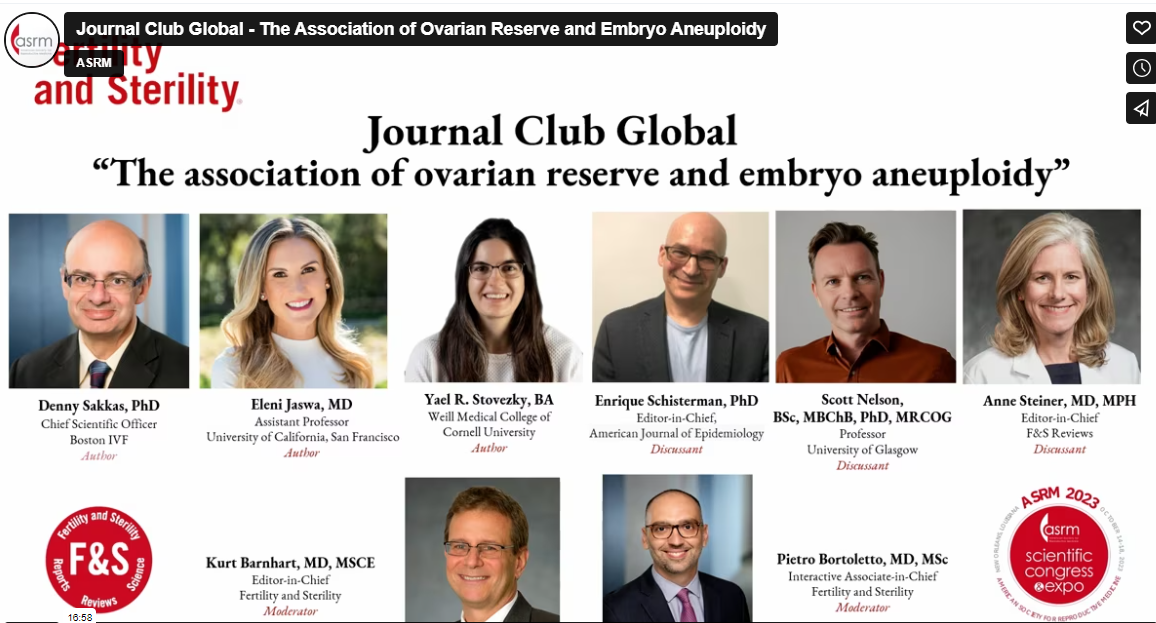
Presented in Partnership with Fertility and Sterility

Live and virtually broadcast from the ASRM 2023 Congress in New Orleans, LA
Presented in Partnership with Fertility and Sterility Live and virtually broadcast from the ASRM 2023 Congress in New Orleans, LA


Recent research suggests that the Antimullerian hormone (AMH) may not reliably predict embryo health in both infertility and non-infertility cases. Diminished ovarian reserve doesn't seem to significantly impact embryo quality or live birth rates compared to normal ovarian reserve; however, there is some evidence of a link between lower ovarian reserve and fewer healthy embryos, independent of age. This connection between egg quality and quantity may be influenced by factors like DNA repair, mitochondrial function, and genetic changes over time. Variations in research methods and patient selection can explain differences in study results. Fertility is not solely about egg quantity; egg quality plays a crucial role, and our understanding of this connection is evolving in reproductive science.

Antimullerian hormone is not associated with embryo ploidy in patients with and without infertility undergoing in vitro fertilization with preimplantation genetic testing. 
 
A diagnosis of diminished ovarian reserve does not impact embryo aneuploidy or live birth rates compared to patients with normal ovarian reserve 
 
Diminished ovarian reserve is associated with reduced euploid rates via preimplantation genetic testing for aneuploidy independently from age: evidence for concomitant reduction in oocyte quality with quantity.

Fertility & Sterility is proud to bring another Journal Club Global live from the annual ASRM Scientific Congress.  This event will discuss three recent publications in Fertility and Sterility which evaluate the association of ovarian reserve with the risk of embryo aneuploidy.  These recent studies explore if the known association between ovarian reserve and oocyte quantity also has implications for oocyte quality.   

Authors:

Eleni Jaswa, MD  
Yuval Fouks, MD  

Discussants:

Anne Steiner, MD
Scott Nelson, BSc, MChB, MRCOG
Enrique Schisterman, PhD
Yael Stoyezky, BA

Moderators:

Kurt Barnhart, MD, Editor-in-Chief, Fertility and Sterility
Pietro Bortoletto, MD, Interactive Associate-in-Chief, Fertility and Sterility

Transcript

The following transcript was automatically generated.

Hello, everybody. I'm Kurt Barnhart, the Editor-in-Chief for Fertility and Sterility, and it is my pleasure to introduce you to A Journal Club Global, an annual event here at the American Society of Reproductive Medicine Annual Congress. So A Journal Club Global is live to the world, live screen, as well as to you in the audience.

So good morning, good evening, or good afternoon to wherever you are, might be in the world. Today we're going to talk about the Association of Ovarian Reserve and Embryoaneuploidy with a very distinguished panel of authors and discussants. It should be a very lively discussion.

It's my privilege to introduce Pietro Bortoletto, who is the Interactive Associate-in-Chief for Fertility and Sterility, and our apologies for Micah Hill not being able to join us today. Pietro will be our emcee and host, and we will, again, look forward to your participation during this event as well. Thank you.

Pietro. Hi, everyone. Welcome.

Thanks for making time out of your lunch break to come join us. We typically have these debates at ASRM every year, and they're typically in debate style, where we pit groups of authors against each other. We decided to do things a little bit differently this time.

Our goal is to highlight authors who have published papers in Fertility and Sterility that have kind of all coalesced around the same theme, which is the Association of Ovarian Reserve and Embryoaneuploidy, and have the authors here, highlighted, and being able to discuss what they did, how they did it, and what they found. But then we've also aggregated a group of experts to talk specifically about this topic and put this literature into context for us. How does it fit into the world? How does it fit into our understanding? I want to start by introducing our authors today, who are each going to be giving us a short three-minute presentation about their individual papers.

Our first author is Dr. Lenny Jaswa. She's an RAI at the University of California, San Francisco. We also have Dr. Yael Stavetsky, soon to be doctor, who's a fifth-year medical student at Weill Cornell, who's here presenting her research.

And then finally, we have Dr. Denny Sakas, who is here in place of Dr. Yuval Folks, who was supposed to be here to present his outstanding work, but instead is back home in Israel, serving as an Army reservist. And our thoughts are with him and all the men, women, and children, both in Israel and in Palestine, who are affected by this conflict. I want to start off by discussing these papers and really have the authors tell us about the research rather than us tell you about it.

So I'd like to invite Dr. Lenny Jaswa to begin and tell us about her paper. Thanks so much, Pietro and Kurt. I'll begin just by saying I really appreciate the opportunity to have this exciting conversation today.

I enjoy listening to this recorded Journal Club content during my commute from Silicon Valley to San Francisco, so it's a real privilege to be participating and sharing ideas today. So our paper, I published with Dr. Mitch Rosen at UCSF in 2000. When did we do this? 2020? And our hypothesis was that a reduction in ovarian reserve quantitatively would be associated with reduced egg quality.

And we used pre-implantation genetic testing as a proxy for egg quality. So what we did was review all of our PGTA cycles from 2010 to 2019, amassing over 8,000 trophectoderm biopsies generated from about 1,200 women over the course of 1,700 IVF cycles, and we really tried to focus on women with infertility. So we excluded PGT cycles done primarily for monogenic disease, PGTM.

We excluded those intended primarily for fertility preservation, and we excluded women with recurrent pregnancy loss. And what we found using generalized linear models with cluster robust standard errors for the modeling was a 23% reduction in the odds of a blast being euploid. I should mention these women were 19 to 42 years old.

And so we did indeed find evidence of a reduction in what we used as a proxy for egg quality in those women with diminished ovarian reserve, which was a clinician-assigned diagnosis. That was our predictor. We did a secondary analysis looking not at the clinician-assigned diagnosis of diminished ovarian reserve, but instead at those women generating the lowest quartile of mature eggs in any given IVF cycle.

We did this as an analog to poor ovarian response, and the findings in that analysis mimicked our primary findings, again, identifying a reduction in euploid rates overall. We then looked finally at whether, once you have a euploid embryo in your hands, when you transfer that to a woman, do live birth rates differ between women with DOR and without it? And at that point, we found no difference in live birth rates following embryo transfer of euploid embryos. So in summary, looking at women 19 to 42 years old with infertility, we found that clinician-assigned diagnoses of diminished ovarian reserve was associated with reduced euploid rates but not ultimate live birth potential of euploid embryos.

Thanks, Eleni. I remember reading this paper as a fellow and thinking, oh my goodness, this is going to open up a Pandora's box. We should study this.

And it's with great pleasure that we have one of our medical students who helped us with this project here to present her work, soon-to-be Dr. Stavetsky. Would you tell us a little bit about what you found? Yes, absolutely. Thank you so much for having me.

It's such a great honor to be here and to speak about our work. So we were motivated basically with the aim of understanding the correlation between AMH as a quantitative measure of ovarian reserve and blastocyst ploidy as the quantitative marker. We chose two populations of women.

One was the general population of women pursuing IVF with PGTA, and the second was a less-studied population of women who pursued IVF with PGTM and who were presumed to share the reproductive potential with the general population. We used all of our data from 2012 to 2020. And we decided to use AMH because we felt that some of the challenges of interpreting the quantity-quality question using available data was that there was a variety of quantitative markers used in the studies.

And there was also the use of clinical definitions of DOR, which we felt is interesting in its own way but may actually obscure the interaction. And so we chose to use AMH, and we used a cutoff of 1.1 to classify women as either low AMH or normal AMH. And we found overall no interaction in terms of euploidy rates as well as aneuploidy and mosaicism.

We continued to conduct sensitivity analyses using AMH quartiles, and we also conducted sensitivity analyses of age categories that were women less than 35 years old, women who were 35 to 37, and women who were 38 to 39. All of our women were less than 40 years of age. These sensitivity analyses actually added pretty important nuance to our study, and namely that was that the non-significant trend, which we have seen, whereby women with increasing AMH classified categorically as either less than 1.1 or not or as increasing AMH quartiles, this non-significant trend where the women with the increasing AMH actually had increasing euploidy rates was entirely driven by the age of the patient.

So when we looked at the age groups, we found that women who were 35 to 37 and 38 to 39 had that trend, whereby those who were less than 35 years old either had a negative trend or nothing whatsoever. So that finding really corroborated our conclusion that it was factors linked to age rather than just the pure effect of having a diminished ovarian reserve that compromises the quality of the egg. So for us, our take-home message from this study was that AMH at this point cannot predict euploidy rates and cannot be used in a clinical way to help patients who are pursuing IVF and would like to have a better idea of what their success rates might be.

Thank you. Dr. Sarkis, tell us a little bit about Dr. Foulkes' study from Boston IVF. Thanks, Pietro.

So firstly, I'd like to acknowledge Yuval who drove this study. He's an exceptional doctor and actually has incredible talents at statistical analysis which has led to quite a number of interesting papers that we've published with him. And what we did in our study, we used aneuploidy rates as a very good marker for embryo quality.

And we looked at the aneuploidy rates in young women who were less than 40 with diminished ovarian reserve which was assessed before treatment, before their IVF cycle. And we also looked at patients who had poor ovarian response post-cycle. So we actually created two groups.

We had the diminished ovarian reserve group and the poor ovarian response group and we used a statistical technique called propensity score matching to, you can do a pseudo-randomised trial if you want, so where you match statistically the patients in control to the patients of interest. So the two patients of interest we had was the diminished ovarian reserve patients and we actually matched them as a 1 to 2 ratio of other patients who had similar characteristics to them. And we also did the same for patients with poor ovarian reserve.

We actually matched them with a higher ratio of control groups. So allowing you to match these statistically gives you a very good way of actually comparing patients who have a slightly similar profile. And as I said, these were all young women who were less than 40, were doing autologous treatment, and we were looking at their first frozen transfer results.

To assess these patients, we actually did a comparison. We looked at the aneuploidy rates of all these patients and what we found was that young women diagnosed with diminished ovarian reserve or poor ovarian response, they exhibited equivalent aneuploidy rates and live birth rates per couple, per euploid embryo, before transfer and this was in the large match population that we had. And the matching was based largely on age, body mass index and IVF cycle initiation characteristics.

There was a lower percentage of cycles with no euploid embryos available for transfer in the diminished ovarian reserve and the poor ovarian response patients, but what we actually found was that the question for these patients is quantity, not quality. So all our euploidy rates, our pregnancy rates, once they had a blastocyst for transfer, a euploid blastocyst, were always exactly the same. They were not significantly different.

So the conclusion for our study was for this group of patients with diminished ovarian reserve or poor ovarian response, it's not the quality that actually is their limiting factor, it's actually the quantity of oocytes they have in the end. So if you can actually improve that quantity by maybe repeat cycles, you will actually have a good outcome for them. So we postulated that it's quantity, not quality, for these types of patients which hopefully will help diagnose these patients and treat them and counsel them in the future.

Thank you, Denny. It's really nice to have three excellent papers published in Fertility and Sterility over the course of the last three years that have looked at the same kind of topic but in slightly different ways. We're going to now introduce our discussants for today and have them tell you a little bit about how these papers fit into our understanding of diminished ovarian reserve and embryo aneuploidy.

Our first discussant today is Dr. Ann Steiner, an REI at the University of North Carolina and editor for FNS Reviews. We also have Dr. Scott Nelson who has my old job, the Muir Head Professor of OB-GYN at the University of Glasgow. I think that's the third time I've made that joke, Scott.

And then Dr. Enrique Shisterman who is the chair of the Department of Biostatistics at the University of Pennsylvania. I wanted to open up our discussion by talking a little bit about biologic plausibility. Does any of this even make sense? I think when we're all kind of considering hypothesis generation, why would this make sense to look at, Scott? How do you think that this fits as a question that's worth investigating? So I think there is some question about what is biologically plausible.

So this all started in 1999 with a research letter in The Lancet where it's associated with women with babies with Down syndrome had slightly higher baseline FSH compared to others. So that was the very first measure we had of ovarian reserve suggesting that there may be a very small and weak association between aneuploidy and ovarian reserve. And then people have tried to evaluate that.

But we know when they're thinking about ovarian reserve, across a lifetime there's essentially a normal distribution. At any given age there's a distribution. And people will potentially follow those trajectories across their lifetime.

And then there's also this accelerated ovarian decline where people are changing centiles. So they start on the 90th centile and then their AMH falls to the 50th centile and then their AMH falls to the 10th and then it falls through. And one of the questions is the mechanism of that accelerated ovarian decline is probably the one that we're thinking about here because that's a pathological process as compared to someone who's just following their standard genetic profile.

So when we're trying to think about chromosomal abnormalities versus ovarian reserve, it's trying to then tease out which of these two populations that we're looking at, those who are changing centiles and have got an accelerated pathological pathway and may end up with an early menopause or premature ovarian insufficiency versus the kind of control population who are just following their standard genetic trajectory. And I think that's one of the things we'll hopefully come on to in terms of discussing it. But you can see that there may be a biological possibility for that because of the DNA sequencing or the DNA mechanism, control mechanism, that are going to facilitate that accelerated decline because they've clearly got something wrong with their pathways that are underlying that.

And I think that's why we think there may be some biological plausibility in this. We know that AMH is a predictor of IVF success rates probably through egg yield predominantly. So any effect size is going to be absolutely small, absolutely tiny.

I think we just need to bear that in mind when we're thinking about how do we interpret some of these studies. What's the effect size we've got to be able to do that? Well, this is now a good question, I think, for Ann and Enrique. Scott mentioned AMH.

You've mentioned the effect size. Is AMH really the best marker we have for ovarian reserve if we're really trying to find an association? And do you think that there are other markers that we should be using that may arrive a little bit closer to the truth? Well, I think it's quite interesting. We can see kind of when we're using the impact of using various or different markers of ovarian reserve.

So in the presentation of the first paper, which is very nicely presented, we saw that it was physicians assigned using the Bologna criteria and which is defined by a combination, two out of the three, of low ovarian reserve by a marker or poor ovarian response or age over 40 years of age. That is very different from what was used in the other groups when we were talking about what is your marker of ovarian reserve. There we were specifically relying on

More JCG Videos

Journal Club Global Teaser
Video

Journal Club Global (Portuguese): Access to fertility services by transgender and nonbinary persons

ASRM webinar explores transgender and non-binary fertility care, preservation options, gender dysphoria, ethics, and inclusive reproductive healthcare. 

View the Video
Journal Club Global Teaser
Video

Journal Club Global: The Evidence-Practice Gap in Immunotherapy for Recurrent Pregnancy Loss

F&S Reviews is proud to once again partner with the Stanford REI Fellowship Program for an important discussion of The Evidence-Practice Gap in Immunotherapy for Recurrent Pregnancy Loss.

View the Video
Journal Club Global Teaser
Video

Journal Club Global: Healthy euploid dizygotic twin birth after transfer of nonmosaic aneuploid embryos

This interactive session will feature an in-depth discussion on the paper “Healthy euploid dizygotic twin birth after transfer of nonmosaic aneuploid embryos.”

View the Video
Journal Club Global Teaser
Video

Journal Club Global at Turkish Society of Reproductive Medicine Meeting

Fertility & Sterility is proud to once again partner with the Turkish Society of Reproductive Medicine. The panel will discuss the evidence behind an association between endometrial thickness and chance of live birth.

View the Video
Journal Club Global Teaser
Video

Journal Club Global: Emulated Trials - A New Research Method With Insights Into Fertility Vitamin Supplements

Explore how emulated trials reveal the impact of vitamin D on fertility, featuring ASRM experts and real-world research insights from the FAST trial.

View the Video
Journal Club Global Teaser
Video

Journal Club Global: SREI Fellows Symposium 2025

Journal Club debate: do surgically retrieved sperm match ejaculated sperm in donor-egg IVF? Review of evidence, blastulation, fertilization, outcomes, equity.

View the Video
Journal Club Global Teaser
Video

Journal Club Global LIVE at ANZSREI 2025

ANZSREI panel reviews a PGT-A study on male age and sperm factors in blastulation and euploidy, finding female age dominates and calling for better research.

View the Video
Journal Club Global Teaser
Video

Journal Club Global en Español: AMMR 2025

Experts discuss chaotic embryo classification, PGT-A rebiopsy outcomes, embryo quality, biopsy techniques, and transfer protocols for mosaic embryos.

View the Video
Journal Club Global Teaser
Video

Journal Club Global LIVE at MRSi 2025: Sibling Oocyte Studies in ART

Experts discuss sibling oocyte trials, PIEZO-ICSI, and microfluidics in ART, evaluating outcomes, design limits, lab impact, and clinical implications.

View the Video
Journal Club Global Teaser
Video

Journal Club Global Portuguese: A relação entre Fertilidade e Saúde do Homem

Experts discuss male infertility, its health links, lifestyle impact, and treatment strategies, emphasizing proactive care and fertility preservation.

View the Video
Journal Club Global Teaser
Video

Journal Club Global en Español: Proyecto SOP 2025

Fertility and Sterility presents Journal Club Global at the 2nd International Congress of "Proyecto SOP" 

View the Video
Journal Club Global Teaser
Video

Journal Club Global: Clinical Evaluation and Management of Chronic Endometritis and Its Impact on Fertility

Experts discuss chronic endometritis, its diagnosis, treatment, and impact on fertility, highlighting key findings, diagnostic methods, and future research needs.

View the Video
Journal Club Global Teaser
Video

Journal Club Global: Embriões mosaicos ao Teste Genético Pré-Implantacional para Aneuploidia (PGT-A): o que fazer?

Discutiremos embriões mosaicos ao teste genético pré-implantacional para aneuploidia (PGT-A)
View the Video
jcg tsrm 2024 thumbnail
Video

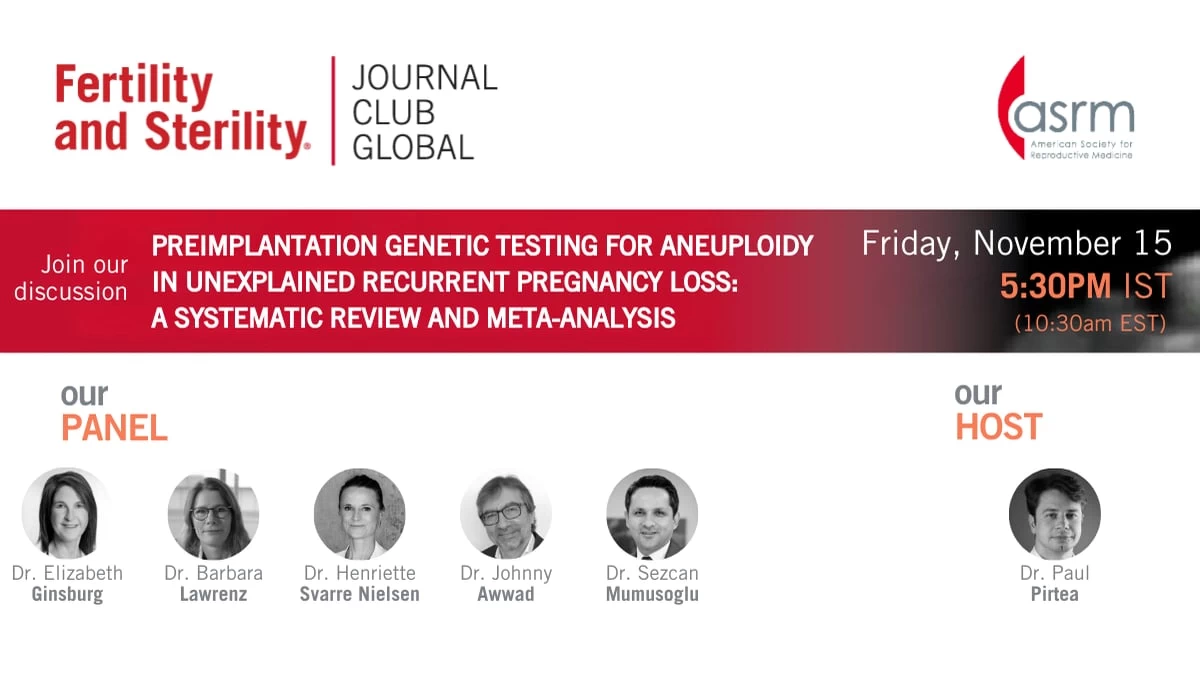
Journal Global Club From TSRM 2024: Preimplantation genetic testing for aneuploidy in unexplained recurrent pregnancy loss: A systematic review and meta-analysis

Explore the effectiveness of PGT-A in managing unexplained recurrent pregnancy loss, featuring systematic review findings, insights on miscarriage risks, and live birth rates.

View the Video
Journal Club Global Teaser
Video

Journal Club Global from MEFS 2024

Explore BMI's impact on IVF outcomes in a global fertility discussion, analyzing studies, obesity trends, and regional variations in reproductive health care.
View the Video
jcg ASRM 2024 thumbnail
Video

Journal Club Global from ASRM 2024: Obesity and Reproduction

Join experts from Fertility and Sterility Journal Club as they explore the impact of obesity on reproduction, weight loss interventions, and emerging treatments in fertility.

View the Video
JCG SAMER 2024 teaser thumbnail
Video

Journal Club Global en Español: De la Reunión de la SAMER 2024

 Onsite de la Reunión de la Sociedad Argentina de Medicina Reproductiva (SAMER) de Córdoba, Argentina

View the Video
Journal Club Global Teaser
Video

Journal Club Global: SREI Fellows Retreat - Fellows vs Faculty Debate: Luteal Support in Programmed FET Cycles

Fertility and Sterility Journal Club debate on progesterone administration in frozen embryo transfers, featuring faculty vs fellows discussing IM vs vaginal routes.

View the Video
Journal Club Global Teaser
Video

Journal Club Global from ANZSREI 2024: Debate Unexplained infertility; Straight to IVF?

ANZSREI 2024 debate: Should unexplained infertility go straight to IVF? Experts discuss pros, cons, and alternative treatments. No clear consensus reached.

View the Video
Journal Club Global Teaser
Video

Journal Club Global en Espanol: Actualizacion sobre el síndrome de ovario poliquístico

Fertility & Sterility se enorgullece de traer un Journal Club Global en Español en vivo desde Cancún, Mexico

View the Video
Journal Club Global Teaser
Video

Journal Club Global: Oral Progestin For Ovulation Suppression During IVF

Live broadcast from the 2024 Midwest Reproductive Symposium
International in Chicago, IL

View the Video
Journal Club Global Teaser
Video

Journal Club Global: Recent clinical trials in Fertility and Sterility from the Asia Pacific region

Join ASPIRE 2024 for a Journal Club Global on PGT-A and IVF. Learn from top experts discussing recent clinical trial data and pregnancy outcomes

View the Video
Journal Club Global Teaser
Video

Journal Club Global en Español: Avances recientes en el tratamiento del síndrome de ovario poliquístico e Infertilidad

Un panel de expertos discutirá dos artículos recientes de Fertility and Sterility que estudian la infertilidad y el síndrome de ovario poliquístico.

View the Video
Journal Club Global Teaser
Video

Journal Club Global: Cost effectiveness analyses of PGT-A

Infertility treatments can be financially burdensome, often without insurance coverage, making understanding the cost effectiveness of PGT-A crucial.

View the Video
Journal Club Global Teaser
Video

Journal Club Global: The future of REI Fellowship training: debating opportunities and threats

This exciting collaboration discusses the controversy and future directions for the field of Reproductive Endocrinology and Infertility medicine.

View the Video
Journal Club Global Teaser
Video

Journal Club Global: Infertility and Subclinical Hypothyroidism

The impact of treating SCH on fertility, obstetric outcomes, and offspring neurocognitive development is debated in the literature.

View the Video
Journal Club Global Teaser
Video

Journal Club Global: Actualidad En Tratamientos De Fertilidad Para Pacientes Con Endometriosis

Live in Spanish from the 2024 Peruvian Fertility Society Meeting - Lima, Peru

View the Video
Journal Club Global Teaser
Video

Journal Club Global - Recurrent implantation failure: Reality or statistical mirage?

This exciting new collaboration brings authors and experts to discuss the controversy and future directions for recurrent implantation failure.

View the Video
Journal Club Global Teaser
Video

Journal Club Global - Evidence based guidelines for (PMOS) PCOS

This virtual event discusses the international guidelines for the assessment and management of PMOS (formerly PCOS), conducted by the International PCOS Network.

View the Video
Journal Club Global Teaser
Video

Journal Club Global - Recurrent implantation failure: Reality or statistical mirage?

This exciting new collaboration brings authors and experts to discuss the controversy and future directions for recurrent implantation failure.

View the Video
Journal Club Global Teaser
Video

Journal Club Global - Actualización en la suplementación con progesterona en fase lútea para transferencias de embriones congelados

Efectividad del rescate de progesterona en mujeres que presentan niveles bajos de progesterona circulante alrededor del día de la transferencia de embriones

View the Video
Journal Club Global Teaser
Video

Journal Club Global - Revisiting the STAR trial: The Fellows debate PGT-A

We are excited to host a debate covering the pros and cons of PGT-A and how new technologies should be validated before clinical implementation.

View the Video
Journal Club Global Teaser
Video

Journal Club Global: Absolute uterine infertility a Cornelian dilemma: uterine transplantation or surrogacy?

Absolute uterine infertility presents as a Cornelian dilemma for patients and providers.

View the Video
Journal Club Global Teaser
Video

Journal Club Global: Transferencia de embriones frescos versus congelados: ¿Cuál es la mejor opción

Los resultados de nuevas técnicas de investigación clínica que utilizan información de bancos nacionales de vigilancia médica.  

View the Video
Journal Club Global Teaser
Video

Journal Club Global: IVM in Clinical Practice: An Idea Whose Time Has Come?

In vitro maturation (IVM) has the potential to make IVF cheaper, safer, and more widely accessible to patients with infertility.

View the Video
Journal Club Global Teaser
Video

Journal Club Global - What is the optimal number of oocytes to reach a live-birth following IVF?

The optimal number of oocytes necessary to expect a live birth following in vitro fertilization remains unclear.

View the Video
Journal Club Global Teaser
Video

Journal Club Global: Surgical management of endometriosis in women diagnosed with infertility (Spanish language)

Fertility and Sterility is excited to partner with our global professional colleagues to begin broadcasting regular Journal Club Global events in Spanish.

View the Video
Journal Club Global Teaser
Video

Journal Club Global: Natural versus Programmed FET Cycles

A significant portion of IVF cycles now utilize frozen embryo transfer.

View the Video
Journal Club Global Teaser
Video

Journal Club Global: Moving leiomyoma research from bench to bedside

Uterine leiomyomata are benign tumors that develop during the reproductive years with a 70-80% prevalence by menopause.

View the Video
Journal Club Global Teaser
Video

Journal Club Global: Does diminished ovarian reserve impact embryo aneuploidy or live birth rates?

Do patients with diminished ovarian reserve (DOR) have poor outcomes because of lower ovarian response, or because of additional factors that affect the egg quality.

View the Video
Journal Club Global Teaser
Video

Journal Club Global: Is PGT-P cutting edge or should we cut it out?

PGT for polygenic risk scoring (PGT-P) is a novel screening strategy of embryos for polygenic conditions and traits.

View the Video
Journal Club Global Teaser
Video

Journal Club Global: Should everyone freeze oocytes by age 33?

Oocyte cryopreservation is one of the fastest growing areas of reproductive medicine.

View the Video
Journal Club Global Teaser
Video

Journal Club Global: Management of poor ovarian response

A poor ovarian response to what should otherwise be a successful stimulation cycle presents a clinical conundrum for clinicians.

View the Video
Journal Club Global Teaser
Video

Journal Club Global: Non-invasive Diagnosis of Endometriosis

One of the most exciting developments in the field of endometriosis is the push towards earlier and less invasive approaches to diagnosis.

View the Video
Journal Club Global Teaser
Video

Journal Club Global: Prognosis in unexplained RPL

Recurrent pregnancy loss is one of the bigger challenges in the field of reproductive medicine.

View the Video
Journal Club Global Teaser
Video

Journal Club Global: Evidence for Immunologic Therapies in Women Undergoing ART

Reproductive immunology is perhaps one of the most controversial and promising fields within ART.

View the Video
Journal Club Global Teaser
Video

Journal Club Global Live from PCRS - Non-Invasive Embryo Selection Techniques

The next great frontier in reproductive medicine is how to non-invasively select an embryo with the highest reproductive potential for transfer.

View the Video
Journal Club Global Teaser
Video

Journal Club Global Live from PCRS - ICSI for Non-Male Factor Infertility

While intracytoplasmic sperm injection (ICSI) has revolutionized the treatment of male factor infertility, a significant controversy still remains regarding its ubiquitous use in all IVF cycles.

View the Video
Journal Club Global Teaser
Video

Journal Club Global - To Operate Or Not To Operate: Debating Intramural Fibroids And Fertility

The event will debate the upcoming F&S Fertile Battle “Intramural myomas more than 3 to 4 cm should be surgically removed before IVF”.

View the Video
Journal Club Global Teaser
Video

Journal Club Global - PGT-A - Can non-invasive approaches based on spent medium analysis

PGT-A by trophectoderm biopsy aims to select available euploid embryos for transfer.

View the Video
Journal Club Global Teaser
Video

Journal Club Global - Obesity & Reproduction: An Update on Management and Counseling

Obesity can negatively impact reproduction in various ways, including ovulatory and menstrual function, natural fertility and fecundity rates, infertility treatment success rates, infertility treatment safety, and obstetric outcomes

View the Video
Journal Club Global Teaser
Video

Journal Club Global - Does the Endometrium Play a Major Role in Endometriosis-Associated Infertility

This will be a virtual event in the style of the "Fertile Battle" debate that took place at the 2019 SREI Fellows Symposium

View the Video
Journal Club Global Teaser
Video

Journal Club Global - Best Practices of High Performing ART Clinics

This Fertility and Sterility Journal Club Global discusses February’s seminal article, “Common practices among consistently high-performing in vitro fertilization programs in the United States: a 10 year update.”

View the Video
Journal Club Global Teaser
Video

Journal Club Global - Should Fellows Perform Live Embryo Transfers in Fellowship?

Few things are more taboo in reproductive medicine fellowship training than allowing fellows to perform live embryo transfers.

View the Video
Journal Club Global Teaser
Video

Journal Club Global - Fertilization rate as a novel indicator in ART results

This Journal Club Global discusses a provocative article recently published in Fertility and Sterility, discussing the results of a multicenter retrospective cohort study with the objective to appraise the fertilization rate as a predictive factor for cumulative live birth rate (CLBR).

View the Video
Journal Club Global Teaser
Video

Journal Club Global Live from ASRM - Optimal Management of the Frozen Embryo Transfer Cycle: Insights From Recent Literature

Three recent papers published in the Fertility and Sterility family of journals, all explore different aspects of optimizing frozen embryo transfer cycles.

View the Video
Journal Club Global Teaser
Video

Journal Club Global - Are We Approaching Automation in ART?

Some ART diagnostic devices are already available and offer objective tools of evaluation.

View the Video
Journal Club Global Teaser
Video

Journal Club Global Live from India - Adjuvants in IVF and IVF Add-Ons for the Endometrium

Many adjuvants have been utilized by IVF centers to improve their success rates.

View the Video
Journal Club Global Teaser
Video

Journal Club Global - Accuracy of Preimplantation Genetic Testing for Aneuploidies

One of the highest aspirations in reproductive medicine is to develop a technology allowing for ID of embryos that have true reproductive potential.

View the Video
Journal Club Global Teaser
Video

Club Global Académico - ¿Cual debe de ser la primera línea de tratamiento en parejas con infertilidad inexplicable?

Nuestro debate se enfocará en el manejo óptimo de la infertilidad inexplicable, y como el problema debe de ser abordado en Latinoamérica basado en la literatura global reciente.

View the Video
Journal Club Global Teaser
Video

Journal Club Global - Recurrent Implantation Failures in ART: Myth or Reality?

Classically, implantation failures in ART were believed to result from alterations in embryo or endometrium quality.

View the Video

Fertility and Sterility

F&S Reports cover image
Journal

F&S Reports

F&S Reports is an open-access journal that publishes peer-reviewed original scientific articles in clinical and translational research that have strong potential to transform clinical practice.

Read F&S Reports
F&S Reviews cover image
Journal

F&S Reviews

F&S Reviews publishes both systematic and comprehensive, authoritative review articles spanning reproductive medicine or science.

Read F&S Reviews
F&S Science cover image
Journal

F&S Science

F&S Science publishes peer-reviewed original scientific articles in basic, laboratory, and translational research that has strong potential to transform clinical practice.
Read F&S Science
Fertility and Sterility journal cover image
Journal

Fertility and Sterility

Fertility and Sterility® is an international journal for health professionals who treat and investigate problems of infertility and human reproductive disorders.

Read Fertility and Sterility
Journal Club Global video conference image
Video

Journal Club Global

Fertility and Sterility Journal Club Global is an interactive online discussion of a hot topic or seminal article from Fertility and Sterility. 

Watch the Journal Club Global videos

Topic Resources

View more on the topic of ovarian reserve
Videos Icon

Is There a Test for Fertility?

This video explains the concept of ovarian reserve and the limitations of fertility tests, emphasizing that ovarian reserve does not equal fertility. View the ASRMed Talk Video
Videos Icon

Journal Club Global - The Association of Ovarian Reserve and Embryo Aneuploidy

Recent research suggests that the Antimullerian hormone (AMH) may not reliably predict embryo health in both infertility and non-infertility cases. View the Video
Coding Icon

Follicle Monitoring For Diminished Ovarian Reserve

If a patient has decreased ovarian reserve (ICD-10 E28.8) and patient is undergoing follicle tracking to undergo either an IUI cycle or IVF cycle... View the Answer
Videos Icon

Journal Club Global: Does diminished ovarian reserve impact embryo aneuploidy or live birth rates?

Do patients with diminished ovarian reserve (DOR) have poor outcomes because of lower ovarian response, or because of additional factors that affect the egg quality.
View the Video
Document Icon

Testing and interpreting measures of ovarian reserve: a committee opinion (2020)

Ovarian reserve is defined as the number of oocytes remaining in the ovary, or oocyte quantity (oocyte number). View the Committee Opinion