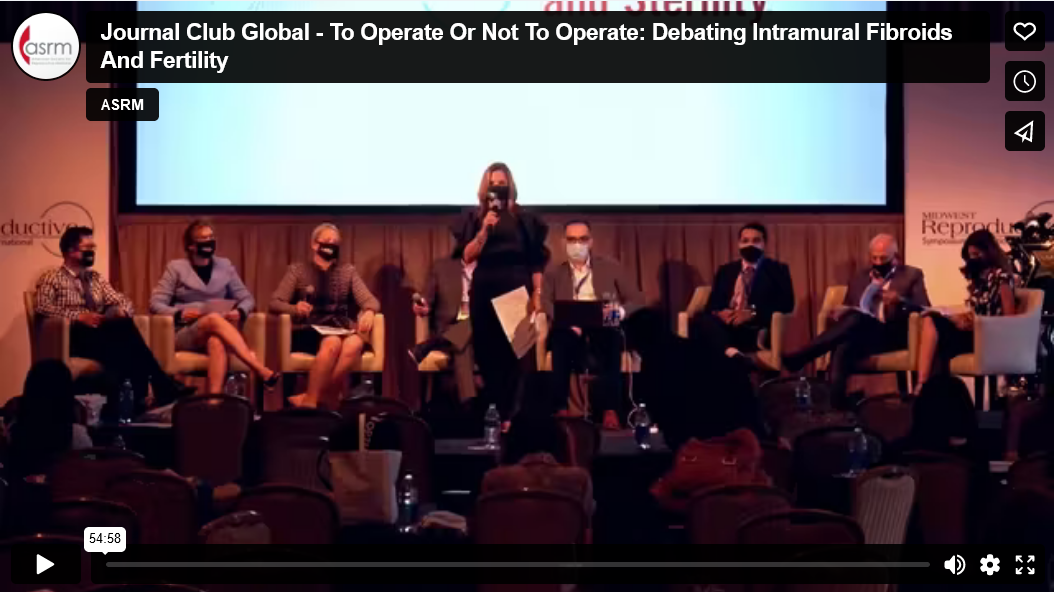
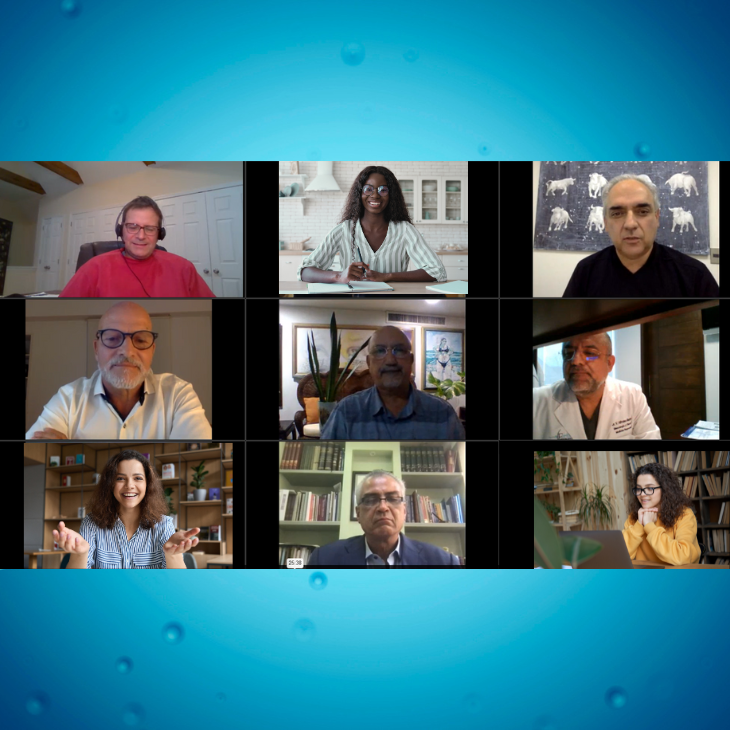
Hello world, I am Dr. Angie Beltzos from the Midwest Reproductive Symposium International here in Chicago. We are live coming to you from the Drake Hotel in downtown Chicago, USA, and we have a room full of our amazing participants at our MRSI. This is our 19th year and I have an amazing faculty here who are going to battle it out.
We are talking about fibroids and fertility. So to operate or not to operate, debating intramural fibroids and fertility. Are you guys ready? Yeah, we've got an amazing group.
We've got the pro and the con and of course our amazing moderators. We have Dr. Micah Hill. He is serving his 19th year in the U.S. Army as a colonel at Walter Reed National Military Medical Center where he's the medical director for the ART program and OBGYN research director.
Dr. Hill, that means that this meeting is 19 years old and your time at the NIH is 19. That is awesome, I didn't realize that. We're going to celebrate next year together.
He is the REI fellowship director at the NIH with 11 current fellows and soon to graduate their hundredth trained REI. He is the media editor for fertility and sterility, vice president of SREI, quality assurance committee chair for SART. The list is long and lengthy and distinguished and when he's not doing all that he is a lover of family, faith, fishing, football, barbecue, and bourbon.
This is your season. I love the fall. This is your season, amen.
And we also have our friend Pietro Bortoletto. Yes, he's a third year fellow at the Weill Cornell Center for Reproductive Medicine in New York City. He graduated here in Chicago from Northwestern University Feinberg School of Medicine and completed his residency at the amazing combined Brigham and Women's Mass General residency program.
And now he is an interactive associate in chief for fertility and sterility as the media editor for FNS reports. Without further ado, the battle begins. All right.
Thank you, Dr. Beltzos. Thank you MRSI and all of those who are still here watching us live in person in Chicago. Pietro, it's good.
This is the first time in two years you and I have been together to co-host this at FNS Journal Club live. It's good to get the band back together. It's good to see everyone even if we are masked.
We're going to get right into this. I'm going to introduce our panel. On the pro side saying that we should be operating, we have Dr. Amber Cooper, Medical Director of Vios Fertility.
We have Dr. Emily Youngheim, the REI Division Director and Professor at Northwestern University. And we have Lowell Kuhl joining us from Dallas IVF. Lowell, thanks for making the trip from Texas.
On the con side, we have Dr. Luis Hoyos. He is from IVF Florida Reproductive Associates. We have Dr. Jared Robbins also from Vios Fertility.
And last but not least, Dr. Ruhi Jalani also from Vios Fertility. So just to set the stage, this is an upcoming fertile battle in a month in fertility and sterility. This was put together by one of the legends in surgery of reproductive medicine, Jacques Donez.
And the point of this is to look and see if intramural fibroids type three and four that are three to four centimeters should be removed. He makes the point in his introduction that fibroids are increasingly present in our patient population. And he argues that this is for two reasons.
One, women are electing to postpone childbearing for career and social reason, predisposing them to have more fibroids. The other is that through our science and innovation, we have expanded the reproductive timeline through frozen embryo transfer and through donor egg. And so more of our patients are having fibroids, which means we're seeing more of these large intramural fibroids.
So Amber, I'm going to start off with you on why we should be doing surgery for these patients. All right. First of all, we have a fantastic pro team, so I'm just not going to bias anyone.
But I'm excited to be on the side because I think it's the right answer, right? So I think we can all agree that zero to two fibroids, they're in the cavity. And I think we've had a ton of data and I don't think anyone in this room or anywhere would argue that. And I think that's why this is a hot topic, right? We all look at ultrasound, we see that three or four centimeter fibroid that abuts the endometrium and it's right there, but it's not distorting anything.
What do we do with it? Are they recurrent implantation failure? Are they recurrent miscarriage? Are they unexplained infertility? Have we even done an embryo transfer? But I think we have to remember it's 2021. We have newer hysteroscopic, laparoscopic instruments. We have better ultrasounds.
We have really trained surgeons, even our colleagues in minimally invasive surgery, right? Fantastic surgeons. So all the things the con side's going to argue, I think we can argue in 2021, we might have a rebuttal for it. I'm not going to give you all of our tips yet.
But I think that one of my passions has always been the lack of understanding of the immune system. And I think that plays a potential big role here. When you have something in the musculature distorting the endometrium locally, okay, we discussed that.
But if it's not distorting, it may be distorting something else. One being the blood flow that goes to the endometrium. And if you have alterations in blood flow, alterations in anything structurally, you may in turn create an inflammatory response.
And it's a very interesting argument. And I always say, you know, the immune system, in my opinion, is one of the most poorly understood systems in our body. And that's why we debate this in many areas of reproductive health.
But there is emerging data. If you look at some of the mRNA studies, if you look at some of the more basic histology studies, looking at the endometrium, there's data that these fibroids, these intramural fibroids, even without distortion of the cavity, can change TGF beta, which in turn may downregulate some of the BMP, the HOX proteins in mRNA. Some of these things have to somehow be involved in how an embryo implants and how pregnancy is maintained, right? So more and more data is suggesting in these women with type 3 and 4 fibroids, at minimum of 2 centimeters, that we're seeing decreased pregnancy rates and decreased live birth rates.
So why wouldn't we remove them? I guess I'm going to, but I'm going to leave you with kind of one of those questions before I hand it over to the next Khan person. Khan Saeed, she asked you the question. Why wouldn't we remove them? Well, actually, I think there's many, many reasons why we shouldn't do it.
But first, I would like to acknowledge the things that we're in agreement, right? When we talk about intramural fibroids, we have to make the distinction about type 3 and type 4, right? Which is what Dr. Cooper was saying. So let's talk about type 3, right? I think that most of us agree that those need to be taken care of because of the changes that you have with increased secretion of TGF beta 3, right? With then it impairs BMP2 and then it decreases the action of HOX10, right? So we're in agreement with that. So I do think that those need to be removed, but with two caveats, right? Number one, only before embryo transfer, all right? Not before an egg retrieval, because we know that fibroids will recur, right? And we don't know if we're going to get those embryos.
I don't know. It really depends on the patient's age. And number two, that if we're going to remove them, we should remove them hysteroscopically, right? And that means using a bipolar resectoscope, which we are using less and less today.
I think that many OBGYNs, many REIs are now using morcellators, right? And those make that type of surgery really, really difficult, okay? So I will give you those two points. I definitely agree. But let's talk about type 4 fibroids, which is the part in which we do not agree.
We know that even though they do secrete TGF beta 3, they're so far removed from the cavity that they do not affect implantation. But okay, let's say that they do affect implantation. There's a recent Cochrane review that says that even with a myomectomy, you are not improving the reproductive outcomes with intramural fibroids.
So why would you do it, right? I feel that the surgical risk in this case will outweigh any potential benefits. I mean, come on. A vascular surgery, any abdominal, any surgery that has an abdominal approach will come with risk.
For example, a hysterectomy. You know, if you're talking about a big fibroid, you will always have the risk. I'm not saying that will happen every time, but that risk is there, whereas for a hysterectomy approach, there is much, much, much less.
So again, why would you go and undergo that risk if you know, if you don't have any certainty about the benefit? So Emily, it seems that Luis is saying we agree that there's a association with a pathology and a negative outcome, but that doesn't mean we're in agreement that we should be doing an intervention to resolve that association. What do you answer? What do you think? Oh, so in discussing factors that contribute to infertility with my patients, I usually break it down into three simple things. To get pregnant naturally, we need eggs, we need sperm, and we need open tubes with a normal uterine cavity.
But we know it's so much more complicated than that. Many of our patients enter IVF without a diagnosis. Doesn't mean there isn't one, but our knowledge of reproductive physiology isn't sophisticated enough to have an answer.
And when it comes to fibroids, historically, our approach has been equally unsophisticated. We talk about size and location, but we're learning more and more every day about how fibroids impact reproductive function on the molecular level. In addition to altering the normal anatomical relationships and function within the uterus, including displacing the uterine cavity and impacting uterine contractions, fibroids secrete important cytokines that have the potential to impact embryo implantation.
So in the non-pregnant state, the average uterus is about the size of a fist, okay? And we're talking about a fibroid that's three to four centimeters, which I don't have a soccer ball here, that would be very large, but I do have a golf ball. So how can you tell me something this big, inside a structure this big, is insignificant and shouldn't be removed? Golf ball, Rick Paulson, this is for you. It doesn't make sense that this could cause or contribute to someone's infertility.
And when it comes to people with other known causes of infertility, whether it be male factor or tubal factor or someone who's doing IVF for other reasons, like they need PGTM, can we say with confidence that a three to four centimeter fibroid will not impact their chance of pregnancy or their pregnancy outcome after IVF? Further fibroid growth and behavior during pregnancy is unpredictable. Fibroids can grow, they can shrink, they can necrose. Any of these outcomes can be problematic during pregnancy and have a devastating impact.
We have all sorts of recommendations for patients to optimize their IVF outcomes. Recommendations for supplements and changes in diet, lifestyle recommendations, recommendations for acupuncture. We intervene with prescriptions for antibiotics and oral steroids, recommend assisted hatching.
Our patients agree to these interventions despite the fact that we have very little good quality data that we should use these interventions and that they'll benefit them. When it comes to a three to four centimeter fibroid in the uterus, this is data that I can see. What do we risk when we don't intervene? What if IVF doesn't work? Will we do the myomectomy then where all patient wonder about it if we don't? Will they drop out of treatment or try again? Can they try again? Most women have coverage for a myomectomy.
Most women don't have coverage for IVF. Why wouldn't you do everything in your control to optimize your patient's outcomes when the stakes are so high? I love how contentious this has already started, and thank you, Louise, for getting us started. I figured it's probably a good point for us to get some baseline sense of what people around the country, around the world, who are joining us and thinking.
This is a poll question that we're posing to our audience joining us virtually. We asked them, when you are faced with this intramural fibroid, three to four centimeters in size, that's isolated, just that single fibroid, how do you counsel a patient of reproductive age on its impact? It's very interesting. From our online audience, we had 55% agreed, said that they were somewhat unlikely to impact reproductive potential, whereas the rest thought that there was at least somewhat or a very likely impact.
The smallest percentage was actually the group that said there's no impact at all. I think people agree with the analogy that this little golf ball-sized thing in a fist probably does have some impact. You brought up an interesting point about what happens when IVF doesn't work, but there's also the important question, what happens when IVF does work? We do get these patients pregnant.
Are there any obstetric risks of having a large intramural fibroid? Prematurity, preterm birth, growth restriction, are those things that are worth modifying for patients before we help them conceive? I'll ask the con side. Well, I mean, I'm not sure that that's the question here that we're asking, because we're not talking about large fibroids. We're talking about three to four millimeter fibroids.
I think the discussion around three to four millimeter fibroids and the discussion around centimeter fibroids, right? Three to four centimeter fibroids versus your large 10 centimeter fibroids are a very, very different question. I do think that we're hearing arguments that are about association. I think it's important to bring our very esteemed pro-colleagues back to the simple epidemiologic concepts of association versus causation.
I think that there are theories around TGF-beta and HOX and that they can have an impact. I completely agree with my partners about the type zero through three fibroids, but we're talking about a theory where we have no idea if these are reaching the endometrium. I heard an argument around alterations of blood flow and impacts on uterine motility, and I'm sure my very esteemed pro-colleagues remember operating.
Surgery creates anatomical changes. Surgery creates blood flow changes, and so the scar tissues that can be created from going after a relatively small diameter fibroid can have major impacts on endometrial competence, on scar tissue within the myometrium that can affect peristaltic changes of the uterine cavity. Certainly, we have seen patients post-myomectomy that have endometrial lining developmental issues that we attribute to things such as alterations in blood flow.
I think we do need to remember that surgery is not benign, even if our technology so that we can do it maybe a little bit better, we haven't eliminated the ability to prevent scar tissue and anatomic changes. Causation versus association, I think that should we remove them is a great question. The question is, do they have an impact? I agree with Dr. Jungheim that we should maximize every patient, but it is, and I agree with Dr. Cooper, that it is 2021.
Here in 2021, we have actually developed some excellent medications and non-surgical techniques to treat fibroids. If we are thinking that these fibroids are having a major impact, why not lean towards fibroids are a chronic disease, how many times are we going to remove those fibroids? Why not use medical technologies or non-surgical techniques to treat these fibroids? So while I think we're in agreement about the maximizing a very high stakes outcome, I think we can do it in non-surgical ways. There's lots of studies now on uterine artery embolization that have demonstrated safety, pregnancy rates.
In your institution, Dr. Jungheim, there's several studies that they've published now on reports of outcomes after UAE and showing safety. And again, other techniques, there's a bunch of medications now that are on the market from your oral antagonists that have very successfully treat these fibroids and shrink these fibroids. And so I do think that there are options for maximizing these benefits without having to operate on them.
So Lowell, I think as we read through these studies, Jared's right. Most of the data is association studies without intervention studies. You're in a busy private practice.
You talk to patients about this all the time. Why are you on the con side? Why should we be doing surgery instead of these medical treatments that Jared brought up? Absolutely. Thank you for all the cons that you guys have brought up.
In a private practice, we do operate quite frequently and we have a lot of experience operating on fibroids, on many patients who do have these fibroids that are type three and type four. My concern is that my esteemed colleague had suggested maybe we should medically treat before we operate. It does make logical sense, but maybe some patients may not be quite the type of person that might be needing that.
For example, if a patient needs these medical management treatments that may take months, many months before you might see a change in these fibroids. Some patients may not have that as their fertility declines. And then maybe if they fail the medical management and they still need surgical management, now we've delayed their treatment and their in vitro fertilization even further.
So it might be even faster just to go ahead and try to surgically remove and then get to IVF. In terms of surgical management, as you all know, there are three different modalities of surgeries. There's the open technique, the laparotomy, and then you have laparoscopy, which is a minimally invasive technique.
And then of course you have hysteroscopy, which is also one of the minimally invasive techniques. Most studies do suggest that if you're going to choose between laparotomy and laparoscopy, laparoscopy is the preferred route of choice of surgery because of decreased adhesion formation, less myometrial damage and quicker recovery, as well as less pain postoperatively. Now, hysteroscopically, our esteemed colleague has also said that, well, it may be difficult to access a type 3 or type 4 fibroid, especially if they're only 3 or 4 centimeters.
So I would argue that a 3 centimeter or even a 2 centimeter type 3 fibroid is still accessible hysteroscopically and with minimal damage to the myometrium, with minimal damage to the blood flow, and as well as minimal postoperative scarring. I do agree that tissue shavers and these types of instruments that sort of shave down the myomas may not be as successful as, let's say, a resectoscope. So I know many of us have been trained and well trained by some of the master surgeons using a resectoscope, and I still use a resectoscope every time I operate on myomas that are submucosal or even type 3 myometrial.
So I would argue that you can still get access to those myomas with minimal effect and damage to the myometrium. We asked our live audience, if you're going to be surgically managing these fibroids, what's your preferred route of tackling them for the isolated intramural fibroids? And 50% thought that robotic myomectomy was actually the preferred way to do it. And I don't know about this stage, but I don't think many of us are doing robotic myomectomies as REs anymore.
Do you think a lot of the push against surgery con side is because it's just not something that we do, and there's a certain hesitancy to refer out to have the surgery done, and then delaying their care and the amount of time it takes them to get in, takes them to have surgery, takes them to recover. We're much more willing to go at it without repairing, removing the fibroid, without having to make a surgical plan for them. What do you think, Luis? I don't think that's entirely true.
I mean, I think that if I thought that there was a benefit to the patient, I will have no problem referring her to an MIS. For example, if you have a fibroid that is 2 to 5, based on the fibroid classification, I mean, that patient would probably be better served by a minimally invasive surgeon, and that's completely fine. However, if it's only a type 4 myoma, let's say 3, 4 centimeters, in which I really do not think that there's going to be any benefit, I'm not doing it because I don't feel comfortable doing it.
I'm just not referring the patient because I don't think she's going to benefit at all. You know, even on a master surgeon, complications indeed happen, you know, and the more time they are practicing, you know, they still run into complications. So, they are not completely preventable, all right? So, do I think that my patient should take that risk? Definitely not.
So, no, I'm not referring her for that reason. If your patient is referred to surgery prosign, how long are you telling them to wait before trying to conceive if they've had a hysteroscopic robotic abdominal laparoscopic myomectomy of an isolated 4 centimeter intramural fibroid? What's your rule of thumb? I think it's a great question. I think approach matters.
If it's a through and through in the myometrium, I, in my opinion, most tend to recommend three months healing time. I always talk to the surgeon who performed it and how difficult it was and what sort of closure and concerns. If it's hysteroscopic approach, there is some argument you may not have to wait as long if you don't have full thickness, you know, incision, and I think that's part of Lowell's argument in some of these type 3, 3 centimeter fibroids that you can access hysteroscopically with, you know, really quicker recovery and a shorter time to pregnancy.
So, Ruhi, you get to back clean up for the con side. Let's hear the final comments from you and then we'll get to some back and forth debate and hopefully questions from our live and virtual audience. Let's do it.
I feel bad I'm going to have to debate some of Lowell's arguments. He's so nice. I'll apologize in advance.
I think Dr. Cooper left off at good point when she said, in my opinion, that's exactly it. There's an opinion. We don't have a duration that we should wait, right? We don't know.
It can range anywhere from 12 weeks to 12 months and then coming back to our patients who are infertile, they don't necessarily have that time on their side. So, do we, going back to what Luis answered, we don't not refer out because, you know, of the risk of time. We just don't refer out because it may not help in achieving our outcome.
Going back to what Peter asked earlier, does it help pregnancy outcomes? Does it help prevent that preterm delivery? If you look at the data, if you look at these reviews, even despite a myomectomy, these risks still persist. So, why do it? And then the risk of adhesions, no matter whether we do it laparoscopically or a laparotomy, they're still there and they can range anywhere from 25 to 88 percent and that's just not a risk that we should be willing to take when we don't necessarily know if there's an outcome, like an impact on our outcome in our pregnancy. So, while Pietro is preparing a question here from our virtual audience, Jeff, if we could have a microphone for our live audience and we'd like to engage you.
What questions, what comments do people have for our experts? We have about 20 minutes for Q&A before we have closing arguments and let the audience decide who wins this debate. So, while we wait for a question from the audience, there we go. We have one.
Go ahead, sir. I'm always puzzled about these fibroids because in African women, we have at least 30 percent of those who are getting pregnant and delivering having intramural fibroids greater than three, four centimeters. But at the same time, I have many patients that only get pregnant once they remove these fibroids.
So, I think we should be finding a tool to differentiate between those fibroids that would affect implantation from those who are not going to affect implantation and pregnancy. Thank you. That sounds like a question for the pro side.
He does see a lot of patients that get pregnant that have fibroids. He does see some that doesn't. How can we determine who needs the fibroid to come out and who doesn't, if that's the case? I agree.
I think there should be a classification system that should be created. And I think that it should determine what fibroids are more instrumental in allowing for pregnancy. And those that are not, I agree completely, there should be some sort of classification to be created.
I think that is the challenge with our current classification system. It's purely location, and that doesn't necessarily inform everything we want to know about it. Right.
The current FIGO classification is good, but it doesn't also include size. It just talks about location, right? What about a type three that is two centimeters versus a type four that is three centimeters? Are those the same, or are they not? It's very good. We need to include that into the classification system.
We have a question from our live audience, our virtual audience. Dr. Mortimer, who's a resident at the Brigham Mass General Program in Boston, asks, but is the treatment worse than the disease or at the very least equivocal? Remember, we should first do no harm. If we resect these type three, type four fibroids hysteroscopically with a bipolar, are we risking intrauterine adhesions without good evidence of a benefit in terms of reproductive potential? What would you say to that, Dr. Youngheim? I'd say anything we do has a potential risk.
And if you're sending, all of it depends on the surgeon, too. I wouldn't do that myomectomy. I would refer out to somebody who's doing it all day, every day.
And I know if I refer to one of the surgeons I work with, certainly there is a risk. But in their hands, that risk is super, super low. And just to kind of hearken back to something Dr. Robbins mentioned earlier, we do have epidemiologic data, yes.
Having said that, that's looking at big cohorts of people. And when I've got a patient in my office, it doesn't get more personal than that. And there is no way I can tell someone that a fibroid this big is not going to impact her chance of pregnancy with IVF or her pregnancy outcomes.
Dr. Hoyos would like to rebut. I think that Dr. Youngheim came here trying to impress us with a golf ball. But, you know, if that size is so significant, then why is it so hard to be hit with the golf club, which is of a similar size, like of a uterus? At the end of the day, the only thing that matters for the ball to be close to the hole, which in this case is the endometrial cavity.
I love a good golf metaphor. We have another question from the audience. Dr. Chen.
So I'd like to know from this group, because Dr. Khoo had said he likes to use the resectoscope. And personally, I like the instruments like, you know, MyoShore and TruClear that are, don't use energy. Do we have any data showing that the lateral thermal damage potentially from a resectoscope might cause more harm than just using mechanical means? And Dr. Khoo, I think you and I have to talk about this more because I want to make you a mechanical fan, because I think you're going to like it if you use it more.
Absolutely. Good question, Serena. When you're operating on the fibroid hysteroscopically, the fibroid actually is encapsulated, and there's a little pseudo capsule that it sits in.
So though you may need to make an incision on the myometrium initially to get to and get access to that fibroid, it's sitting within that capsule. So you can operate pretty freely within that capsule, making sure that with very good technique, that you're not going to stray outside of that capsule and cause disruption of the myometrium or the blood flow. So it is possible to do it safely and with minimal damage and scar tissue.
We have one more question from the audience. Great debate. So a lot of this is centered on a solitary fibroid.
Would you feel different in your opinion if you had a patient that had a uterus that wasn't exactly studded with fibroids, but had five or six fibroids potentially ranging in the two to five centimeter range? That's a good question for both the con and the pro side, but let's start with the con side. Someone has five or six. Are you changing your mind from no surgery to surgery? I think it once again goes back to location and history.
Going back to that question from Egypt, why do some women have infertility and implantation failure, and some women with multiple fibroids don't seem to have any trouble? I'm going to reference Dr. Youngheim's presentation yesterday where she said in most patients, this nutrition, BMI, diet don't vary, but then when we see them in an infertile patient population, it may be different. So I would say once again, I would revert back to size, location, because operating in general may put them at higher risk of infertility, adhesions, damage to the endometrial cavity, which is, as we know, it's still experimental and irreversible, I would say. So we have, and we'll get back to the audience questions in one moment.
So we have other ways to treat fibroids other than surgery. We've spent a lot of time talking about resectoscope versus a hysteroscopic morselator, the different abdominal approaches that one could take. And Dr. Robbins, I think you brought up medical therapies for intramural fibroids.
Do you think they work? And if so, which one do you think works best? I mean, it's hard to know. Again, the question of do they work goes back to how do you measure success, right? I think that if we're talking about patients that are symptomatic fibroids, I think the data is clear that most of them work. Do they improve pregnancy rates? I think the data is not clear that the fibroids are causing infertility to begin with.
And so whether they work in terms of improving pregnancy rates is still a question out there. When we hear, when I removed that patient's fibroid and she got better, she got pregnant, there's clearly that recall bias, that investigator bias. And so without a systematic trial, I completely agree with Dr. Jungheim that we're all very emotionally attached to our patients.
And that's why the importance of having systematic studies to really determine whether these interventions are impactful from a fertility outcome are really critically important. So I want to go back real quick to the question before that. So we were talking about numerous fibroids and Ruhi brought up the risk of potential damage to the uterus.
So does the protein feel different if it's just a fibroid studded uterus, a bunch of small ones, the cavity's clear, but you know you're going to have to make anterior, posterior, fundal incisions. Do you still want those patients to do surgery or what's your counseling to patients in that setting? I usually make the analogy that the uterus is like a jello mold. And when you've got those fibroids, it's like a bunch of pineapple in that jello mold.
And if you pluck them all out, what do you have left? But in discussing the different approaches, you know, I wouldn't be doing that myomectomy. When I trained, I would have, but now I wouldn't. And so, you know, if you have a patient with a complicated history, it's something to consider for sure.
But hopefully this doesn't count against me for the debate. And we had asked our audience joining us virtually as well, if medically managing fibroids, what's your preferred method for medical management? And the vast majority of people still use injectable GnRH agonists followed by combined hormonal contraceptives with a much smaller percentage using the new oral agents and the selective progesterone modulators, which I suspect we'll start to see more and more being used in the reproductive medicine community beyond just the benign gynecology community. Do we have more questions from our audience? Yes, up front we have one.
Yeah, sure. Yes. Cases, and he had his license taken away because he mixed up patients.
He only got his license back within the past few years. And so that's just something to consider. He was going to China and doing retrievals.
I'm not sure how that worked because he wasn't a licensed doctor in China, but he was bringing eggs back from China while he was banned by the Medical Board of California. So he's been back practicing two years, but I would think that would be something to consider if you are doing these types of surgeries to be extra sure the medical record keeping in the offices wouldn't allow for any mix-ups in patients. And then I do have a question.
So this is a lay person question, but using the golf ball analogy, which I think is fabulous. What if an embryo does try to implant into the golf ball, the fibroid, does it then lose its chance to move around and implant someplace else? You know, and that's why if it is in the cavity, we would certainly remove it because that makes it very difficult for an embryo to implant. And if it implants close to it, that's when you see pregnancy complications.
In regards to it being present in the myometrium, it wouldn't be as obvious of an issue with implantation. It looks like we have another question in the middle. Yeah.
Hi, Mackenzie Purdy, Vios. This would be a question more for the con side. I think the tough patient population is the one that has recurrent implantation failure.
They've got no real reason of why they're not having success and they have, you know, a type three, type four. Do you feel differently about that patient population? Because that's probably who I would struggle with the most. I mean, in my opinion, at that point, you're just doing it out of desperation, you know, which is completely understandable.
Like the drawings were saying, we are very attached to our patients, but you do have to, you know, ask yourself whether this is just regression to the mean and whether the patient was going to get pregnant either way Other questions from the audience? In the back. Yeah. Hi, Sam Polly from Boston IVF.
Does the panel feel any different if it's a larger fibroid? We keep talking about the golf ball, the three to four, but let's say five to six centimeters. Just want your opinion. So again, it goes right back to the studies to which Dr. Jelani was referring earlier.
I mean, the majority of studies don't show a benefit, even in the larger fibroids. There certainly, I think it becomes a more debatable argument when you're looking greater than six centimeters, because there are, you know, there are some better studies demonstrating the larger fibroids may have an impact. But I think when you look at the meta-analyses, even in the larger studies, the majority show that as long as they're not distorting the cavity, they don't have a major impact on outcome when live birth rate is the outcome that you're looking at.
So earlier on the medical side and in the article, they talk about uterine artery embolization as being safe. We're all reproductive REIs up here. Does anyone up here ever recommend a uterine embolization for an infertility patient? Even though there's been reported successful pregnancies after uterine artery embolization, I do not personally recommend it.
I, you know, am uneasy about decreasing blood flow in the uterine artery in a patient who wants to be pregnant. And we know that. And there are certain situations with severe menorrhagia or surgical risk factors where, you know, surgically really, really the risks are high where maybe, maybe it's an option.
Maybe they've failed medical management and, you know, they have inflammatory bowel disease and they've had a colectomy and we could go down the options. But I still feel as most of the data is patients who just anecdotally come back and now want a pregnancy and we report a successful pregnancy. We don't have a lot of data, but it makes me feel uneasy.
What about anyone on the con side? Has anyone ever recommended it for an infertility patient? So again, I think that the question is, what's your indication? And if these are symptomatic, large symptomatic fibroids, there is, there are data, there are several series now of data, Bob Vogelzang being one of those authors, that have looked at relatively large cohorts of women after UAE and showed no significant impacts on their ability to get pregnant or on their ability to stay pregnant. And so, you know, live birth rate data, they've looked at live birth rate data, they've looked at effects on ovarian reserve, which has also been a concern with sort of, with the particulate movement from the embolization itself and show no significant impact on ovarian reserve or on live birth rate. So I do think that it's, you know, as surgeons, we do, you know, if, if we're talking about larger symptomatic fibroids, surgical surgery is a reasonable approach.
Medical therapy is a reasonable approach. I think UAE and the right, in the properly selected patient who may not be a candidate for surgical or, or a medical approach would, it would be appropriate. Looks like we have another question in the middle.
Yes. Thank you, Dr. Hill. Meg Sax here, University of Cincinnati.
It's been fantastic hearing both sides go back and forth. We are curious to hear a little bit more about immune and vascular considerations, both from the pro and con side, and if there might be any role in ERA studies in the future, anything that you're aware of regarding this? That's a great question. I think the, and we've talked a little bit about this as well here in the panel is there's just a lack of data to help restratify which patients deserve an intervention to improve their reproductive potential.
And not to put anyone on the spot, but how, what, what's the study that needs to be done to help answer these questions? And how do you, is it at a molecular level? Is it imaging? Is it advanced imaging where you're looking at perfusion to the overlying endometrium? If you think there's something to do with the receptivity of that overlying endometrium above the intramural fibroid, how do we answer this question? Because we, we all have this kind of persistent, there's a lack of data, there's a lack of data, there's a lack of data. I think there's a lack of data. I think you're, I think you may have mentioned that.
And yeah, I mean, I think it's a great, it's a great question. You know, I think that again, and this is purely opinion because there's a lack of data. And so the questions are, I think before we could ask the question about what are the, what are the immunologic factors that are impacting, that the fibroids may be impacting, I think we have to really understand what are the immunologic factors that are associated with implantation.
And that's still, that's where the research needs to focus in order to have those better outcomes, right? And so, you know, I think, I mean, is the ERA-1 tool that we can use? Certainly. But I think we just don't have a great understanding as to what are the factors that we need to use as our endpoints. Dr. Taylor's studies on Hox, on the Hox is great.
I mean, Dr. Lessee's studies looking at integrins, but we just don't have that fact. We haven't found that gold that, you know, that golden ticket, right? That what is that factor that we can say, this is the immune factor that we need to use as a marker. And so until we have that, I just don't think we can answer that question yet.
A question in the back, Dr. Lawson. Thank you so much to all the panelists. I'm really enjoying this conversation today.
And I'm probably going to be throwing a little bit of a curveball question to you as I am a psychologist. My question is based on my experience in talking to patients who either have not gotten pregnant or who have gotten pregnant and had miscarriages and did not have fibroids removed. They oftentimes question whether or not that fibroid should have been removed.
They have a lot of regret and sometimes a lot of anger. And I'm just wondering in your experience from both sides, which approach do you think from a psychological perspective would benefit patients the most? We'll start with the pro side first. This is a tough question.
I'm glad I'm moderating. I'll take a quick stab. I think you're supporting the pro side, Dr. Lawson.
And so thank you very much. You're exactly right. I mean, I think there is a lot of regret and in, you know, at least definitely in the United States where access to care is an issue and this patient might be able to afford one cycle and have one or two embryos.
And, you know, it's you need to have a conversation about all options with patients. And, you know, if I have a patient with a lot of embryos and, you know, it may not always be my first line, particularly more type four than type three. But I think we have to have these conversations and talk through the pros and cons of all of them, because sometimes this regret exists.
And even though we try to reassure our patients and say, we don't know for sure, and we go down all the paths and aneuploidy and all that, I think that is a big reason why in today's day and age, we have to have that conversation. What, what about your side, Luis? I think that, you know, a priori acknowledgement, you know, before letting her question whether the fibroid played a role on the miscarriage, the conversation should be had that, listen, you have these fibroids or these fibroids that measures this. It's away from the cavity.
I do not believe we need to intervene. If she were to have a miscarriage, you could send the post-conception for genetic analysis. If it's an aneuploid pregnancy, then again, you'd get reassurance.
If it's not, then at least you acknowledge it beforehand. So we have time for one more audience question. Do we have a last question that anyone would like to ask our expert panels? Hi, I'm Jenny, one of the residents at Rush.
I just had a question about with the people that have fibroids, is there any data on PGD-tested embryos going into people that may have fibroids or not? I can take that. From, I did a study at Wayne State looking at PGD-tested normal embryos and fibroid uteri. Granted, most of our patients were African-American with dominant fibroids, larger in that, greater than, between that 6 to 10 and even 10 range.
We found a higher cesarean section. And Luis, I think you were on the study as well, looking at more of a, I think T incision was noted and then lower birth weight, but nothing else significant. Would you, Luis, do you want to add to that? All right, so Pietro, you've been listening to this all the time here.
What's your take home before we have our closing arguments and we let our live MRSI audience decide the winner of the debate? Like so many things in reproductive medicine, I just wish we had better data. And it may be that it's our, because our field is really only 40 years old and there's so much more that we need to learn. I feel I want to put the challenge out to both the pro, the con side and everyone listening.
Study this, figure out how to do a well-designed study to be able to answer some of these questions for us, because we certainly need it on the counseling side. Our patients deserve to have better data to answer these questions, prevent decisional regret like Dr. Lawson discussed. And I think there's so much left to know about intramural fibroids.
And I don't know that I was swayed. I think they probably still come out. What do you think, Micah? Well, I think we have 60 seconds each for them to sway us and have us decide who won this debate.
So we'll start with you, Amber. I think we all agree we have a lack of data. I think I would say the immune system is still the most poorly understood and I think we need to start there.
It's a big place to start. I think we go back to the question that we started. Should we remove a three to four centimeter type three or four fibroid before transferring an embryo? So, you know, and is it more recurrent implantation failure or lower clinical pregnancy rates? Putting miscarriage aside for a minute, we have to have the discussion with patients.
In 2021, with good operative technologies and instruments and minimally invasive surgeons, we have to have the conversation that it's an option, particularly in the United States with lack of access to care and the cost of IVF before we transfer an embryo. Luis. I think that if we let the protein win while going after these golf-sized fibroids, the next journal club is going to be about the increased incidence in Asherman syndrome and how to deal with it.
Or worst case scenario, uterine transplant after a hysterectomy because we just were too greedy. So I do not support myomectomy for type four myomas. Emily.
I think it's tough. A lot of us don't operate much anymore and a lot of us in that transition of not operating have a recollection of some tight outcomes that are that are tough, but we do have resources, really great trained minimally invasive docs, and some of us who still operate all the time. And as Amber mentioned, a lot of these patients only have one shot and there are so many other things that they're trying to optimize.
So I definitely think the conversation should have to happen. And patients ultimately having that patient-centered discussion, the risks, the benefits, the alternatives, and after that discussion, having the patient make the decision that's best for her, recognizing that if she doesn't have it removed and she doesn't get pregnant, you know, the data didn't say she was going to get there. She made a good decision regardless.
But ultimately, I think the patient needs to be the one to make that decision. Jared. So I'm going to quote two people much smarter than me.
Hippocrates, right, who said first do no harm. And Mark Twain, I think it was Mark Twain, who said that minor surgery is defined by surgery not performed on me. I think that, you know, that we need to make smart decisions and counsel our patients appropriately.
I'm a big believer in patient autonomy, but with the proper guidance and with proper informed consent. And to do surgery, again, I think that we are very attached to our patients and we worry about things like decisional regret. But to do surgery for an indication that is not proven to be to improve outcome and where most of the data have demonstrated actually don't improve outcome, I think that it's, I just think it's bad medicine.
Lowell. I agree with my colleagues that if you counsel your patient properly, give them all the risks and the benefits of all the options, I think in making a good team decision that's right for your patient is absolutely we all agree. But I also want to state that the right patient in the right hands, a surgery can be very effective and very safe.
And I think that we may not have a lot to talk about for Ashman syndrome at the next visit, Luis. Love you, man. Ruhi.
I'm definitely not going to argue that surgery can be very effective and safe, but is it needed is the question. And with the risk of adhesions, no matter the skill of the surgeon, it's not predictable, right? So when you counsel a you tell them that removing this fibroid may not necessarily improve your outcome. Once again, going back to patient autonomy and education, I think they would make the right decision and say, well, I don't want to risk something that may not help me.
All right. So we've heard the arguments. First of all, I want to thank our all-star panel.
I assigned them to their teams and no one complained and no one asked me to switch teams. They just took their assignment and ran with it. I think we all agree this is actually a nuanced topic that involves shared decision making with patients.
So I think it's hard to say yes or no, should we do this? So instead I want to ask the audience, which side won the debate? Who debated better? So everyone has to vote and Pietro, you will be the arbiter of who you think wins. So go. So by a show of hands, who believes that the pro side made the more convincing argument for removal of intramural fibroids or active management of them? I believe that's two hands in the audience.
Oh, come on. And then who believes the con side made a more convincing argument for leaving them alone? Wow. Almost unanimous.
That's amazing. Well, thanks everyone for participating both in person and for those joining us virtually. This was a lot of fun and hopefully we don't have to have that intrauterine adhesions fertile battle soon.
We want to say a final word of thank you to Dr. Angie Beltzos and MRSI for having us here. MRSI will be back in June of 2022. And we hope that if you have never attended this meeting for our virtual audience, please, we encourage you to come and join us for another fertile battle.
Then the next FNS Journal Club Global will be live from ASRM in Baltimore on the 19th of October at 12 p.m. So come hear us talk about the optimal management of frozen embryo transfer. Dr. Beltzos, do you have any closing remarks for us? What a magnificent presentation. And on behalf of the audience here, as well as virtually, thank you all for your attention and preparation for this.
You were awesome. So the conversation doesn't end here. After this Journal Club's done, please make sure to follow us on our Instagram account, Fertility and Sterility, Twitter, Fertstert, as well as our Facebook page where we can continue the conversation and tap into both the pro and con experts beyond the meeting today.
All right. Thank you, everyone, and have safe travels back home today or tomorrow.