


Transcript
And we're recording. Hi everyone, welcome to Journal Club Global. Full disclosure, this is a retake.
This is the take two. We had recorded live from Eshrey, but unfortunately the audio from the hall was not very excellent. So we are gonna be talking about a paper and we have our author here by Angelus Youssef called Prognosis in Unexplained Recurrent Pregnancy Loss, a Systematic Review and Quality Assessment of Clinical Prediction Models.
And we're gonna have a robust discussion talking about this fantastic paper and what we learn. So first I'm gonna go around. I'm co-hosting this with Dominique DeZiegler and we're gonna go around and each participant is gonna tell us their name and their institution.
Henrietta, we'll start with you. Thank you. My name is Henrietta Svendilsen.
I'm a consultant and a professor at University of Copenhagen and Vidal Hospital. I'm heading the Recurrent Pregnancy Loss Clinic there. Paul.
Hello everyone. Thank you for participating with this great talk. And so my name is Paul Couture.
I'm a physician in RA specialist in Paris. I'm working in hospital sports together with Dominique DeZiegler. I'm also in the research department.
Angelus. Hello everyone. My name is Angelus Youssef.
I'm a PhD student at the Leiden University Hospital and also working as a doctor at the Obstetrics and Gynecology Department. Okay. Well, we're gonna start with a brief overview of the paper and then we'll begin our discussion after that.
Great. So the authors are to be applauded for a super nice paper, a systematic review using all available databases until December, 2020. And they were looking only for original studies reporting on prognosis in recurrent pregnancy loss.
And the authors looked at reporting quality using the tripod statement, which is a checklist addressing the reporting of the title, abstract introduction method, results discussion. And then also a study quality assessment using the PROBEST method where you actually look at the risk of bias and you have a low risk if it's cohort studies with sufficient numbers, if continuous variables are not categorized, if predictors are consistently defined and measured and if missing data is taken care of. And then also the authors did a retrospective sample size calculation.
Then they go into model performance. And when we talk about model performance, it's important to distinguish between discrimination and calibration. And you need to discuss both when you talk about model performance.
So discrimination is the ability to distinguish patients with and without the outcome. And to do that, you use a seat statistics which for practical terms is the area under the rock crew. So if you have a 0.5, that's the same model performance as flipping the coin.
But if it's higher, then there is a better discriminative ability to say who is likely to get the outcome and who is not. Then also the other part of the model performance is the calibration. And that's the observed outcome fitted against the predicted outcomes.
And finally, the authors looked at risk scenarios for free hypothetical patients, low, middle and high risk patients. And they use the author's own variables to see how they did in three categories. And to go to the results, they looked at 1170 studies after removing duplicates.
And then they screen title and abstract and they were left with 13 studies. They had to exclude six, ending up with a total of seven studies. Four were published before 2000 and only one after the guidelines on how to report predicting models.
The studies were done in Australia, UK, Japan, Israel and Denmark. They looked at hospitalized patients and the number of included patients in the different studies ranged between 165 and 1250. And then very importantly, the studies used different definitions of recurrent pregnancy loss.
Free studies looked at RPL saying that needed to be two losses and one only required that they were consecutive. The other four studies required three or more consecutive losses. Two studies did not mention how they defined and investigated unexplained recurrent pregnancy loss.
Then they looked, the different studies had different predictors, age, number of pregnancy losses, abortion history, time index, age, cycle, previous life birth, anticardial lipid antibodies, and whether they had set primary or secondary recurrent pregnancy loss. None of the studies did a sample size calculation. And when the authors of the systematic review, they put them into this different risk scenarios, three of the seven studies had sufficient numbers and they all showed a high variability and put it into the different models.
So the authors end up saying that four out of seven had a full prediction model. And those three studies actually reporting on performance showed performance ratios around 0.64. So all in all, what the authors call out for is much better studies. And they show here that the biggest flaw is the high risk of bias.
All the studies were at very high risk of bias. And that goes to the analysis part where none of the studies actually did a verification and external validation of their studies. I think that was kind of the overview.
Yeah, no. This was a fantastic overview. We have the opportunity of having one of the authors.
So it's now time for the time to respond and add more comments, possibly ask more questions. And this is Angelo's result. Go ahead.
Thank you for introducing the article, Henriette. I think you discussed everything that we had in the paper. I think the main objective of this paper was to check if there were any other prediction models available.
Because when we look at the ASHRAE guideline for recurrent pregnancy loss, we see that the recommendation is to use either of two prediction models, which were both included in our study. The one by Brigham et al in 1999 was published in Human Reproduction and the article by Lund et al as well. And we were wondering why are these two included in the ASHRAE guideline? Are there any other prediction models and which one is best to use in clinical practice? That was the main goal of the study that we performed.
Indeed, as you just mentioned, all studies included in this review were found to be of high risk of bias because of not taking all steps necessary to develop a prediction model. And all were at high risk of bias in the analysis part for not performing internal validation, not performing a sample size calculation, and furthermore, not being externally validated to know for sure that a prediction model could also be generalizable and could be used in different practices. And so I think where I struggled a little bit was even the best prediction models weren't like really that predictive.
Can you comment a little bit more on that? That's indeed true. And the question is always as predicting pregnancy, which is really a multifactorial process, it's quite difficult. And we always ask ourselves this question, how discriminative do you think that a prediction model predicting pregnancy could be besides having this population of recurrent pregnancy loss? And I think that's quite difficult.
So that's one part. And the second part is that most prediction models predicting the success chance of pregnancy after having multiple miscarriages include two predictors, which is age and number of pregnancy losses. And I think those two are indeed of predictive value, but I think there has to be much more which can predict pregnancy success after recurrent pregnancy loss.
And with only two predictors, I think we will not be able to discriminate well enough between those who will have a pregnancy loss and those who will have a pregnancy success. Okay, this is very interesting. I mean, this is intriguing and clinically highly relevant.
I wonder what Paul, whom I have the chance to work with, Opitel-Farge in Paris, has to add to this discussion. What are your thoughts, Paul? Well, thank you. So the first thing that shocks me is the number of studies and models that you have taken out when you started the research.
I mean, it's quite substantial. And one of the question I have before going forward is, Youssef, what is your evaluation of the risk of bias and the performance and whether this can be applied to larger scale given the data that you have looked into and all the research that you have done? So of course, we followed the PROBUS, which is a tool that can be used to assess risk of bias in prediction models. And the PROBUS uses four domains, participants, investigations, the analysis, and the predictors.
And when we look at all those domains in all included studies, we see that it differs mainly between the first three domains, but in the analysis part, that's where the big problem is, is how have these studies developed the prediction model? And did they take all necessary steps to have a really robust prediction model? Did they take these steps into account? And I think that's the main problem in prediction models in general is that you really have to develop them according with the latest evidence, according to how you can provide a prediction model that includes as low bias as possible. And this is necessary to be able to use it in clinical practice and to be able to make predictions with a certain knowledge that these predictions are both relevant and true and are not subject to any inconsistencies. Because you developed your model around the definition, the extra definition of unexplained pregnancy loss, the ROAR.
In your opinion, is that definition still valid today given the research that you have done or it's still something that you should work on? Of course, the different prediction models have used different definitions of unexplained recurrent pregnancy loss. And of course, that makes it a bit more difficult to compare to each other, but it was not primarily the goal to compare those prediction models to each other. But I think this definition of recurrent pregnancy loss, of unexplained recurrent pregnancy loss has been something throughout the years which researchers have been struggling with.
And I think the latest definition of the SRA, that is the definition for unexplained, which we should follow, which has of course not been the case with all included studies. But it's always important to keep this in mind when looking at these different studies regarding recurrent pregnancy loss. Because throughout the years, the definition has been different regarding number of pregnancy losses, regarding investigations performed to say that a couple has unexplained or explained recurrent pregnancy loss.
So it's a really valid point. And I think it's important to have this in mind when looking at different studies in recurrent pregnancy loss. Because one of my fears, and I think all of our colleagues here is to not overestimate, not to overestimate or to label a patient with something like this.
Because I think the burden for a patient to be labeled like recurrent pregnancy losses is very difficult to manage. So my question would be, what's the practicability of this model? How can it be used, whether it can be used in clinical practice? And what should people take note from your study? I think the main conclusion of our study is that these prediction models are not really fit to be used in clinical practice because of the different risks of bias that we have found. And I think when looking at the future, what we need in clinical practice is a prediction model that is developed according to all steps necessary to have as low as possible bias in it, and to include the different number of pregnancy losses as well.
Because as you mentioned, it's of course important whether you label women or couples as couples with recurrent pregnancy losses or not. But in general, in the clinic in which we see those couples, it's really something that they try and hold on to. If whether they have a relatively high chance of having a successful pregnancy in the future, in case their recurrent pregnancy loss is unexplained, then it's something they really try to hold on to.
And it is useful for clinicians as well because it could help counsel couples to see what their future might look like. And they might be able to change their plans according to this chance of having a future successful pregnancy. If it's really high, then they can hold on to that hope and still try to get pregnant.
But if it's really low for whatever reason, then they might consider other options. And I would like to add here, because I think after this systematic review was published, we did a publication where we used the whole Danish national data set. And that was 1.3 million Danish women and more than 3 million pregnancies.
And we actually were doing really, really good according to the requirements to do a prediction model. And we end up with the same poor C-statistics as in the poor high risk bias C-statistics. And I think that is really where it starts to get mind disturbing because that to me means that our definitions are simply not good enough.
We can do a model that is super strong. We can validate it in one third of the data set. It's perfectly performing, but the C-statistics is only 0.6. And I think that's really showing us when we look at maternal age and number of losses, that is far from enough to understand why some women and couples experience recurrent pregnancy loss.
And I think what we need to take home to the funding sources and to the research groups is that we need to understand pregnancy losses much better. We need to take into account the paternal contribution and the fetal contribution. And before we do that, we will not get a C-statistics that's better.
That's my best take on really strong data. I also- I think- Oh, go ahead, Paul. Go ahead.
No, but I would just say, I think that's completely true. So I think that because we are all trying to counsel in the best way possible on our patients, but given that for that we need international guidelines, that's very difficult given the different practices we have around the world. In Europe, PGTA is still something that doesn't really happen that often.
And doing research, not knowing the embryo side is very difficult because probably some of those pregnancy losses are due to aneuploidies or other anomalies. And therefore it's very difficult to control for because regardless of whatever statistical model we use, we're given that we use an infertile population. It's very difficult to know or predict what's the aneuploidy rate for those couples.
So therefore, the biggest bias is there. Probably in the U.S., I don't know what's your take on it, but there you have more PGTA and therefore maybe the research done in the U.S. maybe it's more precise or more elucidate maybe different other categories of disorders that could explain record pregnancy loss. I don't know.
What's your take? I think my take on it is that it's not one phenomenon that we're predicting. So I think when we look at other predictive models, let's use number of eggs that can be retrieved at the time of an egg retrieval, you're looking in the same person who has the same ovarian reserve parameters, who more or less is on the same dose of medications. Here with RPL, I mean, there are multiple reasons why recurrent pregnancy loss happens and there may be different reasons within the same individual.
And so while one pregnancy may be aneuploid, there may be more of a paternal contribution or an endometrial component like endometritis. And you're not predicting the same event in the same woman every single time. And so I think that's where it goes to your point, Henriette, about understanding the varied etiologies.
And I think until we have a better handle on the varied etiologies, we're not gonna be able to predict with incredible accuracy what the outcome will be. So in the end, it will be a different cause every month or every episode? I mean, I'm sure that there are patterns, but, and I'm sure that there are, I know, in having taken care of numerous women who have done PGTA, like certainly there are patients who have a disproportionate amount of aneuploid blastocysts in patients who have RPL, but that is not always the answer. There is a new study coming out looking at US SART data.
Dana McQueen is one of the authors. She may be the first author, but that study specifically looks at the use of PGTA in recurrent pregnancy loss and does show benefit. But I think that's one of a multitude of different etiologies of RPL.
The other thing where I would really love a predictor model, I don't know necessarily that I need a predictor model for every patient that has RPL, but where I think I would really love a predictor model is in those patients at the extreme end where we may be able to counsel them that they need to move on to use of a gestational carrier or adoption. And I wish that data maybe from the Danish cohort or maybe from somewhere else, but I wish that data could be abstracted to find out if there is a small subset of patients that will never be able to carry a pregnancy or maybe I shouldn't say never, but where the probability is just so low that we can encourage them perhaps earlier than the like sixth pregnancy loss to move to an alternative way of family building. If I can add a bit to the previous discussion, I think it's really important to understand more of the etiology of recurrent pregnancy loss, but I think it's also important to mention that we do not have to fully understand a certain disease or a certain syndrome to be able to predict the outcome well enough.
That's the nice thing about prediction. We don't have to fully understand what's going on etiology wise to be able to predict the outcome, which is pregnancy success right now. And this is what Henrietta said, that's the difficult part.
Even if you have enough data and large enough groups and you know for sure that your data is solid, it's still quite difficult to predict a pregnancy success with still a low C-statistic. And that's where I think an important role is there to find predictors that can help us increase this discriminative ability of our prediction models. And I think the main goal, what you said, Eve, is that maybe the small differences in pregnancy success chances is not what is most important.
Like is it 70 or 65 or 75%, but I think it would be nice to know with a certain amount just to be sure whether certain people have really high chances of future pregnancy success, whether it's almost impossible that these couples could carry to term. I think that's where we really need to try to distinguish between our patients with different pregnancy models. I have myself, I want to take the opportunity of talking to this panel of experts and particularly Angelos and Henrietta.
I have a question regarding what was called classic way back then placebo effect. Okay, there was a belief, maybe it's something to throw out the window, but there was a belief that in case of recurrent pregnancy losses, as soon as you started taking care of these patients, whatever you did, whatever measures you undertook, they would do better. Do you want to comment on that? I mean, is it something that we have to forget? No, but I think that's what happens every time we do a study and there has been quite some publications showing that patients included in studies, patient being looked after will do better than if not.
So I think that's just the small things you do while you look at it, but I don't think, I'm not sure that just taking care of the patients will improve their chance unless we do something different. If we believe this is biology, I think that's where we have to. We have to.
Yeah. Angelo, do you want to add something to that? I agree with Henrietta, it's something that is likely if women are more taken care of, that there might be some sort of effect. We know that supportive care in these couples is really important and that it might help their outcomes.
It's something to keep in mind, but of course, especially with couples having higher number of pregnancy losses, there must be some kind of biological explanation. So I don't think it's just the placebo effect here. Okay.
There's another question, a practical question for what we have. Today IVF, ART is presented as the solution to all problems of conception. And now we have patients who have recurrent pregnancy losses following natural conception.
And is there anything to do with ART? Is there any place for ART in these patients who conceive naturally, but have recurrent pregnancy losses? I mean, I think it's important to say that we see the same risk of losing after IVF pregnancies as after spontaneous pregnancies. If anything, then it seems a little higher on ART pregnancies, but I think that's because we monitor them much better than we monitor and we get more of the early losses in ART pregnancies. But we have done a small cohort where we had repeated biochemical pregnancies.
And we actually saw in that group a much better performance if we did IVF after these recurrent biochemical pregnancies. And what we thought is the background for this is the fact that some of these biochemical pregnancies could in fact be resolved extra uterine pregnancies. So there is an open tube, but it might not be fully functioning.
Maybe the celia is not perfectly moving and then it ends up being a biochemical pregnancy in the tube. And for those cases with recurrent biochemical, we saw much better life birth chance after IVF. If we push the question, so we use them.
If we push the question one step further, is there any difference between fresh embryo transfer in ART and frozen embryo transfer? Can we say anything about that? The data I've seen, then it's equal the risk of losing. But I'm not having big series or anything. I don't know.
What about the other one? What do you think? Angelos. I'm not an expert at all at the IVF transfers, the embryo transfer. I wouldn't know whether there is any difference between fresh or frozen embryos.
Eve, what are your views on this? I think there are some data showing improved, slightly improved outcomes in live birth rates and frozen over fresh in some of these patients. But I think the studies have some limitations and some bias within. I fully agree with that.
I agree that because it's also important to differentiate between the euploid embryo transfer and non-tested transfer. Because usually when you have the fresh cohort, usually they are not tested. But so far, I think data is more towards frozen embryo transfer success, higher.
But I don't think that it's a fair comparison. At one point, it was addressed, the issue of the male factor. And I think this is something that we're only stepping into now.
Is there a role, is there a place for the DNA fragmentation assay? And at what time do you have to do it? And what are the measures you need to undertake if it's abnormal, taking it to assumption that the man doesn't smoke and eats well? Do you want to comment on that? And exercise enough. Right. Yes.
No, I think that it's so strong, the association between recurrent pregnancy loss and DNA fragmentation. It seems on several publications that 40% of the men coming into an RPL clinic will have high DNA fragmentation. What I think is out there to be explored is whether these DNA fragmentation to aneuploid or euploidosis.
And then as you say, very important to find out how to treat it. Is it ICSI treatment? Is that the role for us, that those who are very high should get ICSI so it's less travel time or what we should do? I think that's a lot of science that needs to be done before we can answer that question. I certainly think that there is an important role for paternal factors in recurrent pregnancy loss.
My colleague, Nadia DiCose has already shown that adding certain paternal factors might improve the predictive ability of our prediction model. So smoking, higher BMI age, even in male, we know that lifestyle factors can play an important role in recurrent pregnancy loss. And of course, as Henrietta just mentioned, there is an association between DNA sperm fragmentation and recurrent pregnancy loss.
The question is, what treatment is evidence-based? And we don't know that yet. We don't know yet if we give antioxidants, whether this might improve RPL outcomes or not. We don't know what the exact biological pathway is that this DNA fragmentation might lead to pregnancy losses in these couples.
So I really think that's something that in the future we have to look into. Is there a point in DNA fragmentation and recurrences of pregnancy losses and lack of effect of trivial treatments such as antioxidants? Is there a point where you might consider AID, sperm donation? I was even going to say a testicular sperm extraction, and we've had there- Yes, this has been addressed too. Yeah, go ahead.
No, I was going to say before I would move to sperm donation, and certainly it's an option. I think that there is a paternal contribution, but some of the thought process is that testicular sperm may not have the same level of DNA fragmentation as ejaculated sperm. Are two experts agree with what Eve just said? Consider TC, testicular biopsy in case of- Go ahead.
I think that it's a super, from a hypothetical point of view, that that makes total sense. And I think that's what needs to be explored in larger studies. And I think what we need to have is a robust method to measure DNA fragmentation.
And I think that that is one of the things, to find the good method and then apply it to sufficient numbers so that we get data to really tell us what can be done. Because one thing is the testicular extraction, the other thing is to do ICSI, then all the antioxidants, lifestyle interventions. So there's a lot of things that should be tried, but I think we still need the data to really tell us what to do in the cases we see in the clinic.
And I think it's important as well to keep in mind that couples with recurrent pregnancy loss do not have an issue with getting pregnant, like in sub-parentile population. The problem is staying pregnant. And with all these experimental things that we haven't tried yet in recurrent pregnancy loss, I think it's important to have this distinction in mind.
And only when we have enough data and know the biological background, why these women do not stay pregnant, that we might try these things of looking at sperm donation or whatever, because the question still remains, even if you do it, will they stay pregnant or will they carry further to term or not? And I think at this point, the scientific evidence does not point towards the direction in which we need to have a closer look at only performing IVF or ICSI or those kinds of treatments in couples with recurrent pregnancy loss. But I think that ART in general might be a predictor for pregnancy success in those couples that need ART after recurrent pregnancy loss or do not need it. This might be a predictor that can improve discriminability in prediction models.
Repeated pregnancy loss is a complex problem. We don't understand enough, but I think we've gone through a very instructive and very interesting discussion. And Red, do you want to add a closing comment on what was said? I would like to say that we should get so much more research into RPL.
And I think what the big Lancet series in April 2021 was kind of paving the way, saying this is the literature until now. The study by Angelos and colleagues is the next one saying there's so much need for proper research in RPL. And we need to do that because it's so many patients affected by pregnancy loss.
And we just need to do large enough, good enough studies to really be able to guide these patients. I want to make a couple of comments, concluding comments. First of all, I want to thank all the participants for going through a take-two.
Eve had a great idea, and this was shared with Kurt Bernhardt, the Editor-in-Chief of the Athenian Serility, to actually hold the journal club at a European time for European listeners at ASHRAE. But we got caught with the possibility of people talking to their friends all over the place. So we went to a take-two, and thank you for having the grace to actually accept that.
I also want to make a comment to our friend, Micah Hill, who is actually the person in charge of special media at FNS. And Micah is unfortunately on medical leave. We heard good news that he will be with us back at least for ASRM, and he is the man who has introduced journal clubs global at the European time.
We are considering possibly having a third time at the Far East time. I want to thank Eve for her participation and all of you here. Thank you very much.
And see you again soon at a journal club global. Thank you. All right, I'm going to stop recording.
Okay, this was good.
More JCG Videos
Journal Club Global (Portuguese): Access to fertility services by transgender and nonbinary persons
ASRM webinar explores transgender and non-binary fertility care, preservation options, gender dysphoria, ethics, and inclusive reproductive healthcare.
Journal Club Global: The Evidence-Practice Gap in Immunotherapy for Recurrent Pregnancy Loss
F&S Reviews is proud to once again partner with the Stanford REI Fellowship Program for an important discussion of The Evidence-Practice Gap in Immunotherapy for Recurrent Pregnancy Loss.
Journal Club Global: Healthy euploid dizygotic twin birth after transfer of nonmosaic aneuploid embryos
This interactive session will feature an in-depth discussion on the paper “Healthy euploid dizygotic twin birth after transfer of nonmosaic aneuploid embryos.”
Journal Club Global at Turkish Society of Reproductive Medicine Meeting
Fertility & Sterility is proud to once again partner with the Turkish Society of Reproductive Medicine. The panel will discuss the evidence behind an association between endometrial thickness and chance of live birth.
Journal Club Global: Emulated Trials - A New Research Method With Insights Into Fertility Vitamin Supplements
Explore how emulated trials reveal the impact of vitamin D on fertility, featuring ASRM experts and real-world research insights from the FAST trial.
Journal Club Global: SREI Fellows Symposium 2025
Journal Club debate: do surgically retrieved sperm match ejaculated sperm in donor-egg IVF? Review of evidence, blastulation, fertilization, outcomes, equity.
Journal Club Global LIVE at ANZSREI 2025
ANZSREI panel reviews a PGT-A study on male age and sperm factors in blastulation and euploidy, finding female age dominates and calling for better research.
Journal Club Global LIVE at MRSi 2025: Sibling Oocyte Studies in ART
Experts discuss sibling oocyte trials, PIEZO-ICSI, and microfluidics in ART, evaluating outcomes, design limits, lab impact, and clinical implications.
Journal Club Global Portuguese: A relação entre Fertilidade e Saúde do Homem
Experts discuss male infertility, its health links, lifestyle impact, and treatment strategies, emphasizing proactive care and fertility preservation.
Journal Club Global en Español: Proyecto SOP 2025
Fertility and Sterility presents Journal Club Global at the 2nd International Congress of "Proyecto SOP"
Journal Club Global: Clinical Evaluation and Management of Chronic Endometritis and Its Impact on Fertility
Experts discuss chronic endometritis, its diagnosis, treatment, and impact on fertility, highlighting key findings, diagnostic methods, and future research needs.
Journal Club Global: Embriões mosaicos ao Teste Genético Pré-Implantacional para Aneuploidia (PGT-A): o que fazer?
Discutiremos embriões mosaicos ao teste genético pré-implantacional para aneuploidia (PGT-A)
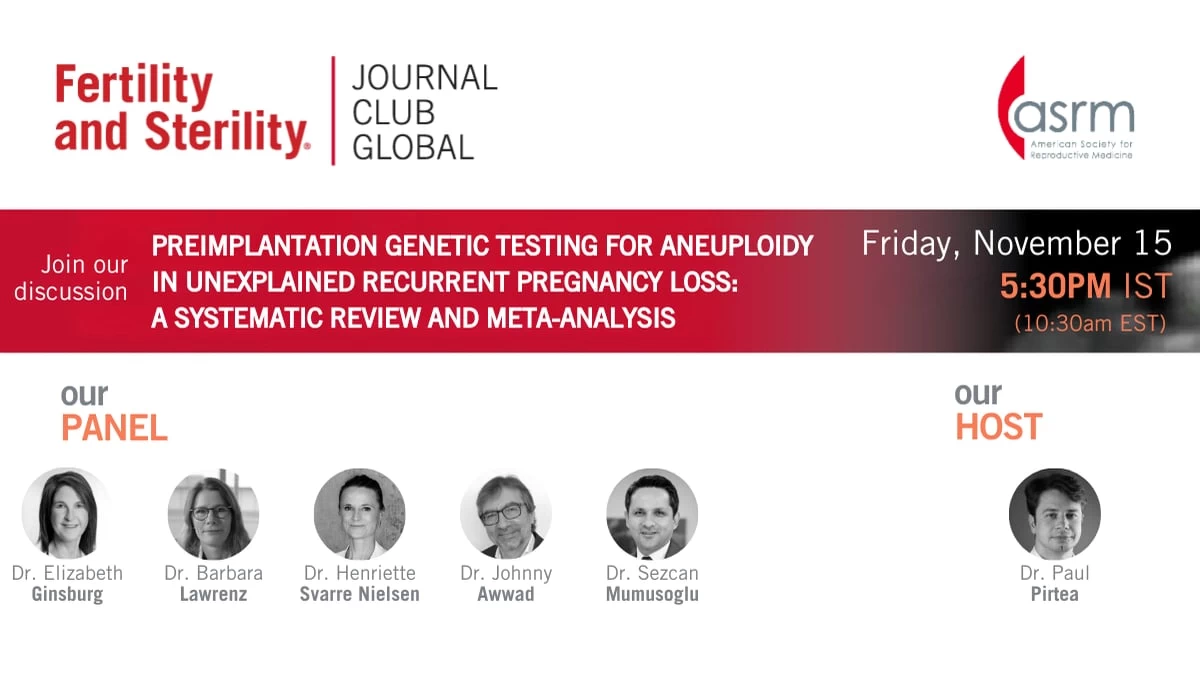
Journal Global Club From TSRM 2024: Preimplantation genetic testing for aneuploidy in unexplained recurrent pregnancy loss: A systematic review and meta-analysis
Explore the effectiveness of PGT-A in managing unexplained recurrent pregnancy loss, featuring systematic review findings, insights on miscarriage risks, and live birth rates.
Journal Club Global from MEFS 2024
Explore BMI's impact on IVF outcomes in a global fertility discussion, analyzing studies, obesity trends, and regional variations in reproductive health care.
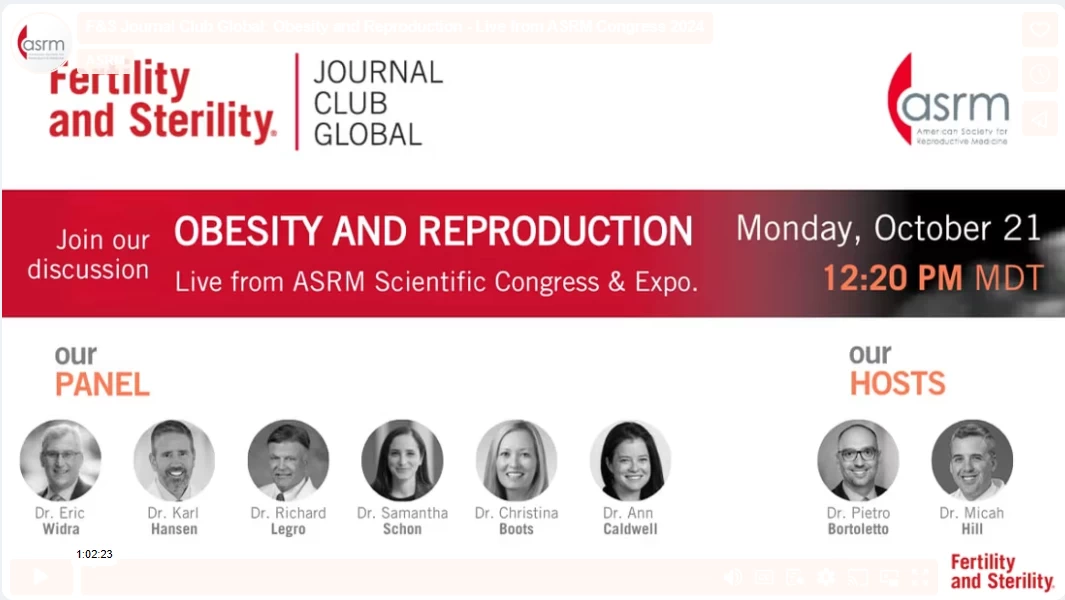
Journal Club Global from ASRM 2024: Obesity and Reproduction
Join experts from Fertility and Sterility Journal Club as they explore the impact of obesity on reproduction, weight loss interventions, and emerging treatments in fertility.
Journal Club Global en Español: De la Reunión de la SAMER 2024
Onsite de la Reunión de la Sociedad Argentina de Medicina Reproductiva (SAMER) de Córdoba, Argentina
Journal Club Global: SREI Fellows Retreat - Fellows vs Faculty Debate: Luteal Support in Programmed FET Cycles
Fertility and Sterility Journal Club debate on progesterone administration in frozen embryo transfers, featuring faculty vs fellows discussing IM vs vaginal routes.
Journal Club Global from ANZSREI 2024: Debate Unexplained infertility; Straight to IVF?
ANZSREI 2024 debate: Should unexplained infertility go straight to IVF? Experts discuss pros, cons, and alternative treatments. No clear consensus reached.
Journal Club Global: Falha de implantação: realidade ou ilusão estatística?
Fertility and Sterility Global Journal Club from Brazil
Journal Club Global en Espanol: Actualizacion sobre el síndrome de ovario poliquístico
Fertility & Sterility se enorgullece de traer un Journal Club Global en Español en vivo desde Cancún, Mexico
Journal Club Global: Oral Progestin For Ovulation Suppression During IVF
Live broadcast from the 2024 Midwest Reproductive Symposium
International in Chicago, IL
Journal Club Global: Recent clinical trials in Fertility and Sterility from the Asia Pacific region
Join ASPIRE 2024 for a Journal Club Global on PGT-A and IVF. Learn from top experts discussing recent clinical trial data and pregnancy outcomes
Journal Club Global en Español: Avances recientes en el tratamiento del síndrome de ovario poliquístico e Infertilidad
Un panel de expertos discutirá dos artículos recientes de Fertility and Sterility que estudian la infertilidad y el síndrome de ovario poliquístico.
Journal Club Global: Cost effectiveness analyses of PGT-A
Infertility treatments can be financially burdensome, often without insurance coverage, making understanding the cost effectiveness of PGT-A crucial.
Journal Club Global: The future of REI Fellowship training: debating opportunities and threats
This exciting collaboration discusses the controversy and future directions for the field of Reproductive Endocrinology and Infertility medicine.
Journal Club Global: Infertility and Subclinical Hypothyroidism
The impact of treating SCH on fertility, obstetric outcomes, and offspring neurocognitive development is debated in the literature.
Journal Club Global: Actualidad En Tratamientos De Fertilidad Para Pacientes Con Endometriosis
Live in Spanish from the 2024 Peruvian Fertility Society Meeting - Lima, Peru
Journal Club Global - Recurrent implantation failure: Reality or statistical mirage?
This exciting new collaboration brings authors and experts to discuss the controversy and future directions for recurrent implantation failure.
Journal Club Global - Evidence based guidelines for PMOS (PCOS)
This virtual event discusses the international guidelines for the assessment and management of PMOS (formerly PCOS), conducted by the International PCOS Network.
Journal Club Global - Recurrent implantation failure: Reality or statistical mirage?
This exciting new collaboration brings authors and experts to discuss the controversy and future directions for recurrent implantation failure.
Journal Club Global - The Association of Ovarian Reserve and Embryo Aneuploidy
Recent research suggests that the Antimullerian hormone (AMH) may not reliably predict embryo health in both infertility and non-infertility cases.
Journal Club Global - Actualización en la suplementación con progesterona en fase lútea para transferencias de embriones congelados
Efectividad del rescate de progesterona en mujeres que presentan niveles bajos de progesterona circulante alrededor del día de la transferencia de embriones
Journal Club Global - Revisiting the STAR trial: The Fellows debate PGT-A
We are excited to host a debate covering the pros and cons of PGT-A and how new technologies should be validated before clinical implementation.
Journal Club Global: Absolute uterine infertility a Cornelian dilemma: uterine transplantation or surrogacy?
Absolute uterine infertility presents as a Cornelian dilemma for patients and providers.
Journal Club Global: Transferencia de embriones frescos versus congelados: ¿Cuál es la mejor opción
Los resultados de nuevas técnicas de investigación clínica que utilizan información de bancos nacionales de vigilancia médica.
Journal Club Global: IVM in Clinical Practice: An Idea Whose Time Has Come?
In vitro maturation (IVM) has the potential to make IVF cheaper, safer, and more widely accessible to patients with infertility.
Journal Club Global - What is the optimal number of oocytes to reach a live-birth following IVF?
The optimal number of oocytes necessary to expect a live birth following in vitro fertilization remains unclear.
Journal Club Global: Surgical management of endometriosis in women diagnosed with infertility (Spanish language)
Journal Club Global: Natural versus Programmed FET Cycles
Journal Club Global: Moving leiomyoma research from bench to bedside
Journal Club Global: Does diminished ovarian reserve impact embryo aneuploidy or live birth rates?
Journal Club Global: Is PGT-P cutting edge or should we cut it out?
PGT for polygenic risk scoring (PGT-P) is a novel screening strategy of embryos for polygenic conditions and traits.
Journal Club Global: Should everyone freeze oocytes by age 33?
Oocyte cryopreservation is one of the fastest growing areas of reproductive medicine.
Journal Club Global: Management of poor ovarian response
A poor ovarian response to what should otherwise be a successful stimulation cycle presents a clinical conundrum for clinicians.
Journal Club Global: Non-invasive Diagnosis of Endometriosis
One of the most exciting developments in the field of endometriosis is the push towards earlier and less invasive approaches to diagnosis.
Journal Club Global: Prognosis in unexplained RPL
Recurrent pregnancy loss is one of the bigger challenges in the field of reproductive medicine.
Journal Club Global: Evidence for Immunologic Therapies in Women Undergoing ART
Reproductive immunology is perhaps one of the most controversial and promising fields within ART.
Journal Club Global Live from PCRS - Non-Invasive Embryo Selection Techniques
The next great frontier in reproductive medicine is how to non-invasively select an embryo with the highest reproductive potential for transfer.
Journal Club Global Live from PCRS - ICSI for Non-Male Factor Infertility
While intracytoplasmic sperm injection (ICSI) has revolutionized the treatment of male factor infertility, a significant controversy still remains regarding its ubiquitous use in all IVF cycles.
Journal Club Global - To Operate Or Not To Operate: Debating Intramural Fibroids And Fertility
The event will debate the upcoming F&S Fertile Battle “Intramural myomas more than 3 to 4 cm should be surgically removed before IVF”.
Journal Club Global - PGT-A - Can non-invasive approaches based on spent medium analysis
PGT-A by trophectoderm biopsy aims to select available euploid embryos for transfer.
Journal Club Global - Obesity & Reproduction: An Update on Management and Counseling
Obesity can negatively impact reproduction in various ways, including ovulatory and menstrual function, natural fertility and fecundity rates, infertility treatment success rates, infertility treatment safety, and obstetric outcomes
Journal Club Global - Does the Endometrium Play a Major Role in Endometriosis-Associated Infertility
This will be a virtual event in the style of the "Fertile Battle" debate that took place at the 2019 SREI Fellows Symposium
Journal Club Global - Best Practices of High Performing ART Clinics
This Fertility and Sterility Journal Club Global discusses February’s seminal article, “Common practices among consistently high-performing in vitro fertilization programs in the United States: a 10 year update.”
Journal Club Global - Should Fellows Perform Live Embryo Transfers in Fellowship?
Few things are more taboo in reproductive medicine fellowship training than allowing fellows to perform live embryo transfers.
Journal Club Global - Fertilization rate as a novel indicator in ART results
This Journal Club Global discusses a provocative article recently published in Fertility and Sterility, discussing the results of a multicenter retrospective cohort study with the objective to appraise the fertilization rate as a predictive factor for cumulative live birth rate (CLBR).
Journal Club Global Live from ASRM - Optimal Management of the Frozen Embryo Transfer Cycle: Insights From Recent Literature
Three recent papers published in the Fertility and Sterility family of journals, all explore different aspects of optimizing frozen embryo transfer cycles.
Journal Club Global - Are We Approaching Automation in ART?
Some ART diagnostic devices are already available and offer objective tools of evaluation.
Journal Club Global Live from India - Adjuvants in IVF and IVF Add-Ons for the Endometrium
Many adjuvants have been utilized by IVF centers to improve their success rates.
Journal Club Global - Accuracy of Preimplantation Genetic Testing for Aneuploidies
Club Global Académico - ¿Cual debe de ser la primera línea de tratamiento en parejas con infertilidad inexplicable?
Nuestro debate se enfocará en el manejo óptimo de la infertilidad inexplicable, y como el problema debe de ser abordado en Latinoamérica basado en la literatura global reciente.
Journal Club Global - Recurrent Implantation Failures in ART: Myth or Reality?
Fertility and Sterility
F&S Reports
F&S Reports is an open-access journal that publishes peer-reviewed original scientific articles in clinical and translational research that have strong potential to transform clinical practice.
F&S Reviews
F&S Reviews publishes both systematic and comprehensive, authoritative review articles spanning reproductive medicine or science.
F&S Science
F&S Science publishes peer-reviewed original scientific articles in basic, laboratory, and translational research that has strong potential to transform clinical practice.
Fertility and Sterility
Fertility and Sterility® is an international journal for health professionals who treat and investigate problems of infertility and human reproductive disorders.
Journal Club Global
Fertility and Sterility Journal Club Global is an interactive online discussion of a hot topic or seminal article from Fertility and Sterility.