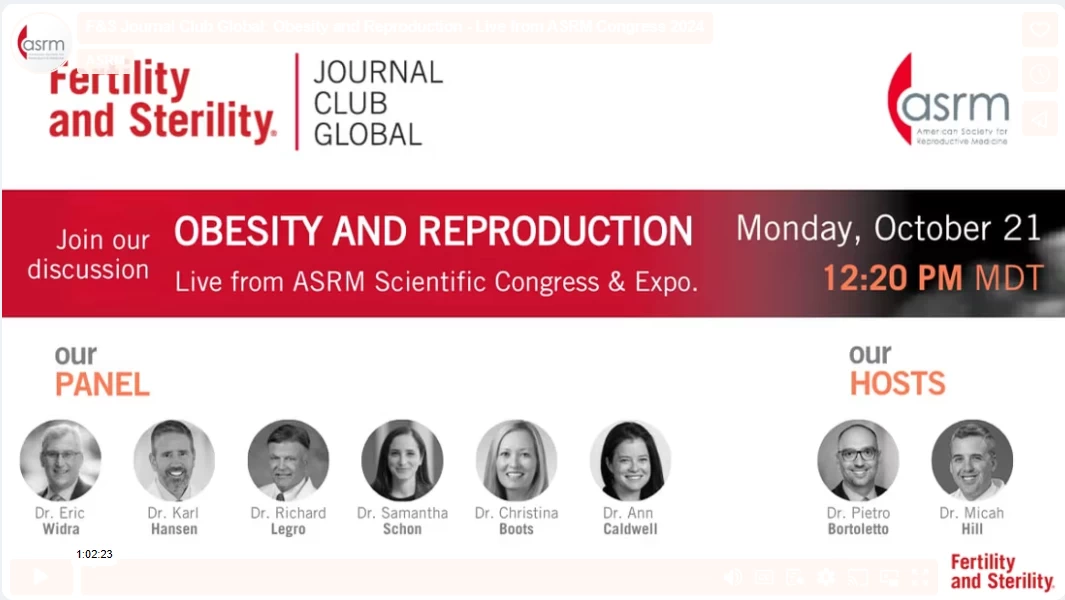
Good evening and welcome. My name is Pietro Bortoletto. I'm the FNS Interactive Associate in Chief and Media Editor for FNS Reports, and it's my privilege to host tonight's Journal Club entitled Obesity and Reproduction, an update on counseling and management.
Tonight's Journal Club is focusing on the recently released ASRM Practice Committee document entitled Obesity and Reproduction. I'm joined tonight with a very illustrious panel of experts that I will introduce shortly. But first, I wanted to welcome Dr. Alan Penzias from the Beth Israel Deaconess Medical Center Boston IPF Practice and Chair of the ASRM Practice Committee to tell us a little bit about how these practice committee documents are created and how they're different from guidelines and guidance documents.
If you're logged into the chat, you'll notice that you have the PDF of tonight's document available for you to follow along, print out, and share. Alan, thanks so much for being with us tonight. Turn it over to you.
Happy to be here. Thank you so much. And thank you for allowing me to share some insights into the practice committee and how the documents that you get to read and that we get to talk about at journal clubs like this come to be.
So Thea, if you can put the slides up. When you go to the ASRM website, if you navigate to the place where the practice committee documents live, you'll see a list very much like this, which I took yesterday as a screenshot. And what you'll notice is that there are really three dominant types of practice committee documents.
The first you'll see are committee opinions. The next are guidelines. And then the third style are guidance documents.
There are subtle differences between the three, but essentially as an overview, the practice committee documents are really developed to assist practitioners with evidence-based clinical decisions and best practices regarding the care of their patients and management of their practices. One distinction that makes the ASRM documents a little different than perhaps other guidance or guideline documents you may see elsewhere is they're not meant to be book chapters. They're really to address a very specific issue.
And they're also not recipes that apply themselves to every single clinical situation. So following a guideline to the letter doesn't guarantee a specific patient outcome. When people understand that there are some subtle differences, and this is probably what I spend a fair amount of time trying to explain, what is the difference between a guideline, a committee opinion, and a guidance document? Essentially what it breaks down to is as follows.
Guidelines conform to a very, very strict methodology. They're based on a documented, structured, comprehensive, reproducible, and systematic literature review. So that is a very key element there that then results in a formal assessment and grading of the literature in terms of the quality of evidence and the strength of evidence.
And those two combined yield a strength of recommendation. Also, very key to guideline development is a clear understanding of the composition of the authorship group. It needs to be multidisciplinary, which we have.
Have a methodologist involved. Have both a patient and a public member. Conflicts of interest need to be disclosed by any member who's going to be writing or touching the document.
And conflict management, which is a very key element, also has to happen. External review is a key feature. And updating every five years or when a seminal paper is published, that may be groundbreaking or disruptive.
In contrast, not all topics are really appropriate for a systematic review. In some cases, the literature may not be available yet. However, at ASRM, it's the same committee structure, the same conflict of interest management, the same external review, and the same updating frequency that our committee opinions and guidance documents have.
So when you look at a committee opinion, it does utilize applicable literature, but there's no formal grading of the quality and strength of evidence or a strength of recommendation. And it really represents clinical expert consensus based on the literature on clinical care, whereas guidance documents are the same but really represent best practices. Now, the question that I also get a lot is, where do these ideas come from? Where do the documents come from? What are the topics? Who picks them? And essentially, the ideas come from two different sources.
One is we already have a trove of documents that we're evaluating very frequently and periodically updating or retiring documents. There are members of the committees at the practice committees that are from a variety of different corners of the society. And we also get suggestions from members.
So if you're a member of ASRM and go to the web page, there's a little box you can check. I have an idea. I'd like to see a document produced.
And you can actually submit a recommendation. And we take those very seriously. And many of our documents have come from suggestions by members.
But the pathway from idea to document goes through the practice committee. Now, for those of you who are not familiar, there are 19 members of the practice committee. And it's comprised as follows.
There's a chair who I am currently in my sixth and final year. Dr. Clarissa Gracia from Penn is the vice chair and will take over as chair upon my completion of my task. Also, there are each of the five affiliate societies, SRBT, SREI, MRU, Society for Reproductive Surgeons, and SART.
Each have a representative. There are three members at large, a community member, patient education member, and a representative from ACOG, along with six members of ASRM leadership and staff. When we think about the timeline from idea to publication, it can range from somewhere between 12 to 18 months.
And there are a handful of steps. First, the practice committee has the idea. And we define the scope of the document.
Typically, we want to keep the document narrow enough to keep the final lengths under 12 pages for the most part. Occasionally, it'll get up to about 18. But we want to make them accessible.
We want to make them usable. And in a question and answer type format that you can actually pull out, apply today to your clinical situation. So that's all done by the practice committee.
At that point, when we decide we're ready to go, we empanel a task force. And this is a great volunteer opportunity for anybody who's a member of the society. Each task force is led by one of the sitting members of the practice committee, who serves as chair of the task force.
But task force members are drawn from the wide range and diverse expertise of ASRM membership. We aim to have senior members who've been members of ASRM for 10 or more years. We want junior members of ASRM who've been members of the society for under five years.
We want people, REI fellows, if you're a scholar and have done the formal training in research, those are the types of individuals we will recruit. And how do we get these folks? From volunteerism. We also have a consulting epidemiologist, an ASRM staff member who's a literature search specialist, as well as the education manager.
From there, we go into an iterative process of writing, review, revise, and repeat, where the interaction between the task force and practice committee will hone the document into a final form that we think is just about ready for prime time. At that point, if you're a member of ASRM, you're going to get an email blast that says, hey, a practice committee document is available for your review and comment. This is the ultimate in peer review.
Every single member of ASRM has the opportunity to look at every one of our documents before they're published in final form. You'll look at the PDF, we ask for your comments, we look for your feedback, and then we take all of the feedback that we get, we take a look at our document, and very frequently we will incorporate member comments, and that has really helped make these documents living, breathing, and really reflective of the society. From there, it goes to ASRM leadership, and from the leadership, once it's signed off, off to fertility and sterility to be published, and you'll see it on our website.
Now, the last slide I have is a final pitch, and that is that also on the quick links that you'll see on the webpage for practice committee documents, where it says volunteer or submit a topic. Please, please, please click to volunteer, because why? We need your intellect. We need your enthusiasm.
We want your unique point of view. We want diversity. The more diverse members of our society that contribute to our documents, the stronger they will be, the more they will really reflect the strengths that we have as a society together.
If you're a fellow, it's a great time to start volunteering and getting involved in ASRM, and for everybody who volunteers, we want you to be part of the future of this great field that we have to produce the best evidence-based documents, and it really takes all of us to do that. And with that, I thank you for allowing me to share my opinions, and I will listen and learn. Thank you, Alan.
Well, now that we all know what a committee opinion is, including myself, let me introduce you to our panel of experts, some who participated in the creation of this document, some whose research was taken into account for this document, and people who live and breathe counseling obesity and reproduction in their daily life. As a reminder, you can pose a question or make a comment to the panel in the chat function, and we'll try to get to as many as possible, and I apologize in the event that we don't, but let me introduce you to our panel. First up, we have Dr. Emily Youngheim.
She's the Chief of REI and Medical Director for the Center for Fertility and Reproductive Medicine at Northwestern, mild stomping grounds, and she also serves as an Associate Editor for FNS Reports. I'm also joined by my co-fellow, Dr. Philip Romansky, who is a third-year REI Fellow at the Weill Cornell Medical Center. His research interests include the association between obesity and infertility treatment outcomes, and he's published extensively in the area on IVF treatment outcomes, embryo ploidy, and complications during stimulation and retrieval as it relates to overweight and obese patients.
Also with us is Dr. Audrey Gaskins. She's an Assistant Professor in the Department of Epidemiology at the Roland School of Public Health at Emory University, and as a reproductive and environmental epidemiologist, she has built a strong research portfolio, designing and executing studies, looking at the relationship of lifestyle and environmental factors to semen, ovarian reserve, miscarriage, and infertility treatment outcomes. And finally, Dr. Carl Hansen is also with us.
Dr. Hansen is an REI Professor and Chair at the Department of OBGYN at the University of Oklahoma Health Sciences Center. He's a member of the ASRM Practice Committee, and luckily enough, was the chair of the task force that revised this practice committee looking at obesity. Thank you to our panel for being here.
Carl, I wanted to start with you. Given that you're so intimately familiar with this document, I imagine a 12 to 18-month timeline, it kind of felt like it had a gestation to it. I was hoping that you could give us your executive summary and highlight to the audience what's changed since the 2015 update.
What are kind of the need-to-know points from this document? Sure. Well, let me just start off by saying thank you. I really appreciate the opportunity here tonight, and also had the opportunity to work on this document with a great task force.
Emily's with us tonight and was one of a number of people that helped write this. It was a fantastic experience, and we're really proud of the work we put together. I think the things that have changed over the last few years that led to a need to revise this document are several things.
The first is that the document from a few years ago relied very heavily on observational data or small clinical trials. Certainly, the bulk of the evidence would suggest from those trials that weight loss intervention should improve outcomes. But what's happened over the last few years is that we now do have large, randomized, controlled trials that directly address this question of interest, and that is, does a weight loss intervention prior to infertility treatments improve outcomes in terms of pregnancy and live birth rates? Additionally, there was also really a desire by our membership for us to address BMI thresholds, and a number of individuals came to the practice committee and said, we need to be talking about this.
And so, a revision of this document gave us the opportunity to address that question. And then, finally, we were hopeful that a revision could make this document very user-friendly in terms of providing information that the reader may want on short notice. And that made the document longer, but we thought the information was helpful.
Things like talking about the types of surgeries that are done, the types of medications that are available, talking about relative and absolute risk of complications of pregnancy associated with obesity to be helpful from a counseling standpoint, and then also, importantly, looking at the relative impact of age and obesity on ART outcomes. So, for example, good data suggests that obesity is associated with poorer outcomes in ART, but we also know increasing ages. And so, if we're going to ask a patient to spend the time to lose weight, how much are we gaining and how much are we losing? So, for all those reasons, we felt it was time to readdress this document.
And I would say, you know, the high-level points from the document, one of which I think is mentioned only once near the end, but I think it's important, and that is that most women and men with obesity are fertile. And I think that's important when we're talking about BMI thresholds to withhold treatment. You know, most patients, women and men with obesity, are getting pregnant all the time without my permission or your permission, and so are those with diabetes.
So are those that are smokers. And so, we need to keep that in mind when we're counseling patients and move to more of a shared decision-making approach when we're talking about BMI issues. When we're talking about the big clinical trials that are included in this document, and there are three that are included, I think, being honest, all of us are a You know, I think when we look at anovulatory patients from a high level, anovulatory patients that go into a weight loss intervention are more likely to achieve an unassisted pregnancy.
They are likely to require lower doses of medications in order to induce ovulation. And in some cases, they will ovulate at all when perhaps they wouldn't before weight loss. But when we look at the outcome of live birth, those trials have not shown a statistically improvement.
I think in the case of anovulatory patients, those trials are still slightly underpowered because the differences in outcomes, I think, are meaningful. They just weren't statistically significant. When we look at ovulatory patients, whether we're talking about non-ART or ART therapy, unfortunately, those trials have not shown an improvement in outcomes following a weight loss intervention.
Now, in both of those cases, what we should be aware of is that what I've talked about from an outcome standpoint so far is pregnancy and live birth rates. But that's not the only thing that should matter to us. What should also matter is a safe pregnancy resulting in a healthy live birth.
And many of these trials suggest that a weight loss intervention may decrease the risk of those complications. But unfortunately, the trials are underpowered, really, to look at those issues. Because if you start off with a trial that already has to be big to look at an outcome from an infertility treatment, and then only a certain percentage of those patients get pregnant, you're just not powered to look at pregnancy outcomes.
But there's the suggestion that pregnancy-induced hypertension problems and preeclampsia are possibly lower with a weight loss intervention. But there's also a small suggestion that maybe the risk of miscarriage is higher. I think from a high level, too, and I think the document does a great job of looking at this from an ethical standpoint, is that BMI thresholds really ought to be based solely on the ability to safely provide care in one's clinical environment.
I just don't think that you can rationally come to a different conclusion, although I know our MFM colleagues would think differently of that. But as I mentioned earlier, patients get pregnant all the time without me saying that's okay. Our job is to counsel them about the risk and benefits and try to take care of them as best we can.
Fabulous. Thanks, Carl. That was a wonderful high-level summary for people who haven't yet had a chance to read the document.
Again, as a plug, located as a PDF in your control panel that you can download and follow along. I want to open it up to the rest of our panel. I want to talk a little bit more about this document, talk about the research that went into this document, and what do we do with it when we're actually sitting in front of a patient and they ask these questions.
It's not often that we have an expert in the field who has done most of this research that goes into this document, but we have Audrey Gaskins, who's here with us tonight. Audrey, I'm so excited to have an epidemiologist help us talk a little bit about something that Carl mentioned, that five, well, five, six, seven years ago now, this document relied heavily on observational data. Could you tell our listeners tonight, what did the observational data tell us and how we think obesity might impair fertility and reproduction, be it from the male or the female side? Sure.
We know a lot from observational data. There's been a lot of it. Among women, there's ample evidence that obesity is related to lower reproductive success, including higher risks of anovulation, irregular menses, infertility, miscarriage, stillbirth, as well as lower success of fertility treatment.
During pregnancy, obese women have an increased risk of almost all complications, including gestational diabetes, hypertension, preeclampsia, gestational diabetes, preterm birth, larger gestational age, etc., and then obesity has also been linked to poor semen quality and altered endocrine and reproductive hormone levels and lower life-birth rates following IVF treatment. However, as I mentioned, all of this epidemiologic evidence has come from observational studies that have compared obese men and women to normal-weight men and women, and this type of research has important limitations. I'm not going to go into all of them, but ones that I would like to bring up are confounding, most notably by other medical comorbidities, such as diabetes and hypertension, and also selection bias, owing to the fact that body weight is often related to the likelihood of seeking medical treatment for infertility, as well as receiving it.
It's also really important to note that in most instances, the reported effect estimates, while elevated and statistically significant, were not large. Therefore, that means the absolute difference in the occurrence of these outcomes comparing obese and normal-weight women tended to be modest, so, for example, on average, a month or two longer time to pregnancy or a couple percentage point difference in miscarriage risk. This is really important.
Also, despite the shortcomings on this literature, weight loss has been strongly promoted as one of an effective means of increasing fertility in overweight and obese women. However, very few studies have actually evaluated this research question, and so, while I think, as was mentioned earlier, there was some initial hope from small trials and observational studies on weight loss and fertility, three large, well-conducted, randomized controlled trials have shown that short-term weight loss among overweight and obese women immediately prior to infertility treatment does not improve a woman's probability of life birth, and although there are no randomized controlled trials evaluating short-term weight loss and fertility among women conceiving without medical assistance, the observational evidence to date also suggests limited fertility benefits with weight loss. There's also extremely limited evidence on the utility of weight loss in obese women.
So, to answer your question, there's a lot of data that's missing to effectively answer the question of whether weight loss impacts fertility in men and women. Conducting additional randomized controlled trials to address this, for example, in men and women conceiving without medical assistance, would be great. That would be ideal, but these trials are extremely challenging to conduct.
They're often also prohibitively expensive. So, observational studies can help us address this question, but it's also quite rare for men and women to report significant weight loss, and then, within that, there's a lot of heterogeneity in how this weight loss was achieved, which makes studying this question a big challenge and still very much an open question. So, you're telling me that we're not going to have an answer anytime soon, definitively, huh? Probably not, but that's kind of an epidemiologist's dream, right? We always want open questions.
That's a good point. So, we're expecting more papers from you and your team, but since you're here, I want to talk a little bit about how we define obesity. I think fundamental to any good research question is a good research definition and defining the outcome, defining the exposure.
We've traditionally kind of dumbed down obesity to a height and weight calculation, where we use that number to sometimes give people care or withhold care, give people medication or withhold medication. Are there better things that we could be using within reproductive medicine to better get at the question, does obesity, however we choose to define it, actually impact reproduction? Things like insulin resistance, number or types of comorbidities, or are there better things than BMI that you with your research brain think we could be moving towards and encourage people who are listening and thinking about putting together the next study to look at? Yes, all the things you mentioned sound great. I would also add, you know, something very simple is like waist circumference.
There have been studies showing that that, in addition to BMI, provides a lot of extra information on both body fat distribution, as well as just body fat in general. Again, that's a pretty simple measure, so that's what I would throw out there. That's a pretty low-hanging fruit, but yes, other kind of metabolic indicators that are associated with obesity, like insulin resistance, that would be great to incorporate because then we can better understand what exactly we're looking at and what actually we're studying.
Yeah, and speaking of studying, I'm going to put you on the spot here since we have your brain and your body of research. You've had an opportunity to conduct a lot of the observational data and participate in some of the prospective studies that have looked at this. What does the perfect study look like to be able to answer, is there a true cause and effect relationship here, and will it ever tell us, is this an oocyte quality issue, an endometrial functioning issue, a male sperm contribution issue? Does the perfect study exist, or is this kind of a pipe dream that we all have? It really depends on your research question.
I feel very much like an epidemiologist with that answer, but again, it really depends. If your question is, does short-term weight loss prior to infertility treatment result in greater success, then those randomized controlled trials are pretty directly addressing that question. I think what might be more relevant is, let's say, among women trying to conceive without medical assistance, if I took a year and tried to lose a significant amount of weight through a variety of means, would that help me avoid infertility treatment, get pregnant sooner? Like I said, those studies are really hard to do because it's really hard to recruit couples who are conceiving without medical assistance.
It's only one to two percent of the population. There's a lot of attrition that goes into randomized controlled trials, so it's hard. It's a challenge.
With observational data, when we get bigger sample sizes, we can study more rare exposures like weight loss, and again, we can target unique populations that might be more likely to have achieved weight loss and then gone on to undergo fertility treatments. Women undergoing bariatric surgery would be a great example. There's more and more reproductive-age women undergoing this procedure, and as that happens, we'll have more data to build that evidence.
But no, I don't think there's a perfect study that's going to answer all of our research questions now. Chucks. I would have already submitted that as a grant, you know, if I had that answer.
We would have funded it. Carl, you and Audrey both touched on something, which is we've really focused a lot on the female contribution to obesity, but more and more, I think, when there is the opportunity to view it as a couple, when the patient in front of you is coupled, let's talk a little bit about the contribution that the male partner may have here. I read somewhere that obese women are twice as likely to be coupled with an obese male partner than thin women, so viewing this diet together may be informative.
Do you think some of this data that we're seeing about miscarriage rate being higher in obese women may have something to do with a male partner who's also obese, contributing sperm, that has higher levels of DNA fragmentation, mitochondrial dysfunction, oxidative stress in the semen? Are we missing half of the story here when we read some of this literature? Yeah, I'll jump in and then certainly I'm interested in Audrey's thoughts and the panelists as well. You know, I would agree that much of the literature that we look at is focused entirely on the female partner, and so in many cases, we don't even have the characteristics available and the demographic information to begin to look at what the male factor component is. But certainly in some of the larger studies where we do have some male data, there are studies that suggest that obesity is associated with concerns in all of the areas that you've mentioned.
So, for example, just semen parameters, DNA fragmentation, epigenetic changes, decreases in outcomes from fertility treatment, and increases in miscarriage rates. So there are some pieces of data that support all those things, but generally speaking, we don't do a good job of capturing that information or addressing it in the design of the analysis of trials. You know, when we look back at the outcome of Amigos, which is one of the big trials that we did as part of the Reproductive Medicine Network, we did not see an association with BMI, with male BMI outcomes of treatment.
But again, BMI alone is a pretty poor way to evaluate body fat distribution, and so if we looked at that in other ways, would we have been able to say something that was more hypothesis generating? Hard to know, but again, we need to do a better job of looking at that question. It's tough to look at. I feel like so often we find ourselves counseling the female partner about her weight, and it's potentially a missed opportunity for risk reduction for the couple and hopefully the resulting family to get them to lose weight, to be able to achieve that conception, but also just be healthy.
I think that's even worse with COVID, because we see so many patients independently, or we're talking with them on the phone or through Zoom, and it's a one-on-one conversation instead of a one-on-two. That's a great point. I want to move now away from what the research tells us, because the perfect study doesn't exist.
Unfortunately, Audrey told us that, and we're left with the observational data and the RCTs that we do have, but at the end of the day, a lot of us still have that patient in front of us who's asking us what it means for them. Emily, I want to ask you, when you have that patient who's in front of you who is overweight to obese, what do you tell them about how that obesity may impact their success with the treatment that you want to propose for them? Well, just as some of you guys have already mentioned, I think Carl had mentioned, you see plenty of overweight and obese women who come in pregnant without any issues. I think it's really important to discuss what her history is and figure out, is there an underlying etiology for why she hasn't conceived? Because it may have nothing to do with her obesity at all.
It may be her partner. It may be her tubes. Who knows? So I think first and foremost, it's really important to look at that.
But then certainly when talking about moving forward, the pregnancy is long and this is a unique opportunity we have to really make an impact in someone's long-term health. So if you see a patient who has a significantly elevated BMI, bringing it up and discussing it, I think is perfectly reasonable and appropriate and we should. Asking the patient how they feel about that.
I mean, everyone who is obese knows they're obese. They've tried to lose weight before. So I think digging into that history and learning a little bit more about it and whether or not they're ready to lose weight.
And if so, what have they tried in the past? What worked? What didn't work? A lot of times it's just trying to find something new. For a lot of these patients, the question is how much weight should I lose? And I think that's where we've struggled a lot in trying to counsel these patients is what's a safe BMI for pregnancy? And then the next piece is a lot of these patients have to lose 100 pounds or more. And how do you achieve clinically meaningful weight loss that's sustainable? A lot of times bariatric surgery is the most efficient and effective way to do that.
And for a lot of our patients paying out of pocket for IVF or other treatments, bariatric surgery may not be covered either. And so that can make it even more difficult. And I could go on and on and on, but I think at the end of the day, it's really taking a patient-centered approach and having shared decision-making about what their goals are, where they're at, really focusing in on what their comorbidities are.
As we've discussed, it may not be just obesity, but the associated comorbidities. And if they have significant comorbidities, really honing in on those and talking to the patient about what that means for their pregnancy, what that means postpartum in terms of how they're going to recover and be able to move forward from that. But a lot of it is just practice, I'd say.
And it gets easier the more and more of these patients you've seen. They have the same goals as everyone else. Yeah.
Carl and Alan, I'll ask you, since we have two other expert clinicians here, how often are you involving ancillary experts into this counseling? Are you having them see a maternal-fetal medicine specialist to help reinforce the obstetric risks? Do you have a nutritionist that you work with and refer patients to routinely? Is bariatric surgery a number that you have on speed dial that you can have them connected with? Or are you really going at this alone and trying to make your best pitch for why weight loss for this patient in front of you may potentially be helpful? Alan, do you want to start with that, or would you like me to? Sure. Sure. Yeah.
I mean, we have a nutritionist who's on staff. We refer patients to an external commercial entity that helps medically manage weight loss, because we know that when we're talking to patients, they often feel there's a lot of shame associated with obesity. There's a lot of blame.
People who have infertility to begin with have shame and blame, and then you compound obesity, and then people making comments to them about, oh, maybe you should just lose some weight. So we just want people to be able to eat a healthy lifestyle. So to be able to get some tools with that, we will refer them out.
But it's not necessarily so much just to achieve a weight loss goal, because as Emily said, and as Audrey has already eloquently said, there's no perfect way to study this, and there's no perfect number. But helping people understand that we want them to be safe when they go through their procedures, we want to be able to have them feel good about themselves, and sometimes just being able to point them in the right direction will help. Yeah.
I would say that from our group's perspective, certainly we have a bariatric surgeon that we can and do refer patients to on occasion. We have dietitians that we can send patients to. I admit that I do a fair amount of just counseling on my own, and thinking about patients, as Emily mentioned, they're well aware that they're obese, and they usually try lots of different things.
And so I try to talk with patients about not going overboard on exercise initially, because I tend to find a patient that is trying to do a really heavy exercise program and then a crazy hard diet, and you know that they just can't be successful with that for very long. And so recognizing that their body weight is much more related to their diet than it is their exercise, and it's the rare person that exercises enough that they make a meaningful difference in their weight. Exercise helps you age well.
It helps you be healthy, but it is not a big weight changer. And so, you know, do things like walking initially, but really focus on your diet in terms of what you're taking in, and then giving them calorie goals, and then actually saying, how do you do this in today's society when portions are huge? You have no idea how many calories you're taking in. And in many cases, it's talking with them about meal replacements just because there's, it's very difficult to figure out how many calories you're taking in, and then having regular follow-up schedule.
You know, for some patients, they don't want to come back in, but for others, it's a powerful motivator to know that in three or four weeks, we're going to make them get on the scale again. And so I offer patients doing that as well that are wanting to focus on weight loss. That's great.
I think that's exactly the stuff I'm hoping to share with our listeners tonight is kind of what's your expert, how do you do things? How are you counseling patients? Is anyone here on the panel? I think we lost Pietro. His questions were so good. Hi, everybody.
I think the internet gods did me in here. Yes. I apologize.
All right. I think we're back. So what my question was supposed to be was, is anyone here on the panel actually primarily prescribing any of the medications that this document nicely outlines, be it Phentermine, Orlistat, Laraglitide, or is anyone prescribing that? Are you having people help you with that prescription in counseling? We will refer people out for that because we feel that those who use those medications most regularly are the best to manage not only the indications, but the side effects from them.
So, you know, we want to make sure that our patients are well supported, you know, in a comprehensive team-based approach way. In light of the nice review that I think this document does, and I encourage everyone to read that section, it highlights a little bit about the evidence base between these medications, and there's a really nice section on surgical options. Is anyone here seeing more patients opting for bariatric surgery ahead of infertility treatment, or are you seeing patients on the back end who have done the bariatric surgery and are now coming to you? Is there a trend that you're noticing in your practices? I would say I see some of both, you know, some on the back end and some that decide and they disappear and get their surgery done and come back.
And I, you know, just to put it out there, I, you know, I was in St. Louis several years ago for in practice for 17 years, and obesity was, I mean, that was my every day, and a lot of folks opted for things like bariatric surgery or had had it done. Now I'm in downtown Chicago, and honestly, it's rare that I see a patient who's obese. So that was kind of mind-blowing to me because my patient populations are just so, so different.
I'm just curious if others, I mean, Carl, I would imagine your population is much different than Alan's and Pietro's and Phillip's. It is really fascinating. I think that influences our opinions and how we approach this and how we approach these patients.
Yeah, I agree 100%. Definitely. And it's actually a nice transition talking a little bit about how there are certainly, definitely regional trends to where some of the higher PMIs will, are more likely to find them.
Phillip and I had the benefit of being co-fellows and co-residents together, and we trained the Brigham and Mass General Program, where we happened to be in a mandated state. So we saw patients who had generally more access, and that generally meant a little bit wider range of pathology that you saw coming through an ART program. Phillip, you've done a lot of this research and have published on infertility and sterility, but we've got, we've talked about is there a link between obesity and reproduction? We've talked about how we counsel these patients about potentially modifying that, but we know from this practice committee document that a lot of patients aren't really going to make a meaningful difference, a large difference to have a modifiable effect on their reproductive potential.
So we're seeing a lot of patients with high BMIs undergoing ART and having to undergo egg retrieval under anesthesia. A lot of you have asked about a BMI cutoff and how it probably relates to the anesthetic risk. So can you tell us a little bit about what your study has shown and what you think the providers who are struggling with this BMI cutoff should know about at least the institutional experience in Boston? Yeah, definitely.
I can talk a little bit about some of the procedural concerns that an REI physician should be aware of at the time of retrieval in patients with obesity, but also a lot about the anesthesia concerns that the anesthesiologist and the whole team has to be aware of. As Dr. Hansen mentioned, making sure that we're treating patients appropriately and in a safe fashion is certainly a primary concern. And as the committee opinion points out, a lot of centers have BMI guidelines around the country, and the most common reason for that is because of, they have, sorry, BMI cutoffs.
The most common reason is because of anesthesia cutoffs that are in place, meaning the anesthesia team is sort of determining what level they feel they can safely care for. And so the things that an anesthesiologist has to consider when evaluating a patient with obesity prior to administering anesthesia, in addition to any prior anesthetic history, would be their mal and potty score. So how easy or difficult do they anticipate that patient would be if they needed to be intubated, as well as all of their additional comorbidities, and that goes into their ASA.
And that's sort of just a way to communicate a patient's systemic disease, whether they're normal, healthy, whether they have mild disease, whether they have more severe systemic disease. And all of these things combined help the anesthesiologist to determine the risks that that patient might have at the time of retrieval. The major risks that we think about for a patient undergoing total IV anesthesia is one, an aspiration risk, and that's a risk that all of our patients have the potential for.
And then two is the risk of desaturation and how the anesthesiologist is going to manage the airway. So with the aspiration risk, we know that that's slightly increased than any patient undergoing a retrieval because they're in lithotomy position and they have elevated estradiol levels, which decreases gastric emptying. In addition, patients with obesity have increased rates of comorbidities like acid reflux, things that increases that potential risk.
So that's a concern that has to be paid attention to. And then the other major concern, of course, is the risk of desaturation. And so in the paper we published with the Brigham data in 2019, we were really looking at the complications at the time of oocyte retrieval, severe complications and more mild complications.
Clearly, what we observed was that as BMI increases, there is a higher risk of desaturation, and that's not surprising. As the amount of adipose tissue increases on the chest and in the soft tissues around the neck, there's going to be a higher level of desaturation that occurs. But the important thing to pay attention to is how easy is that desaturation to manage and how are anesthesiologists managing that.
And in the majority of our patients, they were successfully managed with either continuous positive airway pressure or a nasal or oral airway. And among the cohort of patients with BMI above 40, so class 3 obesity, we had about 20 to 30% of patients did have a desaturation event that had to be managed with CPAP or a nasal or oral airway. So it's a common occurrence and the anesthesiologist has to be prepared to be able to deal with that.
But in nearly all of those events, the desaturation was managed appropriately without any further complication. Then we looked at more serious events, and that would be placing an airway like an LMA or potentially having to intubate a patient because that's what could be very difficult in a patient with a high malaparte score that might be difficult to manage, especially if you're not in a hospital setting and maybe don't have all of the resources to do so. And what we observed was that that was a very rare event.
In the 224 patients that we retrieved with a BMI between 40 and 50, that never occurred. There wasn't a single patient that couldn't be managed with CPAP or with a nasal or oral airway. In the additional 32 retrievals that we had in patients with a BMI above 50, there were two patients that did have to, that necessitated an airway placement, and both of those had an LMA placed.
And that was successful and no further intervention was necessary. So among this cohort, there were no patients that needed to be intubated, but certainly an airway was needed to be placed in two of those patients. And so again, the anesthesiologist and the team has to determine what resources they have and the providers that are providing the anesthesia, what level of difficulty are they able to safely manage and to handle on a daily basis.
Even though some of these events are very rare, when these complications do occur, of course, they can be very serious. And so those are very important things to take into account. Separately from that, we looked at some of the procedural risks that go along with the retrieval in patients with increasing obesity.
And we did observe that the time of the retrieval increased with increasing obesity classes. And I think that's an important thing to be aware of, because that can go a little bit into how retrievals are being scheduled. And obviously, that's a logistical challenge to sort of shuffle things around, but it's something that I pay attention to when ordering, when placing patients in order of trigger and retrieval, is that if I have a patient with class three obesity, I might consider placing that patient at the end of the retrieval day.
In case that retrieval takes a little bit longer, it might be a little bit more difficult. In patients with class three obesity, we more commonly do a trans-abdominal retrieval. You never know until you take a look.
Some patients with obesity are very easy to visualize and access the ovaries vaginally. Sometimes they're very difficult, but when you place an ultrasound probe on the abdomen, the ovaries are sitting right there and they can be very easily accessed. So you want to allow for that potential, especially if it's a patient that you think there's a high potential for that, to be able to convert to a trans-abdominal retrieval if that's necessary.
Fabulous. So the question that I think everyone here on this panel is probably wondering, and everyone who's watching wants to know, is a question about a BMI threshold. Does it make sense from a safety perspective? Does it make sense from a likelihood of success outcome of treatment perspective? Because when they've done surveys of REIs, 60% of SART clinics report a threshold typically between 35 to 45.
It's the rare exception that doesn't have a BMI cutoff or that allows a much higher BMI cutoff. So I'd be curious to see Carl, Emily, and Alan, who are in three very different centers, does your center have a BMI cutoff and how does that negotiation happen between you, the anesthesiologist, and the patient on who you can and can't take care of and who you're willing to stimulate for IVF? Yeah, I think that depends on the individual. We do have a BMI threshold of 50, but that's based on our safety concerns more so than being concerned about the outcomes of treatment, success or failure, because obviously we treat a lot of other prognosis patients.
But that 50 is from a safety standpoint. And then for some patients, in many cases with a lower BMI than that, that have any other comorbidities, then we talk with the anesthesiologist about the particulars of the situation. And then in each of those cases too, you have to do an ultrasound to see, not only can you safely do an egg retrieval, but can you actually safely monitor a patient undergoing stimulation? And you can have someone with a BMI well below that, that if you can't see their ovaries, then you can't see the ovaries and really have to say, we need to focus on an intervention that may help us be able to do this.
What about you, Emily and Alan? We have a BMI cutoff for our procedure room of 45. And we stick to that for IVF, where we won't routinely go to the main OR for egg retrievals above that, unless it's a patient in this situation who needs fertility preservation prior to cancer treatment or whatever else. And I think that can be difficult for folks who don't have access to OR retrievals.
But actually there, we use a little cooler that has a heating device on it, where we do our retrieval in the main OR and put our follicular fluid in this little handheld cooler that gets run back to our IVF lab. So that is a solution that can help folks who have limited access to that in their procedure area. And for us, we're an outpatient center, about 15 minutes from the nearest hospital.
So we also have a BMI cutoff of 45 that we've developed over the years with our anesthesia teams, all about safety. And one of the things that we are, is we're very upfront with patients at intake, because I wouldn't want somebody to go through a full workup, finish some ovulation induction with intrauterine insemination and be told, oh, by the way, your BMI is too high to go through. And we knew this eight months ago.
So we're very upfront with people and it's part of the comprehensive care. We tell patients it's not something personal, it's about your safety. And we want to meet you where you are.
As Carl said, it's not about the outcomes. It's really about making sure that the journey is safe and that we don't cause harm, which is one of the things that we're trying to avoid. And for the panel who do perform abdominal retrievals in these patients, we have a question from the audience.
Glad to hear that there are still providers doing trans-abdominal procedures in these patients. Are you using a guideline on an abdominal probe? And are there any other helpful tips or techniques you can share with the audience about how to best accomplish retrieval abdominally in high BMI patients? Carl? Yeah, I do them rarely, but I've actually done them more commonly with a transvaginal probe because I have a needle guide on it. It's a little bit different than trying to position the needle just with an abdominal transducer.
So that's the way I've done them. And in many cases, you can see the ovary quite well, but you don't have a lot of freedom of movement from side to side because the abdominal wall is so thick. But you can certainly retrieve a number of eggs that way.
Taping of the pannus or Trendelenburg, anything else that usually helps you accommodate seeing what you need to see to get the needle safely in and out? Emily or Alan? No, also using the transvaginal as a vaginal transducer abdominally because of the needle guide on the occasions when we have to do a transabdominal retrieval. Yeah, at Cornell, we have a needle guide that fits on the transabdominal probes, so that's what we use. But I think whatever setup you have and whatever you're comfortable with is going to be the easiest way to do that.
If it's a retrieval that you're anticipating ahead of time, at some centers, they might have a radiologist that comes to help with the imaging if they find that it might be more difficult access. But I agree with Dr. Hansen, once the needle is in the abdomen, there's much less mobility. And that's, I think, the primary difficult, you know, the difficulty or the challenge.
It's kind of like operating laparoscopically in the pelvis and then going up into the upper abdomen. You're disoriented a little bit. But I think with the appropriate support there, it's certainly something that can be accomplished well.
Fabulous. Well, I don't think we'll ever have an answer to the BMI threshold, but I think we've hopefully made a convincing argument that there is safety data, at least from a single center, more extreme BMI cutoffs and how this can be safely accomplished and what happens when things do go not as expected during these retrievals. We only have a few minutes left.
And because we have a panel that is expert, I'm going to give everyone, including Alan, an opportunity to give closing round of remarks. What you have taken away from either reading the document from tonight's discussion, things that you want the listener tonight to know about how obesity may impact reproduction and our ability as REIs to deliver care that is compassionate, evidence-based, and high quality to patients with elevated BMI. Carl, I'll start with you.
Sure. You know, I'm actually going to focus on something that Emily said earlier. You know, we highlight three large studies that unfortunately don't show an improvement in live birth rates after a weight loss intervention.
And I think that that is all, it's disappointing, I must say, but it's important that we understand it. And just because a weight loss intervention may not improve the outcome of getting pregnant or having a live birth, there are still unknowns about whether it decreases the risk of complications in pregnancy. And one of the things that Emily mentioned that really struck me is that, you know, certainly we have a very motivated patient population, and we have that captive audience for a brief period of time, who in many cases are willing to do things that not only might help them have a healthy pregnancy, but may impact their health long-term.
And so I think it's important that we continue to take advantage of that opportunity and not be dissuaded just by the fact that it may not improve the outcomes of live birth to encourage patients to try to achieve a healthy weight. Emily, your closing comments? Yeah, just to echo with what Carl said, I mean, our patients all come to us wanting the same things. And I wish we could guarantee that they would all get it.
But at the end of the day, we have to focus specifically on that person, what their goals are, and provide patient-centered care, recognize that this is just a snapshot in their life. We have an opportunity to help them achieve both short-term and long-term goals. And yeah, that's my take on it.
Audrey, anything from the epi and research side that you would like the panel and the listeners to know? I think this was highlighted by somebody. You know, I think we've put too much focus on BMI and weight, and there are many other interventions, preconception, and other risk factors that probably are more impactful. And so, you know, I think, again, like, this is an important window when you can really achieve a lot of lifestyle change.
And, you know, it doesn't have to focus solely on weight loss. It can be diet. It can be, you know, other changes that will have, you know, just as much, if not more, impact than a meaningful change in weight.
Alan, your two cents as practice committee chair? Yeah, I think I want to pick up on a thread that Emily brought up, and that is that patients who are obese know it. And as long as a doctor is able to, or a nurse, whoever is reading the document and interacting with the patient, is familiar with the evidence and makes the patient feel that they're on their same side. So that's not an adversarial thing.
We're coming at it from an evidence-based way. We're trying to be their ally. We want them to succeed as much as they do.
And we're going to try to use the existing data and add to it, like Audrey's going to help us do with great studies, to be able to help them achieve their goals. And that's really kind of the bottom line. Philip, we'll close out with you.
Yeah, I just wanted to add that hopefully the document provides good data that with appropriate anesthesia and administrative support, these retrievals can be performed safely in patients with class 3 obesity, BMIs greater than 40 or 50. And that centers that have cutoffs face more on concerns for maternal risk in pregnancy. I would ask that you consider that cutoff.
What would be considered safe? I think the committee opinion has a really nice table that shows the risks of diseases in pregnancy, like hypertension and diabetes, and how those are two or threefold, even in patients with class 1 obesity. So even as patients move below that cutoff, that risk is still present. That risk is still there.
So making that cutoff for that indication alone, I think, is very arbitrary. Something to reconsider. What a great point to end on.
So I want to thank all of you, our panelists and our listeners at home tonight. As usual, tonight's recording is going to be saved and posted on the FNS and discussion continues well beyond this one hour that we have together. You can find us on our Twitter, our Instagram and Facebook accounts.
And if you haven't had enough of me and FNS material, you can always tune into the FNS podcast, where we discuss what's coming out in the journal and in the family journals. And reminder for everyone listening, our next journal club will be February 24th at 1 p.m. This is a journal club that's going to be hosted by our European colleagues, where they dissect the best practices of high-performing ART programs in North America and see how they stack up to what they're doing in Europe. On behalf of FNS, my co-host, Dr. Micah Hill, who couldn't be here tonight, and our panelists, I want to thank everyone for spending your evening with us.
And until next time, bye-bye.