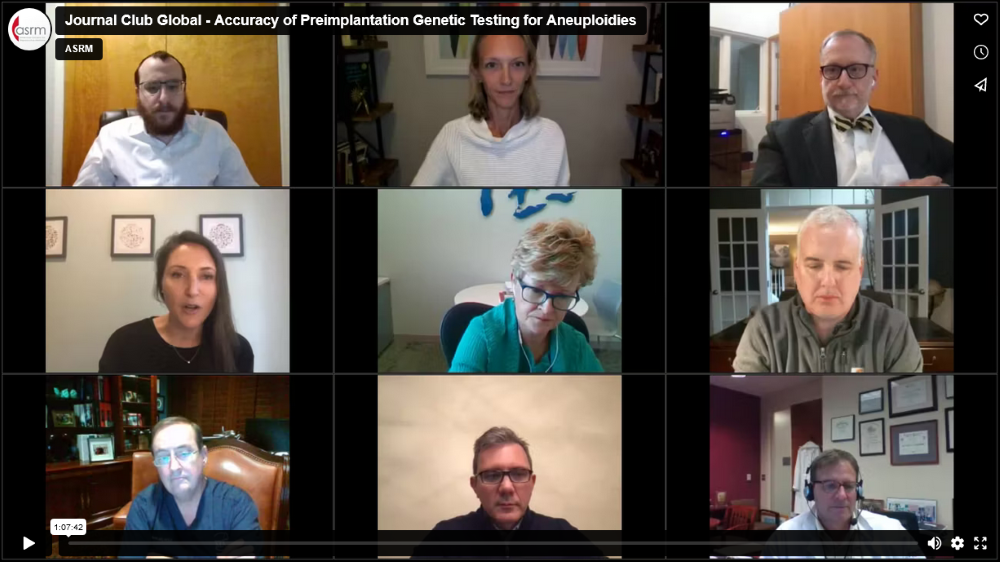
Hello, everybody. Good morning, good evening, or good night, wherever you are in the world. Welcome to another Fertility and Sterility Journal Club Global.
I'm real pleased to have a wonderful panel and a wonderful article today. Thank you for joining us. We're gonna talk about the accuracy of pre-implantation genetic testing for aneuploidies.
And we're gonna talk specifically about a very intriguing article in Fertility and Sterility entitled The Multi-Center Prospective Blinded Non-Selection Study Evaluating the Predictive Value of Aneuploidy Diagnosis Using Targeted Next-Generation Sequencing Based Pre-Implantation Genetic Testing for Aneuploidy. Quite a title, but we have the authors on it to explain it to us. We have Drs.
Ashley Keegs, Richard Scott, Emery Selle, and Chaim Halas. And after the presentations from the authors, we have some discussants, some experts in the field, which will also bring us up some other points, including Drs. David Frankfurter, Kate Devine, and Amy Sparks.
So again, thank you for joining us. I look forward to a lively discussion, and I'm gonna turn it over to Dr. Keegs, who's gonna start us off by reviewing the paper for us, give us the facts, and then we'll start delving into some of the intricacies of it. So Dr. Keegs, please go right ahead.
All right, thank you so much. I really appreciate you having us here, as well as some of my co-authors. I would like to say it truly takes a village to perform a study like this, as you can imagine.
So there are a lot of people who contributed, and we couldn't have done it without them. So I am going to introduce the study, talk about the primary objective, secondary objective, review the methods, and summarize the results and primary findings. Taya, if you could pull up the slides.
I have some slides because I think we're all getting used to living virtually, and we've had to become visual learners, so I think this can help. So certainly the reason why we did the, we would like, we wanted to perform this study was the concern regarding PGTA causing some harm. So if PGTA didn't, there was no concern for any harm, then everyone would do PGTA.
If there was only benefit. So the concerns for how it can cause harm are primarily twofold. Really, the main concern is when we diagnose embryos as aneuploid, we are discarding them, and we are not giving them a chance.
And so the concern is, are those, are any of those embryos that are diagnosed as aneuploid, are they reproductively competent? Do they have the potential to yield a healthy live birth, but we're discarding them? And then another question that came out of kind of our study design was, does the biopsy harm the embryo? The biopsy itself, can that harm the embryo? You can go to the next slide. So in order to answer this primary question, the real question here are, are we discarding competent embryos that are being labeled aneuploid? And so it takes a specific study design. And so that's what we're gonna talk about as well.
I think some controversy lies here, and that's why this slide is here, because a randomized controlled trial is not the study designed to answer this question. And the reason is, in a randomized controlled trial, we are transferring PGTA-euploid, because we're looking at the clinical benefit of the PGTA test versus untested embryos. And intentionally, in this type of study, aneuploid embryos are not being transferred.
Therefore, their reproductive potential cannot be assessed. Tay, you can go to the next slide, please. So a non-selection study is so named because all of the embryos are transferred in a blinded fashion.
And so this is not a randomized controlled trial. Next slide, please. So the primary objective was towards answering this first question we just talked about.
What is the predictive value of a PGTA diagnosis of aneuploid to prognosticate the failure of a delivery or the failure of success? Next slide, please. So our methods, we included patients undergoing their first IVF cycle between 18 to 44. We excluded patients who had high day three FSH, low antral follicle count, high BMI, history of recurrent pregnancy loss, or those who would require PGTM or PGTSR.
Next slide, please. This is a prospective blinded selection study, as Dr. Barnhart mentioned in the study title, at four approved study sites. And all of the biopsies were analyzed at a single center at the Foundation for Embryonic Competence.
Took place over several years. The patients underwent IVF stimulation per the protocol made by their primary doctor. And then all patients underwent a subsequent embryo transfer, a single embryo transfer using a synthetic protocol.
Next slide, please. So the study design is outlined here. So again, all patients underwent their IVF cycle with their protocol from their primary doctor.
All usable blastocysts were biopsied, and then those biopsies were held and not analyzed. And then in a subsequent cycle, in a frozen embryo transfer cycle, embryos were selected for transfer based on morphology alone. And then we determined the clinical outcome of that transfer.
So it was either successful, which was defined as at least making it through 13 weeks of gestation versus a failure. And then once we had the clinical outcome of that transfer, we then analyzed the biopsies. So in effect, they were unblinded.
So the primary outcome, we just mentioned the ability of the analytic result of PGTA aneuploid to predict the clinical result, which was failure to deliver. And then as a secondary objective, we had, it was really because of the study design, we were conveniently able to evaluate the impact of the biopsy. And so what I mean by that is we looked at sustained implantation rates between our study group who underwent IVF cycles with biopsy of the embryos.
However, those biopsies were not used to inform the transfer. The transfers were based on morphology alone. And we pulled a control group that were age matched, matched on BMI, embryo quality, and thickness of the lining before transfer.
And these were cycles, IVF cycles conducted during the same time period as the study, but they did not undergo PGTA. So there was no biopsy. So really the only difference between these groups was the presence of the biopsy in the study group.
And so that helped us evaluate if there was a difference in sustained implantation, if there was an impact of the biopsy. So to review the results, this first next slide here is a reference. This is in the paper.
We had 402 total participants that ended up undergoing 484 single embryo transfers. And so some patients underwent more than one transfer because as part of the study design, we allowed patients who failed a first transfer to undergo a second transfer as part of the study. Next slide, please.
So these are the patient baseline and cycle characteristics. These are also obviously in the paper for your reference. Next slide, please.
I don't think this one translated. So the point of this slide is, or are marked out here, sorry about that. So the clinical outcomes by diagnosis were evaluated.
So the embryos that were diagnosed as PGTA-euploid progressed to sustained implantation or delivery 64.7% of the time. And so embryos that were labeled aneuploid that were transferred and only later did we find when we unblinded the biopsies that they were aneuploid, they resulted in some positive pregnancy test. I think the number was 40%, around 20 or so percent clinical pregnancies, but 0% progressed to sustained implantation or delivery of the aneuploid embryos.
And that's really the key here. Next slide, please. Next slide, please, Taya.
Actually, you may want to keep going without your slides, just in the interest of- Okay, yeah, yeah. Yeah, sorry, I guess Taya can't hear me. Yeah, so then we calculated predictive values based on PGTA diagnoses and the predictive value of euploid delivering 64.7%, predictive value of aneuploid delivering 0%.
So that's the aneuploid error rate. And we calculated a binomial proportion, 95% confidence interval around this error rate based on our sample size of aneuploid transfer number. And that confidence interval was zero to 2.4%. So that means, meaning that in a much larger population, the true aneuploid error rate is unlikely to be zero because the test is perfect, but it's somewhere, it lies somewhere between zero and 2.4% for this app.
And then our, let me see here, she's got it. Next slide, please. So then towards that secondary objective, looking at whether the biopsy harms the embryo, we compare the sustained implantation rates between our study group, which again, underwent a biopsy.
And that was really the only difference between those cycles and a control group. Both selected embryos for transfer based on morphology alone. And there was no difference in sustained implantation between the two.
Next slide, please. So our conclusions were this PGTA assay being evaluated does not result of embryos with significant reproductive potential as evidenced by none of the embryos labeled aneuploid progressing to sustained implantation or delivery. Next slide, please.
And then the second objective, does the biopsy harm the embryo? And we didn't find any demonstrable adverse impact on sustained implantation after a biopsy compared to no biopsy. I think that's all I have to add. Okay, why don't we go ahead and go to the next author? I think I.M, you were gonna have some comments, yes? Yes, thank you for the invitation to present.
First, I'd like to thank all the study participants who trusted us and underwent this novel non-selection study. I'd also like to acknowledge, since I'm the only one from the lab side, Dr. Xin Tao, Dr. Yiping Zhang that developed this platform and the software for it. The main points that I'd like to emphasize on this study is why is this non-selection study needed if it's over 20 years and there's still debates around PGTA? So there are critics in technology that talk about that it's impossible to be accurate because of technical limitations.
Others claim that PGTA is biologically impossible to be helpful because every embryo could be aneuploid or euploid and they can self-correct or that every embryo is a mixture of euploid and aneuploid cells and your biopsy does not predict the outcome of the embryo. What we've learned from this non-selection study is that when you have an accurate technology and when you have evidence-based reporting of whole chromosome aneuploidy, that over 102 embryos that were transferred with whole chromosome aneuploidy, it predicted the outcome, that's number one. Number two, any losses that resulted from these transfers of aneuploid embryos were indeed the same exact aneuploidy seen on the PGTA.
While this is not an RCT, RCTs do not look at the abnormals and the biggest criticism of PGTA has always been, we don't know if your abnormals are truly abnormal and are we discarding reproductive potential embryos that can lead to live births? So this study and the importance of this study is first of all showing that we are not discarding embryos that have reproductive potential. Virtually 100% and of course it will never stay at 100% resulted in either a loss or no pregnancy. So this non-selection study answers only a question about the assay.
It does not tell you which patients might potentially benefit from it based on age, based on reproductive history, based on the number of embryos available to test or which day to do your transfer. This talks about what is the accuracy of these technologies and specifically the technology evaluated in this specific paper when they call it aneuploid, is it truly aneuploid and does it match the outcome? And I think this study is the only design looking at the aneuploid transfers and it had close to 100% predictive value which is what clinicians need to understand the clinical positive predictive value of the test and this is what we've achieved with this study. So why don't we go ahead and finish having some comments by the authors then we'll invite some of our discussants.
Perfect. Okay, so I'll go in. First of all, I'd like to thank Kurt and Micah and the journal club organized for the invitation.
Ashley and Haim gave a really good overview of the manuscript and they summarized the technology behind it. I'll quickly focus on why it is such a privilege to be part of this study. As I started paying more attention to PGTA field over the past years, I realized that at least at times it was being discussed a little too broadly for my taste or focused on a lot of opinions and those of us who spend their lives more in basic science, basic research area would feel more comfortable with smaller questions, well-defined questions as the one Ashley described such as is PGTA leading to the discovery of viable embryos or how often it is leading.
And in this study, once the investigator reached a consensus that this was a valid question and you may or may not agree with that, then came the question of what is the best way to answer this question. And I think most researchers would agree that a non-selection study would be the right format. Actually, and Haim emphasized that this study only assesses this specific platform.
So this means that as soon as another technology comes up from them or someone else, the relevance of the current study will diminish. But I still believe this will remain an important study and it is worth discussing not only for its relevance to the currently applicable and efficacious test, but also I think that kind of leads, shows us the way to how to initiate validation of any other study that we use. Would it be for, you know, it could be for embryos or endometrium or anything else? That's all I wanna say as I started.
Richard, this was an ambitious study and I'm really pleased that you took the time and energy to put this together. I know it took time and resources and these kinds of studies are rarely done. So thank you for putting that together.
What comments would you like to start with before we open up for discussion? You're muted, I'm sorry, Richard. Can we, Richard, you're on mute. Can you unmute yourself? Thank you.
I wanted to say, I'll be very brief because everyone else has covered things so nicely, but, you know, I just wanna point out that there are clinical studies in this area and there are physiologic ones that teach us about the biology of the embryo. This is definitely focused on the clinical. So you really can't refute data like these by saying that there's no evidence or saying that there's a study showing that this karyotype self-corrects or that one doesn't.
The reality is the embryo either delivers or it doesn't. And the reality is there was no detrimental impact to biopsy. And I think that's true in most programs.
I think something can always be done wrong, but I think the vast majority of programs do it very well. And I think these are just extraordinary useful data as we go forward and try to solve that problem of why some embryos don't implant. And of course we still have a 35.3% left based on Dr. Teague's data.
So there's more work to be done in the future and it's very exciting. Thank you. Thank you.
So it's great to hear from the author's perspective and they put on great data and really good explanation. So let's open it up for discussions. We'll start with Dr. Amy Sparks.
Please chime in. What are your thoughts? Thank you. What questions do you have? Well, I want to congratulate the authors on this publication and for completing this very important study.
Just with any lab test, it's not only what goes on in the lab when you're doing the test, but the quality of the sample is important. And there are many questions I have for you. As other studies have shown that biopsy size, time of assisted hatching, embryo grade can all impact the ability of euclid embryos to implant and they may impact the PGTA result.
So if we're going to achieve this level of predictive value, it would be really helpful to know some of the additional details that outside of what you presented in the paper. So if you could provide details regarding criteria for embryo selection for biopsy, when the assisted hatching was done, perhaps limitations on number of cells removed if you keep a really tight gate. And lastly, how you determine the embryologist competency.
I know most of the embryos came from two programs and that's another important point because I think you were able to control things really well as far as what was being delivered to the PGTA lab. I can take a quick crack at it. I can take some of those questions and then Dr. Tease can jump in.
So for sure, most of the specimens came from two programs. Certainly that's true. We get interpret results on about 97 or 98% of our samples.
And that was true during this study. Haim is certainly much more expert than I am. It's based on MAPD scores and other amplification issues.
But this was no different than our routine cases. So these were not ultra selective. These were not different than routine care provided in our program.
And once, now, again, as Dr. Tease mentioned, you had to be at least a reasonable responder to get into the study. We wanted some opportunity to have embryos to select from or to provide the full range of possible outcomes because there was no selection. But after that, there was really, this is no different than any other cases in our demands for embryo quality, kind of 3BB or betters if you use Gardner score were not different than anyone else.
Cystic hatching is done on day three in our program. That's referenced in the paper. And we do that so that we can tell when the embryo is expanding because that's when we biopsy.
And we are shamefully, shamefully imprecise on how many cells we take when we do a biopsy. So I just want to confess and be honest. If the embryo is highly cellular, we know we get a lot more cells.
Maybe we're getting 10 or 12 or a bit more. And we know that some of the less cellular ones, we get a smaller income. The data that Angeles and Chantal have put together, they really taught us that really three or more cells is enough, five or more cells is enough to get good low MAPD scores and good reproducibility in the NSA.
So I hope I answered your questions. I think it's very much like business as normal. I think this is all routine stuff.
Sure. Yeah, and I think that was the goal was to make sure these patients are undergoing routine care and you're getting the real data. I don't know if there's any question left to answer.
Dr. Scott got them all. Sorry, Ashley, I still- So I'm going to roll into just a couple more before we discuss it. So when you were selecting the embryos for transfer, you stated that you selected them based on morphology, but did you incorporate the day they were biopsied into your decision-making? Dr. Steeves? Yeah, so the embryologists have a modified Gardner scale that they use for morphology grading.
In general, I think if the grading of the trophectoderm and ICM, you guys can, Dr. Scott, you can correct me if I'm wrong. If that grade was, those grades were higher than, on a day six embryo, if those grades were higher than a day five embryo, then that would be selected. Is that the case? It's certainly true, Dr. Teegs.
Obviously, if you wait to day six, particularly the expansion score gets bigger. You've just got more time. I would imagine we've all seen that in our laboratories.
But across the board, in our program, day fives do a little better than day sixes. And day sevens go down about 15 points. I'm smirking only because that's also Dr. Teegs' paper.
She published that. And if they're euploid, though, they still do quite well. So there was a strong propensity to day five or six.
And day sevens, I would say, are definitely devalued in our decision-making based on morphology. But I have to say, based on that prior paper Dr. Scott is talking about, the day sevens are really the minority of embryos. So the majority of embryos are biopsied on day six, and then the rest, really day five, and the small minority, day seven.
Okay. That's helpful to know. Last question.
Did you have 100% embryo survival upon warming, or what was the survival rate for the study arm versus the control arm? Yeah, that's a great question. I don't have that data in front of me. And I know, just historically, Dr. Scott could probably tell us it's very... In this study, there was 100% survival.
But I would love to say that's true for the lab. It is not. So don't, again, no craziness here.
Overall, our vitification warming cycle survival is 98.7% for the program. And when you have 300 or 400, you can get a good stretch and do okay. I'm sure that if we increased the numbers, it would have regressed right back to the mean and been normal.
I don't think there's anything else. Every embryologist on this webinar is very happy to be left off the hook a little bit. We're not expected to have 100% survival.
No, definitely not. I wish. Definitely not.
Thank you. So why don't we move on? Dr. Devine, do you have some questions or comments? Yes, first of all, thank you so much for inviting me to discuss this paper. And I wanna share in congratulating the authors on what is a remarkably well-done study.
I would say that it is a gleaming success and on its own really noble terms, which is to say to be a non-selection study, a clinical non-selection study validating the positive predictive value of the PGTA platform in this laboratory. And thankfully that the positive predictive value is extremely, extremely high. And essentially embryo wastage from discarding aneuploid embryos with this platform is going to be extremely, extremely low.
I do know that these studies are incredibly difficult to carry out. And so it's remarkable that this one exists. And I know that it was a ton of work.
So I think we all benefit from that. In terms of not wasting embryos, that's something that we are all very much invested in for our patients every single day. And it's very helpful to know that at least with this platform, and I wish every lab would carry out this study and validate their platforms in the same way.
I know they won't because it is so hard, but it would certainly be a nice thing. It's wonderful that we wouldn't be wasting embryos if we were to be discarding all the aneuploid embryos or wasting very, very few, around 2% or fewer. That said, and I know it's a somewhat tangential topic because again, on your own terms, you state very clearly that the mosaic outcomes are reported for completeness sake and obviously not what the study was powered to do.
That said, we knew already, and this is clear from this data set as well, that in centers where we are not transferring mosaic embryos or embryos that have segmental gains or losses, we probably are wasting embryos on the simplistic terms of sustained implantation in live birth. And obviously we're very preliminary in terms of whether sustained implantation in live birth is the only goal. It's really important to note that that is a, quote unquote, normal appearing neonate is not the same as knowing that we have a normal child or a normal adult, importantly.
But I do think that in assessing PGTA as a whole, which again, not your terms, but kind of mine in broadening the discussion to some extent, especially in a young population like this, where there would have been 29 fewer births, essentially, if we had discarded those embryos, still important to consider whether or not this should be used universally. Again, not what we're trying to answer here. I think it's clear that you succeeded in your primary goal.
I also think it's worth noting that in terms of assessing the impact of the biopsy on the chances of sustained implantation, we have to interpret those data and that analysis with a little bit more caution. That the age-matched control group still does very much leave room for some selection bias there in terms of which patients elected not to be in the study over this time period and also elected not to do a PGTA. There are some parameters that were not reported, including that could potentially co-vary, including race, socioeconomic status, and other factors that could certainly play a role.
One question I have for you, and then I'll stop and let you guys talk, is it was noted in the manuscript that the age-matched control group had met the same inclusion criteria as the participants in the non-selection study, but it was not clearly stated that they met the same exclusion criteria. I take it they probably did, but if they were to, for example, have had, any of them had a history of RPL, I know they were more gravid and more PARIS, that could potentially be a confounder. And I'll stop there and see what you can tell us, if you can give us a little bit more information about that population.
Yeah, you're right. We did carefully select that population, and they did meet both inclusion and exclusion criteria, and that's just my fault for not explicitly noting that, but that is an excellent, and I agree, there's definitely some bias that we can't quantify, because those, like you said, those patients were not in the study for whatever reason during that time. If I can just add one comment.
Yeah, go ahead. I think your comments, they may not be exactly in the study, but they're exactly the right ones. I think those are all really important points, and they need to be addressed.
And I will only pick on the assays and work that we've done within our own program. I don't need to pick on anyone other than ourselves, but the error rate and the non-result rate was extremely high in the fish era, and it went down in SNF. That was our first non-selection study, where 4% of the ones we call the aneuploid delivered, and not everyone that goes back that's normal is gonna plant, so the error rate had to be at least probably 7% or 8%.
I think qPCR was no better, and in some ways, maybe worse, and so these technologies have evolved over time, which is why you do these studies over and over. In terms of the mosaics and segmentals, I think you're right, but I think it matters, the impact clinically depends on what the prevalence is in your assay. So the biology is the same for everybody, right? I don't think anybody is really very different, and I don't think there's compelling evidence that you're different.
I think the difference is in the precision of the assays. Mosaicism should be 2% to 3%, right? If it's more than 2% to 3%, then I don't think that those are really mosaic. I doubt those are real.
And again, we've had these problems with our own assays, so I only wanna pick on ourselves to say we've struggled with those things. And implantation rates, sustained implantation rates, certainly with a 60% normal or higher cells by proportion in the result are normal, and we and many other investigators now are finding and reporting that. So I think mosaics are pretty much in the safe group to transfer, although you're right, we're gonna have to watch these kids grow up to say whether or not they're there or not, but of course, they're in the general unscreened population as well, and we don't see big problems with mosaic issues.
The segmental issue is tougher to deal with. I think Dr. Dietz found that there was about a 50% reduction in the sustained implantation rates. So segmentals remain a very interesting and confusing topic.
You can use those. They're more likely to implant and create an abnormal gestation, and they're more likely to result in losses, something we're not finding in other types of abnormalities. So that, and that shows up more often, maybe six or 8% of embryos.
So that is a hot topic for investigation, but the other hand for 92 or whatever percent it is, I just didn't maybe do the math exactly right, of embryos, we can get a clear definitive answer that says they have high or essentially no reproductive potential, and that's pretty useful. Can I make a comment? So I wanna add to Kate's comments. Very, very important, of course, the mosaic question and the segmental question.
Within the context of our research program, we don't only develop platforms and test platforms in clinical. That is what we present to more clinical society, but in the meantime, we use this opportunity to study biology. And one of the reasons I really enjoy being with the group is that there is really no good animal model to assess unemployed or segmentals or anything.
You know, human is the best place to study this. And we did attempt in developing systems where we can check the biology of human embryo. In 2019, we presented ASRM, which later was published in Nature Communications.
We took embryos diagnosed as unemployed, and we want to see what happens to those cells as the embryos grow in vitro to day 12 or further. And we did see some changes. We did see alterations in some of the diagnoses.
Many of them remain the same. These approaches also allowed us to study the biology of the unemployed itself. We wanted to do the mosaicism also.
We also wanted to develop a technology that would allow us to mark an unemployed cell in a mosaic embryo and then follow it as the embryo grows into day 12. We have not yet been able to achieve this. There is really no, because that would be, if you really wanted to study the human embryo, that would be the way to go.
We did, of course, collaborate with people who are better than us in this field, more basic people like Magdalena Zernicka-Gerst and others. But really, as I said in the beginning, these studies has to be like very well defined in the basic science also. And I'm sure that's a very specific question because there's so much unknown.
And what happens to a mosaic cell? Are they all together? Are they separate? So we're doing studies to check all those questions that may not be as relevant clinically, but you can make indirect conclusions to the biology of mosaics. I'd like to add one comment. Sure.
Sure, so on the topic, so as all of you know from the paper, we were not powered to give you definitive conclusions on mosaicism and segment. But what is important to know is that every baby that was born or any prenatal testing that was done, either from a euploid or aneuploid or potential mosaic or segmental transfer was tested and follow up, either in the newborn period or in the prenatal period. And what's important to know is that not a single baby, at least in the buccal swabs, did we find any evidence of mosaicism, no POC or loss or prenatal testing confirmed it.
Versus when we looked at the full chromosome aneuploidy, they confirmed nearly 100%. Where if the POC was tested, it confirmed the initial biopsy. So what I think is important for people to remember is that it seems that the positive predictive value of calling these secondary findings seem to be very low.
There's still an open question about higher miscarriage rates or maybe lower implantation rates. But the reason we do PTA is for age-related aneuploidy. And that's what this paper was powered to detect.
And that's what it found. One of the topics I want you to shift maybe to is what we've learned from this study and how we've changed practice. So for example, at FEC at the lab that we did the study at, previous assays had higher aneuploidy rates on all ages.
And what we see now is lower aneuploidy. So we think that the accuracy, like Dr. Scott said, we didn't have any live births, but the SNP arrays we did with the non-selection study, the accuracy is better. Number two, we only report what we know clearly is the positive predictive value, which is whole chromosome aneuploidy.
You can opt in for mosaicism. You can opt in for segmental. But I agree with all of you that by reporting these things as abnormal, it does lead to embryo wastage, which leads to a lower cumulative pregnancy rate.
So we need to be very careful about validating technology ahead of time to make sure what is the positive predictive value. And that's what this study has done. But for these secondary findings, we don't have the full data yet.
We're not fully powered to answer those questions. But what we could tell the audience, the live births were helpful. So I think that's a nice summary there.
Let me see if I can summarize it in epidemiology speak because we're throwing some terms around. So what this study is showing is that the test is accurate in diagnosing aneuploidy. I would call that negative predictive value as opposed to positive predictive value because you're predicting a bad outcome, not a good outcome, but that's semantics.
But the point is it's telling you that aneuploidy is aneuploidy. And perhaps because of the problem of the success of PGTA, we've advanced so far, it doesn't answer the question of all the other quote unquote abnormalities. This study just doesn't have the power to say, are we wasting embryos because of other findings other than aneuploidy? And I just wanna make that clear.
So this doesn't really answer the question that Dr. Teague set up saying, are we wasting embryos? Because we might be because of the other findings. We're just not throwing out aneuploidies are aneuploidies. So we'll leave it that for a second.
And I wanna go back to the other part, the cohort later, but David has been very quietly patient and not had a chance to speak yet. And I want him to bring up his points as well. So David, please.
So I wanna echo the sentiment of the other participants in many levels. First of all, thank you for allowing me the opportunity to participate in this forum as well to Fertility and Sterility to help in contributing to the reflections. And unfortunately my co-author, Dr. Kathleen Humkin couldn't be here this evening.
I know that she would be a very lively discussant reviewing this paper. And I just wanna step back a little bit sort of to echo what Kurt was talking about in terms of framing. Because at the end of the day, there's no doubt this is an important study.
There's no doubt that this is a true contribution to our field. And it's rare that a center would be able to utilize the resources that have been utilized in order to demonstrate what was published. And the authors really need to be applauded on that level.
But at the end of the day, it's the patient that is signing up for this technology. And they're signing up based on what they're hearing both from their physicians and their friends and the buzz around this technology. And what patients generally feel is what this technology is aiming to do is to select a competent embryo.
And that's actually not what Chaim is outlining. That's not what the authors are arguing. What the study is aiming to do is determine which embryos should not be transferred.
At least definitively with those that screen positive for aneuploidy. And those embryos and that screening is set by both your assay and your software. And you may have a higher or better ability to lump what some may consider as mosaic and others may consider as abnormal into one basket, thereby eliminating those embryos from transfer, which ironically, if you transferred, it doesn't appear that you're doing really any long-term harm.
Clearly, no one wants to have a biochemical pregnancy or miscarriage. But in terms of the ultimate failure would be to lead to the delivery of an abnormal, quote unquote abnormal baby. And so when we pitch this or counsel patients, what this test is looking to do is determine if the embryo is abnormal.
Now, as far as the actual influence of the biopsy, I think that Dr. Devine has outlined this very, very nicely. There's gotta be a reason that you have patients that fulfill the inclusion criteria, that they don't have exclusion criteria, and in a practice that's very heavily geared towards PGT decide not to do it. There is probably something different about them.
And whether that co-localizes to an influence on the embryo, who knows. But that part of the study aside, really the value is looking at these epidemiologic features, positive, negative, predictive value, specificity, and sensitivity. And what we are not all that clear on is when we say the embryo is okay, what do we mean? And what is the outcome? And okay is defined here is that it's euploid.
Interestingly, those whole chromosome mosaics tend to have pretty much the same outcome as the euploid. And so there's something else that's clearly going on here. Maybe it has to do with transfer technique, the mood of the patient that day, the atmospheric pressure, who knows what.
But something is influencing those embryos not to stick. Obviously, it can be the endometrium as well. But from the perspective of what happens when you transfer an abnormal embryo, it doesn't yield a baby.
And that then has to back up to what gets us to the point where we can biopsy the embryo, which is we need an embryo to make it through cleavage stage, memorial stage, and blastulate, and then biopsy, freeze, thaw, survival, implantation. And for many people, when they hear, what do you mean you're gonna transfer something that isn't normal, meaning that it's mosaic or whatever, there's anxiety that's involved. There's a long process of self-discovery in terms of whether they should accept an embryo like that.
But if it has the same implantation rate as a euploid embryo, maybe we should stop reporting mosaicism. And we should go back to the binarization of this technology and say that this is abnormal or it is normal, or change the phrasing. This is more likely to be abnormal or this is more likely to be normal.
So we actually don't report mosaicism since, only by opt-in. We actually report binary for whole chromosome aneuploidy detected, yes or no, exactly for that reason. We wanna put a very high bar, as exactly as you said, that when you report something as positive, and positive here is for the test is positive, not that the outcome is positive, but the positive predictive value of the test.
And when we're calling something abnormal, we know that the clinicians and the patients will not transfer. We don't know that the mosaic is abnormal. We don't know if it's misdiagnosed as mosaicism because of the technology, because of artifacts, or maybe embryos could be mosaic, but still survive.
So we actually, one of the lessons learned is we are only calling things abnormal or aneuploid, positive for aneuploid, when it's a full chromosome aneuploidy to avoid these things. We still offer it. You could opt in and choose if you would like to, but don't ask us what the clinical meaningfulness of is, because we don't know.
What we do know is some are definitely making healthy babies. And the other ironic thing is, is that the mosaicism rate tends to be depending on which PGT lab you're using and which technology. Same embryo biop sent to five different labs, you might get five different answers.
That is a problem, and that leads to embryo wastage. So I totally agree. So when you binarize and you call one subset as aneuploid, what do you call the other embryo? Negative for whole chromosome aneuploidy.
We're not calling them normal because we don't know what normal is, but we're saying it does not have a whole chromosome aneuploidy. The test is a screen for whole chromosome aneuploidy. I just want to shift the conversation a little bit.
This is a really good discussion. And I think, I hope our audience isn't missing this. This is a really important study to say your test works.
Your test predicts aneuploidy is aneuploidy. But I think most of us had believed that that was the case, even though it might not have been. What it's not answering is what the clinicians want to know is tell me the best embryo to transfer.
It's not doing that. What it's only saying is, if the embryo is abnormal, it is really abnormal. So we need to know that as a scientist, but that's not really what the patients are asking.
I just wanted to make that comment. But that is number one in the process is deselection and knowing that when you're calling something abnormal, it is truly abnormal, not that you're discarding. There is a different implantation rate for a euploid day five in a 5AA than a day five in a 3CC.
Differences in implantation among the euploids are gonna vary based on the patients, based on the embryos, but an aneuploid doesn't care about your age, doesn't care about your endometrium, doesn't care about how beautiful the embryo is. It's the power of deselect, not selecting among your euploids. And I agree.
This has nothing about which patient potentially benefits. This is step number one asking, does the assay have any predictive value? And the reason I would say that it's important is the aneuploidy rate seen among different labs varies widely. In the youngest age group, we see less than 20%.
Others are reporting 40, 50% aneuploidy, which we know is biologically almost impossible. So there is a problem with embryo wastage, and that's why this is so important. So if I can just add one comment, though.
Go ahead, Richard, sure. All embryo diagnostics, not just aneuploid. So whether an embryo is competent to make a baby or not is dependent on many things.
So it's never gonna be possible to screen for one thing and divide embryos into 100% implantation rate and zero. It's never gonna happen. All embryo diagnostics basically work by doing what Kurt said, which is to say, this one has no chance.
Take it out of the pool. You enrich, the pool then becomes enriched with ones that have high reproductive potential. And guys, we're never gonna get away from that.
The other thing is the limbo, and I apologize, David, but this dilemma over mosaicism. I mean, come on, guys. It's 2% of embryos.
We're spending all our time debating about something that affects one in 50 embryos. And that really tends to make, it makes it sound like it's a crisis that's in the middle of for every patient in every case, when in fact it is almost never the case. And Scott Morin, who's in San Francisco, has shown that a case where there are only mosaics to select from, if you're even worried about them, and I'm not, would only occur 0.2 or 0.3% of the time.
So you can obsess over these last few things that we still need much more data on, but you're missing the big picture if you do that. But that speaks to whether or not the mosaicism is universal across all age groups, across all diagnoses, and across all patient populations. There's variability in terms of different groups and the incidence of mosaicism.
I actually disagree. I would actually disagree very strongly. Mosaicism doesn't change with age, neither does segmental disorder.
Not with age, but in terms of prognostic groups, it's still not entirely clear. I would argue that mosaicism changes with diagnostic labs. It changes with diagnostic labs, but actually the mosaicism doesn't, only the analytical result does.
Kurt said, you know, precision and accuracy is what's changing, not the biology of the system, very likely. And again, I only picked on our own assays because believe me, we've been fighting this fight too. So I don't want to be political.
The opposite is the case. So, you know, the reality is, is that mosaicism and segmentals are a very small percentage of embryos and really have very minimal impact on the value of these technologies to help patients identify which embryos will not make babies, or which ones might make abnormal babies. And so that's where the value comes in.
But guys, that's gonna be the value for everything we do in the lab. That's the value for morphology. And we discard embryos that are arrested.
We discard embryos that are massively fragmented and ugly. Dark Sparks, help me out of here before I goof up and get out of my box and my skillset. But it's not because the ones we say pretty, we know are gonna implant all the time, but we know the ones that have arrested and not cleaved for three days are probably dead.
So everything about what we do is about taking the negatives out and trying to enrich what's left. I agree with you, Richard, and that was well said. I think it's the opposite of what most people that don't think about this question often think.
And that's why it was really important to get that across. Most people think of it in the absolute opposite way. I hope listening will re-educate people.
Mike, I'm gonna put you on the spot because you've been quiet and listening to this. First, are there any questions you wanna address? And secondly, give me your thoughts. Yeah, so thank you for the audience who's listening and in on the chat.
And the second question that this study chose to address was that of the effect of the biopsy. And I think there are certainly practices that maybe feel like in the real world, they don't see the benefits that other programs have published. And then we have the STAR trial.
And so that raises, is that due to the platform and the validation of the platform, which this study is addressing, or is that due to the effect of the biopsy? And certainly the MATCH cohort from this study suggests the biopsy doesn't have a detrimental effect. In my own opinion, I think the best study we have is from your group, which was a random sibling study where one embryo was biopsied, the other wasn't. And then DNA fingerprinting was done if a singleton was, and that suggested no detriment to blastocyst biopsy.
So I guess my question for Richard is, can that study be repeated? Is it ethical a decade later to transfer two embryos? And to Amy, who's an expert embryologist, have we answered this question? This is from the audience. Does the biopsy have detriment and does what's in the literature inform what's happening in my lab? I'll give the quick answer, and then Dr. Sparks will give the real answer. But the quick answer is, the days of two embryo transfer for routine patients are gone.
And it's gonna make very, very challenging. It's gonna make it very challenging to do split cohort studies, which is very sad, because they're very handy in science to answer a lot of things. Probably not safe anymore, and therefore we can't do them.
So we thought that what Dr. Deeks did in her project, where we could compare it, we took everybody without the result, that only differed, the only difference is in the biopsy in one group and not at the other group. That at least gives us an approximation. There is no, those studies always have limits.
But I think with such large numbers, you can say that if there's any detriment, it's gotta be very small. And I think most labs do a great job. We see a lot of samples from a lot of labs, and people, embryologists are good at what they do.
Dr. Sparks? I think there is variation in biopsy techniques, though. I also think that there's a risk, if you don't have good control in the lab, that some embryologists will tend to biopsy lesser quality embryos, because they know that they're going to get results, or at least they're hoping they're getting a result, as we call those, those are the bleeding heart biopsies. And that is what actually, I think, messes with some of the PGTA data.
So we do need to have a good sample going to the lab. This goes back to my original point, garbage in, garbage out, right? So you have to send a good sample tested. I agree with Micah that I absolutely still cite the sibling embryo study, which was powered to detect a 10% difference.
And so I think that's what we know about the biopsy still, is that it's been, you know, with standard technique, it probably does impart the chances of a positive outcome by more than 10%. And I wish we knew more, but I think that data is the best data that's out there. I'd like to make one comment on the comparison to the STAR trial.
So everyone knows the STAR trial was not a non-selection, it was an RCT. One thing to keep in mind is that the aneuploidy rate in young patients in the STAR trial was about double the aneuploidy rate we find. Something must be wrong if the aneuploidy rate is double.
And the only correlation that we know for aneuploidy is maternal age. We don't see history or depending on the IVF lab or the gonadotropins used or the doctor or anything. We just see it as maternal age.
So when we compare studies, it's really critical to know what kind of validation has been done. And most important, making sure that embryos that have reproductive potential are not being discarded. In that study, mosaic embryos or embryos that were diagnosed as mosaic, at least, were not transferred, which definitely affects the cumulative pregnancy rate because we know that they do have reproductive potential.
So it's important to know the studies were different, but the assays are way different if you're finding double the aneuploidy rate or if your lab is reporting 40, 50% aneuploidy in age 35 or younger, something is wrong. You might be discarding reproductive potential embryos. I think that's a good place to say, again, the difference between, because this was in our objectives, the difference between a randomized control trial that's looking for benefit and this non-selection study.
A randomized control trial is comparing one intervention to another to see if the pregnancy rate is higher after intervention A or intervention B. That's not what this is. This is basically something that should be done before a randomized trial, which is how good is your test? And this is saying that the test is good at diagnosing aneuploidy. And we don't know, I would venture to say, how good the test is picking your best embryo.
And again, it's a cohort study that had variations. I don't wanna call your comparison to your crow group definitive. It really should be randomized to get rid of this bias and confounding.
I recognize in the paper, there were differences in ovarian reserve between the two groups. So let's just not go too far in over-interpreting a cohort setting. This is a really good study.
It was the first step. We still don't know enough about the ultimate prognosis of PGTP in getting more people pregnant faster. We just know it's very good at eliminating bad embryos.
I also think that it's incumbent upon us to make sure that our patients know what we're doing this for. And what we're doing this for is to narrow the number of embryos from which we select so that we can select fewer, so we can minimize the risk of multiple births and not ensure that they have a healthy baby, which is what everybody who comes in thinks this is for. Well, it does increase the probability that they'll have an healthy baby.
It does decrease the loss risk. It decreases the risk of an ongoing chromosomally abnormal pregnancy. So I'm not sure I would completely agree with that.
But in principle, I agree completely. So please don't let me be too contrary. I have a question for Kurt.
We always think of the RCT here as being showing that the benefit of PGT or any other diagnostic is greater than the D selection for morphology. You could have the predictive values of the test could be perfect, but if morphologically the embryologists always pick the exact same embryos that were being transferred, there would be no benefit. So to really have a benefit, you actually have to put, excuse my language, you have to put a less attractive, an uglier embryo back, because it's euploid and you have to end up selecting a different group.
And so what you're really doing is saying PGT counts for more than morphology to some extent. And I think that remains to be worked out. There's a lot of questions about how to quantitate that.
And the final point, I wanna give everyone a chance. I know we're running close on time and I'm gonna give everyone a chance in a second. But the final point I wanna make on an RCT is that again, you wanna know if it's resulting in a higher pregnancy rate.
That's what we all think. I find it hard to prove that PGT is ever gonna result in a higher pregnancy rate because it doesn't do anything to make the embryo better. So if you're not improving the embryo, all you're doing is stopping it sooner or faster, which has benefits, don't get me wrong.
It has benefits for loss and time to pregnancy, but it's never making your embryo better and therefore more likely to get pregnant. So I'll leave it at that. But let's go around the table and let everybody get a chance to go through.
So go ahead. So Emery, why don't you go start and then we'll go. No, I just want to ask you, you mean it's not gonna increase cumulative pregnancy rate? Yes, or even if you have a normal embryo and a biopsy normal embryo, there's no way in the world the biopsy is gonna make it more likely to result in a pregnancy.
No, I understand. So theoretically, if you had many, many embryos and some were normal, some abnormal, knowing which one is abnormal may help increase. But cumulatively, you're right.
I always say that to the patients. Nothing we do will make it better. And if anyone's saying that, it's not true.
It gives patients chances, it gives patients information. Don't get me wrong, I'm not trying to talk about the pros and cons of PGTA. I'm just saying that makes an RCT difficult, is all I'm saying.
So you have the floor now. Why don't you give your final words and we'll go around the table. What do you want to tell everyone listening to us about this in general? Well, I don't define myself as a geneticist or a PGTA researcher per se, but again, I want to echo what Kurt said that now actually that you are actually very involved in fertility study.
We should encourage people who provide tests to do similar studies. They are not as difficult as it is for embryos. People who work on endometrium or other, endometriosis diagnosis, et cetera, should make every attempt to do this kind of test so we can actually quote to our patients, positive, negative, whatever you call positive, predictive values.
And as Kurt said, what I want to emphasize is that this should be done before an RCT. This is my point. Amy, I'm just going around what was on my screen.
What comments do you have for us? My take home comment on this is that I think it's very important that embryologists' competency at biopsy be managed and measured in the lab if you're offering PGTA on a large volume basis. It's also important to know how the program is performing relative to all of the programs that are sending their samples to the reference lab. I think those are two very important points and this tightly controlled study was able to address both of those points.
Dr. Teagues, congratulations, wonderful study. Why don't you summarize or give us your parting comments? Yeah, thank you so much for having me. I think really one take home message is that we've all touched on in various ways is really operator dependent in so many ways, widely varies between labs.
And so that's why clinical validation, not just the analytic validation with cell lines is so important. And so we've said it several times, but this study obviously just applies to this assay. And that's why it's important for more clinical validations to be performed.
Dr. Devine, how would you like to summarize your thoughts? I think we all agree that this is a huge contribution to study. I also think we've all agreed that it doesn't prove efficacy of PGTA and that we have to start a trial which did not show necessarily a benefit in terms of why I've heard from PGTA. I'm very much looking forward to the trial that is referenced in this paper as planned.
And some subjects were randomized already to be in the selection study and to see in the setting of this clinically validated platform, whether it's beneficial. So we probably don't have time to talk about it. I was hoping we would, but kind of when that's going to be coming and what the design is, we'll all wait with bated breath.
Dr. Halas, what would you like to leave us with? I'd like to leave it to the IVF field to recognize the fact that if FISH studies have been done with the non-selection, we would likely have never been in this place where FISH would have been used. So if history has taught us any lesson, is for the clinicians to demand predictive values for every test, and not only PGTA, every test that's added on. IVF works perfectly fine without most add-ons.
If it's added on, knowing what the positive and negative predictive value is critical. And the other point to mention is, is that it's depending on the lab you use, the technology, and how it's being used and how it's being reported. All of it works cohesively.
It's between the embryologist, the IVF, and the genetic laboratory, and how the patients are counseled. But we should be begging for the predictive value of any technology, and we should learn our lessons that PGTA could be extremely powerful, but also could be extremely powerful in a negative way by removing competent embryos that leads to embryo wastage. So knowing these type of studies helps with counseling.
Excellent. David, you have some final comments? Again, I just wanna say, I couldn't have phrased it any better that when it comes to IVF, there's a lot of adjuvant interventions that have no clear benefit, no clear data behind them. And what you've done here is clearly delineate what your assay is able to do, and that needs to be applauded.
And I think that the other part of this is that we need to understand what we're doing this for, and what we're doing this for is to select out and not to select in. And you've clearly stated that and done a beautiful job of it. I'm gonna give Richard a final comment, so Michael, you can take us home.
So Richard, first of all, again, thank you. The foundation you put into this, the energy, the time, the validation of techniques is commendable. So I wanted to say that publicly.
But please tell us your final comments about this thought. I will be very brief. I certainly appreciate all the comments.
I agree with basically everything that's been said. The only thing about it not improving cumulative pregnancy rates is that there are good studies, really, Germany and Scandinavia are the best, that if you have six-rate embryos, patients won't transfer. They drop out first.
So by picking the right one in the early going, you do get a high, you're likely, study's not done yet, you're likely to get a higher cumulative rate because patients just won't come back to put that sixth embryo back or their eighth embryo back when they're 41 years old. Not that many of them have that. But other than that, some really insightful comments and I appreciate it.
Thank you. Michael, please say goodbye to everybody and tell us what the audience thinks and share your thoughts as well. All right, thank you, Kurt.
So I just wanna echo my own thoughts. As Kurt and I talked about this paper, I think what attracted us to it was the validation of an assay that's really widespread use in clinical practice. And I think as a field, if we err on one side, I think we would all agree that we err on the side of implementing interventions clinically before they have been validated.
And so I think you can take this data and think about how you think about ERA, endometrial biopsy for chronic endometritis, other things that we do all the time that maybe we haven't even gone through these initial steps and how we think about that. So I echo those thoughts from David and Chaim on that. So we appreciate everyone joining us for tonight and we just wanna thank Kurt and congratulate him on his promotion to Editor-in-Chief of Fertility and Sterility.
And we appreciate very much all these Journal Club Globals, Kurt, that you have led over your tenure. And I would just love to let you have the final word instead of me. Thank you very much.
I look forward to continuing to work with Fertility and Sterility and these Journal Club Globals are terrific. Micah Hill is going to be the new Media Editor for us and he will be taking the mantle on this, but I hope to see you all on future ones as well. Yes, this will be archived and you can all watch it on the dialogue and the Fertility and Sterility webpage.
So with that, I will say I'm Kurt Barnhart, the Media Editor signing off. I thank my wonderful authors and guests and colleagues and good morning, good night or good evening. And we'll see you at the next time on another Journal Club.
Thank you all. Thank you. Thank you.