Registration for ASRM 2026 is Now Open!

Menu
Close Close Icon
Journal Club Global Teaser

Journal Club Global: Infertility and Subclinical Hypothyroidism

View more Journal Club Global videos

Video

A live virtual meeting hosted by the University of Pennsylvania Fellows.

A live virtual meeting hosted by the University of Pennsylvania Fellows.


panelists from the Infertility and Subsclinical Hypothyroidism Webinar

Fertility and Sterility is proud to partner with the University of Pennsylvania Fellows to present this Journal Club Global Live! Practice Committee opinions and guidelines in medicine serve different roles, with the former offering expert insights and the latter providing structured evidence-based recommendations. Subclinical hypothyroidism (SCH) is diagnosed by elevated TSH levels despite normal T4 and T3 levels. The impact of treating SCH on fertility, obstetric outcomes, and offspring neurocognitive development is debated in the literature. The new guideline suggests evidence-based changes in SCH management, focusing on updated diagnostic and treatment criteria to guide practitioners in optimizing patient outcomes.

View the Article being discussed: Subclinical hypothyroidism in the infertile female population: a guideline

Questions to be addressed:
  • What is the difference between a Practice Committee opinion versus guideline?
  • What defines subclinical hypothyroidism?
  • Does treatment of SCH improve fertility and obstetric outcomes?
  • Does treatment of SCH improve offspring neurocognitive development? · What changes in practice did the new guideline recommend?

Panelists: 

Jennifer Eaton, MD
Clarissa Gracia, MD
Micah Hill, DO
Suleena Kalra, MD
Leigh Humphries, MD

Moderator:
Kurt Barnhart, MD

Transcript

The following transcript was automatically generated.

Hello again, everybody. I'm Kurt Barnhart, the Editor-in-Chief for Fertility and Cerility, and it is my pleasure to be involved in the Get Another Journal Club Global, which is a great opportunity to highlight some of the science in fertility and cerility with our world-class experts. Today, we're going to talk about infertility and subclinical hypothyroidism, and I have the privilege of hosting it virtually with my fellows here at the University of Pennsylvania.

So they're going to try to stump our wonderful panel, which includes Clarissa Gracia, who's the Chair of the ASRM Practice Committee and also part of the Penn Fellowship Program, Selena Kalra, who is the Consultant Epidemiology for the ASRM Practice Committee and also part of the Penn Fellowship Program, Micah Hill, who is the Document Good Shepherd at the ASRM Practice Committee, and also we welcome Jennifer Eaton, who is on the Document Task Force and the SREI Practice Committee. We plan to cover some really good topics with a new article in Fertility and Cerility. This is a practice committee guideline entitled Subclinical Hypothyroidism in the Infertile Female Population, a guideline.

It literally is hot off the press. If you go to FNS, it is online, published online, but it won't yet be in journal for another month but it's available to you to look at with a link to this website. This is really a great document in the process because there's a huge evolution.

We're going to try to handle a couple of questions. What's the difference between the practice committee opinion versus other guidelines? What defines subclinical hypothyroidism? Does the treatment of subclinical hypothyroidism actually improve fertility and obstetrical outcomes? Does treatment of subclinical hypothyroidism improve offspring neurocognitive development? And what changes in the practice did the new guideline recommend? We have a mouthful, and we're going to cover a lot, and we have great people to do it. So I'm going to hand this over to an introduction and a summary of how we got here, which is how practice committee documents are actually made.

So I'm going to hand that over to Clarissa and Selena, who can give us a little bit of the history, and then we'll go to a great presentation and see how we go from there. So Selena and Clarissa, thank you for joining us, and please enlighten us. So thank you so much.

It's really an honor and a privilege to be here today to highlight our new document. And it's honestly a privilege to chair the ACE-RUN practice committee. We put together wonderful documents that really help to guide clinical practice across our entire field.

So we did want to, Dr. Coller and I wanted to briefly touch on what types of documents we put together. So overall, ASRM develops documents, as I mentioned, that address kind of clinical practice across reproductive medicine. That includes REI practice, reproductive urology, and laboratory practice, laboratories that handle reproductive tissues.

We publish both committee opinions as well as guidelines. In general, committee opinion documents cover broader topics where high and moderate quality data are lacking and that don't really lend themselves to a systematic review of the literature and answering specific questions. Guidelines, on the other hand, are much more rigorous.

They follow a standard process that Dr. Coller is going to talk about based on national standards to really provide very specific evidence-based recommendations based on the literature. In general, though, I did want to mention all documents are developed by task forces of members, ASRM members, under the guidance of a good shepherd who sits on the actual practice committee. And then they go under extensive review back and forth between the practice committee and the task force multiple times with comments, revisions, et cetera.

Then they undergo member review. Many of you may be members and may receive these documents, so we appreciate your comments and guidance, and we do make significant changes based on that. And then finally, they undergo ASRM board review.

And then at the end, they get published in FNS. So, thank you. So, I did want to show, I don't know if Selena wants to screen share for a minute, we were going to show a list of some of the documents that have been published.

Can you see that? Do you see the screen? Oh, here we go. Yes. Okay.

So, this slide kind of provides an overview of many of the documents that have been published. On the left, you can see our most recent documents. And then the type of document is indicated here.

Thank you, Selena, for pointing out either a G for guideline or committee opinion. And you can see topics like current evaluation of amenorrhea, very broad topic. That is a committee opinion, whereas the current document that we're reviewing today, so clinical hypothyroidism, is a guideline, as is the prevention and treatment of moderate and severe OHSS, which will be the newest version will be released very soon.

So, now I'm going to turn it over to Dr. Kalra to go into a little more detail about the process of guideline development. Yeah. Thank you, Clarissa.

It's great to be here and be sharing a little bit more about how these documents get created. So, yes. So, the question is, what is the guideline? And as Dr. Grassi, I mentioned, not every study question is amenable to a guideline.

And we really are pretty intentional about what we will do a guideline for. And it's mostly based on the available evidence. So, when we set out to put forth a guideline as a practice committee, we really want them to be meaningful to our membership and really address clinically relevant issues in our practice.

As you have noticed, probably with this guideline that you're looking at, you know that we do try to answer predetermined scientific questions. And we do try to structure it in a question and answer format. So, it's more digestible as opposed to just a huge chapter with enormous amounts of information that aren't quite so targeted to clinically relevant questions.

So, when we produce guidelines, it's based on a very methodologically rigorous process. And I'm sure you can all read the methods section of this paper, but it's very structured, it's comprehensive, it's reproducible, and it's a very comprehensive systematic literature review. When you go into the methods section, you'll see the search terms that are used and the very stringent criteria that are used for inclusion and exclusion.

One thing I'd really like to touch on is that guidelines are extremely labor intensive. And, you know, kudos to Dr. Hill, Dr. Eaton, who's on the task force and the rest of the task force, because this was a Herculean effort. And, you know, in general, guidelines do take 12 to 18 months to conceive, develop, review, and publish.

So, I don't want to take too much time, because I know we're anxious to get into the meat of this paper. But basically, you'll see that there's a very clear documentation of how we do the searches, what the dates are, the number of included articles. I think really the most important part is the rigor.

Really, when we're looking at studies, we're looking at very specific studies. Obviously, we want them all to have a control group. And the main types of studies we include are the ones that we would expect.

What's important is that once we have our included studies, the task force goes through the very hard work of looking with a very fine eye at the level of the quality of evidence in that study, and we assign a quality of evidence to each paper. We also look at each question within the guideline and confirm which papers actually address those questions. And then, in addition, and, you know, the quality of evidence, again, is in the subclinical hypothyroidism guideline, how we make those ratings is very clearly delineated.

What's important is that then we take each individual paper to summarize the overall strength of evidence for each question based on the totality of the literature, which gives us a strength of evidence, which, again, helps us determine how sort of certain we are of the recommendation we are making. So this is a lot of information, and it's all available for you to look at, but basically, it's important to know that there's a lot of components that go into the recommendations that come out, and we also do basically measure the strength of how confident we are in the recommendation that we are making. And so this is a very quick overview, but I wanted to share just some basics, and, of course, I know you're all waiting with bated breath to hear Dr. Humphreys present the very important findings of this most recent guideline, so thank you.

Thank you, Dr. Kraler. We're going to now have an overview of this document with one of our many outstanding fellows, Leanne Humphreys. Leanne, please go ahead.

Hi, everyone. Thank you so much for including me on this panel. It's really wonderful to be able to contribute.

My name is Leanne Humphreys. I'm one of the third-year fellows at Penn. I will just give a brief summary of the guideline.

I think we'll spend most of the time in discussion, and I had actually presented this guideline to our division a few weeks ago, and my very first slide of my presentation was actually a picture of a tombstone, and on it, it said, rest in peace, TSH, as if this was kind of the death knell for thyroid function tests in our field, and it seems that we're kind of saying goodbye to this old era in which we really relied on the thyroid function test to diagnose and to treat subclinical hypothyroidism almost every day in our clinics, and so this guideline gives some pretty firm recommendations that answer a lot of the burning questions about thyroid function in our field, so should we order a TSH on everybody? What is an abnormal value? If we diagnose subclinical hypothyroidism, what are the risks we should worry about or not, and is treatment helpful, and then what about anti-TPO antibodies as well? So I want to front load the summary actually with these main recommendations that come out of the guideline because some of them are kind of surprising or controversial based on our current practice, and I want to spend most of the time talking about how we interpret these guidelines and operationalize them in practice. One other thing I wanted to mention is that, similar to what Dr. Kahlra said about the quality of evidence, some of these recommendations are still based on low to moderate quality evidence just because of the available studies, and so that leaves us with this kind of conclusion that treating for the sake of treating without sufficient evidence is not good practice, so we'll get into kind of just the specific recommendations now. So the first recommendation is actually a definitional recommendation, so whether or not the patient is pregnant, to define subclinical hypothyroidism, we are looking for an elevated TSH, but what is an elevated TSH? They define it as the use of a laboratory-specific upper limit, so this is that 97.5th percentile for the lab, and this is not necessarily for, it's definitely not 2.5 at most labs, and an elevated TSH in the setting of a normal free thyroxine, or T4, is the definition of subclinical hypothyroidism.

If there is no age-based upper limit for your laboratory, the practice committee recommends using 4.12 milli-international units per liter, and this is based on the 97.5th percentile for a low-risk thyroid disease-free reference population that's defined by the NHANES survey in the United States in the early 90s. The next set of recommendations really focuses on patient counseling and how we can counsel patients that subclinical hypothyroidism is not associated with the fertility and perinatal outcomes that we've attributed to it historically. So the third recommendation is that subclinical hypothyroidism is not associated with an increased risk of miscarriage, obstetric complications, or adverse neurodevelopmental outcomes in children.

The fourth, and even more specifically, is that TSH from 2.5 to 4, so that kind of lower level that actually is defined as normal based on the cutoff I just said, is also not associated with miscarriage and these abnormal outcomes that we'll go into more specifically in a minute. The last four recommendations involve screening and treatment. So the short answer is don't screen and don't treat because we have not shown a sufficient benefit of treatment in this setting.

A notable exception is that we have limited data on patients that have recurrent pregnancy loss. So for this population, we don't have clear-cut guidance. The fifth recommendation is do not screen thyroid function in pregnant patients unless that patient has risk factors or symptoms.

So risk factors, as defined by the American Thyroid Association, include things like known thyroid dysfunction, autoimmune disease, family history of thyroid dysfunction, history of thyroid surgery, history of neck radiation, or goiter, among other things. But you're not going to be testing a TSH in a pregnant patient unless you have these known risk factors or if the patient is symptomatic. The next guideline is that we also are not going to screen for TSH in patients that have infertility unless they have symptoms or risk factors.

So this is a big departure from at least what we've been doing in our clinic and I think at other clinics around the country in which every infertility patient or nearly every patient has a TSH checked. The seventh is regarding treatment. We do not treat patients who are pregnant or those trying to conceive with levothyroxine for subclinical hypothyroidism, and that's because it has not been shown to have benefit.

The last one is to not treat patients with positive thyroid autoimmunity except possibly in that sub cohort of patients that have RPL because the treatment of anti-TPO antibodies has also not been shown to benefit in terms of pregnancy outcomes. Okay, so just like taking a deep breath, that's a lot of recommendations and a lot of them focus on not screening and not treating in populations that we have historically been screening and treating. So I just want to talk for a few more minutes about these cutoffs and how we started treating people at lower and lower thresholds.

And it's important to draw a distinction between pregnant and non-pregnant populations because this TSH cutoff of 2.5 actually is the appropriate target for pregnant patients and those trying to conceive if they do have a diagnosis of hypothyroidism. So in these patients that do have overt hypothyroidism or Hashimoto's, 2.5 actually is right. We've just extrapolated it to the non-pregnant population that does not have overt hypothyroidism.

And so the hypothesis was that if we treat them at 2.5, maybe we'll be improving their fertility outcomes or their pregnancy outcomes long-term. The studies just haven't supported that hypothesis. And so as a result, we've been using this lower cutoff to potentially over-diagnose or over-treat patients without significant benefit to the individual.

So we'll get a little bit more into the details of the data. But when we look at these retrospective studies, we don't have evidence that preconception, subclinical hypothyroidism, which is really the population we care about, patients prior to conception, is linked to worse fertility outcomes, things like miscarriage, live birth rates, clinical pregnancy rates, and perinatal complications. And specifically in the IVF population, we do have some studies that have looked at this population, and they have not shown any benefit in terms of those outcomes.

And so I keep on coming back to this problem that even if you identify subclinical hypothyroidism, treating this elevated TSH hasn't been shown to have a benefit in terms of the outcomes we care about, live birth, preterm birth, neurodevelopmental outcomes in the offspring. And this is really based on two randomized trials that have looked at treatment. There is a third randomized trial that has been included in many meta-analyses, and we're going to talk about why we need to remove that from our assessments because of fraudulent data.

But really, when you look at the two well-performed of moderate to high-quality evidence, there's no benefit of treatment. And I just wanted to end with one quote that I think is really good for us to start the conversation with. It's from the guideline.

And the guideline, the practice committee very aptly said, our current guidelines specifically aim to look at evidence that an intervention is clearly beneficial before recommending it. An intervention, being inexpensive and unlikely to cause harm, was not viewed as justification for screening and treatment in the setting of insufficient evidence. Thank you, Dr. Humphries.

That was quite comprehensive and, as always, very eloquently stated. Before I go to the questions, I'm going to give Dr. Eaton and Dr. Hill a chance to just comment. In the process of developing this document, what surprised you or what did you think was most interesting? Dr. Eaton, why don't you start off and summarize some of your thoughts? Sure.

I mean, I would say, for me, the biggest surprise was the Abdel Rahman study, which is the randomized controlled trial that has driven all of the significant findings of all of the subsequent meta-analyses that have been done. And when you remove that one study, in fact, there's really no association whatsoever with any of the outcomes. And so that actually was something that I didn't know going into this.

But it's amazing how just one very poorly done study with misrepresented findings can drive practice the way that it did. Micah, what would you like to add and maybe tell us a little bit about why that study was excluded? Sure. So, yeah, I think Jennifer, Dr. Eaton, hit on the main thing that I learned during this.

And thank you, Dr. Humphries, for reading those two lines from the practice bulletin because those were my two favorite from that and I think really drove sort of how we assess this. In other words, I think as a field, we're a little bit guilty of retrospective cohort studies showing an association and therefore we jump very quickly to the intervention and implementing that in our practice. We can just take one example of the ERA, which is over a quarter of a million tests already sold, and now we have RCTs sort of disproving it in the general population.

So we tend to wait for evidence to disprove that an intervention or an association matters to stop doing something rather than waiting for proof that an intervention matters. So that was really the mindset that we went into the update of this document with. I'll share my screen and talk through Abdulrahman real quick, that study and why it matters so much.

So as Dr. Eaton mentioned, this study really drives the findings of all the meta-analyses and international committee opinions that are out there. And if you look at the bottom sort of four columns, miscarriage, fertilization, pregnancy, and delivery, they really just don't make a lot of sense. So let's just start with miscarriage.

It says it's a percentage, 9% versus 13%. We have 35 patients in each arm, a P-value of 0.03. So I know Penn, a lot of you guys do masters in clinical epidemiology. Can we find a 4% difference statistically significant with 35 patients in each arm? And if not, give me just a gestalt of how many patients you would think, just roughly, how many do you think we would need to actually find that a 4% difference is clinically significant? Any guess is fine.

Hundreds, like high hundreds. Yeah, high hundreds is a great answer. I did a quick sample size estimate on it.

I got 960 per arm, so that's almost a 2,000 patient randomized trial. So right there, you're questioning are these data accurate? And not surprisingly, you know, readers reached out to the editor-in-chief of this journal and said, hey, these numbers don't make sense. This wasn't caught in peer review.

So the editor-in-chief reached out to the authors and didn't get a reply. So instead they said, maybe instead of percentages, these are absolute numbers. So instead of, you know, 35%, 10%, 9%, 13%, these are the raw numbers.

So we're going to recalculate it for the authors and give what the P-values would be. So the first thing you notice is that the P-values change a lot based on this assumption for the editor-in-chief. On the bottom for miscarriage, the P-value goes from 0.03 to 0.44, like an 11 times, 12 time difference.

On the top for pregnancy, the difference goes from 0.02 to less than 0.001, again, an order of magnitude difference. The other thing you notice is on the top, how many people get pregnant if we treat them with levothyroxine? 100%. Everybody gets pregnant.

So levothyroxine is sort of curing aneuploidy. It's curing all the other reasons that people don't get pregnant. It's a little bit of an implausible finding if we accept the editor-in-chief's assumption that these are not percentages but raw numbers.

So if we sort of go back to this, I've highlighted in red there, you know, where the editor-in-chief is saying these are numbers and not percentages. But if that assumption is correct, then these authors don't know how to do a simple chi-square. I don't want to be rude with that, but literally this takes five seconds on an online calculator to put in four numbers, and you get very different p-values that are, again, an order of magnitude difference.

And the final thing on the little blue arrow I showed there, the numbers don't even add up. So on the left side, in the treated group, 35 get pregnant, 9 miscarry. That leaves you with 26 patients.

So I can see why the editor-in-chief, you know, thinks that that's raw numbers. But in the placebo group, 10 get pregnant, but 13 miscarry. So we have three women that miscarry that didn't even get pregnant.

So we really have negative three that deliver. So again, the numbers just don't make sense. I want to briefly highlight one of the other trials.

This is an R Journal FNS from about 15 years ago. This one's a little bit higher quality, although I have to point out they did randomization, but they didn't conceal it. So they specifically said the authors or the people doing the study had access to the allocation sequence.

So they sort of knew which patient was going into each arm as it was happening, which a little bit defeats the purpose of randomization and blinding. The other thing you notice is that zero patients miscarry. So in the other study we have, you know, essentially levothyroxine makes 100% of patients get pregnant.

And then in this study, levothyroxine enables zero patients to miscarry. So again, you almost have to presume that if this is true, that levothyroxine cures aneuploidy, which we know is probably the most common cause of not getting pregnant or miscarrying. The other thing I want to point out here is that, you know, alpha or type one error risk doesn't really change based on sample size.

They set it at 0.05. So whether you have 2000 patients is, you know, we would like to see from a study like this or, you know, 60 alpha still set at 0.05. So that risk of type one error doesn't really change, but what does change is the effect that just the single outcome has. And if you take that miscarriage line and you add a single miscarriage to the treatment arm or take away a single miscarriage from the control arm, this finding is no longer statistically significant. In other words, our confidence in this finding is probably decreased.

So why does this matter? You know, Jen Eaton said it well, and so did Leanne. The Rob Duhamel study has really driven every single practice document that is said to treat this and every single meta-analysis. In fact, the one I showed from Rao is the only meta-analysis that at least did a sensitivity model to take it out, but their primary analysis didn't.

Not surprisingly, when you take it out, it's no longer significant, but just look at the effect size there. It's almost showing a relative risk of 10. That's really unbelievable to think that we could increase relative chance of pregnancy by 10 by giving levothyroxine.

And as we said, if we take this single study out, the findings are no longer statistically significant. So I think this was the main change in the document was how we looked at this one study. I will say kudos to the Cochrane Review, who also looked at this data and is the only other guideline I found that has excluded this study for these reasons.

Both Cochrane Review and myself reached out to these authors and we did not get a reply, so it seemed reasonable to us, given all these problems, to say that we needed to exclude this study from our recommendations. I'll stop sharing my screen. I'm going to jump in with an editorial comment, no pun intended, but I'm amazed that in a couple of years that I've worked with fertility and sterility that I guess I was just too much of an honest broker.

I trusted all the information and literature and the amount of studies that we found to be unreliable and in some cases outright fabricated. That's a big word. People never did the trial.

The data is just written on a piece of paper without randomizing a single patient. I mean, I think it's probably the most egregious error you can make or most egregious misconduct you can make in science. And I'm sorry to say that it's probably this kind of fraud is more prevalent than I ever thought, not just in fertility and sterility in all the medical literature.

And I'll take this opportunity to say we're really trying to decrease it in fertility and sterility. All papers accepted now undergo methodologic review. We have a very strong checklist to look at the feasibility of studies, and we're trying very hard to make the scientific literature credible again.

But for those of you that do meta-analyses, this is an important topic. You really have to look at the credibility of the study yourself. You can't always rely on if the paper has been retracted or is a statement of concern.

And I would even advocate that you do two meta-analyses or two analyses. You do one with the papers you think are the most reliable, and then maybe the secondary analysis is all the papers, including the ones that you think have less credibility. So again, I wanted to diverge down that rabbit hole for a second because it's really, really important that people understand this.

Let's get back to the topic at hand. I have a group of outstanding fellows sitting to the right of me and behind me, and I'm going to give them opportunities to ask questions that will generate some discussion with our illustrious panelists. So I have Ben Piper, who's our first-year fellow.

I have Iris Lee, our third-year fellow. Raise your hand or say something, whatever you're talking about. I have Jessica Tozor, our third-year fellow.

I have Daniel Marinian, our second-year fellow, and I have Emily Stiley, who hopefully will be our fellow, and Maggie Rush, our first-year fellow. So I'm going to let them, because they're smarter than all of us, I'm going to let them ask some questions and say, what did we miss in this guideline or what in their reading has intrigued them and what needs clarification? No particular order, but please ask some questions. I think I can start, Lee, and thank you for such a clear summary of the guideline.

That was very helpful. And as you mentioned, you gave a similar talk to our group a couple of weeks ago, and in the interim, we've started to change some of our practices and come out with our own internal guideline, but there has been some growing pains while we start to incorporate the new guidelines. So I'm wondering what the panel would say with these clinical scenarios that have come up as we try to move forward with the new evidence-based guidelines that we have.

So my first question is, what do we do with our patients who have a pre-existing diagnosis of subclinical hypothyroidism, may already be on Synthroid, a low dose, but who now don't meet our diagnostic criteria of subclinical hypothyroidism? I'm happy to tackle that first, and then I'm curious to hear exactly what Penn has done, because we haven't yet addressed this at the Walter Reed NIH program, as far as how we're going to change. I think it's challenging when you have patients that we've already recommended going on to medication. I remember when the Choosing Wisely came out from ASRM in 2013 and recommended we stop testing prolactin on women that were regularly ovulatory and didn't have any symptoms of hyperprolactinemia.

We had a lot of women already on Cobergoline and a lot of women getting probably unnecessary MRIs of their pituitary. And, you know, we sort of use the shared decision model with them. If they had had a previous baby on Cobergoline, then, you know, if they wanted to stay on it and feel more comfortable with that, we let them.

We would counsel them on side effects. I think that'll be what we do in my practice is do that shared decision-making model with the patients, tell them that the evidence is showing it probably doesn't help, even if it helped them in prior pregnancies. It's not an entirely harmless medication.

There are some women that get hyperthyroid-type symptoms even on low doses, so let them know that there is that risk. But if they really wanted to stay on it, especially women who are already on it or have previously been successful with it, I would be loathe if they wanted to stay on it to say no. So I would approach it from a shared decision-making model.

But I'm very curious what Jen Eaton thinks at Brown or what the Penn Group is actually doing, since you're already implementing this and tackling it. Yeah, we haven't implemented any changes yet, but I would agree that shared decision-making is going to play a big role. Because ultimately, you know, as Dr. Hill said, if a patient had a live birth on levothyroxine previously, it's going to be a tough sell to tell them to stop it.

And, you know, so it'll just be a discussion of risk and benefit. Yeah, I mean, this is a major change from our previous thinking, I think, in the field. And our colleagues at other institutions are sending patients who have heard that they have some.

So it's going to be a matter of educating our patients, educating providers, changing practice over time. And I think during that time, we have to be a little bit flexible, but we need to begin educating people that really testing and treating doesn't have, you know, significant, really is not recommended. I would add to that it's really important to remember that we excluded studies with that we're looking at RPL patients.

So, you know, this publication does not at all address these same questions in patients with RPL. So just keep that in mind. Yeah.

And I think that was clearly saying the guideline, but just like everything else, you know, things get extrapolated. So it very explicitly stated, this is not generalizable to a recurrent pregnancy loss population. We actually have another guideline coming out for that population, which stay tuned, maybe in the next, I think, probably, hopefully in the next 12 months, we'll have something there.

But I mean, yes, change is hard. And it's very ingrained. And we've all, you know, I think it's a great question, Dr. Rush, because it's hard to implement change.

And especially people who've had a previous successful birth, when they were on their 25 micrograms of Synthroid, yes, we may not take it away. But, you know, I think that once we, you know, we're counseling patients every day, and it's actually, this has been very helpful in changing some of that counseling. And I think there's patients who also have been put on 25 micrograms of Synthroid, and then they come in, and then all of a sudden, their TSH is 0.01. And then we're, you know, stopping it, and we're bringing them back in.

And so I think that burden of testing and retesting, and then the 2.5 to 3.5, and getting antibodies and all of that. So I think those patients who've gone through that are almost many of them may be relieved. And I also think the flip side is true, if you've had a successful birth on the 25 micrograms of Synthroid, and it's harder for them to potentially stop that.

And of course, again, I agree with, you know, Dr. Hill, we wouldn't take it away. But at the same time, we've also seen the opposite where people come in and say, you know, I had one miscarriage, and my TSH was 2.72. Do you think that that, you know, contributed? And so I think in a way, you know, we have to be careful. It's not always just the intervention, it's sometimes the lack of that people then start to kind of blame themselves or think that there was something that they could have controlled.

And yes, aneuploidy, we all know is the greatest chance of that. And so I think it's just, you know, going to take time, and there will be a transition period. But ultimately, I think many patients will actually be relieved by this.

And the ones, you know, who feel very attached to their Synthroid, we can leave them on it. But I think some will be relieved not to have that chasing of those numbers and the magical 2.5. So it makes me think of two analogies. One of my favorite analogy in medicine is whether you are a numerator person or a denominator person.

This guideline is saying, if you look at the denominator, all of the people, there's no benefit here. But the numerator, the patient in front of you is going to have lots of reasons that may want to stay on it in the short run. And I can see why it's going to be hard to give up.

There's two questions that I'm receiving online that we're going to find anecdotes. And pardon me for calling some of these anecdotes. One anonymous questionnaire says, what about the article in FNS reports that says treating it helps IVF outcomes? And my argument is, whether you consider that or not, is that it's one study, and I would just be careful.

And then there's another person that swears, and I'm not trying to attribute emotion to them, that feels confident enough to say that he or she, it's anonymous, that's in patients with TPO positive, measuring TPO positive, that they improve with treatment. So what we're saying is, you're going to have anecdotes, you're going to think that the old guidelines are correct, but this guideline going forward, it should change the way we practice. So I'm going to be quiet.

I'm going to let my fellows see what other questions we can bring up. Okay, go ahead, Daniel. Well, I have a question that I guess ties off on something that Leanne mentioned in her nice, elegant summary, which was the recommendations for the American Thyroid Association for screening women that are at high risk of having thyroid disorder, specifically in the context of people that are trying to achieve pregnancy.

She mentioned many of the, quote, unquote, risk factors that biologically make sense, history of neck radiation, history of hypothyroidism. If you actually go and look at the guidelines that the ATA put out, albeit now eight years ago in 2015, some of the other, quote, unquote, risk factors are things like age greater than 30, history of infertility, history of pregnancy loss, history of two or more pregnancies, BMI greater than 40, or family history of thyroid disorder. Now, obviously, these are guidelines that are peeling back the recommendations for screening for thyroid disorder.

Given that the underlying incidence of overt hypothyroidism or overt hyperthyroidism is less than 1% combined, how do you balance the discrepancy between the new ASRM guidelines and the ATA guidelines? I'll speak to that. I'm on the ATA task force. So, I can say that we have new guidelines in progress and you can expect some changes in those guidelines as well.

Can't give more detail at this very moment. That's good news. I'll just elaborate on that a little more.

One of the things we did in developing this was pull all of the international organizations' recommendations, including ATA. I made a big Excel file that went through each of these questions and where we agree or disagree and where we disagreed, really drilling down on why that was. I, again, think the ATAs is based a lot on association and low-quality cohort data, not actually level one type evidence.

When you see discrepancies in a dozen different international recommendations, all done by really smart, well-intentioned people, that generally means the quality of evidence is kind of poor. So, we're struggling with how we interpret that and put it together. When Leanne sort of read that mindset that we went into this document with, I think that is probably the driving force of why our current recommendation is different from the prior ATA recommendation.

Yeah, and keeping in mind, too, that the ATA, the previous ATA recommendation also was largely driven by the same falsified study that our previous recommendations were driven by. Even among the ATA task force members, many of them weren't aware that that study actually wasn't officially retracted, but that erratum had come out about that study, and the data was essentially false. So, even among the ATA, I think it just wasn't well-known.

Now that everybody is aware, I think it's going to be causing a lot of the different society guidelines to change. I think that it does speak to the importance of having people cross-pollination across organizations and having some discussions or movement field forward by sharing that information. So, I'm happy to hear.

Yeah, I mean, part of the reason I'm on the ATA task force is to sort of cross-pollinate back and forth between them and ASRM. Awesome. I guess along that same thought, were there any thoughts of having a medical endocrinologist involved in the task force, kind of the other way around when you're creating this? That's a good suggestion.

We did not. When we put this task force together with other task forces, we certainly have. We have a transgender care document coming out that has pediatric surgeons, urologic surgeons.

It's got a lot of cross-pollination in it, and we certainly do that with some documents. That's a good suggestion. I wish I had thought about that three years ago, but no, we did not.

I don't know that it would have changed it, but it certainly would have helped with that cross-pollination that we're talking about. It's a great point. I guess, I mean, one of the things I wanted to comment on that you guys did a great job of including patient input in making these guidelines, something that I think more guidelines should try to do.

I guess, can you speak to how the patient's input actually contributed to the final guidelines? I'm going to take this one because I was not the chair when this document, the inception of this document, and I know we do have a patient representative who sits on the ASRM practice committee and makes comments and so forth. I don't know if there was anything in addition to that, Micah, for this document or Selena. How did that work? There wasn't for this document specifically.

He certainly made comments on it. He's been very helpful with a lot of our documents with his comments from a patient perspective, for example, with the issues that have happened with those site retrievals recently and the anesthesia stuff that was happening with that. He's been very helpful on making recommendations and making us aware of sort of the extreme distraught level that some patients were at because of that incidence.

I would say that involving that patient perspective really elevates these guidelines and committee opinions and actually helps them score better by grading criteria that are out there and for very practical and real reasons to help bring that perspective in. But in this document in particular, I don't think it played a major role. Yeah, I don't recall there being a... He certainly was on the committee, part of the practice committee when this guideline was presented in many iterations.

So it's a very iterative process, whereas Dr. Grossi was mentioning and poor Dr. Hill had to literally come to the practice committee and all of us actually had a fair... I don't know how you would describe it, Micah, but it was not intuitive and immediately accepted. Let me put it that way. We're all like, well, what do you mean by this? And I think you had to say it over and over again.

But I mean, I think it really does improve the quality of what ends up being produced at the end because there's so many different levels of review, including practice committee and then membership and then board and then back to the comment review. And so we keep going through. So our patient representative was part of that every time the guideline came back.

One other thing that did come up with the patient representative is that having a patient facing document as an accompaniment to many of these guidelines is something that would be really well received. And so we are working on crafting those for some of our guidelines. And I don't think we've done it yet for this one, but I think it would be very helpful to have a patient facing material come out around this because of what a big change this is.

Well, if the fellows are thinking of another question, let me just mention there's some questions online about where do I get this document? So again, a PDF of this document is attached to the registration for this meeting, but also I hope you all are often visiting www.fertstert.org where you can find all the papers in press, including this, as well as all of your favorite papers from various other volumes and episodes. So it should be easy to find. And again, it will be in print very soon.

What else you guys got? We started touching on this idea of harm. And so some of the harms are the burden of testing, potential side effects from overtreatment. I guess, is there any concern that there's also some sort of like physiologic harm where you're sort of suppressing the endogenous response that a thyroid could have by overtreating? Because I think the other two harms patients may dismiss more easily.

And do you mean by that question, like suppressing response to gonadotropins or other like implantation and pregnancy events? Yeah, just sort of the ability of the thyroid to respond normally. And then you run into the possibility of kind of, as Dr. Koller mentioned, sort of chasing the levels because potentially then you're overtreating. So I certainly think you could theorize putative mechanisms where that could occur.

Yes. I think that's a reasonable point. I don't know of good evidence to say that we think those harms would be there.

And we're sort of with IVF, we control everything with gonadotropins and exogenous progesterone replacement to such a degree. I don't know that it would have that negative harm, but it's certainly a risk. And again, I think sort of switching the concept from low harm, low cost to sort of, but is there evidence that it matters? I know docs who, you know, you come in for your IVF consult and you could leave on a cocktail of 30 supplements and medications.

And I think that's what we're trying as a field to get away from, is it's so expensive and access to care is so hard for our patient population already. Let's simplify that and that'll make it better in and of itself for our patients. I think one comment I wanted to make is that I think that it's difficult for patients to grasp the idea that they could have a subclinical diagnosis and yet not receive a treatment.

Because the guideline does specify what is the diagnosis of subclinical hypothyroidism. And that is a TSH level above the 97.5th percentile with a normal T4. However, even in those patients that meet that criteria and have a diagnosis of subclinical hypothyroidism, we're not giving them treatment because there isn't a benefit.

So I think that that's a difficult concept for a patient to understand that I'm receiving a diagnosis, but also not receiving a treatment, especially when it's a treatment that we have historically been using. So I think that that's a challenge we're going to try to manage moving forward. That's a nice segue, Leanne, into another question that I'm receiving online, which is we've gotten very used to protocolized medicine and chasing numbers.

And even as I heard already, the diagnosis is based on a 97.5 percent variance. So that's 2.5 percent of people that are going to be outside the variance and be normal. So we have to get back to what is the clinical syndrome we're treating, not just a laboratory value we're treating.

I know that's easier and I know we're busy, but it does require a little bit more thinking to treat the symptoms or the disorder, not just a lab value. Any other questions from our gallery here? I was wondering, I understand that the use of the TPO or testing for TPO antibodies kind of changed a lot, I think, from the previous guideline to this year's guideline, and that there could be a role in RPO, and I think that will probably be covered in the upcoming documents. But other than RPO population, is there any other role for testing TPO antibodies now, especially, I guess, in the subclinical hypothyroidism population? I don't think so, but I'd actually like to ask that question to Leanne because she sent me her slides on her lecture she gave, and she had a really nice summary of sort of the TPO data on that.

So, Leanne, what do you think about that question? Yeah, I think that it is definitely a hot topic. We've looked at TPO antibodies in isolation, so an isolated TPO antibody in a euthyroid patient. We've looked at isolated subclinical hypothyroidism and then the combination.

There are some studies, one of which actually had a very, very low miscarriage rate outright. So, if you compare different groups and one group has a miscarriage rate of less than 2% and the other group has a miscarriage rate of 7%, can you really say that that's a true difference, or is that just this is a population that isn't representative of our population? So, right now, there is still, at least this is my reading of the literature, that I don't think we know for sure how detrimental potentially anti-TPO antibodies are to outcomes. There is some data that anti-TPO antibodies are associated with recurrent pregnancy loss and miscarriage and some of these outcomes.

The problem is we know, based on level one, high quality, randomized controlled trials, that treating anti-TPO antibodies does not improve live birth rates and does not decrease miscarriage rates. So, it's again that same problem, which is you identify a potential problem, but we don't have a solution or we don't have a treatment that has value. And so, I think we're at the same kind of fork in the road, which is do we give the patient this information? Do we give ourselves this information when we don't have any actionable next step? And so, I think that's the argument for not testing.

It's not that it could have potential value if we need to study it more. And maybe there is some world in which we find the outcome, maybe it's RPL, maybe it's something else that TPO antibodies affect. Just right now, it doesn't matter what outcome it affects because if we treat it, it doesn't get better.

So, I think that that's the struggle with TPO. Leanne, do you think it would change potentially your recommendation for like future screening, like in terms of health screenings for that patient, if you knew that she had subclinical hypothyroidism and TPO antibodies? I think that that is the one indication that it's useful. So, with the question is we already have this information on these patients, right? Because some people are going to come from other clinics where it gets ordered and now they come and they're sitting in front of you and they want some information based on the data.

What I would tell that patient is we know that patients that have positive anti-TPO antibodies do have a higher risk of developing overt hypothyroidism in the future. And overt hypothyroidism we do know has important perinatal and pregnancy implications. And we do know that treatment in that case has value.

So, yes, you're somebody that I think in a year, in two years, in four years, we should probably keep checking this TSH because you might be at a higher risk, especially if they have those other risk factors like family history or other things that suggest that they're going develop an autoimmune thyroid problem. So, I guess trying to focus on what we do have data for hopefully can empower patients to feel like we're acting on information as opposed to dismissing it, but trying not to act on it in a way that is not evidence-based. Great.

That was a great segue, Leigh-Anne. I'm going to shout out Alan Dom who wrote two questions or two comments, which I think you just answered, which is with this new recommendation, what about missing patients with overt hypothyroidism? I'll answer that one myself. I mean, we should be looking for overt hypothyroidism based on the clinical syndrome and the symptoms.

What this document is saying is we shouldn't be screening everybody to find it. And the second question I think you also answered, which is, you know, what about the TPO positive antibody subject? And I think, again, it's surveillance, but we're not going to do anything about it in front of us for the next few weeks. And finally, Ronald Strickler, he's had a number of good comments about the statistics, going back and forth with Micah about the probability that some of these things can happen in trials.

You can get zeros in some cells. You can get these numbers, but it still doesn't take away from the great work of this committee in trying to synthesize all that information. So, we only have about 10 minutes left.

So, I'm going to run the table, to put you on a spot. But why don't each of you on the panel share with us, again, what you think is an appropriate summary, what you think is the most important finding, whatever you think can summarize this in a minute or two. And why don't I start, because Selina is up in my upper right-hand column.

Selina, just tell me what, take us out in your own words. Yeah, I mean, well, I do think this is a huge paradigm shift. And I think it's, you know, just to echo what Micah has already talked about, that, you know, just the absence of a high cost or a low risk doesn't mean that we should be recommending an intervention.

And I think ultimately, I think you actually, the burden put on patients and clinics in chasing these numbers and treating without benefit is really something important to alleviate. And so, the other thing I would just, again, caution, I know we said it multiple times, is this was not done in a recurrent pregnancy loss population. So, we are not extrapolating this to patients with recurrent pregnancy loss.

And the last thing is something I learned, which is, you know, about the cross-pollination aspects. I'm very excited to see, as Dr. Eaton mentioned, of what the American Thyroid Association is going to come out with. I didn't actually know that ACOG doesn't even check a TSH at the first OB visit.

I mean, it's just been, it's so in the water of REI that, you know, TSH is not only just checked out at the initial visit, but many times at a baseline scan three months later, even though we just got one three months ago. And so, you know, I think this is actually very, you know, I think this was a really amazing amount of work. And I think it's going to have a big impact.

And I'm just very grateful to Dr. Hill and Dr. Eaton and the rest of the committee and task force for this. Well, where did you find the take-home points would be? Who are you talking to? Sorry, Dr. Eaton? Dr. Eaton. Sorry, I missed the Dr. Eaton part.

I mean, I would echo everything that Dr. Kalra said. And I would also say that it really highlights the fact that we still actually need high-quality randomized controlled trials on this. You know, there have been some really well done trials on TPO antibodies in youth thyroid patients for recurrent miscarriage, T4Life trial, tablet trial.

There are some really good recent studies, but I think, you know, for formulating our recommendations for this particular topic, we were working with a lot of poor quality studies. So there is a need for more research. Dr. Grassi, what would you like to summarize for us for the take-home message? These, I echo everything that everyone has said here.

And I think as practice committee chair, I can say we're very proud of this document that has come out. I think there's an opportunity to educate our patients, our members, physicians, nurses, clinicians across the field to really start promoting evidence-based treatments and avoiding over-treating conditions that seem unnecessary and don't improve outcomes. So hot off the press, I got a good question.

And I think I want to ask you guys, even at risk of going over time here. The question from Claudio Benavida. Benavida, sorry, I mispronounced your name, Claudio.

For patients already taking levothyroxine, it's traditionally recommended that we increase the dose by 30% with pregnancy. Should we stop doing that based on this recommendation? No, I think that if they have, well, if they have overt hypothyroidism and they're being treated, we should presumptively increase the dose by 30%. And for example, in our practice, we have changed from, you know, one dose is seven doses a week to nine doses a week.

That's a simple strategy. And then repeat a TSH four to six weeks later to make sure their level is less than 2.5 in pregnancy. That's a reasonable strategy.

Okay. I'm going to leave the last word for Micah because he's so experienced at this, but I'm going to go back to Leanne. Leanne, you gave a very eloquent presentation that had a ton of information.

So for the audience here, give us your elevator pitch on what you think you've learned from this document and what you'd want to tell everybody in just a couple of sentences. Sure. I have two things.

One is I think that this sets a good precedent for the idea of the implementation in a world in which we don't have good evidence. I think there are a lot of things that we do in our field that have now become common practice across the country. And so taking a deep dive into the literature and then really holding ourselves accountable to the evidence I think is just a good precedent to set.

And it like feels good to know that evidence and to be able to do good by our patients based on what we know. The second piece though, is as someone who is studying this, I want to kind of remind what Dr. Eaton said as well, which is that a lot of this, we still don't know the answers to. So I think that even though these recommendations seem kind of firm, like don't test, don't treat, don't look when we don't know what to do with it, I don't think that that rules out the fact that we could have new answers in the future.

And I think the ability to be flexible in our guidelines and our recommendations is like why we are strong and why this group is able to kind of like stand behind it. So I think that if we came back in three years because we had new data, and actually we are saying something different, it would be a good thing. And that we're just trying to be accountable to the evidence.

And that's why I feel like we can make these changes in policy, in our practices, because we've done a good job. We've done our due diligence to feel good about it. And just before you, just to tack onto that, we do look at guidelines every four years to see the new evidence that has come out, because we realize that, you know, the answers can change.

And so that's just a part of the practice of the committee is to actually reevaluate each one of those guidelines and update them based on more recent evidence. Thank you. Dr. Micah Hill, a man who wears many, many hats.

I want to thank you for putting together this Journal Club Global as the media editor for Fertility and Serility. He does a great job. Also a practice committee member and also a good shepherd for this document.

So you really had your hands all over this in a very positive way. This is one of the most dynamic ones I've done in a long time. So tell us, you know, your parting thoughts.

What makes this so intriguing? And what would you like us to recall as the last word? I think we've hit the highlight on evidence quality and really looking at the data to see, does it make sense? Is it trustworthy? And how just one rogue study that we, for whatever reason, whether it's falsified or just inaccurate and they didn't do it well, for whatever reason, it's driven 15 years of practice guidance across the world. I agree with Leanne and Jennifer that most of these recommendations, the strongest recommendation is B and some of them are C, which means more trials could change our answers. And that's true for every one of these, except one that we didn't have time to touch on yet, which is neurocognitive development, which really was the other big thing driving this treatment.

When the first, when the document was published last, we only had CATS-1 trial. Now we have CATS-2 and we have another New England Journal randomized neutral trial. So we have three RCTs that go to three years and nine years of neurocognitive development, and there really is no difference.

And that one is a level A recommendation. With 2000 patients randomized, I don't think more trials are going to change that. And so that's great.

There's few areas in IVF and REI where we have that level of quality of data to say, okay, there really is or is not benefit. So it was very good to see that we've touched on some of the negatives of the literature. That's a real positive on something that's been studied on this topic.

Thank you, everybody. This was fantastic. Thank you to my fellows who did a great job and all the panelists.

Again, this is a Journal Club Global sponsored by Fertiligen's Sterility. It is taped and it will be online that you can rewatch at your convenience either on the FERT and STERT.org website. That's F-E-R-T-S-T-E-R.

I messed it up. F-E-R-T-S-T-E-R-T.org. So you can find it there. And also it will be on the ASRM website, like all the Journal Club Globals will be.

So to all of you watching, thank you very much. Your questions were terrific. We'll hope we'll see you again very soon.

And again, my thanks, sincere thanks to everyone that participated.

More JCG Videos

Journal Club Global Teaser
Video

Journal Club Global (Portuguese): Access to fertility services by transgender and nonbinary persons

ASRM webinar explores transgender and non-binary fertility care, preservation options, gender dysphoria, ethics, and inclusive reproductive healthcare. 

View the Video
Journal Club Global Teaser
Video

Journal Club Global: The Evidence-Practice Gap in Immunotherapy for Recurrent Pregnancy Loss

F&S Reviews is proud to once again partner with the Stanford REI Fellowship Program for an important discussion of The Evidence-Practice Gap in Immunotherapy for Recurrent Pregnancy Loss.

View the Video
Journal Club Global Teaser
Video

Journal Club Global: Healthy euploid dizygotic twin birth after transfer of nonmosaic aneuploid embryos

This interactive session will feature an in-depth discussion on the paper “Healthy euploid dizygotic twin birth after transfer of nonmosaic aneuploid embryos.”

View the Video
Journal Club Global Teaser
Video

Journal Club Global at Turkish Society of Reproductive Medicine Meeting

Fertility & Sterility is proud to once again partner with the Turkish Society of Reproductive Medicine. The panel will discuss the evidence behind an association between endometrial thickness and chance of live birth.

View the Video
Journal Club Global Teaser
Video

Journal Club Global: Emulated Trials - A New Research Method With Insights Into Fertility Vitamin Supplements

Explore how emulated trials reveal the impact of vitamin D on fertility, featuring ASRM experts and real-world research insights from the FAST trial.

View the Video
Journal Club Global Teaser
Video

Journal Club Global: SREI Fellows Symposium 2025

Journal Club debate: do surgically retrieved sperm match ejaculated sperm in donor-egg IVF? Review of evidence, blastulation, fertilization, outcomes, equity.

View the Video
Journal Club Global Teaser
Video

Journal Club Global LIVE at ANZSREI 2025

ANZSREI panel reviews a PGT-A study on male age and sperm factors in blastulation and euploidy, finding female age dominates and calling for better research.

View the Video
Journal Club Global Teaser
Video

Journal Club Global en Español: AMMR 2025

Experts discuss chaotic embryo classification, PGT-A rebiopsy outcomes, embryo quality, biopsy techniques, and transfer protocols for mosaic embryos.

View the Video
Journal Club Global Teaser
Video

Journal Club Global LIVE at MRSi 2025: Sibling Oocyte Studies in ART

Experts discuss sibling oocyte trials, PIEZO-ICSI, and microfluidics in ART, evaluating outcomes, design limits, lab impact, and clinical implications.

View the Video
Journal Club Global Teaser
Video

Journal Club Global Portuguese: A relação entre Fertilidade e Saúde do Homem

Experts discuss male infertility, its health links, lifestyle impact, and treatment strategies, emphasizing proactive care and fertility preservation.

View the Video
Journal Club Global Teaser
Video

Journal Club Global en Español: Proyecto SOP 2025

Fertility and Sterility presents Journal Club Global at the 2nd International Congress of "Proyecto SOP" 

View the Video
Journal Club Global Teaser
Video

Journal Club Global: Embriões mosaicos ao Teste Genético Pré-Implantacional para Aneuploidia (PGT-A): o que fazer?

Discutiremos embriões mosaicos ao teste genético pré-implantacional para aneuploidia (PGT-A)
View the Video
jcg tsrm 2024 thumbnail
Video

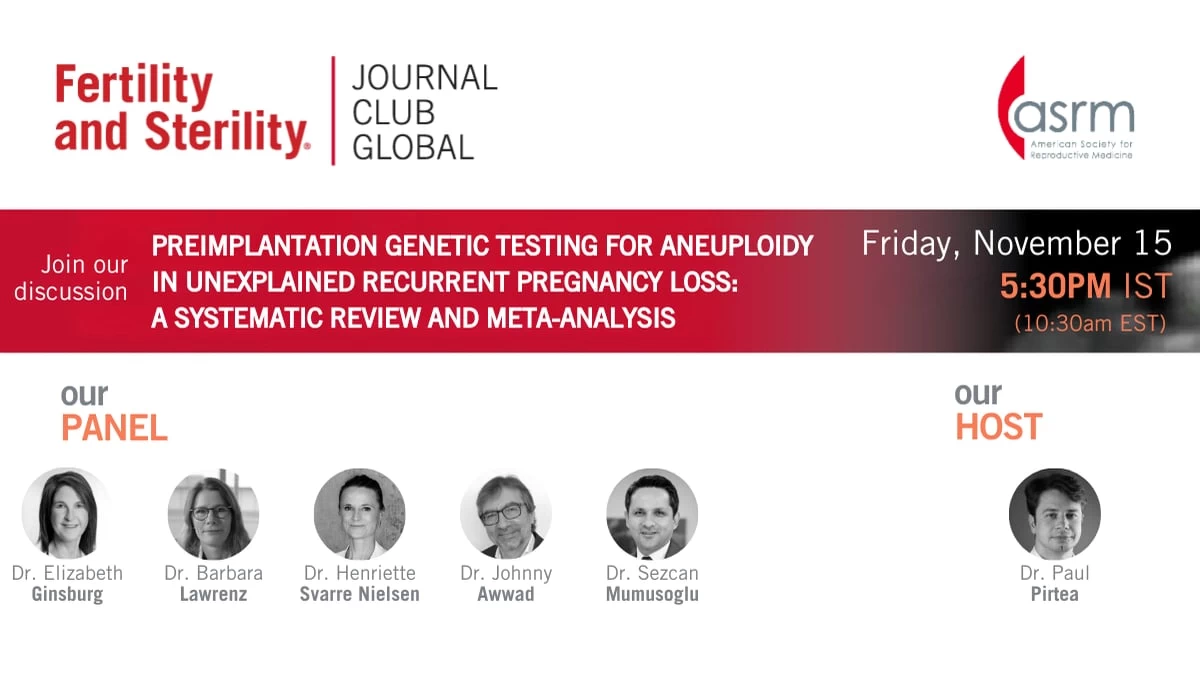
Journal Global Club From TSRM 2024: Preimplantation genetic testing for aneuploidy in unexplained recurrent pregnancy loss: A systematic review and meta-analysis

Explore the effectiveness of PGT-A in managing unexplained recurrent pregnancy loss, featuring systematic review findings, insights on miscarriage risks, and live birth rates.

View the Video
Journal Club Global Teaser
Video

Journal Club Global from MEFS 2024

Explore BMI's impact on IVF outcomes in a global fertility discussion, analyzing studies, obesity trends, and regional variations in reproductive health care.
View the Video
jcg ASRM 2024 thumbnail
Video

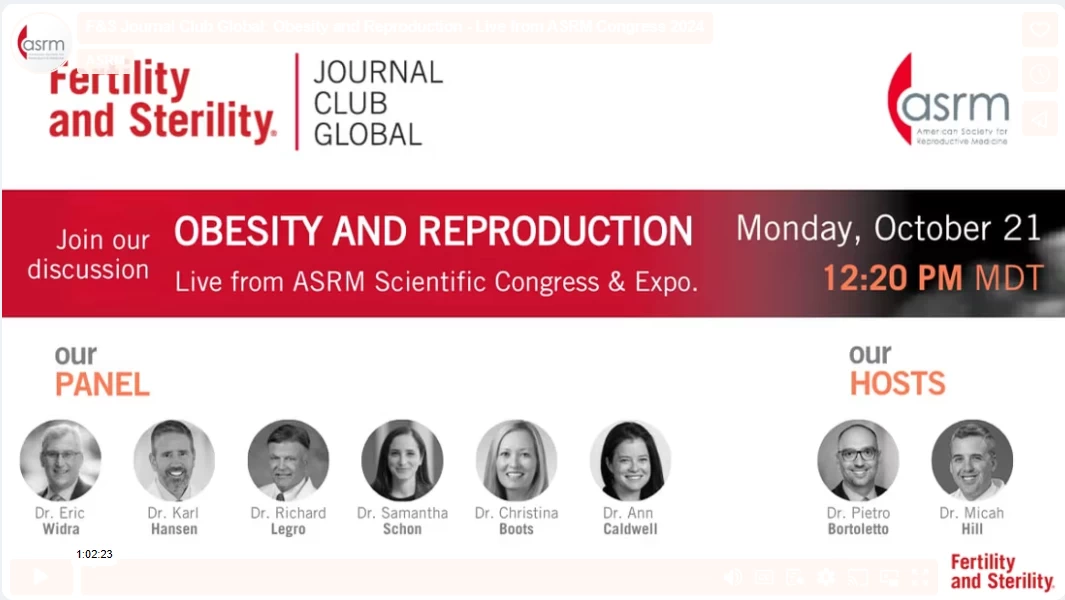
Journal Club Global from ASRM 2024: Obesity and Reproduction

Join experts from Fertility and Sterility Journal Club as they explore the impact of obesity on reproduction, weight loss interventions, and emerging treatments in fertility.

View the Video
JCG SAMER 2024 teaser thumbnail
Video

Journal Club Global en Español: De la Reunión de la SAMER 2024

 Onsite de la Reunión de la Sociedad Argentina de Medicina Reproductiva (SAMER) de Córdoba, Argentina

View the Video
Journal Club Global Teaser
Video

Journal Club Global: SREI Fellows Retreat - Fellows vs Faculty Debate: Luteal Support in Programmed FET Cycles

Fertility and Sterility Journal Club debate on progesterone administration in frozen embryo transfers, featuring faculty vs fellows discussing IM vs vaginal routes.

View the Video
Journal Club Global Teaser
Video

Journal Club Global from ANZSREI 2024: Debate Unexplained infertility; Straight to IVF?

ANZSREI 2024 debate: Should unexplained infertility go straight to IVF? Experts discuss pros, cons, and alternative treatments. No clear consensus reached.

View the Video
Journal Club Global Teaser
Video

Journal Club Global en Espanol: Actualizacion sobre el síndrome de ovario poliquístico

Fertility & Sterility se enorgullece de traer un Journal Club Global en Español en vivo desde Cancún, Mexico

View the Video
Journal Club Global Teaser
Video

Journal Club Global: Oral Progestin For Ovulation Suppression During IVF

Live broadcast from the 2024 Midwest Reproductive Symposium
International in Chicago, IL

View the Video
Journal Club Global Teaser
Video

Journal Club Global: Recent clinical trials in Fertility and Sterility from the Asia Pacific region

Join ASPIRE 2024 for a Journal Club Global on PGT-A and IVF. Learn from top experts discussing recent clinical trial data and pregnancy outcomes

View the Video
Journal Club Global Teaser
Video

Journal Club Global en Español: Avances recientes en el tratamiento del síndrome de ovario poliquístico e Infertilidad

Un panel de expertos discutirá dos artículos recientes de Fertility and Sterility que estudian la infertilidad y el síndrome de ovario poliquístico.

View the Video
Journal Club Global Teaser
Video

Journal Club Global: Cost effectiveness analyses of PGT-A

Infertility treatments can be financially burdensome, often without insurance coverage, making understanding the cost effectiveness of PGT-A crucial.

View the Video
Journal Club Global Teaser
Video

Journal Club Global: The future of REI Fellowship training: debating opportunities and threats

This exciting collaboration discusses the controversy and future directions for the field of Reproductive Endocrinology and Infertility medicine.

View the Video
Journal Club Global Teaser
Video

Journal Club Global: Infertility and Subclinical Hypothyroidism

The impact of treating SCH on fertility, obstetric outcomes, and offspring neurocognitive development is debated in the literature.

View the Video
Journal Club Global Teaser
Video

Journal Club Global: Actualidad En Tratamientos De Fertilidad Para Pacientes Con Endometriosis

Live in Spanish from the 2024 Peruvian Fertility Society Meeting - Lima, Peru

View the Video
Journal Club Global Teaser
Video

Journal Club Global - Recurrent implantation failure: Reality or statistical mirage?

This exciting new collaboration brings authors and experts to discuss the controversy and future directions for recurrent implantation failure.

View the Video
Journal Club Global Teaser
Video

Journal Club Global - Evidence based guidelines for (PMOS) PCOS

This virtual event discusses the international guidelines for the assessment and management of PMOS (formerly PCOS), conducted by the International PCOS Network.

View the Video
Journal Club Global Teaser
Video

Journal Club Global - Recurrent implantation failure: Reality or statistical mirage?

This exciting new collaboration brings authors and experts to discuss the controversy and future directions for recurrent implantation failure.

View the Video
Journal Club Global Teaser
Video

Journal Club Global - The Association of Ovarian Reserve and Embryo Aneuploidy

Recent research suggests that the Antimullerian hormone (AMH) may not reliably predict embryo health in both infertility and non-infertility cases.

View the Video
Journal Club Global Teaser
Video

Journal Club Global - Actualización en la suplementación con progesterona en fase lútea para transferencias de embriones congelados

Efectividad del rescate de progesterona en mujeres que presentan niveles bajos de progesterona circulante alrededor del día de la transferencia de embriones

View the Video
Journal Club Global Teaser
Video

Journal Club Global - Revisiting the STAR trial: The Fellows debate PGT-A

We are excited to host a debate covering the pros and cons of PGT-A and how new technologies should be validated before clinical implementation.

View the Video
Journal Club Global Teaser
Video

Journal Club Global: Absolute uterine infertility a Cornelian dilemma: uterine transplantation or surrogacy?

Absolute uterine infertility presents as a Cornelian dilemma for patients and providers.

View the Video
Journal Club Global Teaser
Video

Journal Club Global: Transferencia de embriones frescos versus congelados: ¿Cuál es la mejor opción

Los resultados de nuevas técnicas de investigación clínica que utilizan información de bancos nacionales de vigilancia médica.  

View the Video
Journal Club Global Teaser
Video

Journal Club Global: IVM in Clinical Practice: An Idea Whose Time Has Come?

In vitro maturation (IVM) has the potential to make IVF cheaper, safer, and more widely accessible to patients with infertility.

View the Video
Journal Club Global Teaser
Video

Journal Club Global - What is the optimal number of oocytes to reach a live-birth following IVF?

The optimal number of oocytes necessary to expect a live birth following in vitro fertilization remains unclear.

View the Video
Journal Club Global Teaser
Video

Journal Club Global: Surgical management of endometriosis in women diagnosed with infertility (Spanish language)

Fertility and Sterility is excited to partner with our global professional colleagues to begin broadcasting regular Journal Club Global events in Spanish.

View the Video
Journal Club Global Teaser
Video

Journal Club Global: Natural versus Programmed FET Cycles

A significant portion of IVF cycles now utilize frozen embryo transfer.

View the Video
Journal Club Global Teaser
Video

Journal Club Global: Moving leiomyoma research from bench to bedside

Uterine leiomyomata are benign tumors that develop during the reproductive years with a 70-80% prevalence by menopause.

View the Video
Journal Club Global Teaser
Video

Journal Club Global: Does diminished ovarian reserve impact embryo aneuploidy or live birth rates?

Do patients with diminished ovarian reserve (DOR) have poor outcomes because of lower ovarian response, or because of additional factors that affect the egg quality.

View the Video
Journal Club Global Teaser
Video

Journal Club Global: Is PGT-P cutting edge or should we cut it out?

PGT for polygenic risk scoring (PGT-P) is a novel screening strategy of embryos for polygenic conditions and traits.

View the Video
Journal Club Global Teaser
Video

Journal Club Global: Should everyone freeze oocytes by age 33?

Oocyte cryopreservation is one of the fastest growing areas of reproductive medicine.

View the Video
Journal Club Global Teaser
Video

Journal Club Global: Management of poor ovarian response

A poor ovarian response to what should otherwise be a successful stimulation cycle presents a clinical conundrum for clinicians.

View the Video
Journal Club Global Teaser
Video

Journal Club Global: Non-invasive Diagnosis of Endometriosis

One of the most exciting developments in the field of endometriosis is the push towards earlier and less invasive approaches to diagnosis.

View the Video
Journal Club Global Teaser
Video

Journal Club Global: Prognosis in unexplained RPL

Recurrent pregnancy loss is one of the bigger challenges in the field of reproductive medicine.

View the Video
Journal Club Global Teaser
Video

Journal Club Global: Evidence for Immunologic Therapies in Women Undergoing ART

Reproductive immunology is perhaps one of the most controversial and promising fields within ART.

View the Video
Journal Club Global Teaser
Video

Journal Club Global Live from PCRS - Non-Invasive Embryo Selection Techniques

The next great frontier in reproductive medicine is how to non-invasively select an embryo with the highest reproductive potential for transfer.

View the Video
Journal Club Global Teaser
Video

Journal Club Global Live from PCRS - ICSI for Non-Male Factor Infertility

While intracytoplasmic sperm injection (ICSI) has revolutionized the treatment of male factor infertility, a significant controversy still remains regarding its ubiquitous use in all IVF cycles.

View the Video
Journal Club Global Teaser
Video

Journal Club Global - To Operate Or Not To Operate: Debating Intramural Fibroids And Fertility

The event will debate the upcoming F&S Fertile Battle “Intramural myomas more than 3 to 4 cm should be surgically removed before IVF”.

View the Video
Journal Club Global Teaser
Video

Journal Club Global - PGT-A - Can non-invasive approaches based on spent medium analysis

PGT-A by trophectoderm biopsy aims to select available euploid embryos for transfer.

View the Video
Journal Club Global Teaser
Video

Journal Club Global - Obesity & Reproduction: An Update on Management and Counseling

Obesity can negatively impact reproduction in various ways, including ovulatory and menstrual function, natural fertility and fecundity rates, infertility treatment success rates, infertility treatment safety, and obstetric outcomes

View the Video
Journal Club Global Teaser
Video

Journal Club Global - Does the Endometrium Play a Major Role in Endometriosis-Associated Infertility

This will be a virtual event in the style of the "Fertile Battle" debate that took place at the 2019 SREI Fellows Symposium

View the Video
Journal Club Global Teaser
Video

Journal Club Global - Best Practices of High Performing ART Clinics

This Fertility and Sterility Journal Club Global discusses February’s seminal article, “Common practices among consistently high-performing in vitro fertilization programs in the United States: a 10 year update.”

View the Video
Journal Club Global Teaser
Video

Journal Club Global - Should Fellows Perform Live Embryo Transfers in Fellowship?

Few things are more taboo in reproductive medicine fellowship training than allowing fellows to perform live embryo transfers.

View the Video
Journal Club Global Teaser
Video

Journal Club Global - Fertilization rate as a novel indicator in ART results

This Journal Club Global discusses a provocative article recently published in Fertility and Sterility, discussing the results of a multicenter retrospective cohort study with the objective to appraise the fertilization rate as a predictive factor for cumulative live birth rate (CLBR).

View the Video
Journal Club Global Teaser
Video

Journal Club Global Live from ASRM - Optimal Management of the Frozen Embryo Transfer Cycle: Insights From Recent Literature

Three recent papers published in the Fertility and Sterility family of journals, all explore different aspects of optimizing frozen embryo transfer cycles.

View the Video
Journal Club Global Teaser
Video

Journal Club Global - Are We Approaching Automation in ART?

Some ART diagnostic devices are already available and offer objective tools of evaluation.

View the Video
Journal Club Global Teaser
Video

Journal Club Global Live from India - Adjuvants in IVF and IVF Add-Ons for the Endometrium

Many adjuvants have been utilized by IVF centers to improve their success rates.

View the Video
Journal Club Global Teaser
Video

Journal Club Global - Accuracy of Preimplantation Genetic Testing for Aneuploidies

One of the highest aspirations in reproductive medicine is to develop a technology allowing for ID of embryos that have true reproductive potential.

View the Video
Journal Club Global Teaser
Video

Club Global Académico - ¿Cual debe de ser la primera línea de tratamiento en parejas con infertilidad inexplicable?

Nuestro debate se enfocará en el manejo óptimo de la infertilidad inexplicable, y como el problema debe de ser abordado en Latinoamérica basado en la literatura global reciente.

View the Video
Journal Club Global Teaser
Video

Journal Club Global - Recurrent Implantation Failures in ART: Myth or Reality?

Classically, implantation failures in ART were believed to result from alterations in embryo or endometrium quality.

View the Video

Fertility and Sterility

F&S Reports cover image
Journal

F&S Reports

F&S Reports is an open-access journal that publishes peer-reviewed original scientific articles in clinical and translational research that have strong potential to transform clinical practice.

Read F&S Reports
F&S Reviews cover image
Journal

F&S Reviews

F&S Reviews publishes both systematic and comprehensive, authoritative review articles spanning reproductive medicine or science.

Read F&S Reviews
F&S Science cover image
Journal

F&S Science

F&S Science publishes peer-reviewed original scientific articles in basic, laboratory, and translational research that has strong potential to transform clinical practice.

Read F&S Science
Fertility and Sterility journal cover image
Journal

Fertility and Sterility

Fertility and Sterility® is an international journal for health professionals who treat and investigate problems of infertility and human reproductive disorders.

Read Fertility and Sterility
Journal Club Global video conference image
Video

Journal Club Global

Fertility and Sterility Journal Club Global is an interactive online discussion of a hot topic or seminal article from Fertility and Sterility. 

Watch the Journal Club Global videos

Topic Resources

View more on the topic of infertility
Newspaper Icon

Coming Soon: The Next Evolution of the Mac2021 Tool

Explore the updated ASRM MAC2021 tool, featuring AI guidance, imaging resources, and mobile access to improve Müllerian anomaly diagnosis. Learn more about our updates to MAC Tool
Document Icon

American Society for Reproductive Medicine recurrent implantation failure: a committee opinion (2026)

Patients who have several unsuccessful embryo transfers may be at risk for possible conditions that affect implantation.  View the Committee Opinion
Podcast Icon

Fertility and Sterility On Air - Unplugged: April 2026

Explore the latest fertility research on IVF, mental health, embryo transfer, PFAS exposure, and reproductive medicine in Fertility & Sterility Unplugged. Listen to the Episode
Document Icon

The International Glossary on Infertility and Fertility Care, 2025

Previous editions of the International Glossary on Infertility and Fertility Care established internationally recognized definitions related to clinical practice, research, and policy. View the Committee Opinion
PR Bulletin Icon

Half of Infertility Cases Involve Men. Why Does Care Still Treat It as a Women’s Issue?

Since 1989, National Infertility Awareness Week (NIAW) has marked a critical moment each April to elevate public understanding of infertility and push for better care. View the Press Release
PR Bulletin Icon

National Infertility Awareness Week Highlights Record IVF Births, Growing Demand for Fertility Care

IVF births surpass 100,000 in one year, highlighting demand for fertility care as ASRM urges awareness, reduced stigma, and expanded access nationwide. View the Press Release
Advocacy Icon

National Infertility Awareness Week

April 18-24, 2027, is National Infertility Awareness Week (NIAW)! 

View the NIAW Toolkit
Coding Icon

Mar 2026: Is Infertility a Chronic Disease? Why This May Matter for Billing and Coding

This document reviews a recent question regarding whether infertility is considered a chronic disease. View the blog post
Podcast Icon

Fertility and Sterility On Air - Roundtable: Should you do ultrasound monitoring for IUI cycles?

This episode of Fertility and Sterility is a roundtable, hosted by Dr. Emily Barnard and Dr. Ben Peipert with a discussion with the authors of "Views and Reviews" and "Fertile Battle" articles published in a recent issue of Fertility and SterilityListen to the Episode
Newspaper Icon

From Guidance to Global Impact: How ASRM’s Updated Definition of Infertility Helped Shape Policy in Australia

SRM's updated infertility definition became a catalyst for regulatory action internationally and yielded new hope for growing families on the other side of the world. Read about the impact
Videos Icon

Journal Club Global: Emulated Trials - A New Research Method With Insights Into Fertility Vitamin Supplements

Explore how emulated trials reveal the impact of vitamin D on fertility, featuring ASRM experts and real-world research insights from the FAST trial. View the Video
Document Icon

The reproductive endocrinology and infertility subspecialist: definition, training, and scope of practice in the United States (2025)

Learn the 2025 ASRM definition, training, and scope of practice for reproductive endocrinology and infertility subspecialists in the U.S. View the Committee Opinion
Document Icon

Improving access to care and delivery to marginalized and vulnerable populations: a committee opinion (2025)

ASRM committee opinion on reducing infertility care disparities, outlining barriers and actionable strategies to improve equitable access. View the opinion
PR Bulletin Icon

Key Abstracts Presented at the ASRM 2025 Scientific Congress & Expo

ASRM 2025 reveals support for IVF access, wildfire smoke's fertility risks, and how insurance mandates improve outcomes in reproductive health care. View the Press Release
PR Bulletin Icon

Fertility and Sterility Publishes Editorial Exploring the Origins of “Restorative Reproductive Medicine” and Why Modern Fertility Care Must Remain Comprehensive

Restorative reproductive medicine overlooks IVF, male-factor care, and the need for full-spectrum fertility treatment using modern technologies. View the Press Release
PR Bulletin Icon

ASRM PRIMED Cohort Members—Including Physicians, Providers, and Experts—Meet with Congressional Offices to Advocate for IVF Access & Educate About Realities of Restorative Reproductive Medicine

ASRM PRIMED cohort meets Congress to push for IVF access, clarify risks of restorative reproductive medicine, and defend science‑based fertility care. View the Press Release
PR Bulletin Icon

ASRM Hosts Capitol Hill Briefing for Policymakers & Congressional Staff to Hear From Providers & Patients About Importance of IVF Access, Realities and Limitations of Restorative Reproductive Medicine

ASRM briefing united lawmakers, physicians & patients on IVF access, exposing RRM limits and urging policies to expand fertility care options. View the Press Release
PR Bulletin Icon

SRS Warns Against Limiting Access to IVF Under the Guise of “Restorative” Care

SRS, an ASRM affiliate, advocates evidence-based reproductive surgery and full-spectrum fertility care for conditions like endometriosis, fibroids, and PMOS. View the Press Release
PR Bulletin Icon

Fertility and Sterility Publishes Editorial Piece on How Restorative Reproductive Medicine Violates Reproductive Autonomy and Informed Consent

Editorial in Fertility and Sterility warns that Restorative Reproductive Medicine spreads stigma, delays care, and undermines IVF and patient autonomy. View the Press Release
PR Bulletin Icon

F&S Reports Publishes Editorial Piece on the Unscientific Nature of the Arguments for “Restorative Reproductive Medicine” and Why We Need to Understand Them

F&S Reports editorial critiques “Restorative Reproductive Medicine” as unscientific, faith-driven, and a threat to evidence-based IVF care and reproductive rights. View the Press Release
PR Bulletin Icon

ASRM, Leading Medical Organizations Urge National Governors Association to Reject ‘Restorative Reproductive Medicine’ in Open Letter

Medical groups urge governors to reject Restorative Reproductive Medicine laws, defending evidence-based infertility care and IVF access. View the Press Release
Newspaper Icon

Reproductive Medicine in the Era of Social Media: Pearls and Pitfalls

For couples struggling to conceive, social media has become a lifeline, a source of information, inspiration, and community. View the Latest Tech Talk post
PR Bulletin Icon

ASRM Center for Policy and Leadership Releases Fact Sheet on Following the Science & An Evidence-Based, Science-Driven Response to Infertility

ASRM’s fact sheet outlines an evidence-based infertility care pathway, countering misleading RRM claims with science-backed medical best practices. View the Press Release
Advocacy Icon

Follow the Science: An Evidence-Based, Science-Driven Response to Infertility

A science-based infertility evaluation and treatment guide, grounded in clinical best practices, counters ideologically driven alternatives like RRM. View the advocacy resource
Videos Icon

Empathy in Action: Strengthening the Patient-Provider Connection

Dr. Tara Harding discusses how healthcare providers can foster empathy, trust, and patient-centered care to improve women's health outcomes. View the ASRMed Talk Video
Document Icon

Evidence-based guideline: Premature Ovarian Insufficiency (2025)

This guideline on premature ovarian insufficiency (POI) offers best practice advice on the care of women with POI. View the Joint Committee Document
Document Icon

Use of preimplantation genetic testing for monogenic adult-onset conditions: an Ethics Committee opinion (2024)

Preimplantation genetic testing for adult-onset monogenic diseases is ethically allowed when fully penetrant or conferring disease predisposition. View the Committee Opinion
Coding Icon

Appropriate Use of Modifier -25

Is Modifier -25 appropriate in the monitoring cycle when an ultrasound View the Answer
Coding Icon

Billing for E/M Visits

When billing Evaluation & Management (E/M) visits based on medical decision-making, would we View the Answer
Coding Icon

When to use code Z31.83

When a patient is completing an approved fertility cycle, is it necessary View the Answer
Coding Icon

Timed Intercourse Cycle Codes

Is it appropriate to utilize codes N97.8 or View the Answer
Document Icon

The use of preimplantation genetic testing for aneuploidy: a committee opinion (2024)

PGT-A use in the U.S. is rising, but its value as a routine IVF screening test is unclear, with mixed results from various studies. View the Committee Opinion
Videos Icon

Fertility Support and AI: Help or Hinderance

Discover how fertility apps impact patient care and nursing staff. Explore the balance between tech and human touch in complex fertility treatments View the ASRMed Talk Video
Coding Icon

HyCoSy and CPT 74740

When Office HSG/HyCoSy is performed but no x-ray/fluoroscopic imaging is performed, only ultrasound is done, is it appropriate to bill CPT code 74740? View the Answer
Document Icon

Subclinical hypothyroidism in the infertile female population: a guideline (2024)

This guideline reviews the risks and benefits of treating subclinical hypothyroidism in female patients with a history of infertility and miscarriage. View the Committee Guideline
Document Icon

Tobacco or marijuana use and infertility: a committee opinion (2024)

In the United States, approximately 21% of adults report some form of tobacco use, although 18% report marijuana use. View Committee Opinion
Videos Icon

Journal Club Global: The future of REI Fellowship training: debating opportunities and threats

This exciting collaboration discusses the controversy and future directions for the field of Reproductive Endocrinology and Infertility medicine. View the Video
Videos Icon

Journal Club Global: Infertility and Subclinical Hypothyroidism

The impact of treating SCH on fertility, obstetric outcomes, and offspring neurocognitive development is debated in the literature. View the Video
Document Icon

Ethical considerations for telemedical delivery of fertility care: an Ethics Committee opinion (2024)

Telemedicine has the potential to increase access to and decrease the cost of care. View the Committee Opinion
Document Icon

Ethical obligations in fertility treatment when intimate partners withhold information from each other: an Ethics Committee opinion (2024)

Clinicians should encourage disclosure between intimate partners but should maintain confidentiality where there is no harm to the partner and/or offspring. View the Committee Opinion
Document Icon

Definition of infertility: a committee opinion (2023)

Defines infertility as a disease impacting reproductive function, guiding evaluation and inclusive treatment regardless of age, status, or orientation. View the Committee Opinion
Document Icon

Diagnostic evaluation of sexual dysfunction in the male partner in the setting of infertility: a committee opinion (2023)

It is the responsibility of the clinician to assess for erectile dysfunction, ejaculatory dysfunction, or diminished libido in men presenting for infertility. View the Committee Opinion
Videos Icon

Journal Club Global - Actualización en la suplementación con progesterona en fase lútea para transferencias de embriones congelados

Efectividad del rescate de progesterona en mujeres que presentan niveles bajos de progesterona circulante alrededor del día de la transferencia de embriones View the Video
Coding Icon

Post Vasectomy Infertility

If a husband has had a vasectomy, does the sterilization code apply to the wife's visits? View the Answer
Coding Icon

Pregnancy Of Uncertain Viability Ultrasound

My staff is telling me that I am getting reimbursed for the first sonogram and OB visit (using ICD 10 code for pregnancy of uncertain viability – O36.80X0. View the Answer
Coding Icon

Pregnancy Ultrasound

Our practice does routine ultrasounds (sac check- 76817) at the end of an IVF cycle and bill with a diagnosis code O09.081, pregnancy resulting from ART.  View the Answer
Coding Icon

Psychological Evaluation

Many REs require patients (and their spouses/partners) who are considering using donor gametes to see an infertility counselor first. View the Answer
Coding Icon

Self-referred New Patient

A patient self-refers to our physician for an initial new patient consultation instead of referred by another physician, how do we code for the consult? View the Answer
Coding Icon

Surgery Coding

I took the ASRM coding course, and in that course, coding for bilateral neosalpingostomies was coded using only a dx of N70.11 (hydrosalpinx). View the Answer
Coding Icon

Telephone Consult

Does a physician need to speak directly to a patient to code for a telephone consult (99371-99373) or can a staff member relay physician notes to patients? View the Answer
Coding Icon

Testing With No History of Infertility

What diagnosis codes should  providers submit to insurance carriers while trying to evaluate fertility issues? View the Answer
Coding Icon

Infertility Consult

Does ASRM have any examples of evaluation and management documentation for patients being seen for an initial infertility evaluation? View the Answer
Coding Icon

Infertility Consult by Nurse

What code is used for a nurse practitioner seeing a fertility patient for the first time? View the Answer
Coding Icon

Initial Visit for Infertility With No Mandated Coverage

What code would be appropriate for an initial visit for infertility?  View the Answer
Coding Icon

IUI or IVF

Should other ovarian dysfunction (diagnosis code E28.8) or unspecified ovarian dysfunction (diagnosis code E28.9) can be used for an IUI or an IVF cycle View the Answer
Coding Icon

Monitoring E&M

Our group would like to know if others are billing an evaluation and management code for ultrasound and blood draw visits? View the Answer
Coding Icon

New vs Established Patient

How soon can you bill as a new infertility patient? View the Answer
Coding Icon

General E&M Consult

Recently we have received a “re-code” on a new patient (we billed a 99203 and the insurance re-coded it to a 99213).  View the Answer
Coding Icon

Hysteroscopy Recurrent Implantation Failure

What is the appropriate ICD-10 code for recurrent implantation failure?  View the Answer
Coding Icon

D&C Under Ultrasound Guidance

What are the CPT codes and ICD-10 codes for coding a surgical case for a patient with history of Stage B adenocarcinoma of the cervix ... View the Answer
Coding Icon

Diagnosis of Infertility for IVF Procedure

How important is it to have accurate documentation of the type of infertility diagnosis for IVF procedures?  View the Answer
Coding Icon

Diagnostic Testing of an Infertile Couple

The Z31.41 is or is not the correct code to use for diagnostic testing of an infertile couple? And If so can if be used as the primary and only code? View the Answer
Coding Icon

Blood Draws

If a patient comes in only for a blood draw (venipuncture) and is seen only by the lab technician (not an MD, PA, or NP), may we bill for a (minimal) office visit? View the Answer
Coding Icon

Blood Tests

Patients are requesting to have lab work drawn from the female patient moved to the males account due to the female fertility coverage being maxed out.  View the Answer
Coding Icon

Male Infertility

A summary of common codes for Male Infertility compiled by the ASRM Coding Committee. View the Coding Summary
Document Icon

Fertility evaluation of infertile women: a committee opinion (2021)

Diagnostic evaluation for infertility in women should be conducted in a systematic, expeditious, and cost-effective manner. View the Committee Opinion
Document Icon

ASRM müllerian anomalies classification 2021

The Task Force set goals for a new classification and chose to base it on the iconic AFS classification from 1988 because of its simplicity and recognizability. View the Committee Opinion
Document Icon

Moving innovation to practice: an Ethics Committee opinion (2021)

The introduction of new strategies, tests, and procedures into clinical practice raises challenging ethical issues. View the Committee Opinion
Document Icon

Use of exogenous gonadotropins for ovulation induction in anovulatory women: a committee opinion (2020)

Pretreatment evaluation, indications, treatment regimens, and complications of gonadotropin treatment. View the Committee Opinion
Document Icon

Reproductive and hormonal considerations in women at increased risk for hereditary gynecologic cancers: Society of Gynecologic Oncology and American Society for Reproductive Medicine Evidence-Based Review (2019)

Providers who care for women at risk for hereditary gynecologic cancers must consider the impact of these conditions. View the Joint Statement
Document Icon

Guidance for Providers Caring for Women and Men Of Reproductive Age with Possible Zika Virus Exposure (Updated 2019)

This ASRM guidance specifically addresses Zika virus infection issues and concerns of individuals undergoing assisted reproductive technologies (ART). View the Guideline
Document Icon

Fertility treatment when the prognosis is very poor or futile: an Ethics Committee opinion (2019)

The Ethics Committee recommends that in vitro fertilization (IVF) centers develop patient-centered policies regarding requests for futile treatment.  View the Committee Opinion
Document Icon

American Society for Reproductive Medicine position statement on uterus transplantation: a committee opinion (2018)

Following the birth of the first child from a transplanted uterus in Gothenburg, Sweden, in 2014, other centers worldwide have produced scientific reports. View the Committee Opinion
Document Icon

Child-rearing ability and the provision of fertility services: an Ethics Committee opinion (2017)

Fertility programs may withhold services on the basis that patients will be unable to provide minimally adequate or safe care for offspring. View the Committee Opinion
Document Icon

Removal of myomas in asymptomatic patients to improve fertility and/or reduce miscarriage rate: a guideline (2017)

This review evaluates if uterine myomas impact likelihood of pregnancy and pregnancy loss, and if myomectomy influences pregnancy outcomes. View the Guideline
Document Icon

Improving the Reporting of Clinical Trials of Infertility Treatments (IMPRINT): modifying the CONSORT statement (2014)

Clinical trials testing infertility treatments often do not report on the major outcomes of interest to patients and clinicians and the public. View the Guideline
Document Icon

Endometriosis and infertility: a committee opinion (2012)

Women with endometriosis typically present with pelvic pain, infertility, or an adnexal mass, and may require surgery. View the Committee Opinion