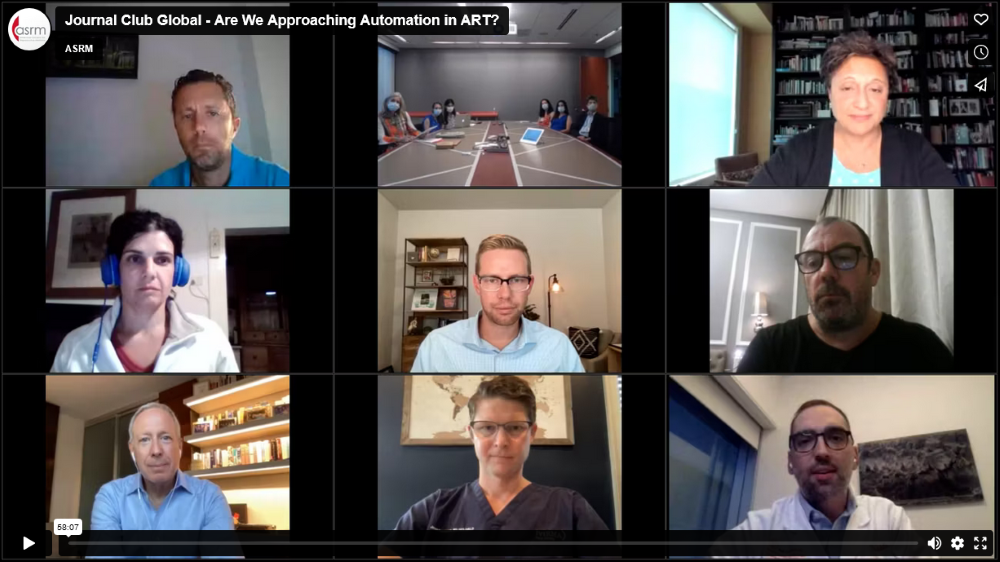
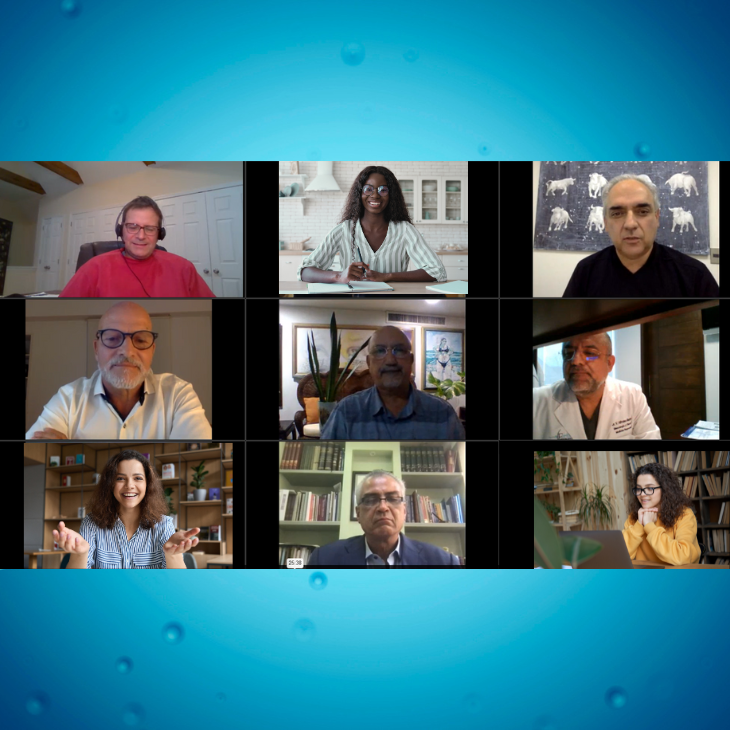
Good evening, everyone, and welcome to Fertility and Sterility Journal Club Global. My name is Pietro Bordoletto, and I'm the Interactive Associate-in-Chief for FNS and Media Editor for FNS Reports. And I'm joined by my co-host, Dr. Blake Evans, FNS Reviews Media Editor, Interactive Associate, and Faculty Member at the University of Oklahoma.
Tonight's Journal Club Global is being hosted by the Duke University Division of REI, and we're joined by a panelist of superstars from all around the world, as well as a few of the authors of the article who will be discussing with us tonight. Tonight's article is entitled, Are We Approaching Automated Assisted Reproductive Technology? Sperm Analysis, Oocyte Manipulation, and Insemination, recently published in FNS Reviews. I wanted to start off by introducing our authors tonight.
Dr. Valentina Casciani is a Clinical Embryologist at General Life in Rome, Italy, and our paper's first author. Dr. Marcos Messeger is the Scientific Supervisor and Senior Embryologist at the EV Valencia IVF Unit. And Dr. Jason Frenisiak is Lead Physician and Laboratory Director of RMA New Jersey and Marlton, and Assistant Professor of REI at Thomas Jefferson University.
We are also joined by three esteemed experts. Dr. Sangeeta Jindal is an Associate Professor in the Department of OBGYN and Laboratory Director of Montefiore's Institute for Reproductive Medicine and Health. Dr. Jose Jorgejadas is a Molecular Biologist by training, but also serves as the Chief Scientific Officer at Overture Life, a biotech company focusing on embryology lab automation.
And finally, Dr. David Sable is a Reproductive Endocrinologist who teaches Entrepreneurship and Biotechnology at Columbia University. He also directs Healthcare and Life Science Investing for the Special Situations Fund. And finally, but certainly not least, our host for the evening, the Duke University REI Fellowship.
At Duke, Dr. Tom Price is Professor in the Department of Obstetrics and Gynecology and Director of the REI Fellowship Program at Duke University. And he's joined by Dr. Anne Steiner, who's Professor and Chief of the Division of Reproductive Endocrinology at Duke. Dr. Steiner also happens to serve as Editor-in-Chief for FNS Reviews, where our paper comes from this evening.
Welcome, everyone. Welcome to our panel. I'm very happy to be here with all of you this evening.
Dr. Steiner, I want to turn it over to you as our host. I want to first ask you if you can tell us a little bit about FNS Reviews, since it's a relatively new journal, then also have you introduce your team and introduce the panel this evening. Thank you.
We are thrilled that Journal Club Global is featuring an article from the latest issue of FNS Reviews. FNS Reviews quarterly publishes systematic and narrative reviews spanning reproductive medicine and science. We hope that this article and others published in FNS Reviews will serve as an authoritative resource for clinicians, scientists, and trainees and will advance the readers and the Journal Club attendees' understanding of human reproduction.
I encourage you to visit our website, www.firstcertreviews.org, to learn more about our journal and browse the content. For those of you interested in submitting to FNS Reviews, please see our author guidelines. Dr. Seltzer? Thank you, Dr. Steiner.
I'm going to just briefly introduce the de-fellowship program for Dr. Steiner and Dr. Price, who Dr. Borlau already introduced, as well as Dr. Neal and Dr. Acharya, and then Dr. Arguello is our first-year fellow, and my name is Jessica Seltzer. I'm a second-year REI fellow. First of all, I just want to say thank you so much to FNS Journal Club Global for allowing us to host tonight.
Today, we're going to be discussing the FNS Review article, Are We Approaching Automated ART, Sperm Analysis, Oocyte Manipulation, and Insemination? Just as a little bit of a background, currently most... Next slide. Theo, can you pull up the slides, please? Perfect. We can do next slide.
Just a bit of a background. Currently, most ART protocols are performed manually, and this requires meticulous attention to detail and very precise handling and timing, which is extremely important in order to avoid exposing cells to adverse environmental conditions. All of these requirements are met by highly skilled clinical embryologists who are essential to our final reproductive outcomes.
However, the repetitive procedures that are performed by embryologists are at high risk of human error in setting of high clinical volume. Potentially, automation of ART could work to reduce the work volume of embryologists while contributing to standardization, a reduction in performance variability. Importantly, it could also decrease the cost of medical treatment, allowing increased access to care, as well as decrease human error.
There is precedent for the automation of complex tasks. For example, the automotive industry has progressed from initially handmade vehicles to highly automated production with increased safety, quality, and cost savings. Therefore, in the future, the goal of the ART automation would be to potentially use existing automated platforms that have been or are currently being developed in order to create a comprehensive platform that would integrate these technologies with the goal of full automation of the IVF lab.
Therefore, the goal of this FNS Reviews article was to review the current potential for automation within the IVF lab, focusing on sperm and oocyte manipulation, selection, and insemination. Next slide. Next slide.
So, first, the authors described some of the automated systems that are being developed in the processing analysis of sperm. So, one of the first steps of automation would be to incorporate a standardized sperm analysis instrument. There are a variety of computer-assisted semen analyses that have been developed in order to standardize and increase the reproducibility of semen analysis.
And some of those are currently on the market, but their concerns about validity and reproducibility have prevented them from being used in routine clinical practice. Other semen analysis instruments are being used based on microfluidics, but often only assess one parameter, such as sperm motility. And there also has been a new generation system that uses AI, optical microscopy, in order to quantitatively measure sperm concentration, motility, and seminal pH.
However, the eventually fully automated ART system would require not just diagnostics, but also the ability to prepare and select sperm for ART. And microfluidics is a promising sperm selection approach that offers the possibility of selecting sperm from semen while avoiding the damaging and centrifugation steps that can lead to DNA fragmentation. So, some examples of these microfluidics devices are on the slide above, but as you can see in Figure A, they often have inlet and outlet ports where a laminar flow helps to separate motile sperm.
Others use thermotaxis, rheotaxis, or chemotaxis, some of the figures of which are Figures B and C, in order to separate motile sperm. A lot of the current microfluidic systems in development are all motility-based, but there's still research that needs to be done for samples with low motility or concentration. Furthermore, purifying rare sperm from testicular samples remains an issue, and there are some current systems in development that are able to separate rare cells using hydrodynamic interactions between fluid flow and cells, and these are shown in Figures D and E. Another aspect of automation that's currently being developed involves sperm selection for use in AICSI.
So, an automated sperm electrophoresis system, which is shown in Figure F, would potentially be able to separate sperm based on their surface charge. And then there are microfluidic tip systems that have been designed for single sperm entrapment in order to assess sperm characteristics on a single cell layer, of which you can see in Figure G. In the future, the ability to use this or similar systems to trap single sperm and then use a non-invasive evaluation of molecular structure could potentially help an automated system be able to select a single sperm for AICSI. So, the automation of sperm selection and processing, there are many pros and cons.
The pros include a reduced need for space and lab equipment, the ability to control fine control conditions on a very miniature scale, and reduce the risk of human error. However, there are still questions that need to be addressed. These are expensive for large-scale production.
We also need to think about outcome measures like live birth, which have not yet been proven to be superior with these automated systems. And also, the need for increased throughput is essential to be able to process many samples. Okay.
So, we will now be moving over to oocyte manipulation, evaluation of oocyte quality, and insemination of oocyte. So, currently, there is no system for oocyte pickup or the process of washing red blood cells away and filtering the cumulus oocyte complexes into a clean medium under direct visualization. This is a potential area for development.
There are a couple of systems that aid in oocyte denudation or the removal of cumulus cells. And we will talk more about them on the next slide. This is shown in picture A is a series of microfluidic channels and the oocyte progress to smaller channels and progressively moving to smaller channels that remove the cumulus cells.
And in part B, this shows that the cumulus cells are then aspirated from the oocyte as it travels out into the channels. The system shown in figure B, it shows that the oocyte goes through progressively smaller channels that are lined with jagged edges, and that gently sheds the cumulus cells. A study of the latter system reported that none of the oocytes were damaged during this process.
After decumulation, the oocytes are evaluated. There are various characteristics that can be studied, such as morphology, dielectric sporadic velocity, sedimentation rate, membrane permeability, and visoelastic behavior. Some of these characteristics have been shown to be correlated to oocyte competence into developing into a blastocyst, but their use in clinical practice is limited.
There are multiple automated systems that fertilize gametes. For conventional fertilization, microfluidics have been used to create systems that have been shown to reduce polyspermic zygote formation and improve fertilization rates in oligospermic patients. When the microfluidics are used under a dielectric sporadic field, there are higher fertilization rates with a shorter incubation time compared to conventional IDF.
An automated ICSI device has been studied for almost over a decade, and there are three systems worth mentioning, one of which is the robotic immobilization device, which can account for swimming and orientation and able to target and immobilize a moving sperm 94% of the time and can do so in about five to six seconds. Another technique that could lend itself well to automated ICSI is the piezoelastic ICSI device, which uses mechanical pulses to create vibration and enable a flat-tip micropipette to penetrate the oocyte. Lastly, there's a robotic ICSI device that is able to hold the oocyte in a fixed position and able to immobilize the sperm and then inject the sperm into the oocyte.
The rate of sperm deposition in the oocyte was 90%, and the overall survival rate was 9%. This is a schematic of the robotic ICSI device described in the last slide. In conclusion, there are many steps that would require automation for a fully automated ART system, from sperm analysis that could differentiate sperm quality, sperm preparation, as well as improvement in sperm with volatility and concentration.
There would need to be a development of oocyte pickup device with possible integration of a COC denudation. Furthermore, there would need to be a standardized set of criteria used for evaluation of oocyte quality, as well as continued improvement in the devices that immobilize and inject sperm, possibly with the incorporation of a piezoelectric ICSI device. Thus, significant progress is needed prior to the ART automation on a single device.
Most of the automation advances have been made on sperm, but there's limited utilization in clinical settings, likely due to concerns about validity, reproducibility, and lack of data that automation could impact clinical outcomes. Thank you, and we will now move on to questions. So, Dr. Cassiani, after reviewing all of the studies and all of the devices that are being developed in the paper, what aspects within the lab do you think is automation most needed, and what do you think is the aspect in the lab that is furthest along in the potential automation? So, automation is making a lot of, we're making a lot of progress in automation, but still, there is a lot to do.
Most of the work has been done, as you presented, on sperm, and those work were also approved on human sperm. On the oocyte side, there are very few works that were approved on human oocytes, so for sure, a lot of work has to be done in that direction. And also, the big need of improvement will probably be in the culture of oocytes after insemination, so of embryos until the blastocyst stage, because the sense of automation will be to understand which is the ideal embryo to transfer, and not only microfluidics, or robotics, or single technological improvements will be useful in these terms, but all together will need to be integrated.
So, for example, culturing an embryo until the blastocyst stage in a microfluidic system with the supervision of images and image analysis with a time lapse, for example, and at the very end, the analysis of the culture media to see the metabolism of these embryos will be, will give us the full, the full, I don't know, help me to express this, the full picture, the ability to fingerprint of these embryos, so we will be able to select which ones will be the best. And also, artificial intelligence, of course, will help us a lot in this, and also in understanding what is the expectation for couples to achieve pregnancy. Jose, during the talk, I saw you shaking your head when Valentina mentioned embryo culture and microfluidics.
I know your company, Overture, is working on the IVF lab in the box. Why don't you tell us a little bit about the idea of how we move from theoretical concept of automating the embryology lab to actually building a machine that will automate the embryology lab? Well, I think because, I think that if we have this meeting tonight, it's because, or this afternoon in the U.S., it's because all we believe that the automation in some aspects is necessary. So, mainly to standardize the results, the outcomes in the clinics, and also to have the, also to reduce the cost, both.
So, there are some things that are easier to automate, and others that you know very well that is very difficult. Valentina said, talk about the sperm. I think sperm is so, the variability of the sperm is so, it's so variable that it's the worst in automation, but for all sides, if ICSI, even ICSI, I didn't believe in ICSI automation until I started working Overture, and with Palermo and other people, there are many, many advantages in the ICSI automation, and now I believe that this is possible to do, I mean, to avoid the, I mean, to try to do the, in the right way without any mistake.
If we are here, because what we believe that, oh, we know Embryoscope, Embryoscope is working, so why not the other, the sperm, the outside, the denudation that for us, you know, our company, we have done very, we have very good results in the denudation. It's something that also is still dishandling. I think that the, what Valentina says is that, for me, sperm is the worst to do automation.
ICSI is the most wonderful thing we can do in automation, but everything has been to be automated, meaning to standardize the results and to be, and to have cheaper, cheaper IVF, and to standardize and to democratize the IVF. This is what we are working for, everybody. To me, it seems that standardization is probably one of the biggest benefits of automation, and Dr. Jindal, I know you, you manage several busy IVF labs and supervise the work of many embryologists both on and off site.
How do you think that automation in the embryology lab will make your life easier as someone who has to manage a busy lab in multiple places all at once? Yeah, thank you, and thank you for inviting me. I am a big proponent of AI and automation or semi-automation, but I'm coming from a different angle. The labor force for embryology is very tight, and we are not able to staff actual physical bodies enough to fill the laboratories.
The workload is heavy. Consistency is an issue. As you say, economics, human error, all of these things, I think, are tilting us toward welcoming and even diehard embryologists welcoming at least semi-automation and AI, which is already in the laboratory, as you know.
Where do you think we have the biggest opportunity to kind of bring it to life and make it actually happen in the next handful of years? Is it therapeutic automation, diagnostic automation, or just purely technical automation to offload mundane tasks from the embryologist? Yeah, I think it's probably the third one, but I know we're already diagnostic. We have immunoanalyzers. We have cases.
We have witnessing software, which is therapeutic. We have the time lapse microscopy. We now have a robot that maintains our cryotanks, so all of these things are already in place, and they're beta tested if they're not already in place, but I think the mundane tasks, the measurement of lab KPIs, there's a lot of really smart lab directors and senior embryologists developing those softwares now and doing machine learning, and I think that's really where we're going to be able to hand off a lot of that work, so I think there'll always be a place for embryologists, at least I hope so, but probably there'll be less bench work oriented and more focused on complex tasks around data management that comes out of the laboratory.
Marcos, on the European side, do you also see a shortage of highly skilled embryologists to staff your busy clinics around Spain and the world? Not at all. Well, first of all, we are representing the part of Europe with the worst English accent, so I apologize for the English listening or pronunciation, Italy and Spain, even though Valentina has a wonderful English, by the way, but I don't think that we have a shortage in embryologists. On the contrary, in Spain, we are producers.
We are training a lot of embryologists, which means that we don't have that problem. We don't have a problem to find people which is trained, not trained with their hands, but at least trained in the university, doing masters and things like that. It's true that at the end, it's difficult to find a very well-trained embryologist with a lot of years of experience, but in summary, in Spain, we are exporting embryologists elsewhere, and you may find embryologists from Spain in many, many places of the world, so we don't have this problem.
The second side is our salary is not very high at all, so it's not expensive to have embryologists, so the switch to machines isn't necessary for the cost point of view, okay? Then we can talk about all the things related with the consistency of the work or things like that, but we don't have this shortage, so it's not really a problem, actually, and even when you take… I'm trained embryologist and teach in the university, so when you are teaching 40 students every year and you're talking about automation and the future, they're disappointed. What the hell? We're doing a master, we're trying to finish and trying to find a job, and now you're telling me that we're working in the automation, so it makes no sense for us from that point of view, but obviously, I mean, it's an amazing future, very exciting, and Sunjita was talking about hardware and software, so things totally… We are very advanced in the software part with AI in image analysis and data analysis, especially for KPI, very interesting topic, and maybe we're a little far away, or we don't know. I mean, Jose knows more than us, Dr. Cajadas, because he's working in the company, but me, like embryologist, still, we don't see that part in the lab.
A few things are done already, but we see that part like a little bit far away. We will see. David, you kind of straddle both worlds, being a formerly trained reproductive endocrinologist, but now very much on the healthcare and biotech side of automation and technological advancements in the field of IVF.
What do you see as the biggest opportunities in automation and commercialization in this space, and what's coming down the pipeline? Yeah, that's a great question. First of all, the paper is outstanding, as was the review by our fellows. It's great to see great people coming up behind us.
I've probably evaluated upwards of 60 business plans in AI, automation, standardization, robotics for the IVF lab, and I essentially ask the question right back to the entrepreneurs. They can show me an alternative method of doing something. What has been difficult to show has been the value proposition of the individual interventions.
Robotic ICSI, for example, automated AI-based embryo selection. Is this going to result? I have two metrics that I judge everything by. It's the same ones my patients used to use, which was dollars per baby and time to baby.
When an intervention comes to me, how likely is this going to improve those? Because if it doesn't, if it's just different, then why are we spending time doing it? The low-hanging fruit for most of the AI companies seems to be embryo selection. The difficulty there is, are we going to use our algorithms? Are we going to use these optical imaging systems to improve the implantation rate in the best programs from 65% to 67%? In which case, it really doesn't move the needle. On the same hand, many of the interventions, and this is one of the reasons that this is a slow progress right now, is many of the interventions are very distant from the metric we can use to assess how successful they were.
We know how quickly ICSI was adopted and relatively quickly pre-implantation genetic diagnosis, or now PGT, was adopted. With those, you had a metric right away, very close and very much a cause and effect. If we're introducing an intervention and we're waiting for pregnancy results, there are so many co-founders that come in an interval that we need so many tens of thousands of entries into our database to isolate that single variable, so it's a little difficult.
My personal preference would be, and this is kind of a pipe dream, would be to set up a Bell Labs of embryology, put together all of the best technologies at once, fully automate the lab, and see how we do. Then one after another, pick apart those areas that are working the least until we come up with a fully robotic system. We may find purely from an engineering standpoint that it's easier to put the data together that way than it is to try to incrementally prove the value of each of the individual interventions.
But, and we'll say the progress we're making is remarkable. This is not necessarily new, this is part of a continuum that's seen the per embryo implantation and development rate go from the low single digits when I started out in the late 1980s to live birth rates per euploid blast system well into the mid-60s. So we're doing tremendous work in bringing the tools of automation, standardization, artificial intelligence, and artificial intelligence machine learning can only improve that.
So I'm tremendously bullish on what's being done here. And I do think Dr. Kashiani's summary was outstanding. Dr. Jindal, what do you think? You, again, managing busy, busy labs.
Do you like the idea of put it all together at once and work backwards and figure out where the weaknesses are? Or do you like the idea of gradual introduction of some of these technologies, despite it maybe taking the time horizon being a little bit longer to prove that individually they work, and hopefully cumulatively they all improve patient outcomes? I would say I'm a little risk averse about completely automating and seeing how it works. I think that is a proof of concept. That's a beautiful idea.
But as a practitioner running labs, I think introducing things one at a time and getting people comfortable with it. I mean, you don't want to revolt in your laboratory where all the staff are like, I don't know exactly what I'm supposed to be doing. And how does this work? And how does it integrate? I think bringing it in slowly, that has been my experience over years.
You can't startle the staff too much. You have to bring things in slowly and get buy-in. So I'm not sure if switching over completely, but certainly as a proof of concept, it would be great.
Yeah. Jason, as one of the clinicians on our panel tonight, I have to ask you, do you have patients asking you about what's going on in the embryology lab and what's being automated? What are machines doing in the same way that surgeons get asked about the robot performing their procedure versus traditional straight stick laparoscopy? Yeah. Again, very grateful to be a part of that panel.
And thanks so much to the Duke team for a great presentation of the paper. I think that patients in the clinic certainly range in sophistication. There are certain patients who come in and they will do almost anything that you tell them ought to be done.
And then there are other patients, particularly those who have had multiple failures and had been through many cycles who come with a lot of their own research and a lot of their own ideas and thoughts and having to talk to them about what the science is and is not, and what the limitations of studies are, can be a pretty challenging thing. I think that in terms of what patients know about the embryology lab itself, it overall, from my perspective, has been fairly limited. There are patients who certainly ask about diagnostic studies like PGTA.
There are some patients who will ask about the use of embryoscopes or other time-lapse imaging. I think that really from the laboratory automation standpoint, it really does come down to the ability to try to ensure that there is more reproducibility in the actions that are going on to decrease the chance of human error. I know our friends in Spain don't seem to have the issue, but I certainly share Dr. Jindal's thoughts in that embryologists are very, very hard to find in the United States at any rate.
As the labs are progressively opening at ever-increasing rates, the good and well-trained embryologists are becoming very scarce, and I think that the automation may serve to take some of that workload off of embryologists. You're always, always going to need human embryologists in the laboratory, no matter how automated a system becomes. You're going to have to have embryologists who oversee the automation, who are involved in the quality assurance and quality control of any machine that ultimately comes about.
So I don't think that assuredly we are saying goodbye to our embryologists by doing this, but I think that the hope will be to be able to meet the demand, expand the bandwidth of care that can be provided to patients, and ultimately, hopefully, limit the variability. And that's one of the things that in the lab is really the most challenging thing, is the variability that you get on any procedures. And we have constantly tried to evolve since the IVF labs were introduced to decrease the spread in data that we have.
Jason makes a couple of extremely important points, particularly the fact that there's this kind of myth that automation is going to result in replacement of embryologists. If anything, it's going to result in an upgrading of the type of work that you do. It's going to be, as you mentioned, much more quality control, quality maintenance.
We've modeled out a 5x increase in IVF volume over the next 15 years. And whether you're in a country that has a shortage of embryologists or not, that's going to require an awful lot of quality control work. And the average embryologist should be overseeing thousands of cycles instead of hundreds.
Similarly, you know, we're speaking about the lab in isolation. The same things are going to be happening on the clinic side. You know, the average reproductive endocrinologist in the U.S., if we continue with the rate of graduation that we have now, should be overseeing well over a thousand cycles a year, which means a lot less commodity-type labor work and a lot more really fine-tuned quality control, quality maintenance, oversight, and very executive function.
And I think this can be done in conjunction with an overall improvement in quality. And certainly, it's going to require the type of disciplined data management that we're seeing in an awful lot of other fields within health care and outside of health care that generate as much data as reproductive endocrinologists. Marcos, you mentioned that you have a plethora of embryologists at your disposal and happen to be involved in educating many of them.
But how do you get them excited about automation at the lab if they're worried that it's going to eventually take over some or parts of the tasks that they're being trained to do? How do you light that fire or at least teach them to be part of automation and not fear automation? Marcos, I think we are having a hard time hearing from you. Maybe we'll come back to you. Blake, I understand we had a question from the audience.
Maybe we could pause here and ask the panel while Dr. Messinger gets his audio set up. Yeah, thanks, Pietro. So, one of the questions came from… They did say he spoke fast.
Blake, I'll keep it with you with the question while Dr. Messinger sorts out his audio. Sure. So, one of the questions came from our social media platforms and regarding DNA fragmentation, mainly alluding to some of these sperm selection methods, as it's stated in the paper, can potentially reduce oxidative stress to the sperm that's selected.
So, I know that the data is very mixed in regards to whether or not we even do this test anyways, but is this something that we can abandon altogether if these automated tests will decrease oxidative stress to begin with? So, can we just tell our patients, I wouldn't worry about DNA fragmentation? Jose, what do you think? You're putting together the IVF lab in a box. About the DNA fragmentation? If your system to select sperm and inject sperm will bypass… No, no, no. I mean, the overture method that we are building is, I mean, our lab in a chip.
I think, I mean, our overture method is going to introduce the sperm at high quality, or the quality at least, the quality to be enough to have a fertility, good fertility rates. So, we are not working on the sperm selection at this moment, as we are not using any method of selection of oocytes. So, our idea of the natural life, the machines to have, to introduce the oocytes and the sperm at a high quality at least.
So, at the end, it's like in the IVF, in the regular IVF clinic. So, if you don't have enough good quality of sperm, you go to ICSI. It's the same.
In our machine, you need a minimum quality of to introduce the sperm and a minimum number of quality number of high quality oocytes to introduce in the machine. And after that, we are going to have IVF in a classic fertilisation and to introduce in the machine and to have the growth. This is a natural life.
For the vitrification, it's something we didn't speak at the moment. I think it's different because we are going to use oocytes of metaphase two to introduce in the machine. But for the natural life, so the big machine for natural life, so the IVF automation, sperm is not going to be selected in the machine.
It's going to be selected before. I would say that one of the interesting things about that portion of the paper, looking at the DNA fragmentation in sperm, one of the things that the papers compared was DNA fragmentation in sperm that were selected via these microfluidic chips versus DNA fragmentation in sperm that had undergone the standard sperm preparation, which includes centrifugation, which we know induces perhaps DNA sperm damage. And so it may be difficult to know what component of the DNA damage in those studies was introduced via the centrifugation in preparation of the sperm.
What might have been achieved kind of through the male reproductive tract, which is one of the other things that many of the DNA sperm fragmentation tests out there attempt to assess. I agree with you, Jason. Jason, there was another part of the paper that I really enjoyed, which was the, and David touched a bit about this, is on automating clinical care and helping to reduce the burden of accessing infertility care, particularly at scale, if we're expecting a lot more patients needing our services in the coming years.
The paper touched on automating follicular monitoring, leveraging machine learning, Bluetooth technology to be able to do this. Gonadotropin dosing, using the same method and same technology that's been used in type 1 diabetes management now for the last decade, and even serum monitoring in a remote fashion without having to ask the patient to come into the lab. Which of these things do you think kind of has the biggest promise for you as a clinician? And which of these things do you think patients would be willing to accept and welcome the introduction of? Yeah, well, you know, I think that, you know, one of the really interesting things, and I think back to a report from Stanford in their 2020 health trends report, in which it said that physicians expected essentially a third of their jobs to be automated by 2040.
And, you know, I feel like in many ways, for some things having to do with perhaps cost savings, other things having to do with being able to provide care on an ever-increasing scale, and some things having to do with better standardization, that there is going to be a heavy reliance on AI and on automation in the future. You know, I think that in terms of what we can see being brought into the clinic, you know, there are things like the automated follicular measurements, and these are not new. Some of the first publications for automated follicular management were over a decade old.
There have been some more recent publications, I believe there was one in FNS in 2020. There's even a randomized controlled trial in 2020, which looked at this and found fairly equivalent outcomes. Again, this is not something that we're looking to necessarily improve outcomes, more standardized and be able to increase the volume with which we can do it.
You know, I think that it goes back and forth between the ability of us as clinicians or ultrasonographers to be able to accommodate the volume versus being able to incorporate some of these other 3D follicular monitoring tools. I know from my perspective, in my practice, you know, REI fellows are in enormous demand. The folks sitting around the table there, Duke, you guys are in good stead these days, because there are more job postings than there are REI fellows out there as it stands right now.
And so, you know, I think that we will have to look at ways that we can do more patient care with less providers, and I think that automation and artificial intelligence are going to be ways that we can do that. And I think that with some exceptions, that automation and standardization is a very helpful way to go about it. I actually was just on vacation last week and re-read Atul Gawande's Complications, which is a really fantastic book.
And he talked a lot about the issues that we have in medicine and why we always have this wrestle between the way that clinicians practice medicine based upon a feel versus standardization of things. And, you know, I think that that wrestle is going to continue in REI medicine, both in the clinical practice and the laboratory. I think that there is something to a very experienced embryologist having a feel for something and making a clinical judgment or decision that may not fit into an algorithm.
And it's difficult to know when those types of things actually benefit our patients. Yeah, I just wanted to comment. That's great, Jason.
And I know just this week I have two of my labs, they did tessie cases, and these embryologists searched for no less than four hours for sperm. And that is not something you can automate or teach a machine to do with an algorithm. Those are things that, as you say, it's the touch, it's the clinical decision-making they make.
At that point, they get a sperm sample that doesn't quite meet the standard for the standard in SAM that it was supposed to, and they have to switch it to ICSI. Those are the decision-making points I don't think you can replace with automation. So I agree, we do need it to support perhaps the more, not mundane tasks, they're all critical tasks, but they can benefit from standardization and consistency.
But the actual decision-making points, I think, will still need very, very experienced hands. Speaking of automating some kind of routine and maybe less critical tasks, one of the things that the group has touched on is the actual step of vitrification. And I know a lot of us are familiar with companies, at least in the United States, that are coming to market to help to automate some of these steps and improve the tracking of specimens.
David, do you want to tell us a little bit about what you're seeing in the commercial space about specifically that step, the part of putting things in the freezer and forgetting about them for a while? Well, the cryoprocess itself, it was like the slowly boiling frog. Back when I was practicing, we'd have one or two tanks filled with liquid nitrogen under a lab bench and it didn't require a heck of a lot of tracking because there weren't all that many specimens in it. We were putting back still two, three, four embryos at a time.
We were cryopreserving, we weren't doing vitrification yet. And suddenly we got better at a lot of things all at once. So we started putting back one embryo at a time, sort of freezing more per stimulation.
We were making better blastocysts. And then we had that little change in 2012 when people started coming in for homicide freezing. So before long, the ability to scale up the solution we had previously was just crazy.
So taking some robotic systems, taking really good software systems and being able to track specimens and essentially automate cryomonitoring was something that if things hadn't happened so gradually and then so quickly, probably would have happened 15, 20 years ago. This was one of those situations where these were not scientific challenges, but mainly kind of routine engineering design challenges. And I think we're going to see that turnover very rapidly.
One of the things we're seeing one step away from that is the fact we're doing so well with oocyte vitrification and then fall fertilization development in terms of outcomes is we're approaching a time when we can disaggregate the stimulation vitrification phase from the rest of the cycle. And that's being done in practice under the same roof, but as our needs and labors and the way we fulfill the labor problems that have been mentioned quite several times already, we may find that there's a whole different place where stimulation and vitrification occur. It may be done by different professionals.
And then the more intensive lab work is done in the traditional IVF program. To me, the ideal situation is to have the most highly skilled, highly trained, and highly credentialed people doing all of it. But we study the trends in what we think is the population that's coming.
And if you look at the trends in employer-based insurance that's available, the policy underpinnings of what's happening with IVF in the US, you look at the fact that the 16 biggest economies in the world are now looking at 880 million person population deficit, which may lead to policies that are very not only friendly to IVF, but very encouraging to IVF. And we may see a real increase in our volumes in the next five to 10 years, which might necessitate a complete re-engineering of how we're doing IVF in terms of site, in terms of the site of it. We're doing a lot of things in the thousand dollar square foot build-out laboratories that could be done in procedure rooms if we can close engineering systems and stop exposing early specimens to the air, things of that sort.
Very, very exciting. Pranachar, I realize I've gone far afield from your original question, but the fact that we do have reliable, potentially siloed central cryo storage opens up a lot of different possibilities for re-engineering this acceleration demand for the procedure itself. Every time we talk about demand, I keep wanting to go back to Marcos, who says he's got a lot of embryologists coming down the pipeline that he's training.
Marcos, we had wanted to ask you earlier before you cut out, how do you get these young embryologists who see the tide of automation coming into the embryology lab? How do you get them excited about becoming an embryologist in this climate? And how do you train them to be really good embryologists who understand automation and understand what's coming? So today I was talking with one of my colleagues in the lab. I don't understand why they are excited because if they look at the perspectives in work in Spain, I mean, we're training 40 potential embryologists in our master's degree, and maybe they will get the position, maybe two or three, the other 35, maybe they will go through research, they will do maybe a PhD at the university, things like that. Most of them, they will need to go abroad of Spain.
So it's difficult, I mean, to be honest, to motivate them in the future for working, because actually the situation is complicated. And when I was listening, David, that he was telling that the future was like a growth in the demand of IVF. What, I don't know, maybe the people of marketing here in Spain, or you listen that our population, our natality has decreased in the last 10, 15, 20 years.
And the people that is going to come to do IVF is going to be less, because there's going to be less people at this age range to do IVF. So let's say that the future is not very encouraging for our field, at least that's the feeling that we have here in Spain. And the same can be translated to the future embryologists.
So in the university that we are teaching actually, they are even, even knowing that they are very excited with the work, because it's a wonderful activity. I mean, it's so exciting to have the chance to create life. And all the things that we're doing are so exciting for the embryologists.
And they are very excited also with automation. The new embryologists, they actually, the senior embryologists are not very excited here, at least I still in the lab. And they see me like an enemy when I'm working in AI and things like that, because they are thinking that in the next year, some of them will be dismissed of the world because of this new technology that are coming, automating just the process of embryo selection.
Maybe we will need this embryology for that or for other activities. I would love to see also the replacement of the gynecologists in some of the tasks, because it's more difficult to find doctors than embryologists, at least in Spain. I don't know if in other parts of Europe, I guess it's the same problem.
Pietro, can I add something, please? Please. Marcos, you are, you are, you know, Marcos is my friend also. But in fact, if you are an embryologist, you know many clinics, they are using technicians for doing many things in the IVF lab.
So, what would you prefer if you are starting doing embryology? Do you prefer to do life, as you say, creating life, or do you do research? So, if you have more time to do research, while the embryos are growing along, I think the people are going to be happier than they are now. So, I believe, I'm overture, we believe that we are not, we don't need less embryologists. We want to have embryologists happier, because they are doing more investigation, research, and having more time, that while the machines are doing the work that they do every day, without any, any overview.
That is a, I would like to be in that position now, if I was an embryologist. What do you think? Yeah, that would be ideal, but I would say that some of the embryology... What I mean, Marcos, do you want to spend three hours doing ICSI, or do you? No, no, no. I'm a happy embryologist, I spend time doing ICSI, and I'm a researcher.
So, I think that embryologists must do two things, because if not, you are disconnected from the reality, and you became like, I don't know how to say in English, in Spanish, will be a paria, because you are talking about ABF and doing research on that, but you have no idea what are you doing in the lab. So, it's important to be like hybrid, but I would say that more than 50% of embryologists are not interested at all in research, at all. It's a reality, because it's more complicated that you need to spend more, I mean, your life is more complicated.
Perhaps they want to have more time to do other things, not research, but have more time for other things, carry babies, I don't know. But there are groups that are not interested at all in research, I would say, and it's difficult to find an environment to do research. So, I feel very happy working in Valencia, because we work in the university too, and we are in an environment very active in research, but this is not very common, I would say.
Clearly, we have a lot of strong thoughts on the future of automation in the embryology lab, both from the embryologist perspective, the commercialization perspective, but also the clinical perspective, and I want to thank the panelists for a very, very rich discussion. We've covered a lot of ground in a very short amount of time, so thank you to all of you. I want to close by turning it over to our host, Dr. Steiner.
Since the paper is published in your journal, I want to give you the last word. Do you think we are, in fact, approaching automated assisted reproductive technology? Thank you. I'd really like to take this opportunity to thank these authors for writing an excellent review, and for submitting it to FNS Reviews.
I really am happy that we were able to highlight it in Journal Club Global today. I think it certainly deserved such attention. I want to point out to those of you on the webinar today that found this article informative that they should look for the accompanying article published by these same authors that will shortly be out in FNS Reviews entitled, Are We Approaching Automated ART, Embryoculture, Metabolomics, and Cryopreservation? This will be published in the next issue of FNS Reviews to be released September 30th.
I hope we've whetted your appetite for automation, and therefore you'll be interested in looking at our next issue of FNS Reviews and reading more about automation. Thank you. Thank you, Dr. Steiner, and thank you to the team at Duke's REI Fellowship Program.
Please join us at our next Journal Club being hosted live from the Midwestern Reproductive Society International Meeting in Chicago, Illinois on September 24th. We'll be tackling the very complicated topic of, Do Intramural Fibroids Impact ART Outcomes? We'll see what experts have to say in the Midwest. As always, please make sure you follow us on our Twitter, Instagram, and Facebook accounts to keep up with the latest research from FNS and the FNS Family of Journals.
And on behalf of all of us at FNS and our panelists, thank you to our authors and our experts, and again, the team at Duke Fertility for spending your Thursday evening and for some Thursday, Friday morning in Europe with us. Good night and until next time. Thank you.
Good night. Good night. Good night.
Thank you.