Transcript
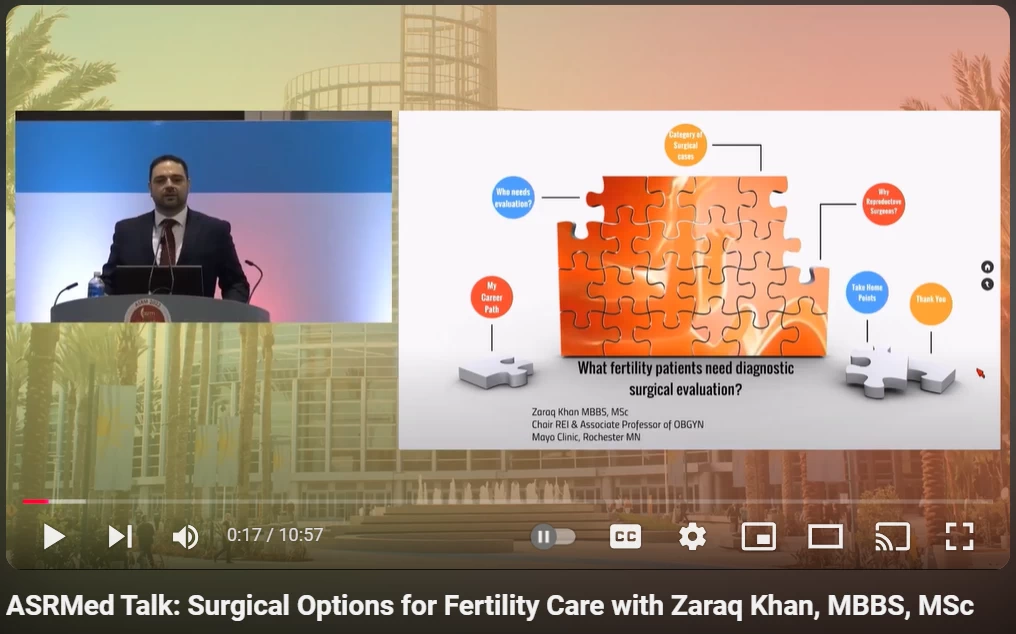
Dr. Zaraq Khan discusses his journey and passion for reproductive surgery, addressing complex fertility challenges and advocating for better surgical training and research.
Good morning, everybody. Congratulations for making it this far into the meeting. My name is Zaraq Khan, and I'm the chair of Reproductive Endocrine and Infertility at Mayo Clinic, and have a joint appointment in minimally invasive GYN surgery, and reproductive surgery is one of my passions.
When I was asked to give this talk, they told me that this would be more of a prez. Please tell me if you can, okay, you can hear me. So I was asked to give it more in a TED-style talk, and give really a story of why I'm so passionate about reproductive surgery.
We'll start by just saying what my career path was, and my personal journey and career choice of why I'm interested in reproductive surgery starts from residency and fellowship. For those of you who do reproductive surgery, or minimally invasive GYN surgery, these are not any familiar, these are pretty familiar pictures to you. So patients like these would come to our clinic, they would come in with years of pain, years of infertility, 20, 30 years old, and we would have no options for them.
I was working at the Mayo Clinic, which is the number one hospital in the US, and we would still have no options for these patients. We would tell them to go on Lupron, put a Band-Aid on it, we would say, go have surgery, send them to a GYN oncologist who sees cancer everywhere, and of course does a big debilitating, debulking surgery for fertility, debilitating for fertility, but really enhancing for their pain. So we would give patients a pain-free life, but also a child-free life.
And that is where my passion really started for reproductive surgery. Cases like these, where we had no options, absolutely no cure, no hope for these patients. I took it upon myself to really travel the world to try and get the best training that I could, and I'll explain to you why that's so important.
I start in Pakistan, which is home for me, and then went on to the Mayo Clinic to do my residency and fellowship in reproductive endocrinology and infertility, residency in OBGYN, and a master's in clinical research. I still couldn't take care of those patients with those advanced diseases. What I then did was take a sabbatical, travel around the world, and learn from experts, because we all need the appropriate training to cater to our patients well.
And from that, we started with doing and starting a complete division of reproductive surgery in our group. And when I think of the topic for today's talk, which is who do you take to diagnostic evaluation in infertility, it's a one-slide show, essentially, but I really want to take you over this journey of why this is my passion and how we can continue to help these patients. When I think about just basic approach, there's certain very significant things that a reproductive surgeon can see, and I break them by organ system.
So the ovary can have endometriomas, or endometriosis. There can be ovarian hyperthychosis, where surgery can help fertility. For the uterus and cervix and vagina, the most common one are obviously fibroids, adenomyosis, isthmus seals, polyps, Asherman's, malaria anomalies, combination of all these things that can make care exceedingly complex in otherwise physicians trained to do IVF only.
When we talk about the fallopian tubes, proximal disease, hydrosalpinges, history of tubal ligation, all of these are important things that we can help patients with with surgery to enhance their fertility. And really what we need is primarily a good history, because we're trying to see if the patient is in pain, especially in cases of endometriosis, and if that is one of the primary goals for the patient. And just start with basic imaging, just an ultrasound.
That's all we're starting with, because if we look at an ultrasound, you can catch all those list of ingredients for a reproductive surgeon that I listed. Now from there, one can move on to advanced imaging like MRI and dynamic MRIs when we talk about deeply infiltrating endometriosis, but for the purpose of screening, I think ultrasound and a history, talking to the patient about pain versus fertility is the bread and butter of a reproductive surgeon. Now as we sort of move forward, I want to describe to you sort of the various categories that I keep in my mind for reproductive surgery.
But before we even start that, I think the key ingredients for the success of any surgical field advancement are twofold. One, and most importantly, is surgical skill, training, knowledge, confidence, expertise, and knowledge of anatomy. Without that, I don't think you could be a good surgeon.
Followed by high quality multi-center research regarding surgical outcomes for pain, and of course, fertility outcomes. Those are gonna be the two most important essential ingredients for success. But when we think about reproductive surgery, in my mind, I try to make it simple and divide it into sort of four categories.
When we look at the first one, these are, in my opinion, technically easy surgeries, and there's good evidence for enhancement of fertility after these surgeries. Now here, you can see the first example, for example, is a patient with submucosal fibroids. There are two, they're fairly large.
Good data for excision of these fibroids. All the patients I'm showing you today are actually pregnant, so I specifically picked those patients to show you today. This one had a hysteroscopic myomectomy.
Within six weeks, she was pregnant. Did not require any fertility treatment. Had 15 years of infertility.
This patient came in with bilateral hydrosalpinges. No problems, no issues otherwise. 12 years of jostling around from practice to practice.
Just needed a salpingectomy, followed by IVF. And this is where that knowledge of surgery and fertility really comes to play together. There are other cases that are technically, I think, easier, but there's minimal evidence to support that they're fertility-enhancing.
An example here is a uterine isthmus seal, classic uterine isthmus seal. There's some gray literature, though in our world, we usually do repair these for otherwise unexplained secondary infertility. And of course, the famous endometrial polyps that become a bread and butter for most fertility practices.
If we really look at the literature and the evidence behind that, it's gray at best. But because these are technically easy procedures, we tend to get into these, but then we make the same argument and say a stage four pelvis does not need surgery, it needs Lupron and IVF. That's where the issue lies.
I think we need to think about both things together. The next, things are technically difficult, but there's really good evidence to support that they will be fertility-enhancing. So an example here is a patient that had about 50 submucosal fibroids and her entire myometrium was studded with myomas.
So there's possibly no way of doing a safe open myomectomy because you're gonna leave this patient with a completely obliterated scarred cavity. Now that knowledge and approach of utilizing your fertility knowledge base, as well as all the tools that you have in the surgical toolbox helps patients like this. So this patient, for example, we approached with a submucosal myomectomy, followed by UAE, followed by another submucosal myomectomy to get the cavity cleared, and she is pregnant and actually delivered a couple of days ago.
So there are some nuances that you can use. This is another patient that was referred to me by one of my mentors. And this patient was told in all major medical institutes around this country that there was nothing they could do for her.
And I don't blame them. I mean, look at this pelvis. You cannot see the uterus.
And I'll show you some pictures, but it took us three hours just to get to the uterus in this case. And so moving on, we also, another one is where we have good evidence but these are technically difficult surgeries to do are something like Asherman's, when we see a completely obliterated cavity as shown here with an ultrasound, a 3D ultrasound, a sauna histogram, and then finally a diagnostic office hysteroscopy and the ultimate postoperative image that we achieved after surgery. Again, these are some of very, very tough cases, but they are good evidence to show that surgical correction really enhances fertility.
And then comes this whole bucket of what I call technically very difficult surgeries with minimal evidence. An example for here is an adenomyoma, a localized adenomyoma in the posterior wall of the uterus. These are primarily patients where we talk about pain and fertility and balancing that act.
And you can see here excision of these adenomyomas are fairly aggressive, but work well. Similarly here, you can see ureteric disease and bilateral anastomosis of the endometriosis. And finally, some bowel disease that are really aggressive, but help patients with their pain.
And in my opinion, also gives them a bump up in their fertility. Now, why a reproductive surgeon? We can deal with complex fibroid cases, adenexal cases and keep the age and ovarian reserve and IVF before or after surgery in mind. And we can take care of their post-op care as well as bridge to their fertility.
And we can counsel them for third party and gestational carriers, egg donors, when appropriate. Now, this is what I wanted to show you, the before and after advanced training or additional training is that same patient where it took us about eight hours. We did an LAR, bilateral salpingectomy, an adenomyomectomy, ileocecectomy, and actually a bladder excision for a nodule.
And this patient is pregnant post-IVF. Again, in the interest of time, I'm gonna zoom real quick to my last slide. And I want to take some take home points.
Reproductive surgery has a big role in fertility treatments. They let your symptoms and basic imaging be your guide. When we talk about more training, I'm really excited to announce that the SRS has started the surgical tracking for fellows.
So I think there's gonna be a lot of bridging of that gap of lack of surgical training. And then we're making a call for collaborative multi-center research because as you know, the two important ingredients for success is surgical skill and multi-center research. So I'd like to thank everyone for their time.
ASRMed Talks
Check out more ASRMed Talks
How to be the Best Abstract Reviewer
Learn how to review abstracts effectively with tips on novelty, relevance, quality, conclusions, rubrics, and scoring from Dr. Chevis Shannon.
How to Write a Well Crafted Abstract
Learn how to write a winning abstract. Follow instructions, highlight key findings, avoid jargon, and keep your message clear and concise.ASRM Academy
Educational Virtual Sessions
Panel discussions on topics to enhance your knowledge of all facets of reproductive medicine
Certificate Courses and Training Modules
View the specially crafted certificate courses and training modules available from ASRM Academy
Podcasts
The ASRM Family of Podcasts were developed with both health professionals and the layman in mind
MedTalks
Head to the highlights! Stay up to date with engaging video excerpts from webinars and courses that cover a topic in 7 minutes or less.
ASRM MAC Tool 2021
The ASRM Müllerian Anomaly Classification 2021 (MAC2021) includes cervical and vaginal anomalies and standardize terminology within an interactive tool format.
ASRM EDGE Tool
Get the EDGE on embryo identification! EDGE allows you to compare your grading of embryos against embryologists in the US and around the world.
Topic Resources
Fertility and Sterility On Air - Live from the American Association of Gynecologic Laparoscopists 2025 Global Congress
Expert surgeons and REIs explore cutting-edge adenomyosis diagnosis and treatment to improve fertility outcomes, live from AAGL-ASRM. Listen to the EpisodeHow to Code for Surgical Tubal Anastomosis
How do you properly code this surgical tubal anastomosis and chromotubation? In this case, codes 58679 and 58662 were billed View the AnswerASRM Hosts Capitol Hill Briefing for Policymakers & Congressional Staff to Hear From Providers & Patients About Importance of IVF Access, Realities and Limitations of Restorative Reproductive Medicine
ASRM briefing united lawmakers, physicians & patients on IVF access, exposing RRM limits and urging policies to expand fertility care options. View the Press ReleaseSRS Warns Against Limiting Access to IVF Under the Guise of “Restorative” Care
SRS, an ASRM affiliate, advocates evidence-based reproductive surgery and full-spectrum fertility care for conditions like endometriosis, fibroids, and PCOS. View the Press ReleaseEvidence-based diagnosis and treatment for uterine septum: a guideline (2024)
To provide evidence-based recommendations regarding the diagnosis and effectiveness of surgical treatment of a uterine septum. View the Committee GuidelineReimplantation of cryopreserved ovarian tissue
What is the correct code for laparoscopic reimplantation of ovarian tissue? View the AnswerCoding of identification of sperm in aspirate
During vasovasostomy/vasoepididyostomy procedures, our surgeons perform intra-op sperm identification from aspirate View the AnswerCoding for fluid aspiration during HSG
For physician-performed sonoHSG (58340& 76831) and uterine aspiration due to fluid, can an additional code for the aspiration be billed? View the AnswerBilling 58558 together with 58560
Can CPT codes 58558 and 58560 be billed together? Also, can 58560 be billed with place of service 11? View the AnswerSurgical Options for Fertility Care
Dr. Zaraq Khan discusses his journey and passion for reproductive surgery, addressing complex fertility challenges and advocating for better surgical training and research. View the ASRMed Talk VideoEndometrioma
Surgery was performed under anesthesia for Aspiration of right hyrosalpinx fluid and right endometrioma. View the AnswerUterine Aspiration of Pregnancy of Unknown Location
What CPT code would be most appropriate for a manual uterine aspiration for a pregnancy of unknown location? View the AnswerEligibility to bill for facility fee
We are planning to open a new fertility clinic and I was wondering about the eligibility to bill insurance companies for “facility fee” for egg retrievals. View the AnswerResection Adenomyoma
I have a patient with an adenomyoma of the uterine wall that requires surgical excision and uterine repair. View the AnswerRobotically Assisted Tubal Anastomosis
What is the correct CPT code for laparoscopic tubal anastomosis with robotic assistance? View the AnswerSurgery Coding
I took the ASRM coding course, and in that course, coding for bilateral neosalpingostomies was coded using only a dx of N70.11 (hydrosalpinx). View the AnswerTompkins Metroplasty
Is there a code for Tompkins Metroplasty? View the AnswerOffice Hysteroscopy Billing
Do you all have a resource that details what all can be billed, or what all is bundled with the 58558 procedure when done in office? View the AnswerOvarian Drilling
Is there a CPT Code for "Ovarian Drilling"? View the AnswerOvariopexy
Learn how to code ovariopexy for benign disease via mini-laparotomy, including CPT options like 49000 with modifier 22 or 58999 for unlisted procedures. View the AnswerExcision Ovarian Endometrioma
What code is used for a laparoscopic excision of endometriosis and an ovarian excision of endometrioma with bilateral ureterolysis is performed. View the AnswerHysteroscopic Tubal Cannulation Under Laparoscopic Guidance
How can one code for hysteroscopic transcervical fallopian tube cannulation under laparoscopic guidance? View the AnswerHysteroscopy Polyp Suspected
What ICD-10 code do you use if a diagnostic hysteroscopy is performed for the preoperative diagnosis of uterine polyp? View the AnswerHysteroscopy Recurrent Implantation Failure
What is the appropriate ICD-10 code for recurrent implantation failure? View the AnswerHysteroscopy Resection of Retained Products of Conception
What CPT is appropriate for a Hysteroscopy Resection of Retained Products of Conception? View the AnswerD&C Under Ultrasound Guidance
What are the CPT codes and ICD-10 codes for coding a surgical case for a patient with history of Stage B adenocarcinoma of the cervix ... View the AnswerDiagnostic Hysteroscopy
If the doctors do a hysteroscope #58555 in the office with a Endosee Scope, can I still use the same code even though it is in the office? View the AnswerCoding for Ovarian Drilling
Can you provide some information related to ovarian drilling that would assist non-physician administration (coders, billers)? View the AnswerCoding For Placement Of A Cervical Stitch
Physicians at our practice are placing a stitch and dilating the cervix after egg retrievals for those patients that have cervical stenosis. View the AnswerC-Section Ectopic Pregnancy
I’m writing for advice for CPT advice for managing cesarean scar ectopic pregnancy without concurrent intrauterine pregnancy (ICD-10 O00.80). View the AnswerCycle Monitoring Fertility Preservation
If the patient is undergoing ultrasound tracking visits for fertility preservation, what I ICD-10 code do you use for the monitoring? View the AnswerSRS-SMRU Travel Scholar Award for Male Reproductive Surgery
The objective of the SRS-SMRU Traveling Scholars Award is for any trainee whose abstract submission focuses on male reproductive surgery to expand their educational and networking experience. View the Award InformationSRS In-Training Awards for Research
SRS Travel Scholar Award for Reproductive Surgery
The objective of the SRS Traveling Scholar Award is to provide for any trainee whose abstract submission focuses on reproductive surgery to expand their educational and networking experience. View the Award InformationDeCherney-Nezhat REI Fellows Traveling Scholars Award in Reproductive Surgery
The objective of this award is to expand educational and networking opportunities for REI Fellows with a focus on reproductive surgery. View the Award InformationJournal Club Global: Moving leiomyoma research from bench to bedside
Role of tubal surgery in the era of assisted reproductive technology: a committee opinion (2021)
This document reviews surgical options for reparative tubal surgery and the factors that must be considered when deciding between surgical repair and IVF.View the Committee Opinion